Find your ai search optimization agency san francisco partner with confidence: learn questions to ask, red flags to avoid, and metrics that matter.
For B2B companies in San Francisco, sticking with old-school SEO is like trying to navigate the Bay Bridge with a paper map from the 90s—you're just not going to get where you need to be. The world of search is no longer about a list of blue links; it's about AI-driven answers. If your brand isn't part of that conversation, you're effectively becoming invisible to your customers.
This makes hiring a specialized AI search optimization agency less of a luxury and more of a core strategy for survival and growth.
Why Traditional SEO Is Failing in an AI-First World
The ground has completely shifted. For years, the SEO playbook was simple and predictable: find the right keywords, build some backlinks, and methodically climb Google’s search rankings. That entire model was built on the assumption that a user's journey always ended with a click through to a website.
But AI-driven search—the kind powering tools like Perplexity, ChatGPT, and Google's own AI Overviews—has shattered that assumption.
Users don't just search anymore. They ask complex questions and expect direct, synthesized answers right there on the results page. The search engine is no longer the starting point; for many, it's the final destination. This poses a serious, almost existential threat to businesses whose funnels rely entirely on organic clicks.

The Vanishing Click and the Rise of AI Answers
Think about a Bay Area tech company that poured a significant budget into ranking #1 for "best enterprise cloud storage solutions." In the past, that top spot was a firehose of high-intent traffic.
Today, a potential customer asks an AI chatbot that same question. They get a neat summary of three providers, complete with key features and pricing, all without ever leaving the search interface. If your brand isn't one of those three, your hard-won #1 ranking is suddenly irrelevant. The click you were counting on never happens.
This isn't some far-off future; it's the reality for marketers right now. This shift is a key part of the zero-click search trend, where user questions are answered directly on the search page. If you want to dig deeper, you can learn more about adapting to a zero-click world in our detailed guide.
The Invisibility Crisis for Top Brands
The scale of this change is staggering. A recent, comprehensive audit revealed a shocking truth: 92% of top brands are completely invisible in AI search results. This forensic study of 1,000 enterprise domains paints a stark picture for San Francisco's B2B sector.
While Gartner’s prediction of a 25% drop in search traffic by 2026 seemed alarming, the current reality is proving far worse. Some data points to a 61% collapse in click-through rates for informational queries since AI Overviews started rolling out.
This isn't just another algorithm update. It's a fundamental rewiring of how people find and consume information online. Brands that don't adapt won't just see their rankings drop; they'll lose relevance entirely.
The problem is that old SEO metrics and tactics are no longer enough. To address this, we need to shift our thinking from keywords to concepts, from links to verifiable facts.
Here’s a quick breakdown of how the priorities have changed:
Traditional SEO vs AI Search Optimization Priorities
This table illustrates the core challenge: the skills and strategies that got you to the top of Google yesterday are not the same ones that will make you visible in the AI-powered search of tomorrow.
The new reality demands a new discipline: Generative Engine Optimization (GEO). An expert AI search optimization agency in San Francisco gets this. The focus is no longer on simply pleasing an algorithm but on ensuring your brand's expertise is so clear and authoritative that the new AI gatekeepers recognize and cite it. That’s how you secure your place in the future of search.
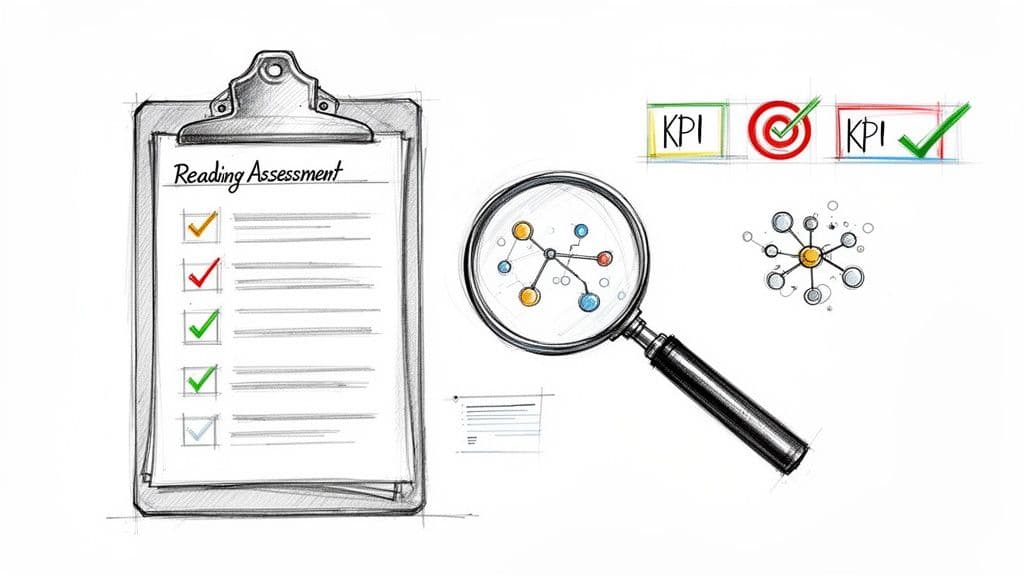
Auditing Your Readiness for AI Search
Before you even think about interviewing an AI search optimization agency in San Francisco, you need to take a hard, honest look inward. Walking into those meetings without a clear grasp of your current situation is like asking a doctor for a diagnosis without describing your symptoms. You have to know where you stand.
This isn't about pulling a standard SEO report. It's a different kind of audit. You need to start seeing your digital footprint through the eyes of a Large Language Model (LLM). It’s less about how you rank and more about how your content, data, and authority signals contribute to a factual, verifiable, and helpful answer.
Getting this groundwork done first puts you in the driver's seat. It lets you lead conversations from a position of knowledge, making sure you find a partner who can fill your specific gaps, not just sell you a one-size-fits-all package.
Evaluating Your Structured Data Foundation
First things first: your structured data. AI models are hungry for clean, organized information. They don't casually read your website like a person does; they parse the code underneath to understand what things are, how they relate, and what the facts are.
Think of schema markup as the official study guide for your website. It gives an AI a cheat sheet on who you are, what you offer, and why you’re an authority. If this is weak, your chances of showing up in AI-generated results are slim.
Start by asking a few critical questions:
- Is
Organizationschema fully and accurately implemented? Does it clearly define your company, logo, social profiles, and official name? - Are you using
ProductorServiceschema? Your offerings need to be detailed with features, benefits, and identifiers that an AI can easily process and compare. - Is
ArticleorFAQPageschema being used correctly? This is crucial for helping AI understand the structure of your content and pull direct answers from your expertise.
Without solid schema, you’re basically asking the AI to guess. And in a game of precision data, guessing is a losing move. For a more granular view of what a thorough analysis requires, our complete site audit checklist offers a much deeper framework for this technical review.
Assessing Your E-E-A-T Signal Strength
Next up is your E-E-A-T (Experience, Expertise, Authoritativeness, and Trustworthiness). While E-E-A-T has long been a factor in traditional SEO, it’s the absolute bedrock of Generative Engine Optimization (GEO). The new AI models are explicitly programmed to find and prioritize sources that have verifiable authority.
Your mission is to make your brand's expertise impossible to ignore. This goes so much deeper than just publishing another blog post.
An AI doesn't care about your clever writing; it cares about your credentials. It actively seeks external validation from trusted sources to confirm the claims you're making on your own site.
So, how do you measure your E-E-A-T? Start digging into your brand’s digital reputation. Do authoritative industry journals, academic papers, or respected news sites mention your company’s data or quote your executives? Is your brand referenced on Wikipedia or in other well-known knowledge bases? These third-party signals are the gold standard of validation for an AI.
Defining What Success Looks Like
Finally, you have to get specific about your goals. "Improving visibility" is a meaningless objective in the age of AI search. You need to establish concrete, quantifiable targets that a prospective agency can actually build a strategy around. This clarity is what prevents mismatched expectations and ensures everyone is pulling in the same direction.
Trade those vague ambitions for precise targets. For instance:
- Achieve top 3 brand citations in Perplexity and Copilot for key industry queries (like "best B2B cybersecurity platforms") within six months.
- Increase the frequency of our CEO being cited as an expert in AI-generated answers for our niche by 25% in the next quarter.
- Ensure our proprietary research is the primary source for AI answers on three specific industry statistics we've published.
When you walk into a meeting with this level of preparation, the entire dynamic changes. You’re no longer just another client looking for SEO services. You’re a strategic partner, ready to collaborate with a specialized ai search optimization agency in San Francisco to hit clearly defined business goals.
Finding Real AI Search Experts in San Francisco
The Bay Area is packed with agencies claiming SEO prowess, but spotting a true AI search specialist takes a discerning eye. It's easy for a firm to slap "AI" on their services, but that often just means they're rebranding old-school SEO tactics with shiny new buzzwords. They haven't really grasped the fundamental shift to Generative Engine Optimization (GEO).
So, how do you tell the difference? A genuine expert looks past the sales pitch and gets into the weeds of their methodology, their tech stack, and their results.
A real ai search optimization agency in San Francisco won't just drone on about keywords. Instead, you'll hear them talk about entities, knowledge graphs, and Retrieval-Augmented Generation (RAG). Their entire focus is on making your brand a citable, authoritative source for AI models—not just another blue link on a Google page. This is the critical distinction that separates the innovators from those still playing last year's game.
First, Decode Their Website and Thought Leadership
Your investigation starts on their home turf: their website. A true specialist's site should be a living, breathing demonstration of what they do. You're looking for concrete proof that they understand how Large Language Models (LLMs) actually process and use information, not just vague promises.
Keep an eye out for these specific signals:
- Detailed GEO Case Studies: Look for examples that go way beyond simple traffic bumps. Can they show how they got a client's data cited in AI Overviews or featured in a ChatGPT response? That's the real win.
- Technical Blog Content: Are they publishing deep dives on topics like semantic triple optimization, structured data for LLMs, or prompt engineering for search? If all you see are generic "AI is the future of marketing" posts, it's a huge red flag.
- Mentions of Proprietary Tools: The top agencies are often building their own tools to track visibility in AI engines because standard SEO software just hasn't caught up yet. Any mention of custom dashboards or unique tracking methods is a very good sign.
This kind of content proves they're actively solving the new challenges of AI search, not just talking about them.
The most telling sign of a true expert is their focus on proof over promises. They'll be far more interested in explaining their process for ensuring factual accuracy and verifiability—the actual currency of AI models—than in guaranteeing you a #1 ranking.
This analytical mindset is the hallmark of an agency that truly gets the mechanics of modern search. They know that trust and authority are built through meticulous data structuring and content validation, a far more intricate task than just building backlinks.
Next, Evaluate Their Expertise on a Screening Call
If an agency’s website checks out, the screening call is where you really separate the contenders from the pretenders. This is your opportunity to drill down into their process, technology, and strategic thinking. Forget your standard SEO questions; you need to ask about their specific approach to GEO.
The competition among firms is fierce, especially in the Bay Area's tech ecosystem. As AI search evolves, San Francisco has become a hotbed for top GEO agencies. A 2026 study analyzing industry recommendations found that firms like Thrive Internet Marketing are leading the charge, earning 41.9% 'highly recommend' citations, followed by others like Cleverly and Wpromote. This data underscores the edge held by local players who are immersed in AI optimization. You can read more in the Artios study on Generative Engine Optimization leaders.
Come to the call armed with sharp questions that get to the heart of their capabilities:
- About Their Process:
- "When there are no clicks, how do you actually measure visibility and success?"
- "Walk me through how you'd audit our E-E-A-T signals specifically for an LLM to consume."
- "What's your strategy for getting our company's data into major knowledge graphs?"
- About Their Technology:
- "What tools are you using to track our brand's presence in Perplexity, Copilot, and other AI engines?"
- "How does your approach to schema markup change when you're optimizing for AI search versus traditional SEO?"
- About Value and ROI:
- "Can you give me a specific example of how you proved ROI for a client in a 'zero-click' environment?"
- "How do you report on metrics like citation frequency and sentiment within AI-generated answers?"
An agency that can answer these questions with specific, confident examples is probably the real deal. Their responses should show you they understand that the goal has shifted from just attracting eyeballs to embedding genuine expertise. If you're looking for a broader view, you might find our guide on what to look for in an AI search optimization agency across the USA helpful.
Vetting Your Shortlist With Critical Questions
You’ve got your shortlist of promising agencies. Now the real work begins. It’s time to move past the polished pitch decks and website claims to find out what they really know. Your goal isn’t just to hire a vendor; it’s to find a genuine strategic partner who gets the massive technical and philosophical shifts happening in search.
To do that, you need to ask questions that push them out of their comfort zone. Forget the generic stuff about their "process." You need to probe their real-world understanding of Large Language Models (LLMs), their game plan for a future with fewer clicks, and how they prove value when old-school metrics are becoming obsolete. This is how you separate the true specialists from the agencies just slapping an "AI" label on their old SEO services.
Probing Technical and Strategic Depth
First things first, you need to get into the "how." Any agency can talk a big game about AI, but a legitimate AI search optimization agency in San Francisco can break down the actual mechanics of their approach. Their answers should be confident, specific, and free of vague marketing fluff.
Start by digging into their content optimization strategies:
- "How do you specifically optimize content for Retrieval-Augmented Generation (RAG) systems?" This is a highly technical question that gets right to the heart of how LLMs find and use information. A solid answer will cover creating modular content, using semantic triples, and ensuring factual accuracy through clear citations and structured data.
- "What's your process for identifying and closing entity-level content gaps?" This question tests whether they think beyond keywords. A true expert will talk about analyzing your brand's footprint in knowledge graphs like Wikidata and Google's. They'll then explain how they'd build content to explicitly define your company, products, and executives as distinct, authoritative entities.
- "Can you walk me through your approach to schema markup for AI-driven search?" A sophisticated response will go way beyond standard
OrganizationorProductschema. They should bring up usingsameAsproperties to link to authoritative profiles, implementingFactCheckschema for proprietary data, and structuring content so it can be easily pulled for direct answers.
The quality of their answers to these technical questions is your most reliable indicator of their true capabilities. Vague responses or an inability to explain these concepts clearly is a major red flag, suggesting they lack the specialized knowledge required for modern Generative Engine Optimization (GEO).
This flow chart gives you a high-level view of the vetting process, moving from your initial research to asking the tough questions and making a final, informed decision.
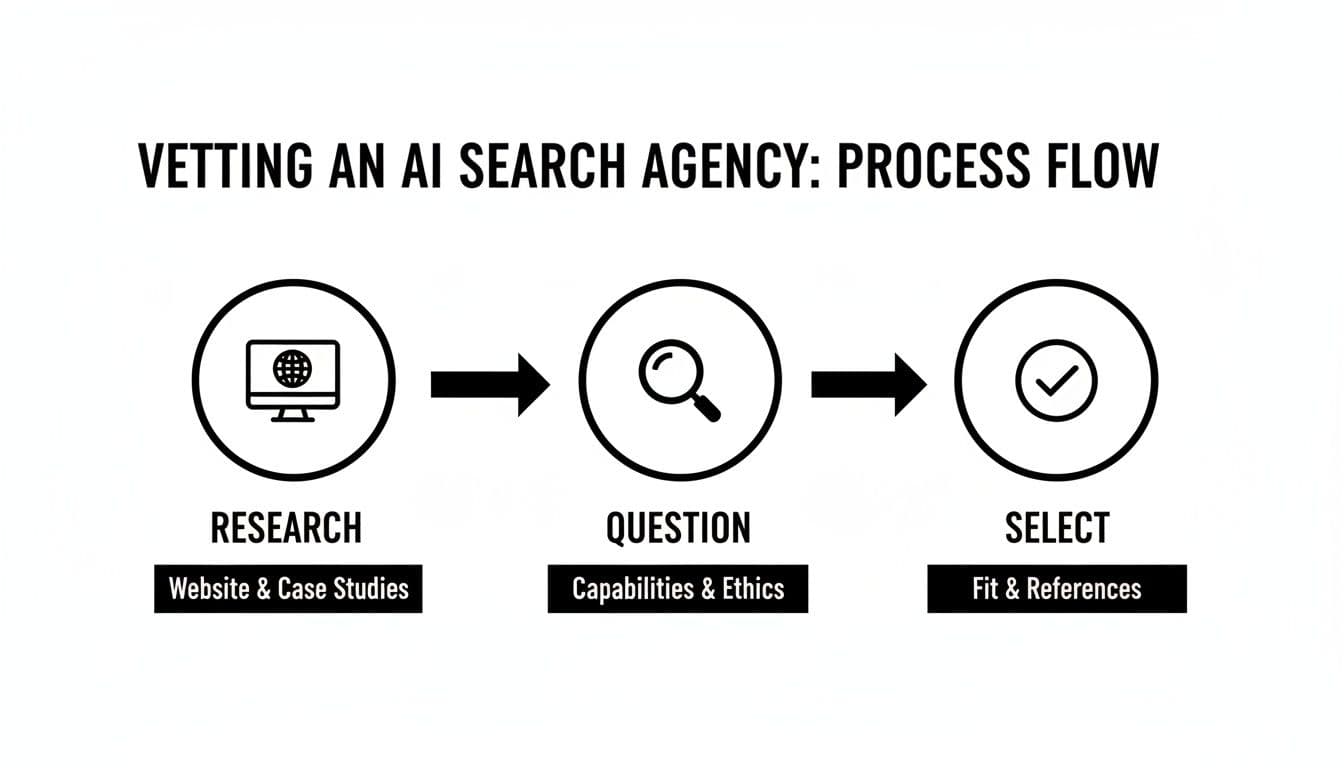
This kind of structured approach ensures you don't just find a vendor, but a partner who can actually navigate the complexities of AI search.
Redefining Success and Measuring ROI
Next up: how do they measure success when clicks are no longer the whole story? The old model of just tracking keyword rankings and organic traffic is on its way out. An agency still fixated on these metrics is living in the past.
Your questions should challenge them to present a new framework for ROI:
- "When organic traffic isn't the main goal, what specific KPIs do you track to show ROI?" Listen for answers that include metrics like citation frequency in AI answers, share of voice within generative results, brand mention sentiment, and the number of attributed facts sourced directly from your domain.
- "Show me an example of how you've reported on these new metrics for another B2B client." This is where they need to show their work. They should be able to share anonymized reports or dashboards that actually visualize this kind of data. For a better sense of what modern reporting looks like, our guide on what constitutes a comprehensive SEO report can give you some valuable context.
Identifying Critical Red Flags
Throughout these conversations, keep your radar up for warning signs. The promises that sounded great in a sales pitch can quickly fall apart under a little scrutiny. It's often the things they don't say, or the way they answer, that tell you the most.
To make it easier, here's a quick cheat sheet to help you spot the good from the bad during your evaluations.
Agency Vetting Checklist Red Flags vs Green Flags
Spotting these red flags early can save you a world of headache and wasted budget down the line. An agency that welcomes tough questions and responds with detailed, confident, and forward-thinking answers is the kind of partner who will help you thrive, not just survive, in this new era of search.
Controlling Your AI Search Destiny Beyond an Agency
While partnering with a specialized ai search optimization agency in San Francisco brings a ton of expertise to the table, many B2B companies are starting to want more direct control and cleaner data. Let's be honest, the classic agency model, with its fixed reporting cycles and layers of communication, can feel a bit slow for tech companies that need to move fast.
So, what if you could pull the most critical AI search functions in-house? Imagine giving your own team the power to see what's happening and act on it immediately. This isn't necessarily about firing your agency, but about upgrading your own capabilities. Think about having a direct, real-time view of how AI engines like Perplexity, Copilot, and Google's AI Overviews are interpreting your brand. A new breed of platforms is making this possible, offering a solid alternative—or a powerful supplement—to the old agency-only approach.
Taking the Reins with In-House Tools
The biggest hurdle in Generative Engine Optimization (GEO) is simply visibility. You can’t fix what you can't see. Platforms like Attensira are built to tackle this head-on, giving you the tools to monitor, analyze, and improve your AI search performance yourself.
It’s the difference between being a passenger and a co-pilot. Instead of passively waiting for a monthly report to land in your inbox, you get live data and concrete insights whenever you need them. For companies that want to be hands-on with their digital presence, this shift is everything.
Taking this route gives B2B enterprises some serious advantages:
- Direct Control and Agility: See a problem? Fix it. You can adjust your strategy based on live data without needing to schedule an agency call.
- Unfiltered Transparency: Get the raw performance data from all the major AI platforms. No spin, no summaries—just a clear, unbiased picture of your brand's visibility.
- Empowered Internal Teams: Give your content, marketing, and SEO folks the tools they need to actually execute an AI-optimized strategy, not just talk about it.
This model is a perfect fit for organizations that want to build their own internal AI search Center of Excellence, where they can grow and scale their own expertise.
A Practical Look at Platform-Based Optimization
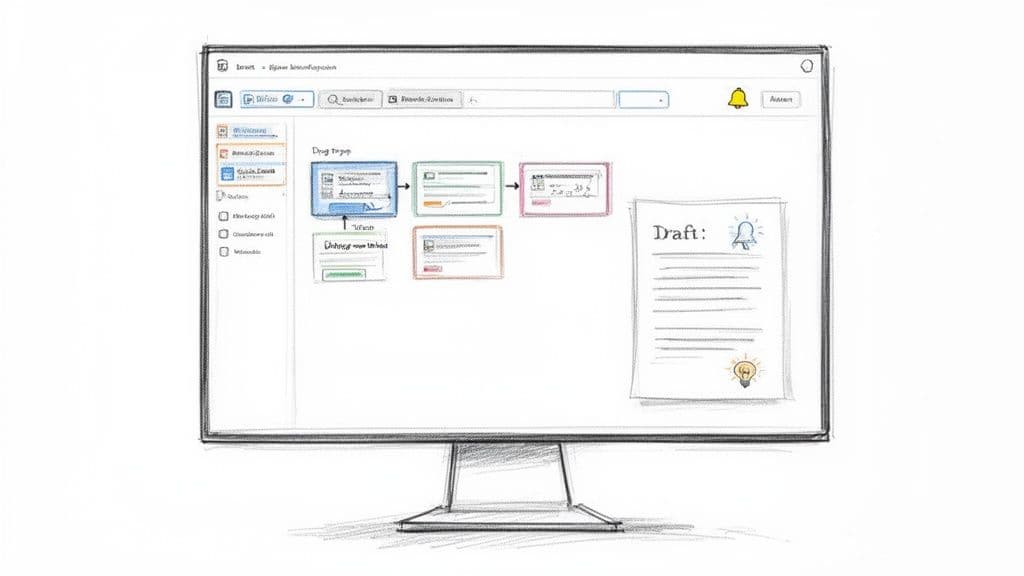
So, what does this actually look like day-to-day? It usually starts with a simple, no-code setup where you connect your domain for monitoring. That’s it. From that point on, the platform is your command center for AI search.
Picture this: your team gets an automated alert that a competitor just published a whitepaper that’s now being cited as the main source for a key industry question—a topic your brand used to own. With a platform, you don’t just see this happen weeks later. You see it now.
This is about more than just tracking brand mentions. It’s about putting a response plan into action. The best platforms don't just flag the problem; they help you build the solution, often generating AI-optimized content drafts to help you reclaim your spot.
This kind of tool flips your team from being reactive to proactive. Instead of waiting for rankings to fall, you’re staying ahead of the game, defending your informational turf and solidifying your brand’s authority. This is where digital marketing is headed, and exploring what dedicated AI SEO software can do is a smart move for any B2B leader who's serious about the future.
Augmenting Your Agency Partnership
Bringing a platform like Attensira on board doesn't mean you have to part ways with your agency. In fact, it can make that relationship much stronger and more productive. When both your internal team and your agency are looking at the same real-time data, you create a far more collaborative and effective environment.
Your agency can use the platform's deep insights to sharpen its strategic advice, while your team can use the tools to execute on content initiatives quickly. It’s a hybrid model where high-level strategy and day-to-day execution are finally in sync.
Here’s how that symbiotic relationship works:
- A Single Source of Truth: Your team and the agency work from the same dashboard. This eliminates conflicting data and gets everyone aligned on the same KPIs.
- A Clearer Division of Labor: The agency can focus on big-picture strategy and complex technical GEO, while your in-house team uses the platform to handle content creation and optimization.
- Better Accountability: With transparent performance data visible to everyone, it’s much easier to measure the impact of every initiative and hold everyone accountable for real results.
Whether you’re looking for complete in-house control or a more supercharged agency partnership, the objective is the same: to master your brand’s presence in this new world of AI-powered search. The right platform gives you the control to do just that, ensuring your brand stays visible, relevant, and authoritative.
Your Questions About AI SEO, Answered
Stepping into the world of AI search is new territory for most B2B leaders. It’s a serious investment, and you absolutely need to have your questions answered before you sign on the dotted line. Let's tackle the most common questions we hear, giving you direct answers to clear up any confusion about the process, what it costs, and what you should expect.
How Is AI Search Optimization Different from Traditional SEO?
The fundamental difference is the endgame. Traditional SEO is all about getting a webpage to rank on a results page, hoping to win a click. AI search optimization, which you'll also hear called Generative Engine Optimization (GEO), has a completely different goal: to get your brand’s data, expertise, and name cited directly inside an AI-generated answer.
Think of it this way: you’re shifting from trying to win clicks to becoming a trusted, citable source of truth that AI models rely on to build their responses. This means the work goes much deeper than just keywords and backlinks; it's about structured data, provable factual accuracy, and verifiable authority signals.
What's a Realistic Budget for an AI Search Optimization Agency in San Francisco?
When looking for a specialized ai search optimization agency san francisco, you should be prepared for a premium investment over what you might be used to with traditional SEO. This is a niche skill set, and the best agencies are often building their own proprietary tools.
As a general benchmark, monthly retainers typically land in these ranges:
- Small to Mid-Sized Businesses: 5,000 - 15,000 per month
- Enterprise-Level Companies: 15,000 - 50,000+ per month
Of course, the final number will hinge on the scope of work, how competitive your market is, and the technical depth required. A word of caution: be skeptical of agencies offering services for much less. True GEO requires a level of expertise they likely don't have.
How Long Does It Take to See Results from AI Search Optimization?
This is where expectations need to shift. With old-school SEO, you might watch keyword rankings creep up over three to six months. With GEO, the results manifest differently. You can actually see some foundational progress quite quickly, sometimes within 60 to 90 days. This often involves getting technical elements like structured data and knowledge graph profiles in order.
However, becoming a consistently cited brand within AI answers is a long game. A realistic timeline for seeing a significant, measurable impact is closer to 6 to 12 months. It takes patience. You're building a deep well of authority that AI models will learn to trust over time.
What Are the Key Performance Indicators for AI Search Optimization?
Since we're no longer chasing clicks and organic traffic as the main goal, a good agency will introduce you to a new set of KPIs.
The new goal isn't just to be found; it's to be the answer. Success is measured by how often your brand is cited as an authoritative source, shaping the narrative in your industry directly within AI search results.
Here are the core metrics you should be tracking:
- Share of Answer: What percentage of AI responses for your target queries mention your brand?
- Citation Frequency: How many times is your domain cited as a source across the AI landscape?
- Brand Mention Sentiment: When your brand is mentioned in an AI answer, is it in a positive or neutral context?
- Knowledge Graph Presence: How complete and accurate is your company's entity profile in Google's Knowledge Graph?
The growth here is staggering. AI search traffic has already jumped 527% year-over-year, and the agencies in this space are racing to keep up. With forecasts suggesting AI search could drive $750 billion in US revenue by 2028, companies that wait too long are risking a massive loss in future traffic. You can dig into more of these AI SEO statistics to really understand the urgency.
Ready to stop guessing and start controlling your brand's visibility in this new era? Attensira gives you the platform to monitor your presence across every major AI engine, find critical content gaps, and make sure your expertise becomes the definitive answer. See how it works at https://attensira.com.