Explore ai search optimization agency france to unlock measurable ROI for your B2B enterprise, with clear proposals and proven optimization tactics.
Hiring an AI search optimization agency in France isn’t just another line item in your marketing budget; it’s a strategic pivot toward the future of how people find information. These agencies specialize in something called Generative Engine Optimization (GEO), which is all about making sure your brand shines in AI-generated answers and summaries. It’s a completely different ballgame than traditional SEO, designed for the new ways French consumers are discovering brands.
Defining Your AI Search Optimization Goals in France
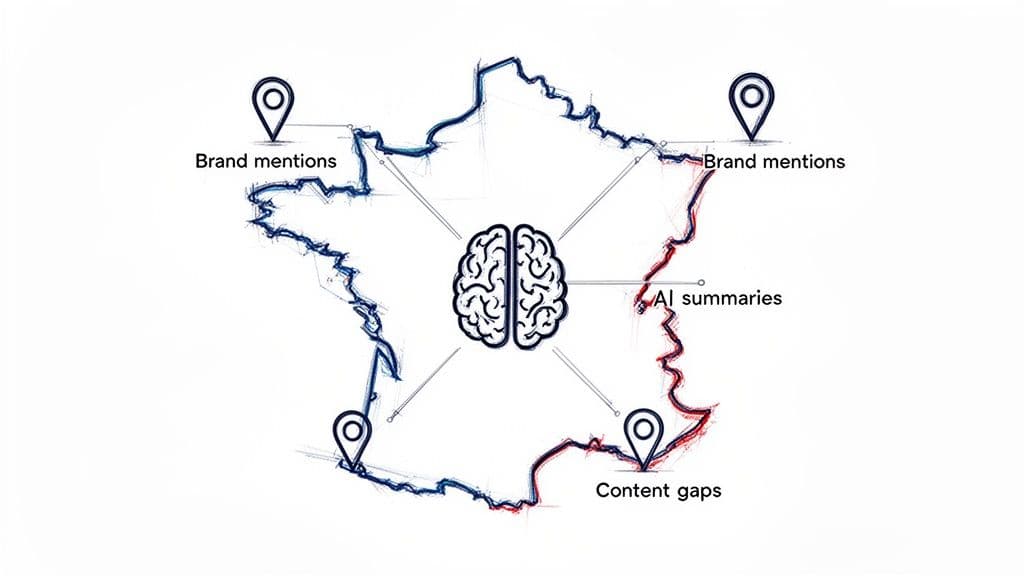
Before you even think about talking to an agency, you need to know what winning looks like for your business. Moving from classic SEO to GEO means your old playbook won't cut it. It’s no longer about hitting #1 on a list of blue links; it's about controlling your brand's story when an AI gives a direct answer. Your goals have to be concrete, measurable, and directly tied to what you want to achieve in the French market.
Getting this right is crucial because the field is exploding. The European GEO market, which stood at 243.8 million** in 2026, is on track to hit a staggering **2,775.1 million by 2034. That’s a 35.5% CAGR, fueled by companies scrambling to stay visible in an AI-first world. This isn't a "nice to have"—it's becoming a critical investment.
Moving Beyond Traditional SEO Metrics
Your targets need to reflect the new reality of AI search. Forget obsessing over keyword rankings alone and start thinking about these more sophisticated objectives.
- Dominating Brand Mentions: The goal here is to be the first and most frequent brand named when someone in France asks a question your business can answer. For instance, if you sell project management software, you might aim to be featured in 80% of AI answers for a query like "meilleur logiciel de gestion de projet."
- Securing Favorable AI Summaries: You need to ensure that when an AI summarizes what you do, it highlights your best features and what sets you apart. This is about influencing the source material that AI models learn from.
- Closing Critical Content Gaps: Find the questions in your niche that AI struggles to answer well, and then create the definitive content that fills that void. This positions you as the go-to expert.
One of the most important goals is to own your "Share of Voice" in AI responses. This isn't just about getting mentioned; it’s about how you're mentioned compared to the competition. A smart GEO strategy makes sure the tone and context of those mentions are exactly what you want them to be.
Aligning Goals with French Market Nuances
Your objectives must also be grounded in the realities of the French market. Language isn't just about translation; it's about culture, regional dialects, and local search habits. A top-tier ai search optimization agency in France will have this local intelligence baked into their process.
A great example would be optimizing for search queries that include regional identifiers or French-specific industry jargon that a generic global strategy would completely overlook. This localized focus makes your content feel authentic to the audience and signals its relevance to the AI models serving them.
By setting these sharp, GEO-centric goals from the start, you build a clear framework for choosing the right agency—one that can actually deliver a real competitive edge. Once you’ve nailed down your objectives, the next step is to figure out which GEO metrics matter most for competitive visibility in AI search.
How to Tell if an Agency Really Understands AI Search
With your goals clearly defined, it's time to start separating the true AI specialists from the pretenders. This is where you have to look past the slick sales pitches. Lots of traditional SEO agencies are now bolting on "AI services" to their offerings, but real expertise in Generative Engine Optimization (GEO) runs much deeper.
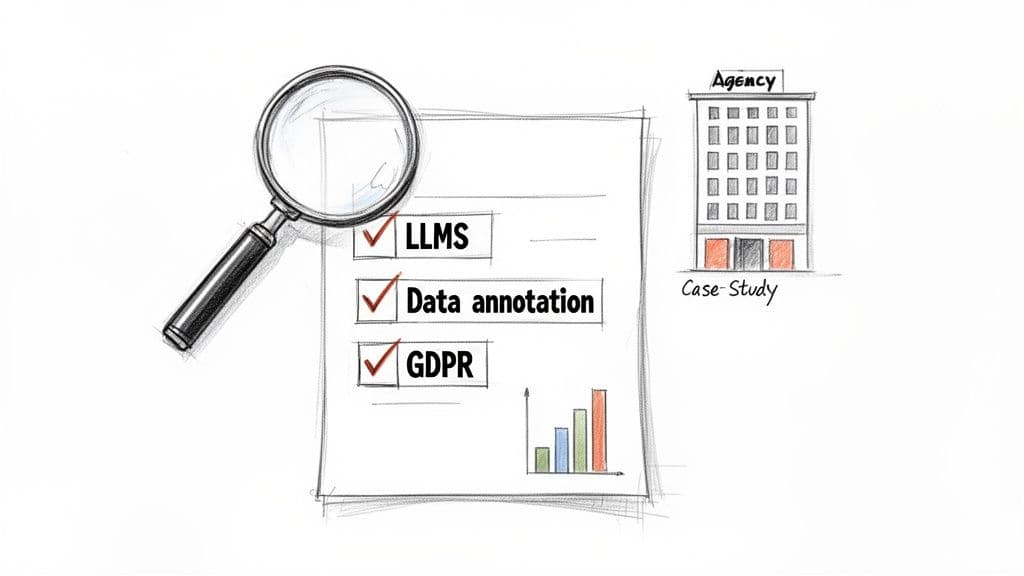
You’re looking for a partner that does more than just use AI to write blog posts. The real value comes from agencies that can fundamentally restructure your content and data to directly influence Large Language Models (LLMs). This is the key to winning in the new search landscape. A legitimate ai search optimization agency france will have demonstrable experience working with the core technologies that power AI-driven answers.
The market for this expertise is heating up. France is quickly becoming a major AI hub, thanks to a flood of investment. Globally, AI investment hit a staggering 202.3 billion** in 2025, with businesses spending **37 billion alone. This is pouring fuel on the SEO services fire, with the market expected to jump from 108.28 billion** in 2026 to **203.83 billion by 2030. Finding a capable partner now is a serious competitive advantage.
Looking Under the Hood of Their Technology
A genuine AI-native agency won't hesitate to talk specifics about their tech stack and data pipelines. Their knowledge should extend far beyond basic content generation. A critical part of their process involves sourcing and preparing massive datasets to train and influence AI models, which includes complex tasks like scraping data for AI.
Don't be afraid to press them on the details of their methodology.
- LLM Familiarity: Ask about their hands-on experience. Have they fine-tuned models? Can they articulate how a model like Gemini might interpret your content differently than, say, Claude?
- Data Strategy: How do they structure your data to make it irresistible to AI? This isn't just about basic schema; it’s about advanced content formatting and data annotation for machine consumption.
- Proprietary Tech: Have they built their own tools? An agency serious about GEO might have proprietary software for tracking brand mentions in AI-generated answers or analyzing AI search patterns.
If an agency can’t give you a clear, repeatable process for influencing AI, consider it a major red flag. Vague talk about "AI-driven insights" isn't enough. You need to see the engine, not just the shiny new paint job.
To help you organize your questions and compare different agencies effectively, use a scorecard. This structured approach ensures you're evaluating every candidate on the same critical criteria.
Agency Evaluation Scorecard for AI Search Optimization
By scoring each potential partner against these questions, you’ll get a much clearer picture of who has the chops to actually deliver results.
Demand Proof That Matters: Relevant Case Studies
Case studies are your best window into an agency's real-world impact, but you have to look for the right kind. A standard SEO case study showing a bump in keyword rankings is practically irrelevant here.
You need to see proof that they can hit the specific GEO goals you've outlined.
What to look for in a compelling GEO case study:
- The "Before" Picture: Where did the client stand in terms of AI visibility before the project started? This could be their share of voice in AI answers or the accuracy of brand information.
- The "How": What, exactly, did the agency do? Did they restructure the entire knowledge base? Did they create specific Q&A-formatted content to target conversational queries?
- The "So What": How did these actions move the needle? Look for hard numbers, like a 30% increase in positive brand mentions within AI summaries or becoming the top cited source for a key industry question.
An agency that can walk you through this level of detail is one that truly understands the new rules of the game. This focus on evidence is critical, and you can dive deeper into these concepts in our guide on AI search monitoring. The best partners will not only expect these tough questions but will have the answers—and the proof—ready.
How to Analyze Agency Proposals and Performance Claims
The proposals have landed. Now, the real work begins—sifting through the sales pitches to find a genuine strategic partner. A generic, copy-paste proposal is an instant red flag. You're not just another client, and France isn't just another market. You need to see clear evidence that they've dug into your specific situation and understand the local competitive landscape.
A solid proposal from a top-tier ai search optimization agency in France won't be filled with fluff. It will be built on data. It should start with a sharp, honest audit of where you currently stand in AI-generated answers and how you measure up against your direct French competitors when real users ask conversational questions.
What a Winning Proposal Actually Looks Like
Forget the glossy brochures and buzzwords. The best proposals read less like a pitch and more like the first chapter of your new strategy. They should clearly articulate the what, the how, and, most importantly, the why behind their approach.
Here’s what to demand:
- A Current State Analysis: This isn't your grandfather's SEO audit. It needs to pinpoint exactly where—and if—your brand shows up in responses from AI tools like Gemini, Perplexity, and Copilot for French-language queries.
- Competitor GEO Benchmarking: The agency must prove they know who you’re really up against in AI search. Look for hard data on your competitors' "Share of Voice" within generated answers for the French market.
- A Tailored Strategic Roadmap: A vague, one-size-fits-all plan is useless. You want a clear, phased roadmap detailing how they'll plug content gaps, structure your data for large language models (LLMs), and build topical authority that resonates with French culture and search behavior.
- Specific KPIs and Reporting: "Increasing visibility" is not a goal; it's a wish. A serious agency will define success with concrete metrics, like, "Achieve a 25% increase in positive brand sentiment within AI summaries in the first six months."
This level of detail signals a commitment to real results and establishes a clear framework for holding them accountable.
Red Flag Checklist
- Vague Promises: Be deeply skeptical of claims like "we'll make you an authority" if they can't show you the step-by-step methodology.
- Focus on Vanity Metrics: If the conversation keeps drifting back to old-school keyword rankings without connecting them directly to AI answer generation, they don't get it.
- Lack of French Market Insight: A global strategy with a few French words sprinkled in won't cut it. The plan must address local nuances.
- Evasive Answers to Technical Questions: Can they explain their process for data structuring or influencing LLMs? If they stumble, they likely lack the necessary technical depth.
Verifying Performance Claims and Case Studies
In this business, talk is cheap. You need to see undeniable proof of past performance. Don't just accept their claims at face value; ask for anonymized client data that directly backs up their assertions about improving AI search visibility.
This is non-negotiable. The AI-powered search market is exploding—valued at 5 billion** in 2025, it’s projected to hit **25 billion by 2033, as detailed in this comprehensive report. With AI chatbots drawing hundreds of millions of weekly users, an agency that can't prove its effectiveness in this arena is a liability.
Ask for specific proof points that demonstrate their impact:
- Measurable Lifts in AI Traffic: Can they show you analytics reports from a previous client demonstrating a clear, attributable rise in referral traffic from AI platforms?
- Improved Brand Sentiment: Do they have before-and-after examples of how they shifted a brand's narrative within AI-generated summaries from neutral or negative to overwhelmingly positive?
- Share of Voice Growth: Request reports that map out how a client's share of voice in AI answers grew against key competitors over a defined campaign period.
A confident, capable agency will have this data ready to go and will be happy to walk you through it. This kind of transparency isn't just reassuring; it's a sign of a true partner and helps you better understand how to measure marketing ROI in this entirely new context.
Getting the Paperwork Right: Contracts and KPIs for the French Market
When you’ve found the right AI search optimization partner in France, the final step is locking in the agreement. This is more than just a formality; it’s where you set the ground rules for the entire relationship. A well-crafted contract protects both sides and eliminates guesswork down the road, especially when navigating French and EU regulations.
This document needs to be ironclad. Vague language creates risk, so your agreement must be built on total clarity, particularly around data, privacy, and who owns what.
Nailing the Contract Clauses for GDPR
In France, the General Data Protection Regulation (GDPR) is non-negotiable, and the penalties for getting it wrong are steep. Your agency contract can't just have a generic data clause tacked on; it has to show a real understanding of your mutual obligations.
Make sure the agreement gets specific on these points:
- Data Ownership and Portability: It must be crystal clear that you own 100% of your data—performance metrics, analytics, everything. The contract should also spell out exactly how you get that data back if you part ways.
- Confidentiality: A strong non-disclosure agreement (NDA) is a must. This should protect not just your business plans but also the unique strategies and insights the agency develops on your behalf during the project.
- GDPR Roles and Responsibilities: The contract needs to explicitly define your role as the "data controller" and the agency's as the "data processor." It has to detail how they’ll secure personal data and what their process is for helping you handle a data breach or a user data request. This is a deal-breaker.
I've seen companies get into trouble by overlooking the "right to be forgotten" or "data access" requests under GDPR. Your agency needs a documented, efficient process for handling these. Why? Because even though they are the processor, the legal buck ultimately stops with you, the controller.
Measuring What Matters in AI Search
With the legal framework buttoned up, it’s time to talk about results. Old-school SEO metrics like keyword rankings just don't cut it anymore for what we call Generative Engine Optimization (GEO). Your Key Performance Indicators (KPIs) have to measure what’s actually happening inside AI-powered search. This is how you hold your agency accountable and prove the investment is paying off.
While you're evaluating agencies, take a close look at how they approach performance. If you're targeting a local audience, some of the foundational ideas in our comprehensive local SEO checklist can provide a good starting point for what to measure.
Your agreement should be built around modern GEO metrics like these:
- Share of Voice in AI Answers: This isn’t about ranking; it’s about presence. It tracks how often your brand gets mentioned in AI-generated responses for key topics versus your competitors. A solid goal would be: "Achieve 40% Share of Voice for our top 10 commercial queries within six months."
- Sentiment Score in Generated Content: Being mentioned is one thing, but how are you being portrayed? This KPI measures the sentiment (positive, neutral, negative) of the language used around your brand in AI summaries. You should aim for something like: "Maintain a 90% positive or neutral sentiment score."
- Citation and Source Dominance: This is a huge one. It measures how often AI engines cite your website as the authoritative source for information. It’s a direct reflection of your credibility and a fantastic driver of high-quality referral traffic.
- Click-Through Rate from AI Referrals: This connects the dots to real business impact. It tracks how many users actually click through to your website after your brand is featured in an AI answer. This is where you see GEO turn into tangible traffic and potential leads.
Your Onboarding Plan for a Successful Agency Partnership
The moment you sign the contract isn't the finish line; it’s the starting gun. A smooth onboarding process is probably the single biggest predictor of whether a new agency becomes a genuine strategic partner or just another vendor. This is where you lay the real groundwork—the operational nuts and bolts that will define the speed, efficiency, and ultimate success of your AI search optimization efforts in France.
A messy start almost guarantees friction down the road. Think of onboarding as the technical and cultural integration of two teams. It needs a clear, methodical plan for granting access, setting up communication rhythms, and getting everyone aligned on what needs to happen right now. A rushed or incomplete process inevitably leads to delays, crossed wires, and missed opportunities in those critical first few months.
Setting Up the Technical Foundation
First things first: you have to give your new agency the keys to the kingdom. Or at least, the relevant parts of it. Prompt access to your core systems is essential. Any delay here can easily push back the initial audit and strategy work by weeks, killing momentum before you've even started.
Your new AI search optimization agency in France will need immediate access to a few specific tools to get a proper performance baseline. This initial data is what they’ll use to measure their impact accurately from day one.
- Analytics and Search Consoles: Get them read-only or user-level access to Google Analytics, Google Search Console, and Bing Webmaster Tools. This is how they'll dig into historical performance and spot early opportunities.
- Content Management System (CMS): Grant editor-level access to your CMS, whether it's WordPress, Drupal, or something custom. They need to see how your content is structured and how your publishing workflow operates.
- Business Intelligence (BI) Tools: If your team relies on tools like Tableau or Power BI for marketing dashboards, share the relevant reports. It gives them vital context on how AI search performance plugs into the wider business objectives.
A classic mistake is to drip-feed access over several weeks. Instead, create a single, consolidated list of all the access they need and assign one person on your team to get it all done within the first 48 hours of the contract start date. It’s a simple move that signals you’re organized and ready to go.
Aligning on Strategy and Communication
Once the technical access is sorted, the focus has to shift to the people. This is where you bring the agency into the fold, introducing them to the people, processes, and quirks that make your business tick. A formal kickoff workshop is the perfect setting for this. And this isn't just a meet-and-greet; it's a strategic deep-dive.
The real goal here is to make sure the agency team understands not just what you sell, but your brand’s voice, your customers’ actual problems, and your internal culture. This context is what allows them to create content that both influences AI models correctly and truly connects with the French market.
This process flow shows the key stages of building that partnership, from nailing down the contract clauses and KPIs to ensuring everyone is accountable for the results.
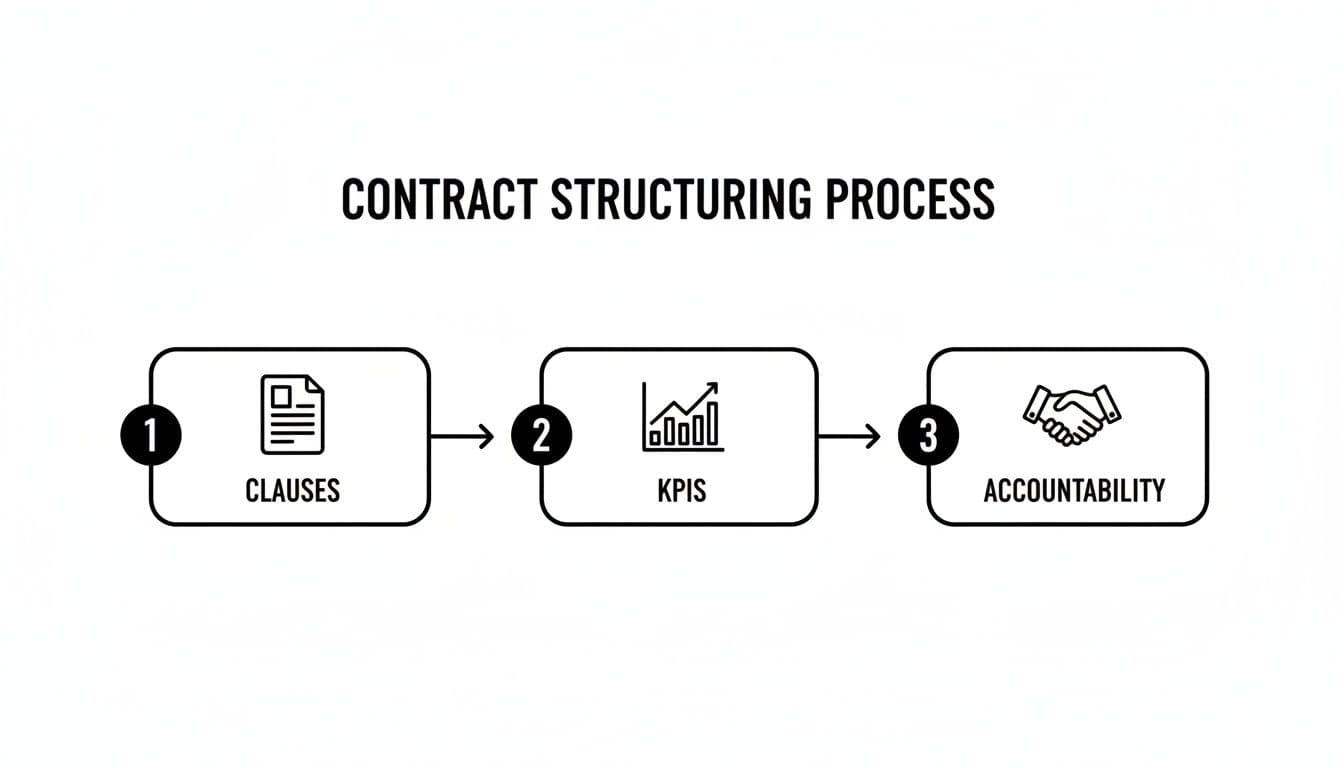
As the visual makes clear, a great partnership is built on three pillars: clear legal terms, measurable performance indicators, and a shared commitment to the outcome.
To make this initial phase as smooth as possible, a structured checklist is your best friend. It ensures no critical steps are missed as you integrate the agency into your workflows.
Agency Onboarding and Integration Checklist
This checklist covers the essential steps for getting your new agency up and running, from technical handovers to strategic alignment and communication protocols.
By following a clear plan, you avoid the common pitfalls that can derail a partnership early on and set the stage for a productive, results-driven relationship.
The Initial 90-Day Action Plan
The kickoff workshop should wrap up with one key deliverable: a collaboratively built 90-day plan. This document is what turns the high-level strategy from the contract into a concrete, week-by-week action plan. It makes sure both teams know exactly what’s happening and when.
This plan needs to be specific and tactical, breaking down the initial work into manageable chunks.
An Effective 90-Day Plan Should Look Something Like This:
- Weeks 1-2: Discovery and Baselining. The agency gets its hands dirty with a deep-dive technical audit, competitor analysis in AI-generated answers, and establishing those baseline KPIs using a tool like Attensira.
- Weeks 3-6: Strategic Foundation. Based on what they found in the audit, the agency presents its core strategy. This should include content gap priorities, recommendations for structuring your data, and the first set of content briefs.
- Weeks 7-12: Initial Implementation and Reporting. The first wave of optimized content gets produced and published. You should receive your first monthly performance report showing progress against the baseline KPIs you established back in week one.
This kind of structured approach strips away ambiguity and sets a productive pace from the get-go. By carefully planning the onboarding phase, you’re not just hiring a vendor; you’re building a partnership founded on clarity, trust, and a shared vision of what success looks like.
Common Questions About Choosing an AI Search Agency
When you're stepping into the world of AI-driven search, a lot of questions come up. It's a new frontier, and if you're looking to partner with an AI search optimization agency in France, you need straight answers. Getting this right from the start lays the groundwork for a solid partnership and sets everyone up for success.
Let's tackle some of the most common questions business leaders have when they're considering this kind of investment.
How Much Does AI Search Optimization Cost in France?
Budget is always front and center, but there's no simple answer for what Generative Engine Optimization (GEO) costs. The investment really depends on the scope of work, how competitive your sector is in the French market, and the agency's pricing structure.
In France, you'll typically run into one of three models:
- Monthly Retainers: This is the go-to for most agencies. You can expect to see fees anywhere from €3,000 to €15,000+ per month. A retainer ensures you have ongoing strategic support, content optimization, and constant performance tracking, which is exactly what you need for a long-term strategy.
- Project-Based Fees: If you have a single, well-defined goal—like overhauling your website’s data structure or conducting a foundational GEO audit—a project-based fee makes sense. These projects can range from €5,000 to €25,000, based entirely on how complex and time-sensitive the work is.
- Performance-Based Models: A few agencies are starting to offer hybrid models. This usually involves a smaller base retainer plus bonuses tied to hitting specific KPIs, like securing a certain Share of Voice in AI-generated answers.
Ultimately, what you spend will reflect the ambition of your goals. For a broader look at this, the strategic framework in how to choose a digital marketing agency offers some great insights on budgeting and assessing value.
The Real Difference Between SEO and GEO
It's tempting to think of GEO as just "SEO for AI," but that's a massive oversimplification. They are fundamentally different disciplines aimed at completely different targets. Grasping this distinction is crucial when you’re trying to figure out if an agency really gets it.
Traditional Search Engine Optimization (SEO) is all about ranking web pages. The entire game is to get your URL to the top of a list of links by matching keywords. The work revolves around technical site health, backlinks, and on-page keyword density.
Generative Engine Optimization (GEO), however, is focused on influencing AI-generated answers. It's not about ranking a page; it's about making your brand's information the most accurate, useful, and credible source for an AI model to use and cite in its direct response.
SEO is a game of ranking. GEO is a game of influence. SEO gets you on the list; GEO gets you into the answer. This requires a complete shift in how you create and structure your content, moving from keyword-centric articles to data-rich, easily parsable information that machines can confidently use.
And if you’re operating across different markets, it's worth noting that strategies can change significantly. Our guide on choosing an AI search optimization agency in the UK explores some of these regional nuances.
Setting Realistic Timelines for AI Optimization Results
Everyone wants quick wins. But influencing complex AI models is a long-term play. While you can see some encouraging signs fairly quickly, achieving real dominance in AI answers is a marathon, not a sprint.
The good news is that GEO can sometimes show initial feedback faster than traditional SEO, where it can take months just to see a flicker of movement.
- Initial Visibility (3-6 Months): Once your optimized content is out there and indexed, you can often spot the first signs of impact within this window. AI models are constantly updating their knowledge bases, so clear, well-structured information gets picked up. This might look like your brand being cited as a source for the first time or a noticeable improvement in the tone of an AI summary about your products.
- Sustained Authority (12+ Months): Becoming the go-to, authoritative source that AI models consistently prefer takes a longer commitment. This means you have to keep publishing high-quality structured content, find and fill knowledge gaps, and reinforce your expertise again and again.
Consistency is everything. A one-off project might give you a temporary boost, but it’s the sustained, strategic partnership that will secure your brand's position in this new era of search.
Ready to see how your brand stacks up in AI-generated answers? Attensira provides the critical insights you need to monitor your AI visibility, identify content gaps, and build a winning GEO strategy. Start tracking your AI presence today at https://attensira.com.