Explore how an ai overview tracker monitors brand visibility in AI-powered search and unlock actionable SEO insights.
At its core, an AI overview tracker is a specialized tool designed to watch when, where, and how your brand shows up in the AI-generated summaries at the top of search results. Think of it as your brand's personal lookout, giving you a clear view of your visibility inside new features like Google's AI Overviews, which are completely reshaping how people find information.
Navigating the New Search Landscape
The way customers discover brands and answers has been turned on its head. Traditional SEO was a bit like setting up a shop on a busy street; a great location (a top organic ranking) guaranteed foot traffic. But that model isn't the whole picture anymore. With AI-driven search, it’s not enough to just be on the street—you need to be the place the new, super-smart concierge on the block recommends to everyone.
This change is especially important for B2B companies. Your potential customers—savvy researchers, product managers, and executives—are increasingly turning to these AI summaries to get quick, authoritative answers. If your brand isn't cited in those crucial first moments, you’re basically invisible while they're doing their homework. This is exactly why an AI overview tracker is no longer a "nice to have."
Why AI Visibility Is Non-Negotiable
Ignoring your brand’s presence in AI search today feels a lot like ignoring mobile-friendliness a decade ago—a mistake you can’t afford to make. The sheer scale of the AI market’s growth underscores how urgent this is. In 2025, the global AI market ballooned to an incredible 244 billion**, jumping from **184 billion in 2024. That’s a 32.6% increase in just one year. Projections show it rocketing to $827 billion by 2030, all fueled by the same generative AI that’s now baked into search engines.
Think of an AI overview tracker less as a simple monitoring tool and more as a strategic compass. It doesn't just tell you if you were mentioned. It reveals where the important conversations are happening, who is being cited as an authority, and what you need to change to become that authority yourself.
This is where data becomes your guide.

By tracking these trends, you can spot opportunities to fine-tune your content and strategy. Understanding this new ecosystem is the key to shifting from a passive observer to an active participant in the narratives AI creates. This requires a fresh mindset, which you can dive into by exploring modern AI search engine optimization techniques. This guide will walk you through what you need to know to make sure your brand isn’t just seen, but heard.
Understanding the AI Overview Tracker
Think of an AI overview tracker as your brand's dedicated radar system for the new age of search. Instead of tracking planes, it scans AI-generated search responses to see exactly how your brand is being portrayed. It’s designed to answer one critical question: when Google’s AI speaks, what is it saying about you?
This goes way beyond a simple keyword alert. It’s not just about getting a notification that your company was mentioned. A real AI overview tracker digs into the context of that mention. It analyzes the sentiment—is the AI framing you positively or negatively?—and gauges the prominence of your brand within the overall answer. For B2B companies, this is huge, because being positioned as an authority in an AI-generated response can directly shape million-dollar buying decisions.
From Rank Position to Narrative Presence
To really get why this matters, let's contrast it with the tools we've used for years: traditional SEO rank trackers. For the longest time, the game was all about climbing a list of blue links. Success was simple and clear-cut—did you hit position #1, #2, or #3? It was a static, predictable race to the top of a list.
The AI overview tracker signals a fundamental change in how we measure success. We're moving away from tracking a 'position on a list' and shifting our focus to monitoring our 'presence in a narrative.'
In the era of AI-generated answers, your brand is no longer just a link. It’s a character in a story being told to your potential customers. The question has evolved from "Where do we rank?" to "What is the AI saying about us?"
This shift is everything. Success is now defined by how influential and visible your brand is inside the conversational, synthesized answers people get from search engines. An AI overview tracker is the only way to measure and improve this new kind of visibility systematically.
Making Complex Monitoring Simple
Let's be realistic: manually searching thousands of queries to see if and how your brand shows up in AI-generated content is impossible. AI responses are fluid; they change constantly based on the user's phrasing, their location, and the AI model's latest updates. This is precisely where an AI overview tracker becomes indispensable for B2B teams. If you want a deeper dive into these AI-generated results, you can learn more about what an AI Overview is in our glossary.
These platforms automate the entire monitoring process, handling several key tasks for you:
- Continuous Scanning: They constantly run checks across thousands of keywords and topics relevant to your business, 24/7.
- Source Identification: They pinpoint the exact source the AI is citing—whether it’s a blog post, a whitepaper, or a press release—so you know what content is resonating.
- Competitive Benchmarking: They don't just show you when you're mentioned; they also show you when your competitors are featured, giving you a serious strategic advantage.
By automating this surveillance, an AI overview tracker transforms a chaotic firehose of information into a clean, actionable dashboard. It gives you the intelligence you need to sharpen your content strategy and make sure your brand is represented accurately and authoritatively in the conversations that truly matter.
The Essential Features and Metrics to Monitor
When you're evaluating an AI overview tracker, it’s easy to get lost in flashy dashboards. The real value, though, comes from the specific features that give you a strategic edge. A great tracker provides granular data you can actually act on. It’s like the difference between a simple compass and a full-blown GPS—both give you a general direction, but only the GPS shows you the terrain, the traffic, and the best route to your destination.
To really appreciate what these platforms can do, it helps to know a bit about the technology working behind the scenes, which often involves sophisticated tools like the 12 Best AI Detectors to Vet Your Content. This context helps you understand how a tracker can so accurately pinpoint and dissect your brand's presence in AI-generated answers. A good tool doesn't just hand you data; it delivers a clear competitive advantage.
Core Features Every B2B Brand Needs
A powerful AI overview tracker should come with a suite of features that paint a complete picture of your brand's standing in this new AI-driven search world. For any serious B2B marketing or SEO team, these are the absolute must-haves.
- Multi-Platform Monitoring: Your audience isn't just on Google. A critical feature is the ability to track mentions across multiple AI engines—think Google AI Overviews, Perplexity, and others—to get a complete view of your visibility.
- Mention Frequency and Context Analysis: Simply getting an alert isn't enough. The platform needs to track how often your brand is mentioned for key topics and, more importantly, analyze the context to make sure your message is coming across correctly.
- Source Content Identification: Knowing that you were mentioned is great, but knowing what the AI cited is a game-changer. This feature pinpoints the exact URLs and content pieces the AI used, showing you which of your assets are really pulling their weight.
- Competitive Benchmarking: You’re not operating in a vacuum. A top-tier tracker lets you monitor your competitors, see when and where they’re being cited, and find gaps you can exploit to get ahead.
This flowchart gives a simple visual of how brand monitoring fits into the new AI ecosystem.
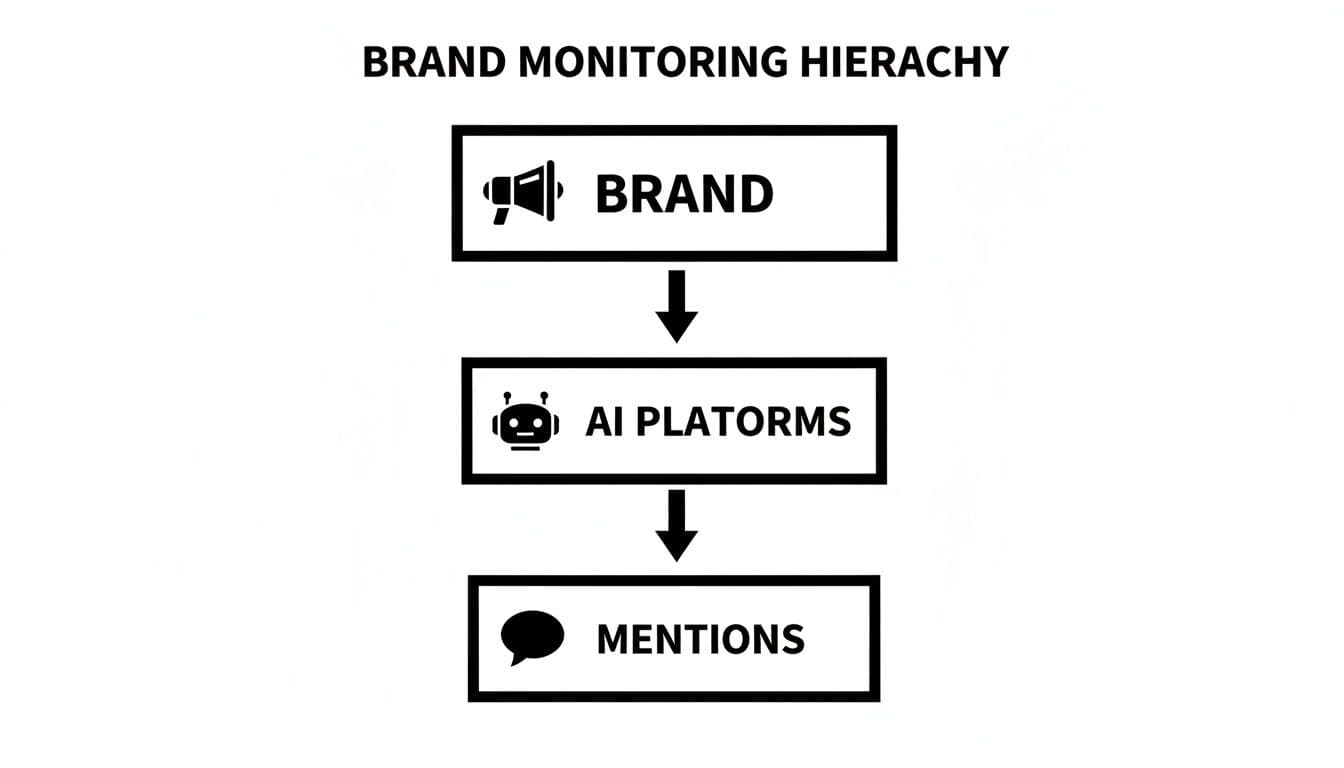
It really clarifies how your brand’s content flows through AI platforms before it reaches your audience as a mention that shapes their perception.
Key Metrics That Drive Strategy
Features are what gather the data; metrics are what give that data meaning. An effective AI overview tracker turns all that raw information into clear performance indicators that can steer your content and SEO strategy.
As AI becomes more integrated into search and everyday tech, these metrics are becoming non-negotiable. Gartner's latest forecast is staggering: the top six AI markets are projected to see nearly $1.5 trillion in global spending by 2025. That money is flowing into everything from GenAI smartphones to the AI software powering them. With that kind of investment flooding the market, you can't afford to guess about your brand's visibility.
The table below breaks down the most important metrics you should be tracking.
Essential Metrics for AI Overview Tracking
A breakdown of the critical metrics to monitor for understanding and improving your brand's visibility in AI-generated search results.
By keeping a close eye on these numbers, you’re not just tracking performance—you’re building a smarter, more resilient content strategy for an AI-first world.
These metrics tie directly into your broader marketing goals. For a deeper look at how they fit into your overall strategy, our guide on essential content performance metrics is a great resource. Systematically tracking these numbers is how you master your brand's visibility in this new landscape.
Practical Applications for B2B Enterprises
It’s one thing to understand the theory behind an AI overview tracker, but it's another thing entirely to see it deliver real-world business results. For B2B companies, where the buying journey is long and packed with research, the applications are more than just practical—they’re strategic. This tool gives you a direct line of sight into the AI-driven narratives that are shaping your market right now.
Let's get past the abstract ideas and look at how different B2B teams can put an AI overview tracker to work to hit specific, measurable goals. These aren't just hypotheticals; they're grounded in the day-to-day challenges that marketing and product teams are wrestling with.
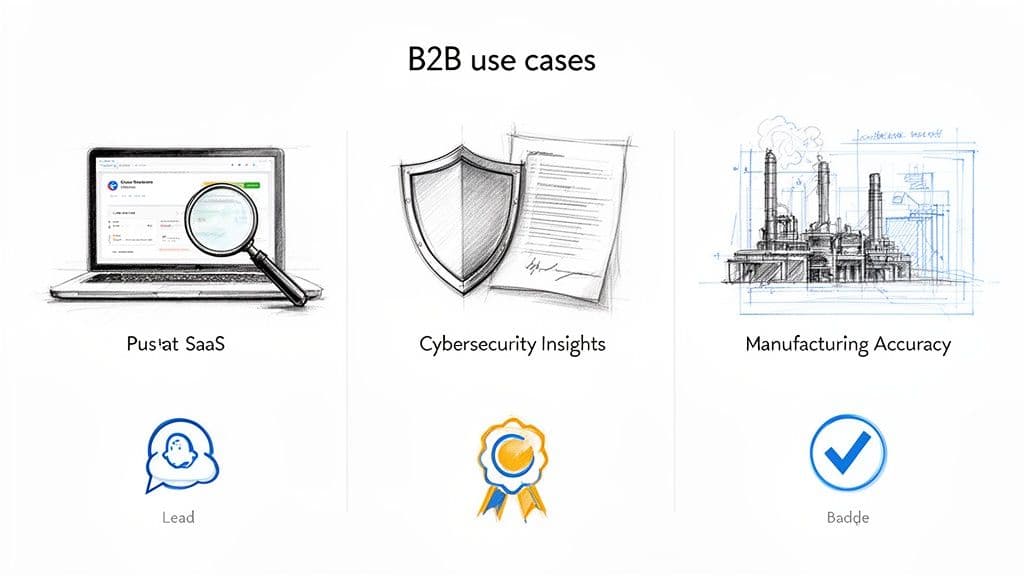
Uncovering Competitive Gaps for SaaS Companies
Let's say you're a SaaS company that sells project management software. Your marketing team uses an ai overview tracker to keep an eye on queries like "best project management tool for remote teams" or "monday.com vs asana features." The tracker quickly reveals that while your brand gets an occasional mention, AI Overviews consistently pull from a competitor's content when talking about Gantt chart features.
That insight is pure gold. It points to a glaring content gap and a clear product marketing opportunity. The team can now create a detailed guide or a video tutorial focused specifically on their own advanced Gantt chart capabilities, optimized to answer the very questions their prospects are asking. The aim here is to get their content cited in the AI response, inserting their brand directly into high-intent buying conversations and driving more qualified leads.
An AI overview tracker turns competitive analysis from a reactive chore into a proactive strategy. It doesn't just show you what your competitors are saying—it shows you what the AI is saying about them, giving you a roadmap to intercept their audience.
Shaping Threat Narratives for Cybersecurity Firms
Now, think about a cybersecurity firm. Their entire reputation is built on being the definitive source for emerging threats. They use an AI overview tracker to monitor how AI models are describing new vulnerabilities, like a zero-day exploit that just hit the news. The tracker shows them exactly which sources AI Overviews are referencing to define and explain the threat.
If the AI is pulling information from less-reputable blogs or a competitor’s thin analysis, the firm’s content team can spring into action. They can publish a comprehensive threat brief, authored by their top researchers, and push it out through all their channels. The goal is to become the primary, authoritative source cited by the AI, cementing their brand’s leadership and building trust with CISOs and IT managers who need accurate, timely information. This kind of authority directly supports long-term sales cycles. For teams focused on this, it's also smart to take a wider look at monitoring SEO performance to connect all the dots.
Ensuring Technical Accuracy for Manufacturers
Finally, imagine a company that makes highly specialized industrial components. Their customers—engineers and procurement specialists—are searching for incredibly specific technical details. An AI overview tracker helps the company monitor queries tied to their product SKUs, material compositions, and compliance standards.
They discover that an AI Overview is incorrectly summarizing the temperature tolerance of a flagship product, citing an outdated spec sheet on a third-party distributor’s site. This is a critical problem that could lead to lost sales or, worse, incorrect applications in the field. With this data in hand, their team can immediately update their own product documentation, publish a definitive spec sheet, and work with the distributor to get the old information corrected. In this case, the tracker functions as a crucial quality control tool, protecting brand reputation and ensuring technical accuracy where it matters most.
These examples show how an ai overview tracker delivers an essential layer of market intelligence. Monitoring is especially vital for global B2B brands, as AI adoption and behavior can vary significantly by region. For instance, North America led the $294.16 billion global AI market in 2025, while the Asia-Pacific region is the fastest-growing. A global tracker like Attensira ensures a brand’s presence remains strong and accurate in localized AI responses across these key markets. You can find more global AI market trends on Fortune Business Insights.
Implementing Your AI Tracking Strategy
Alright, let's move from theory to practice. Getting an AI overview tracker up and running might seem daunting, but it's really about having a solid plan. You don't need a PhD in data science; you just need a clear, methodical approach. This is how you turn the abstract idea of "AI tracking" into a concrete set of steps your team can actually execute.
The whole thing starts with one simple question: What do we actually need to know? Defining your objectives first gives your entire strategy a purpose, ensuring every byte of data you collect is tied to a real business goal.
Step 1: Define Clear Tracking Goals
Before you even think about logging into a tool, you have to decide what success looks like. A focused strategy will always beat a "let's track everything" approach. Are you worried about how your brand is being portrayed, or is keeping an eye on the competition the main goal?
Figure out your primary objectives from the get-go:
- Brand Mentions: Keep tabs on how often—and in what context—your brand, products, or key executives pop up in AI Overviews.
- Competitive Analysis: See how often your rivals get cited for the keywords you care about and pinpoint where their content is winning.
- Product Visibility: Make sure your products are being shown accurately and spot opportunities to appear in those lucrative "best X vs. Y" type queries.
Nailing these goals down helps you set up your tracker to deliver relevant insights, cutting through the noise to focus on what truly matters.
Step 2: Configure Keywords and Competitors
Once you know what you're looking for, it's time to tell the platform what to watch. This is where you plug in the keywords your customers are actually using and list the competitors that keep you up at night. Think bigger than just your brand name.
You'll want to include a healthy mix of query types:
- Informational Queries: like "what is cloud data security"
- Navigational Queries: like "Attensira platform login"
- Commercial Queries: like "best CRM for small businesses"
- Transactional Queries: like "salesforce pricing plans"
Adding your top three to five competitors gives the AI overview tracker the context it needs. It builds a complete picture of the search landscape, showing you not just where you are, but where you need to be.
Step 3: Establish a Performance Baseline
You can’t measure progress if you don’t know where you started. After setting up your keywords and competitors, let the tracker run for a couple of weeks to gather initial data. This is non-negotiable.
Your baseline is the ground truth for your current AI visibility. It shows your starting Share of AI Voice, reveals what content is already getting picked up, and shines a light on the topics where you're currently invisible.
This baseline is the yardstick you'll use to measure every future effort. Of course, a solid strategy also means being responsible. Adhering to a practical guide to a Code of Conduct for AI Teams ensures you're deploying these tools ethically.
Step 4: Integrate Insights into Your Workflow
The last piece of the puzzle is to make AI tracking a living part of your content and SEO processes. The data can't just sit in a dashboard; it needs to fuel your team's decisions day in and day out.
Create a simple feedback loop:
- Review Insights Weekly: Set aside time to look at new mentions, competitor activity, and any new content gaps the tracker has uncovered.
- Assign Action Items: Turn those insights into tangible tasks—a new content brief, an update to an old article, or a tweak to your product messaging.
- Measure and Iterate: Watch how your changes affect your AI Overview visibility over the next few weeks and months. Double down on what works, and adjust what doesn't.
Mastering Your Brand's AI Visibility
The way people discover brands has fundamentally changed. Standing still is not an option. AI-generated search results have wedged themselves between your content and your customers, creating a new reality where traditional rankings are only part of the story. Now, it's about being cited as an authority. Ignoring this shift is like having the best storefront in town, but on a street that's been permanently closed.
An AI overview tracker is your new map. It goes beyond keyword rankings and backlinks to answer the questions that B2B marketers are grappling with right now: What is the AI saying about us? Where are our competitors getting a foothold? Which of our articles and guides are actually shaping the AI's answers? This is the tool that provides the clarity needed to move forward with confidence.
Taking Control of Your AI Narrative
It's time to shift from learning to doing. You don't have to tear up your entire marketing playbook overnight. The smart play is to start small, get some quick wins, and build from there.
The goal isn't just to see where your brand shows up in AI overviews; it's to actively shape that presence. Once you understand the sources an AI trusts, you can fine-tune your content to become one of them. That's how you ensure your expertise is represented accurately and authoritatively.
Here’s how you can take control right now:
- Identify One Core Offering: Start with a single flagship product or a critical service. This keeps your focus tight and makes the initial tracking much more manageable.
- Define Critical Keywords: Brainstorm the top 10-15 search queries an ideal customer would type in when researching that offering. Think about their problems, how they compare options, and the solutions they’re looking for.
- Establish a Baseline: Fire up an AI overview tracker and see where you are today. Get your current Share of AI Voice, pinpoint any obvious content gaps, and take note of which competitors are already in the conversation.
This focused approach turns a massive, intimidating challenge into a clear set of actionable steps. Once you have this baseline, you can expand your efforts, moving from just watching what happens to making things happen. To dig deeper, check out our guide on AI brand monitoring and build a strategy that secures your brand's future.
Common Questions Answered
Even with the best strategy in place, adopting a new way of thinking about search always brings up questions. Let's tackle some of the most common ones we hear about AI overview trackers to clear up any lingering confusion.
How Is an AI Overview Tracker Different From a Standard SEO Rank Tracker?
The core difference is simple: they measure two completely different things. A classic SEO rank tracker is all about your position on a list of blue links. It’s built to answer one question: "Where do I rank for this keyword?"
An AI overview tracker, however, measures your presence inside a dynamic, AI-generated summary. It answers a much more critical question for today's world: "What is the AI saying about my brand, and what sources is it using to shape that narrative?"
Here’s an analogy: a rank tracker is like a stopwatch in a 100-meter dash—it just tells you your final placement. An AI overview tracker is the post-race analysis, breaking down your form, your influence on other runners, and how the commentators described your performance. One gives you a single data point; the other gives you the whole story.
Which AI Platforms Should My B2B Business Monitor?
Google's AI Overviews are the obvious starting point, but stopping there would be a mistake. The AI search space is getting bigger by the day, and your B2B prospects are using more than just one tool to do their homework.
A solid monitoring strategy should cover a few key bases:
- Google AI Overviews: This is non-negotiable. It’s where the bulk of search traffic lives, making it ground zero for brand visibility.
- Perplexity AI: This "answer engine" is quickly becoming a favorite among tech professionals and researchers who want direct, well-cited answers without the fluff.
- Other Niche Platforms: Think about your specific industry. Are there specialized AI search tools or forums your ideal customers frequent? Keep an eye on those emerging platforms.
The goal is to be where your audience is. Tracking multiple platforms gives you a 360-degree view of your brand’s story, not just a snapshot from one angle.
What Is the Typical ROI I Can Expect From Implementing an AI Tracking Strategy?
Measuring the return on investment here isn’t just about counting clicks or traffic. Because AI Overviews influence brand perception and capture users with high intent, the real value is tied directly to bigger business goals.
The ROI of an AI overview tracker isn't just about clicks; it's about influence. It’s measured in captured market share, enhanced brand authority, and the ability to steer the AI-driven conversations that lead to B2B buying decisions.
Here's how to think about the tangible returns:
- Higher Quality Leads: When your brand is cited as an authority in AI Overviews for commercial-intent searches, you attract prospects who are already educated and much further down the buying funnel.
- Smarter Content Investment: The tracker shows you exactly which pieces of content the AI models love and trust. This means you can stop guessing and double down on creating assets that actually work, saving time and budget.
- A Stronger, More Trusted Brand: You get to spot and correct misinformation before it spreads, cementing your status as a reliable industry leader. With over 50% of organic searches now featuring AI answers, this kind of brand management is essential.
- A Real Competitive Edge: An AI overview tracker is basically a competitive intelligence tool. You can see where your competitors are showing up and, more importantly, where they aren't. This lets you find and own the content gaps they've left wide open.
While the exact dollar amount will depend on your business, the ROI comes from building a stronger market position and running a more effective content strategy that directly fuels your sales pipeline.
Ready to take control of your brand's narrative in AI search? Attensira provides the insights you need to monitor, analyze, and optimize your visibility in AI Overviews. Start mastering the new search landscape today.