
Unlock the power of visibility score SEO. Learn what this crucial metric means, how it's calculated, and how to improve it for better search performance.
In the world of SEO, a visibility score is your bird's-eye view of how well your website is performing across search results. It’s a single metric that sums up your overall presence for a specific group of keywords you care about.
Think of it this way: tracking a single keyword rank is like knowing you’re on the radio. A visibility score tells you which stations you’re on, how many people are listening, and how often your song gets played during primetime.
What Is a Visibility Score and Why It Matters
This score moves beyond the simple up-or-down movement of individual rankings. Instead, it blends keyword positions with their search volumes and estimated click-through rates (CTRs) to calculate what percentage of all possible clicks you're actually capturing.
It answers the big question: "Out of all the people searching for our topics, how much of that attention are we winning?" This holistic view is absolutely critical for understanding your true market share and how you stack up against the competition.
From Simple Ranks to Strategic Insight
Let's be honest, traditional rank tracking can often be a vanity metric. Sure, moving from position 25 to 15 for a keyword is progress, but in terms of real business impact, it’s a non-event. It drives almost no traffic.
On the other hand, jumping from position four to position two for a relevant keyword can open the floodgates. The visibility score is the metric that understands this difference. It weighs your rankings based on their actual potential to bring visitors to your site.
A higher visibility score means you're earning a bigger piece of the audience pie for your target topics. You're not just ranking; you're ranking for the keywords that actually drive valuable traffic and connect you with potential customers.
The Core Components of a Visibility Score
So, what’s actually under the hood? While different SEO tools like SEMrush or Ahrefs might have their own unique formulas, they all cook with the same basic ingredients. These data points work together to turn abstract rankings into a concrete measure of your brand’s search engine footprint.
Here's a quick breakdown of what goes into the calculation.
Core Components of a Visibility Score
Essentially, the score is a weighted average that tells you how much of the total "click potential" your website is capturing. It's a far more accurate reflection of SEO performance than just a list of keyword positions. You can dive deeper into how this works by exploring historical search visibility metrics.
How Search Visibility Is Actually Calculated
A visibility score can feel a bit abstract, but the math behind it is surprisingly straightforward. It’s built on a logical formula that pulls together three core pieces of data to paint a clear picture of your search presence. This isn't just about whether you went up or down a spot; it's about measuring the real-world traffic potential that comes with your rankings.
The whole process starts with where you rank for a keyword. Then, it factors in how many people are actually searching for that term (search volume). Finally, it applies a realistic model of how people click on search results (click-through rate). This flow shows how those distinct data points merge into one meaningful metric.
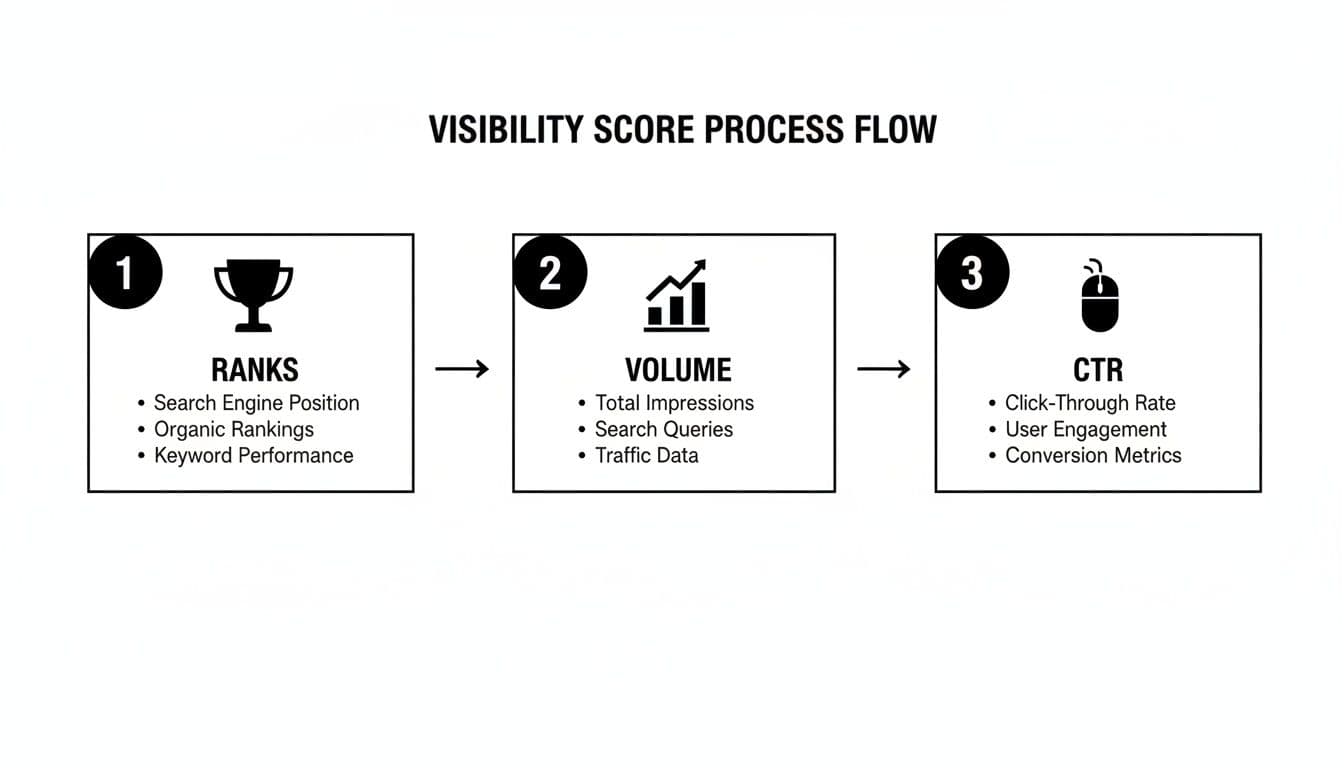
It’s a simple but powerful progression. Visibility isn't defined by rank alone—it’s about the potential traffic your rank can actually deliver, given the search demand and typical user behavior.
The Three Pillars of the Calculation
At its heart, the calculation for any single keyword is just a multiplication problem. It blends your ranking position, the term's search volume, and an estimated click-through rate (CTR) to generate a score that reflects its traffic potential.
Here’s how the pieces fit together:
- Keyword Rank: This is your starting point. Most models only pay attention to keywords ranking in the top 20 or 30 positions. Why? Because anything beyond that gets so few clicks that the traffic is practically zero.
- Search Volume: This tells you the size of the potential audience. Ranking #1 for a keyword with 10,000 monthly searches will have a much bigger impact on your score than ranking #1 for a term with just 100 searches.
- Estimated CTR: This is the critical multiplier that gives the metric its realism. Not all ranking positions are created equal. A jump from position 10 to 9 has a tiny effect, but moving from position 2 to 1 can more than double your clicks. SEO platforms use industry-standard CTR models that assign a specific click probability to every spot on the results page.
This blended approach is exactly why a visibility score offers so much more insight than a simple average rank. It functions as a far more accurate stand-in for potential traffic. This concept is closely related to another key metric we cover in our guide on how to calculate share of voice.
From a Single Keyword to a Total Score
The real value emerges when you add up the scores for all the keywords you're tracking. The software calculates the visibility for each keyword one by one, then sums them to give you that single, overarching website visibility score.
Let's look at a quick example. Imagine you’re tracking two keywords:
- Keyword A ("AI marketing tools"): You rank at position #3. It has a search volume of 5,000 and an estimated CTR of 12%.
- Keyword B ("B2B content automation"): You rank way down at position #15. It has a search volume of 800 and a tiny CTR of 1%.
Here’s what the calculation would look like:
- Visibility for Keyword A: 5,000 (volume) x 0.12 (CTR) = 600
- Visibility for Keyword B: 800 (volume) x 0.01 (CTR) = 8
Your total visibility score from just these two keywords would be 608.
This simple math makes it crystal clear why improving your rank for high-volume keywords has such an outsized impact on your overall visibility score. Pushing Keyword B up a few spots will barely move the needle, but improving Keyword A's position could send your total score soaring.
Measuring Visibility in the New Age of AI Search
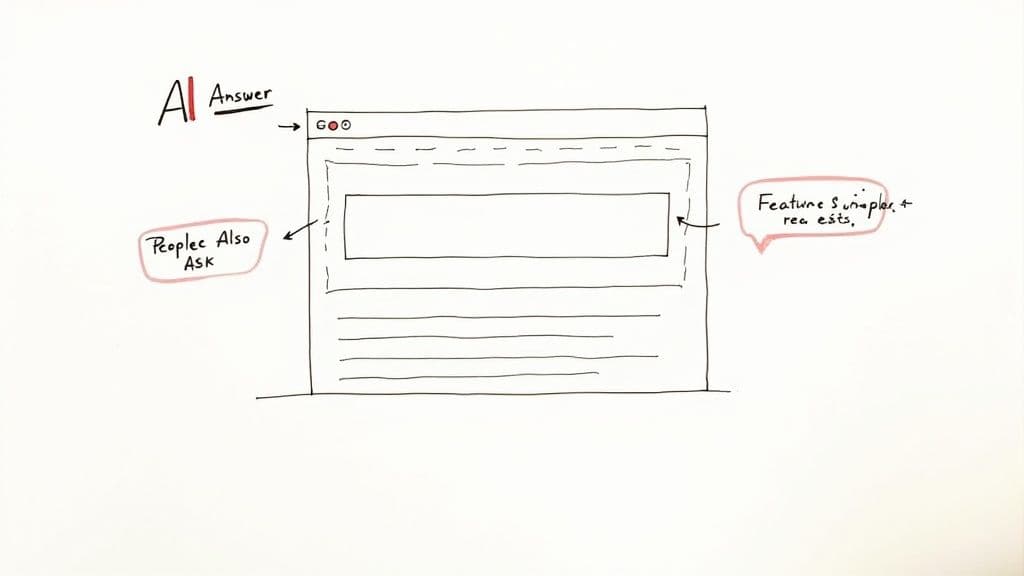
If you’re still basing your SEO success on the classic “ten blue links,” you’re looking in the rearview mirror. Today's search results are a dynamic blend of AI-generated answers, featured snippets, and interactive "People Also Ask" boxes. This isn't just a minor update; it's a fundamental shift that makes old-school metrics like click-through rates feel completely obsolete.
This new reality demands a "visibility-first" mindset. The game isn't just about earning a click anymore. It's about owning the most valuable SERP real estate. Your brand appearing in an AI-generated answer builds authority and awareness, even if the user never visits your site. A modern visibility score SEO strategy has to embrace this.
Beyond the Click: SERP Features and Zero-Click Searches
The surge of zero-click searches and AI answers completely changes how we should be calculating a visibility score. When a featured snippet or an AI response gives the user what they need right on the results page, the CTR model simply falls apart. Success is no longer about who gets the click—it’s about who gets cited as the source. We have to move from counting clicks to measuring influence.
A striking example from 2023 drives this point home. The keyword "seo" gets around 301,000 searches a month. The results page for this query had 10 different features, creating a total potential SERP volume of 3,010,000 points. Brands that were mentioned in just four of those features snagged 1,204,000 of those points. That’s a staggering 40% visibility share, all without a single traditional click. You can dig deeper into this concept of measuring visibility in a zero-click world on searchengineland.com.
This data is crystal clear: if your measurement stops at the click, you're missing most of the story.
How to Adapt Your Content for AI Visibility
To stay relevant, your content strategy needs a major overhaul. The new objective is to become the trusted source that both search engines and AI models rely on to answer questions. This means your content needs to be more than just authoritative; it has to be structured in a way that algorithms can easily understand and pull from.
Here’s how you can start optimizing your content for this new kind of visibility:
- Answer Questions Directly: Structure your content to provide clear, immediate answers to common questions. Use headings (H2s, H3s) to pose these questions, making it incredibly easy for Google to lift your content for a featured snippet or AI answer.
- Embrace Structured Data: Use Schema markup to spoon-feed search engines context about your content. This helps them understand the facts, entities, and relationships on your pages, which dramatically increases your chances of being featured.
- Build Topical Authority: Don't just write one-off articles. Develop comprehensive topic clusters that cover a subject from every angle. This signals to Google and AI that you are a definitive, go-to resource.
By creating content specifically designed to be featured, you put your brand in a position to win visibility even when you don't win the click. That's the heart of a modern visibility score SEO approach—it's about measuring your presence and influence, not just your traffic.
Tracking Brand Mentions in AI Chat
With AI chat interfaces like ChatGPT and Google's SGE becoming the new front door to information, keeping track of your brand's presence there is essential. These platforms represent the next frontier of search. Getting mentioned as a source or recommendation is a powerful way to build your brand’s authority.
The catch? Measuring this new form of visibility requires new tools. Your standard SEO platforms were built for the old SERP and are completely blind to what’s happening inside these AI-driven conversations. You need a more focused approach to truly understand your digital footprint. For a full breakdown, take a look at our guide on how to track your brand’s visibility in ChatGPT and other top LLMs. Fine-tuning your measurement strategy is the only way to ensure your visibility score reflects your real influence across all the places people search, not just the old ones.
Proven Strategies to Improve Your "Visibility Score"
Knowing your visibility score is the starting line. Actually improving it? That’s where the real race is won. Boosting this metric isn't about a single magic bullet; it's about executing a coordinated strategy across three core areas. Think of it like building a high-performance engine: you need a solid technical frame, high-quality fuel, and an advanced guidance system to get ahead.
Let's move from theory to a practical playbook. We'll break down how to increase your visibility score, starting with the technical foundations, moving to strategic content, and finally, optimizing for the new world of AI-driven search.
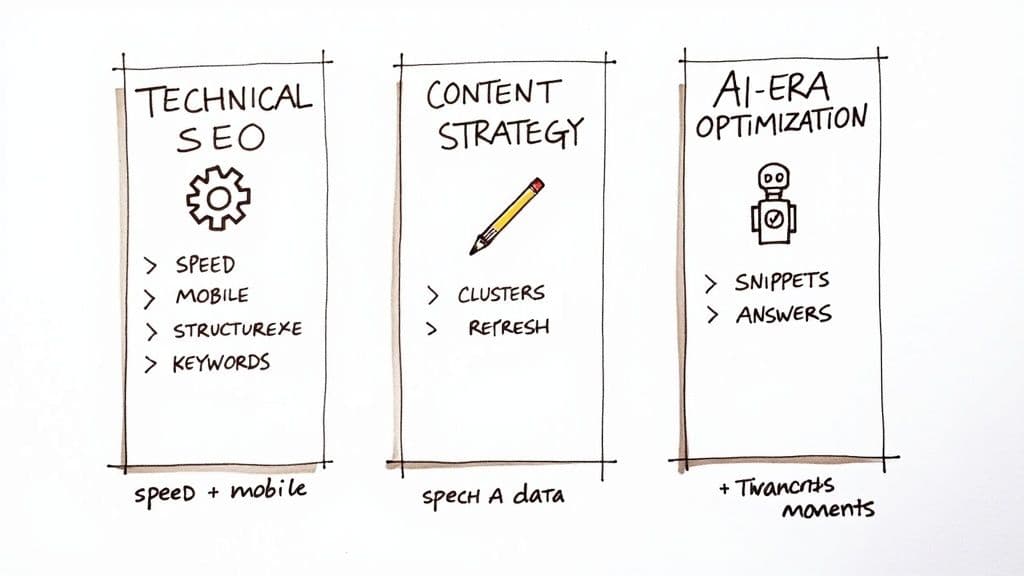
Pillar 1: Foundational Technical SEO
Your website's technical health is the absolute bedrock of its search performance. If search engines can't efficiently crawl, understand, or load your site, even the most brilliant content will get lost in the noise. Technical problems act like a governor on your engine—limiting your top speed no matter how hard you hit the gas.
1. Supercharge Your Site Speed
- Why it works: Page speed isn't just a suggestion; it's a confirmed ranking factor. A slow site creates a poor user experience, drives up bounce rates, and drags down your rankings. In short, it’s a direct hit to your visibility score.
- How to implement it: Start by running your site through Google's PageSpeed Insights to find the bottlenecks. Common culprits include oversized images, clunky code, and slow server response times. Focus on compressing images, using browser caching, and minifying CSS and JavaScript files.
2. Master Mobile Optimization
- Why it works: With over 60% of all searches now happening on mobile devices, Google has long since switched to mobile-first indexing. This means the mobile version of your site is the one that really counts for ranking. A clunky mobile experience is simply not an option anymore.
- How to implement it: Your site must have a responsive design that looks and works great on any screen. Use Google’s Mobile-Friendly Test and manually check your site on a phone. Pay close attention to things like button sizes, font readability, and how easy it is to navigate.
3. Implement Structured Data (Schema Markup)
- Why it works: Schema markup is like a secret language you can use to tell search engines exactly what your content is about. This helps them generate rich snippets—those eye-catching extras like star ratings or FAQ dropdowns in the search results—which dramatically improve click-through rates and, in turn, your visibility.
- How to implement it: You don’t have to be a developer. Use a tool like Google's Structured Data Markup Helper to generate the code for your products, articles, or local business info. Then, just add that snippet to your site's HTML.
Pillar 2: Strategic Content Development
Content is the fuel for your SEO engine. But you can't just pour any old fuel in and expect top performance. You need a strategy that targets the right keywords, builds genuine authority, and keeps your information fresh. This is all about making every single piece of content work toward a higher visibility score SEO.
At the heart of any winning content plan is rigorous keyword research, and using the best keyword research tools gives you a serious leg up. This step ensures you’re not just guessing but targeting terms people are actually searching for.
A great content strategy focuses on depth, not just breadth. Answering a user's entire set of questions on a single topic is far more powerful than creating dozens of shallow articles that barely scratch the surface.
Here’s how to build a content plan that truly drives visibility:
- Target High-Impact Keywords: Look for that sweet spot: keywords with solid search volume that aren't impossibly competitive. Focus on the terms where a jump in the rankings will make the biggest difference to your score.
- Build Topic Clusters: Structure your content around a central "pillar" page for a broad topic. Then, create a "cluster" of related articles that dive deep into specific subtopics, all linking back to the main pillar. This model screams "topical authority" to search engines.
- Refresh Existing Content: Dig into your analytics and find pages lingering on the cusp of page one (positions 11-20). Updating this "striking distance" content with new information, stats, and examples is often the fastest way to get a significant ranking boost.
Pillar 3: AI-Era Optimization
The game has changed. It's no longer just about ranking in the top ten blue links. The final pillar is adapting your strategy to win in an AI-driven search world. This means becoming the go-to source for AI-generated answers, featured snippets, and "People Also Ask" boxes—the prime real estate on today's search results page.
1. Craft Content to Win Snippets
- Why it works: Featured snippets, often called "Position Zero," sit right at the top of the page and command incredible attention. Earning that spot can skyrocket your brand exposure and traffic, even if you don’t rank #1 in the traditional sense.
- How to implement it: Find the common questions people ask about your keywords. Then, answer them immediately and concisely right under a heading that poses the question. Use lists, tables, and short, clear paragraphs that are easy for Google's AI to pull from.
2. Answer User Questions Directly
- Why it works: Search is becoming a conversation. By optimizing for direct questions, you position yourself to show up in "People Also Ask" boxes and voice search results, capturing traffic from users at every stage of their journey.
- How to implement it: Structure your articles to include FAQ sections. Use your H2 and H3 headings as questions and provide the answer right away. Think one step ahead of your reader and preemptively answer the next logical question they might have.
How to Track and Report on Search Visibility
A metric like visibility score is fantastic, but it’s pretty useless if you aren't tracking it over time and explaining what it means to everyone else. Good tracking transforms that abstract number into a clear story about your SEO performance. It’s how you spot what's working, diagnose problems, and get buy-in for your strategy. Otherwise, you’re just watching a number bounce around without any real context.
First things first: you need a baseline. Before you push a big content campaign live or roll out a series of technical fixes, you have to know where you stand today. That initial measurement is your benchmark, the starting line against which you’ll measure every ounce of progress.
This baseline is crucial for telling the difference between everyday SERP volatility and a meaningful trend. Rankings fluctuate—it's just the nature of the beast. The goal isn’t to obsess over tiny daily dips but to keep an eye on the bigger picture over weeks and months.
Setting Up a Monitoring Framework
To really get a handle on your visibility score SEO performance, you need a system. This doesn't have to be complicated; a simple spreadsheet or a dedicated SEO dashboard will do the trick. The key is to log your score at regular intervals, maybe weekly or bi-weekly. That's often enough to catch emerging trends without getting bogged down by the daily noise.
Your tracking system should capture more than just the score itself. Make sure you’re logging:
- Date: When you pulled the data.
- Overall Visibility Score: The main top-line number.
- Key Segments: Break down visibility for different keyword categories (e.g., "AI optimization tools" vs. "B2B content strategy"). This helps you see which parts of your strategy are firing on all cylinders.
- Major Events: Keep notes on anything significant that happened. Did you launch a new content hub? Run a site audit? Did Google roll out a big update?
This structured data is what helps you connect the dots. If you see a visibility spike for a key segment two weeks after publishing a pillar page on that exact topic, you've got a clear win to report.
From Data Points to a Compelling Narrative
This is where the real magic happens. Your job isn't just to present data; it's to translate that data into a story that stakeholders actually care about. An executive doesn't care that your visibility score is 27.4%. They want to know what that means for the business.
So, instead of just dropping raw numbers in a report, frame your updates around business outcomes. The goal is to show how climbing search visibility directly impacts your competitive position and opens up new opportunities for growth.
A rising visibility score isn't just an SEO metric; it's a leading indicator of increased market share. It demonstrates that you are capturing more audience attention than your competitors for the topics that drive the business forward.
When you're putting your reports together, focus on building this narrative:
- Show the Competitive Landscape: Don't just show your score in a vacuum. Put it right next to the scores of your top three competitors. This instantly gives your performance context and pinpoints where you're gaining or losing ground.
- Connect Visibility to Business Goals: Reframe a 10% increase in visibility as "capturing an additional 10% of the available search audience for our core product lines." Suddenly, an abstract SEO metric is tied directly to market penetration.
- Visualize the ROI: The throughline is simple: higher visibility brings in more of the right kind of traffic, which in turn generates leads and, ultimately, revenue. Even if direct attribution is tricky, the correlation is a powerful argument for continued investment.
At the end of the day, tracking your visibility score is about proving your work has value. For a complete look at how this fits into a broader strategy, check out our guide on how to track SEO rankings effectively.
Your Roadmap to Mastering Search Visibility
When you get right down to it, a visibility score isn't just another number to track on a dashboard. It's really the north star for any modern SEO strategy. It forces a fundamental shift in how we think—moving away from the narrow, often misleading, focus on a handful of keyword rankings and toward a much broader, more realistic view of your entire search footprint.
Let's be honest: true success isn’t about snagging the top spot for a few vanity keywords. It’s about methodically building a dominant presence across the entire range of topics that are truly important to your business.
This entire approach is built on the three core pillars we've walked through. It all starts with a rock-solid technical foundation, making sure your site is fast, easy to navigate, and perfectly clear to search engine crawlers. That solid ground is what allows you to build a content strategy that does more than just rank—it establishes genuine topical authority and becomes the definitive resource for your audience's questions.
Winning in the New AI-Driven Search Landscape
Finally, any effective strategy today has to face the new reality of AI-powered search. This means you need to create content that’s deliberately structured to be picked up for featured snippets and fed into AI answers. It also means you have to measure your presence in ways that go far beyond simple clicks, focusing instead on becoming the go-to source in your field.
Getting these pieces right is how you stop being a passive observer of your rankings and start actively shaping your presence in the search results.
The objective has changed. It's no longer enough to just get found. The real goal is to become the undeniable authority that both search engines and AI models consistently rely on. A high visibility score is the clearest signal you’re getting it right.
Adopting this mindset is what leads to real, sustainable growth. You now have a clear framework not just for improving your visibility score SEO, but for turning those improvements into tangible market share and a serious competitive edge. The path forward is clear—it's time to build your authority.
Frequently Asked Questions About SEO Visibility
Even after you get the hang of what a visibility score is, some practical questions always seem to pop up. Let's tackle the most common ones to clear up any lingering confusion and help you use this metric like a pro.
What Is a Good SEO Visibility Score?
This is the million-dollar question, but the honest answer is: it depends. There’s no magic number that works for everyone. A "good" visibility score SEO is completely relative to your specific market and competition.
Think about it this way: a local bakery might dominate its small town with a score of just 8%. But for a national e-commerce giant, a score under 30% could be a major red flag that they're losing ground.
Instead of getting fixated on an arbitrary number, it's far more productive to focus on two things:
- Your own trajectory: Are you seeing consistent, upward momentum month after month? That's a win.
- Your direct competition: How do you measure up against the top three or four players in your space?
True success isn’t about hitting a specific number; it's about steadily growing and outmaneuvering your key rivals.
How Often Should I Check My Visibility Score?
For most businesses, checking in once a week is the sweet spot. This rhythm helps you spot meaningful trends over time without getting bogged down by the daily noise and minor fluctuations that are just part of the SEO game. Looking at it every day can easily lead to overreacting to nothing.
That said, there are definitely times when it pays to watch it more closely.
After you've launched a big content campaign, pushed a major technical update to your site, or know a Google algorithm update is rolling out, checking your visibility score more frequently gives you almost immediate feedback on how those events are impacting your search presence.
Can My Visibility Score Go Down If My Rankings Improve?
Absolutely. This might sound counterintuitive, but it's a perfect example of why visibility score is so much more insightful than just looking at average rankings. Your score can definitely drop even while some of your keywords are climbing the ranks.
Here are a few common reasons why that can happen:
- The Keyword Value Seesaw: You might have gained a few spots for a handful of low-traffic keywords, but at the same time, you slipped just one or two positions for a major, high-volume term. The visibility lost from that single powerhouse keyword can easily wipe out all the gains from the smaller ones.
- A Competitor's Surge: Your rankings went up, which is great. But what if your main competitor made an even bigger jump for the same critical keywords? They just captured a larger share of the audience, which shrinks your piece of the pie and, consequently, your score.
- Seasonal Tides: Sometimes, the search volume for your best-performing keywords simply drops off because of the season. Even if your rankings hold firm, the total potential traffic has shrunk, which will bring your visibility score down with it.
Ready to stop guessing and start measuring your true AI-era search presence? Attensira provides the tools you need to track your visibility where it matters most—in AI-driven answers and conversations. See how you stack up and get actionable insights to dominate your market. Get started today at https://attensira.com.