
Discover what marketing share of voice truly is, how to measure it, and how to use data-driven strategies to dominate your market's conversation.
Ever wonder how much of the conversation in your industry actually revolves around your brand? That's the core question that marketing share of voice (SOV) answers. It's a metric that cuts through the noise to show you how visible your brand is compared to your direct competitors.
Think of it as your slice of the market's attention pie.
What Is Marketing Share of Voice, Really?

Picture your entire industry as a huge, bustling town square. Every brand is there, trying to get people to listen. Your share of voice is literally how loud you're shouting compared to everyone else. It’s not just about being loud, though—it’s about being heard and being part of the most important conversations.
This idea isn't new. It started back in the Mad Men era of advertising, where SOV was all about a brand's share of traditional ad space. If you bought 30% of all the TV commercial slots during primetime, your SOV was a clean 30%.
Simple, right? Well, today, that town square is digital, and the ways to "shout" are practically endless.
The Shift to Digital Battlegrounds
While the fundamental concept hasn't changed, the battlefield has become far more complex. Modern share of voice goes way beyond just paid ads. It measures your brand's footprint across the entire digital ecosystem where customers are talking, searching, and engaging.
To get a true picture of your SOV today, you have to look at your presence across several critical areas:
- Organic Search: How often does your brand pop up in Google search results for your target keywords? This is about dominating the SERPs when people are actively looking for solutions.
- Paid Advertising: For platforms like Google Ads, this is your "Impression Share." It tells you what percentage of the time your ads are showing up when they could be.
- Social Media: This is all about tracking who's talking about you. It includes brand mentions, hashtag usage, and engagement metrics. More positive buzz means a healthier social SOV.
- Media and PR: Think mentions in online news, features in industry blogs, or guest spots on popular podcasts. Every piece of earned media boosts your visibility and credibility.
Share of voice is a powerful benchmark. It’s a direct measure of your brand’s authority and presence in the market. A high SOV almost always leads to better brand awareness, stronger customer trust, and, you guessed it, a bigger piece of the market share.
It's About More Than Just Being Heard
Tracking your share of voice gives you a clear, competitive snapshot of your marketing performance. It takes vague metrics and puts them into context, showing you exactly how you stack up against the competition. This idea is closely linked to your brand's overall Share of Visibility, which is another critical piece of the puzzle for market leadership.
At the end of the day, SOV isn't just a number to brag about. It’s a strategic compass. It shows you where you're winning, where you're losing, and where the untapped opportunities lie. By seeing which channels your competitors are dominating, you can spot the gaps in their strategy and find clever ways to make your own voice impossible to ignore.
Why Share of Voice Predicts Market Share
It's tempting to see your share of voice as just another competitive metric, a way to see how you stack up. But it’s much more than that—it’s one of the most reliable predictors of future growth we have. There’s a powerful, proven link between how much a brand gets talked about and how much it eventually sells.
Think of it like this: your market share is a rear-view mirror. It tells you where you’ve been by reflecting past sales and your current customer base. Share of voice, on the other hand, is a look through the windshield. It measures your presence in the minds of all potential customers, especially those who haven't bought from you yet.
When you consistently own a large part of the conversation, you're building what marketers call mental availability. Your brand becomes the first one that pops into a customer's head when they're finally ready to buy. It's a simple but profound principle: brands that are seen and heard more often are bought more often. This constant presence builds a bedrock of trust and familiarity, tipping future buying decisions in your favor.
To really dig into how these two critical metrics feed into each other, check out our detailed breakdown of share of market vs. share of voice.
The Power of Excess Share of Voice
This predictive link is so strong that there's a specific formula for it: Excess Share of Voice (ESOV). The concept is refreshingly simple, but it can completely reframe how you approach your marketing strategy.
ESOV is just the difference between your Share of Voice and your Share of Market.
If your brand’s SOV is higher than its market share, you have a positive ESOV. That’s your growth engine. But if your SOV is lower than your market share, you’re on defense, likely to lose ground to competitors who are making more noise.
This isn’t just a nice theory; it’s a well-documented marketing law. Study after study shows that brands that maintain a positive ESOV almost always see their market share climb. The rule of thumb for brand growth is clear: you have to punch above your weight.
One of the most foundational studies, conducted by researchers Binet and Field, analyzed hundreds of campaigns and found an undeniable correlation. For every 10 percentage points of ESOV a brand holds, it can expect its market share to grow by about 0.5% annually.
So, if your brand has a 15% market share but you manage to capture a 25% share of voice, that 10% ESOV predicts your future market share will grow to 15.5%. You can learn more about these pivotal marketing findings on Talkwalker.
A Real-World Growth Scenario
Let's make this real. Imagine a competitive software market dominated by "Innovate Corp," which holds 40% of the market. They've grown a bit complacent, and their share of voice has settled at 40%—the same as their market share. Their ESOV is zero. They are in equilibrium, coasting along but not growing.
Along comes a challenger, "FutureTech." They only have a 5% market share, but they come out swinging with an aggressive, multi-channel marketing campaign. Through sharp content, savvy social media work, and well-placed ads, they manage to capture 15% of the industry conversation.
Just like that, FutureTech has an ESOV of +10% (15% SOV - 5% Market Share). While Innovate Corp is busy serving its existing customers, FutureTech is capturing the attention of the next generation of buyers.
So what happens over the next year?
- FutureTech's high visibility turns into more product demos, trials, and eventually, sales.
- Their market share climbs from 5% to nearly 6%.
- Innovate Corp, with its zero ESOV, sees its market share stagnate or even dip slightly as the hungry challenger starts eating into its pool of potential customers.
By over-investing in its voice, FutureTech isn't just marketing for today; it's laying the groundwork for tomorrow's revenue. This is exactly why making SOV a core part of your strategy isn't an expense—it's a direct investment in your future growth.
How To Measure Share of Voice Across Digital Channels
Okay, so we’ve covered why share of voice matters. Now let's get into the how—the part where strategy turns into real, measurable action. Measuring your marketing share of voice isn't a single calculation. Think of it more like gathering intelligence from different fronts where your brand is fighting for attention. Every digital channel is its own unique arena, with its own rules and metrics.
But here’s the good news: the core formula is beautifully simple and works everywhere.
Your Brand Metric / Total Market Metric = Your Share of Voice
This is your universal key. The real trick is knowing which specific "metric" to plug in for each channel to get a true read on your visibility. Let’s break down how this works in the places that matter most.
Cracking The Code For SEO Share of Voice
In the world of organic search, share of voice is all about your visibility on the search engine results page (SERP). It answers a simple but critical question: "When a potential customer searches for something we offer, how often do they see us instead of the competition?"
To figure this out, you need to look at metrics that paint a clear picture of your SERP presence. The ones that really count are:
- Organic Keyword Rankings: This is ground zero. You track your position for a specific set of high-value keywords and see how you stack up against your competitors. A top-3 ranking carries a lot more weight—and a much bigger share of voice—than showing up on the second page.
- Search Visibility: Many SEO tools offer this score, which is a fantastic shortcut. It estimates the percentage of all possible clicks you're likely to get for your tracked keywords based on where you rank.
- Organic Impressions: This is a direct pipeline from Google Search Console. It tells you exactly how many times your website appeared in search results for your target queries.
Let’s make this real. Imagine you and your main competitors are all targeting a list of 50 core keywords. If your site gets 15,000 organic impressions from that list in a month, and the total impressions for everyone (you included) is 100,000, your SEO share of voice is 15%. Simple as that.
This concept map really brings home how growing your share of voice directly fuels market share growth over time.
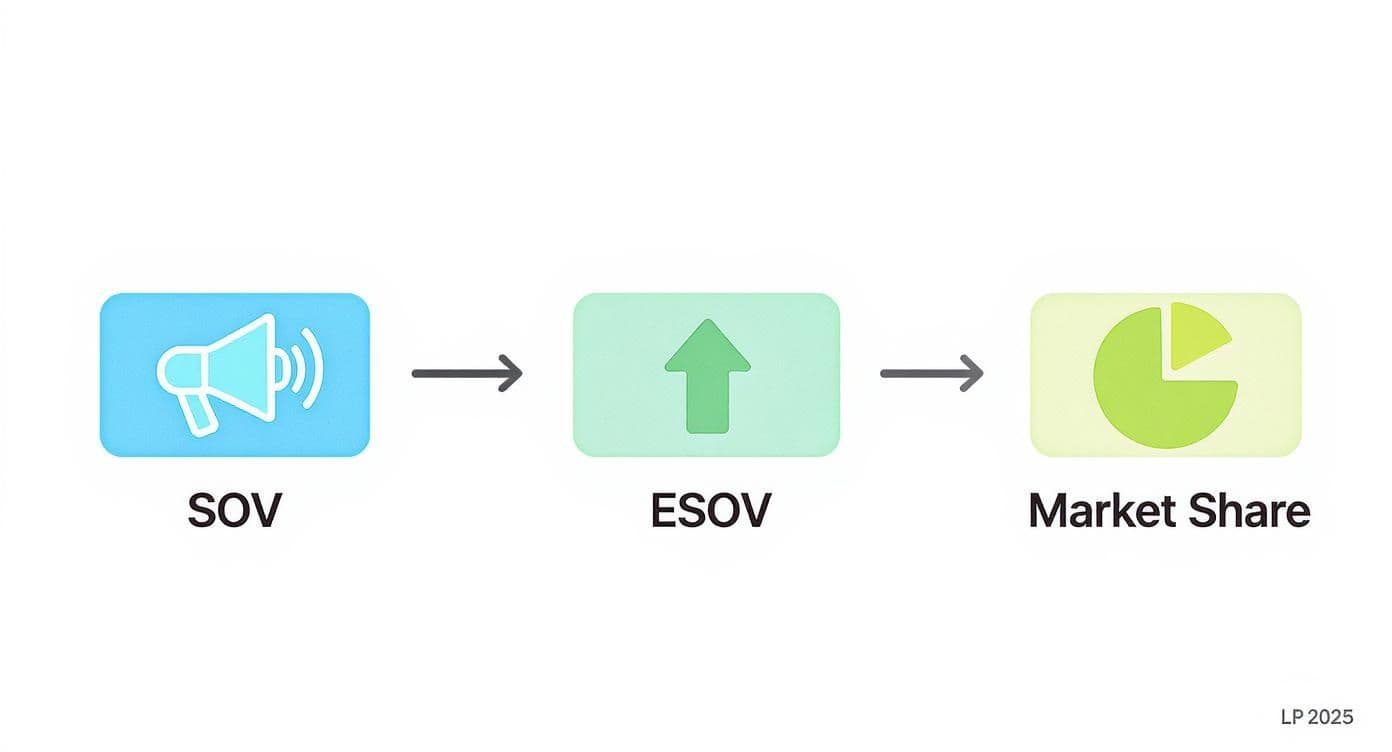
As you can see, a higher Share of Voice (SOV) creates what's known as Excess Share of Voice (ESOV), and that's the engine that drives a bigger piece of the market pie.
Measuring Your Impact In Paid Search
For pay-per-click (PPC) ads, the math is even more straightforward. Platforms like Google Ads give you the exact metric you need right out of the box: Impression Share.
This number tells you what percentage of the time your ads were actually shown versus the total number of times they could have been shown. It's a direct measurement of your paid SOV. If your Impression Share is 60%, it means your ads are capturing 60% of the available eyeballs for your keywords, leaving the other 40% to your competitors or lost due to budget caps.
In paid search, if a brand racks up 30,000 ad impressions from a total of 80,000 available impressions in the market, its paid SOV stands at a solid 37.5%.
Gauging Your Presence On Social Media
Social media is all about conversation. So, naturally, measuring SOV here means tracking your piece of that conversation. You're trying to find out how much of the total chatter around your industry or niche is actually about you.
The key metrics to watch on social are:
- Brand Mentions: Simply track every time your brand handle (e.g., @YourBrand) gets mentioned and compare that to your competitors' mentions.
- Relevant Hashtags: Keep an eye on who's using your branded hashtags versus competitor hashtags or broader industry terms.
- Engagement: Add up all the likes, comments, and shares on your content. Then, do the same for your key competitors to see how your total engagement compares to the market's total.
Here's an example. Let's say your brand was mentioned 2,000 times on X (formerly Twitter) last month. Your top three competitors were mentioned 1,500, 1,000, and 500 times. The total conversation adds up to 5,000 mentions (2,000 + 1,500 + 1,000 + 500).
Your social share of voice is 40% (2,000 / 5,000).
Keeping tabs on all this chatter manually is next to impossible. This is where dedicated social listening comes in, and thankfully, there are plenty of powerful brand awareness measurement tools that can automate the entire process for you.
Calculating Share of Voice Across Key Marketing Channels
To give you a clear roadmap, here’s a breakdown of how to calculate SOV for the most important digital channels.
By consistently tracking these channel-specific metrics, you're no longer guessing. You're making smart, data-backed decisions to strategically and deliberately grow your brand’s footprint.
Setting Realistic Share of Voice Benchmarks
So, you've started measuring your share of voice. The big question that immediately follows is, "What's a good number?" Everyone wants a universal target to aim for, but the reality is, a “good” SOV score is completely relative. Your ideal benchmark is tied directly to your industry, how crowded it is with competitors, and where your brand is in its own growth journey.
Chasing some arbitrary number without that context is a surefire way to burn through your budget. The real goal isn’t just to get a bigger number; it’s to land on a target that actually means something for your business. What feels like an ambitious goal for a startup might be a dangerously low waterline for a market leader.
Your Industry Defines the Playing Field
The first piece of the puzzle is understanding the market you're in. A quiet, niche B2B industry is a completely different world from a loud, hyper-competitive consumer market, and your SOV expectations need to reflect that.
- High-Competition Markets: Think about industries like consumer electronics, automotive, or fast-moving consumer goods. They're incredibly noisy. Brands are constantly pumping money into ads and content, so for a challenger brand, even securing a 10-15% SOV can be a major accomplishment.
- Niche or Emerging Markets: In newer or less saturated spaces, a clear dominant player might not even exist yet. Here, a sharp strategy could help a brand capture a 30-40% SOV fairly quickly, establishing itself as the go-to authority right from the start.
In most competitive markets, the average share of voice hovers somewhere between 10% and 30%. The top brands are usually aiming for anything above 20% to keep their presence strong. Take the tech sector, for example. During a major product launch, a giant like Apple might capture as much as 45% of the social media conversation, while a competitor like Samsung holds steady around 25%. It's a similar story in the automotive world, where an established player like Toyota often maintains an SOV of about 25% during key industry events. You can dig into more data on how SOV varies by industry on umbrex.com.
Your Market Position Dictates Your Goal
Beyond the industry noise, your brand's current standing is the most important factor of all. Your SOV target should be a direct reflection of your strategy, whether that's aggressive growth, maintaining leadership, or simply defending your turf.
A brand's maturity and market share are the true north for setting SOV benchmarks. A startup’s goal is to be heard for the first time, while an incumbent's goal is to ensure no one else can be.
Let's look at a few different scenarios:
- The Disruptive Startup: Imagine a new company trying to break into a crowded software market. For them, grabbing just 5-10% of the conversation in the first year would be a huge win. The objective here is to carve out a niche and get a foothold.
- The Established Challenger: This is a brand that people know, but it isn't the leader. The goal here is to create Excess Share of Voice (ESOV). If your current market share is 15%, a smart and ambitious SOV target would be 20-25%. That gap is what fuels predictable growth.
- The Market Leader: Now think of a massive CPG brand with a 40% market share. Its main job is defense. The benchmark should be to maintain an SOV that's at least equal to its market share—so, 40% or higher—to protect its position and keep challengers at bay.
When you analyze your own unique situation, you can move past generic numbers. This allows you to set an achievable, data-backed benchmark that becomes a powerful guide for your marketing strategy, helping you put your resources where they'll make a real difference.
Actionable Strategies to Increase Share of Voice

Knowing your share of voice is one thing. Actually growing it is where you start to pull away from the pack. Increasing your SOV isn’t about shouting the loudest; it’s about speaking the smartest. This requires a thoughtful, multi-channel approach that’s all about creating value and showing up consistently where your audience is already listening.
This isn’t just a matter of throwing more money at the problem, either. Real growth starts with a solid plan, including effective marketing budget allocation. When you focus your resources on the right tactics, your brand’s voice can cut through the noise and truly resonate.
Let's break down some specific, practical strategies you can use to start carving out a bigger piece of the conversation for your brand.
Amplify Your Voice with Strategic Content
Content is the very substance of your brand’s voice. Exceptional, authoritative content does more than just attract an audience—it cements your brand as a leader, which naturally boosts your SOV in organic search and everywhere else. Your aim should be to become the go-to resource in your field.
One of the most powerful plays here is building pillar pages around your core business topics. Think of these as massive, in-depth guides that cover a subject from top to bottom. By linking from this central pillar to more specific "cluster" posts, you create a powerful content hub. This structure signals deep expertise to search engines, helping you rank for a whole constellation of related keywords.
Another fantastic tactic is to exploit competitor keyword gaps. Using SEO tools, you can pinpoint valuable keywords your competitors are ranking for that you've completely missed. By creating better, more comprehensive content targeting these exact terms, you can directly siphon off their organic traffic and, by extension, their share of voice. A clear plan is essential, which is why it's so important to learn how to develop a content marketing strategy that lines up with these goals.
Your content strategy should be a direct assault on competitor weaknesses. Every piece of content you create should be designed to answer a question better, provide more value, or cover an angle your rivals have overlooked. This is how you systematically chip away at their SOV.
Dominate Conversations on Social Media
Social media is the modern town square, where industry chatter happens in real-time. Growing your SOV here is about more than just scheduling posts. It’s about strategically weaving your brand into relevant discussions and, even better, getting your audience to talk for you.
First, you need to actively monitor and jump into trending conversations. Use social listening tools to spot relevant topics and hashtags that are picking up steam in your industry. When you offer a genuinely valuable perspective or helpful tip, you can ride the momentum of a popular topic and gain a ton of visibility.
Second, make a hero out of user-generated content (UGC). Every time a customer posts about your brand, they are directly contributing to your share of voice. You need to actively encourage this and put it on a pedestal. Running a contest or creating a simple branded hashtag can be all it takes to motivate customers to share their experiences, effectively turning them into a volunteer marketing army.
- Example: A local coffee shop could launch a hashtag campaign like #MyMorningBrew, asking followers to post photos with their coffee. By reposting the best pictures, the shop gets authentic, engaging content and amplifies its voice through its own happy customers.
Maximize Visibility with Smart Paid Media
Paid media gives you a direct lever to pull to increase your share of voice, but you have to be smart about it to get a real return. The key metric here is impression share—the percentage of times your ads appeared out of all the times they could have appeared. The goal is to boost this number without simply outspending the competition.
An incredibly effective strategy is to sharpen your audience targeting. Instead of running broad campaigns that spray your message everywhere, focus on smaller, high-intent audience segments. This allows you to bid more aggressively for the most valuable potential customers, ensuring your ads show up more often for the people who actually matter.
You should also obsess over your ad quality and rank. Platforms like Google Ads are designed to reward relevance. By improving your Ad Rank with better copy, more relevant landing pages, and tighter keyword groups, you can often win more impressions at a lower cost. This means you can achieve a higher impression share even if your budget stays the same.
Actionable Takeaways for SOV Growth
To really move the needle on your marketing share of voice, you need a balanced, proactive game plan. Each part of your marketing machine has a critical role to play in building a dominant brand presence.
- For Content Teams: Go deep. Focus on creating authoritative pillar content and then systematically attack the keyword gaps your competitors have left wide open.
- For Social Media Managers: Be a participant, not just a publisher. Strategically engage in trending conversations and build a repeatable system for encouraging and amplifying user-generated content.
- For Paid Media Specialists: Think beyond budget. Concentrate on boosting your impression share by laser-focusing your audience targeting and improving your ad quality scores.
By putting these targeted strategies into practice, you’ll shift from just measuring your SOV to actively shaping it. That’s how you build a stronger brand that commands attention and drives real growth.
Turning SOV Insights into Competitive Advantage
It’s one thing to know your marketing share of voice, but it's another thing entirely to use that knowledge to make smarter moves. The real magic happens when you stop looking at SOV as just another number on a report and start treating it like a strategic compass for your brand. This is how you shift from simply watching what your competitors do to actively shaping the competitive landscape yourself.
When SOV analysis becomes a regular part of your reporting rhythm, it’s no longer just a metric. It becomes a critical tool for making informed decisions, influencing everything from where you spend your marketing dollars to your high-level competitive strategy. For instance, a sudden dip in your share of voice can be an early warning sign, perhaps telling you it's time to boost your budget in a specific channel before you fall too far behind.
From Data Points to Strategic Direction
To really get an edge, you have to connect your SOV data back to real business goals. This isn't a one-and-done task; it's a constant cycle of measuring, analyzing what you find, and then adjusting your strategy accordingly. Think of it as a feedback loop that keeps your brand sharp and ready to adapt.
Here’s how you can put those insights to work:
- Guide Budget Allocation: See your SOV lagging in a channel where your competitors are surprisingly quiet? That’s a golden opportunity. It’s a clear signal to invest more resources there and grab that open space.
- Refine Creative Direction: Don't just look at the volume of mentions; dig into the quality of the conversation. What messages are actually landing with your audience? Use those takeaways to sharpen your creative and craft campaigns that truly connect.
- Inform Product Development: Is everyone suddenly talking about a new feature from your rival? A rising share of voice around a competitor's product can highlight a market gap your own product team could fill.
The goal is to get beyond tracking for the sake of tracking. A true competitive advantage is born when your SOV data tells you where to invest your next dollar, what story to tell your customers, and which market opportunities to jump on first.
This proactive mindset transforms passive measurement into an active strategy. Instead of just reacting to what the market throws at you, you start anticipating the shifts. By consistently keeping an eye on your marketing share of voice and acting on what you learn, you build a lasting advantage. You ensure your brand isn’t just part of the conversation—it’s the one leading it.
Frequently Asked Questions About Share of Voice
Even after getting a handle on the strategy and numbers behind marketing share of voice, a few questions always seem to pop up. Let's clear up some of the most common ones so you can move forward with total confidence.
What Is the Difference Between Share of Voice and Market Share?
This is probably the most important distinction to grasp, and it's central to good strategic planning. While the two are definitely connected, they measure completely different aspects of your business.
Think of market share as looking in the rearview mirror. It's a lagging indicator—it tells you what percentage of total sales or customers your brand has already won. It’s a reflection of past performance, a scorecard of your current standing based on actual sales.
Marketing share of voice, on the other hand, is like looking ahead through the windshield. It’s a forward-looking indicator. It measures how much of the conversation in your industry your brand owns right now. It’s a gauge of your visibility and influence on future customers.
In the simplest terms, market share is how many people buy from you. Share of voice is how many people hear about you. A healthy share of voice today is one of the strongest predictors of a bigger market share tomorrow.
How Often Should I Measure Share of Voice?
There's no magic number here. The right cadence really depends on how fast your industry moves and what kind of marketing you're doing. But, there are some solid rules of thumb.
- Quarterly Check-ins: For most businesses, looking at SOV every quarter is the sweet spot. It's often enough to catch important trends and see what competitors are up to, without getting bogged down in tiny, meaningless daily fluctuations.
- Monthly for Fast-Paced Industries: If you're in a market that changes in the blink of an eye—like consumer tech or fashion—you'll want to measure monthly. This lets you react quickly to a competitor's big campaign or a sudden shift in how people are talking online.
- Campaign-Specific Measurement: This one is non-negotiable. You absolutely have to measure your SOV before, during, and after any major marketing campaign or product launch. It's the only real way to know if your efforts actually moved the needle and to calculate the return on your visibility investment.
Ultimately, consistency beats frequency. Just pick a schedule you can realistically stick to. The real gold is in tracking the trends over time.
Is It Possible to Have a 100% Share of Voice?
Theoretically, maybe for a fleeting moment. But in any real-world business situation, the answer is a hard no. To hit a 100% share of voice, your brand would have to be the only one mentioned or seen on a given channel. All your competitors would have to be completely invisible.
You might pull it off in a super-specific, tiny context—like buying up every single ad impression for an obscure, long-tail keyword for a few hours. But across an entire channel like organic search or all of social media? It's practically impossible.
Even if you had a total monopoly, people and the media would still talk about the product category in generic terms, which would keep any single brand from owning every last conversation. The goal isn't an unattainable 100%. The real goal is to build a dominant SOV that’s significantly larger than your direct competitors and, ideally, bigger than your current market share.
What Are the Best Tools for Measuring SOV?
Trying to track share of voice by hand is a recipe for a massive headache and inaccurate data. You need the right tools to gather reliable information without spending all your time on it. The best tool for you will really depend on which channels matter most.
Here are some of the go-to options for different needs:
- For SEO: You can't go wrong with industry-standard tools like Ahrefs or SEMrush. They give you incredibly detailed reports on your organic visibility, keyword rankings, and what your competitors are up to, painting a clear picture of your share of the search results.
- For Social Media: For social listening, platforms like Brandwatch and Meltwater are powerhouses. They automatically monitor brand mentions, track hashtags, and analyze sentiment across millions of online conversations.
- For Paid Media: The best tool is already built into the ad platform you're using. In Google Ads, for instance, the "Impression Share" metric is a direct measurement of your PPC share of voice. It tells you what percentage of potential ad impressions you actually captured.
- For Media Mentions: To keep an eye on your PR efforts, services like Cision or even a simple setup with Google Alerts can track your brand's mentions across news sites, blogs, and other online publications.
If you can, find a tool that brings data from multiple channels into one place. It will give you a much more holistic view of your brand’s true presence.
As AI continues to change how customers find information, tracking your visibility in AI-powered search is becoming non-negotiable. Attensira is designed specifically for this new frontier, helping you monitor and optimize your brand’s presence in AI responses. Discover how Attensira can future-proof your share of voice strategy.