Learn how to write product requirements that align teams, prevent scope creep, and deliver results. A practical guide for PMs on crafting clear PRDs.
Writing good product requirements isn't just about listing features; it's about translating a vision into a clear, actionable blueprint that your entire team can rally behind. At its core, the process is about defining the problem you're solving, deeply understanding the user who has that problem, and then articulating exactly what the product must do to solve it. A strong Product Requirements Document (PRD) becomes the single source of truth that keeps engineering, design, and marketing aligned and moving in the same direction.
Why Clear Product Requirements Are Your Secret Weapon
Before we get into the nuts and bolts of how to write requirements, we need to talk about why they are a massive strategic advantage, not just another box to check. I've seen too many teams treat the PRD as a formality—something to rush through so the "real work" can begin. This thinking is a trap. It completely misses the point that a well-crafted PRD is what enables speed, focus, and on-time delivery.
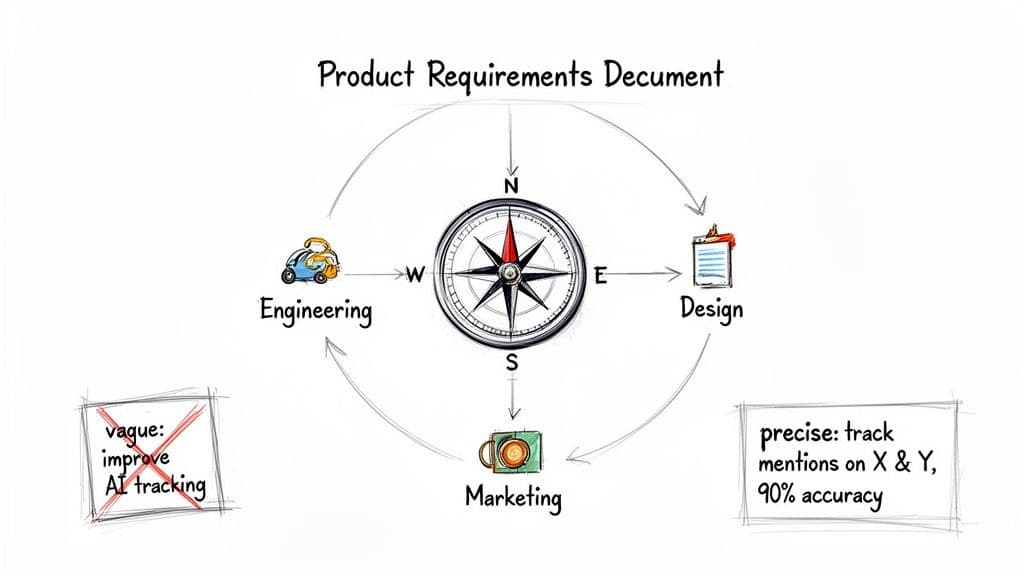
Think of a clear PRD as the project's central nervous system. It connects every team, sending the right signals to keep everyone in sync and preventing costly misunderstandings. Without it, you’re basically inviting scope creep to dinner. Vague requirements create a vacuum that gets filled with assumptions, leading to a death spiral of clarification meetings, rework, and features that nobody actually asked for.
The Massive Gap Between Vague and Precise
Let's look at a real-world scenario. A product manager writes a requirement for a platform like Attensira: "Improve AI tracking." This sounds straightforward, but it’s a recipe for disaster. What does "improve" even mean? What are we "tracking"? The engineering team might think it means optimizing algorithmic speed, while the marketing team is expecting better reports on brand mentions.
Now, let's sharpen that up:
The system must track our brand mentions across GPT-4 and Claude 3 Opus LLM responses with 95% accuracy. It needs to identify and categorize these mentions as positive, negative, or neutral, and then update the user's dashboard within 60 seconds of detection.
See the difference? This version is specific, measurable, and testable. It leaves no room for interpretation. Everyone from the backend engineer to the UI designer knows exactly what the goal is. This is the kind of precision that turns a simple document into a powerful execution tool.
A solid PRD provides the essential context and constraints that guide every other function, ensuring everyone is working toward the same outcome.
The Business Impact of Well-Defined Requirements
The difference between vague and clear requirements isn't just academic; it has a direct and measurable impact on the bottom line. Taking the time to get this right separates high-performing teams from those who are constantly stuck in reactive cycles.
The table below breaks down the real-world consequences.
The Business Impact of Vague vs Clear Requirements
The contrast is stark. Poorly defined requirements lead to wasted time, money, and energy, while clear requirements pave the way for efficient, impactful product development.
In 2023, industry research showed that teams with well-documented PRDs were shipping new features up to 30% faster than teams flying blind. This structured approach also slashes rework by as much as 25%, freeing up your best people to innovate instead of fix.
Ultimately, clear requirements are about de-risking your project and maximizing its value. They force you to ensure you’re building the right thing, for the right person, to solve the right problem. For a masterclass on this, Aakash Gupta’s article is a must-read: How to Write Product Requirements That Get You Promoted. Investing the time upfront to define success with absolute clarity is the single best thing you can do for your product—an effort that pays for itself over and over again.
Grounding Your Requirements: From Business Goals to Real Users
Every great product starts with a clear sense of direction. Before you can even think about features, user flows, or technical specs, you have to answer two fundamental questions: What are we trying to achieve, and who are we doing it for? This is the strategic foundation that prevents projects from spiraling into a mess of feature bloat and missed targets.
It all begins with translating broad business objectives into tangible product goals. A CEO might say, "We need to increase our market share." That’s a fine business goal, but it’s not something an engineer can build. As a product leader, your first job is to distill that into something the team can actually execute.
For example, "increase market share" could be rephrased as, "Reduce the time it takes enterprise clients to identify content gaps from two weeks down to two days." Now that's a goal. It's specific, measurable, and directly tied to delivering real value to a user. It gives the team a clear finish line.
Who Are We Building This For? Get Specific.
Once you know what you’re building, you need to know who you're building for. And no, "marketers" or "small business owners" isn't good enough. You need to get granular and create detailed user personas—fictional representations of your ideal users, built from real-world data and interviews.
A solid persona goes way beyond a job title. It captures a person’s motivations, their daily frustrations, and what they’re trying to accomplish. For a platform like Attensira, a persona might look like this:
- Name: "Strategic Sarah"
- Role: Chief Marketing Officer
- Context: She manages a $10M+ marketing budget for a B2B tech company and is judged on brand visibility and lead generation. The new world of AI-driven search has her feeling completely overwhelmed.
- Pain Point: She’s struggling to prove the ROI of her team's content strategy because she can't easily see where competitors are eating her lunch in AI search results.
This isn't just a creative writing exercise. This level of detail builds empathy across the entire team. Suddenly, you're not just building a feature; you're creating a solution to help Sarah solve a problem that’s causing her serious professional anxiety.
A well-crafted persona is your best defense against feature creep. When someone proposes a new idea, the first question should always be, "Would Sarah actually care about this? Does it solve her core problem?" This simple gut-check will save you from building a lot of useless stuff.
Grounding your PRD in this kind of real data—persona snapshots, user journeys that consider edge cases, and clear value propositions—is proven to work. Teams that do this well often see 15-20% higher user adoption rates for the features they launch.
Defining the Boundaries: What You're Not Building
Just as critical as defining what your product will do is being brutally honest about what it won't do. This is your "out of scope" list, and it's your most powerful tool for managing expectations and preventing scope creep.
Let's go back to our feature for "Strategic Sarah." Here’s how we might define the boundaries:
In Scope:
- Tracking brand mentions across a specific list of AI platforms.
- Running an automated content gap analysis against three pre-defined competitors.
- Displaying mention trends over time in a simple dashboard widget.
Out of Scope:
- Sentiment analysis of brand mentions.
- Tracking mentions on social media.
- Sending real-time push notifications for new mentions.
Being explicit like this draws a clear line in the sand. It helps the team focus its energy on delivering a high-quality, targeted solution without getting sidetracked by every "what if" that comes up in a meeting. Before you even get to this stage, it's crucial to confirm you're building something people actually want, a process covered well in this Practical Guide to Validating Startup Ideas.
Ultimately, getting these foundational pieces right—the goals, the personas, and the scope—provides the necessary context for every single requirement that follows. It ensures your product is aimed directly at a real market need, which is a cornerstone of any successful content-driven marketing strategies.
3. From Vision to Execution: Writing User Stories That Actually Work
You've got your high-level goals and you know who you're building for. Now comes the critical part: breaking that big-picture vision into small, concrete pieces of work for the development team. This is where user stories come in, acting as the essential bridge between grand strategy and daily execution.
A user story is just a simple, informal explanation of a feature from the end-user's point of view. The classic template—As a [persona], I want [action], so that [benefit]—is famous for a reason. It forces you to tie every single feature back to a real user and their motivation, which is the best way to keep the team focused on delivering genuine value.
What Makes a User Story Great?
Crafting a good user story is more art than science. The best ones follow the INVEST principle: they are Independent, Negotiable, Valuable, Estimable, Small, and Testable. The goal is to provide just enough context for the team to grasp the "why" and "what," while giving them the creative freedom to figure out the "how."
For example, a user story like, "As a user, I want a better report," is a project manager's nightmare. It’s a dead end. A far more effective story for a platform like Attensira would be: "As Strategic Sarah, the CMO, I want to generate a competitive content gap report so I can identify topics where my rivals are ranking in AI search and I am not."
See the difference? This version names the user (Sarah), her specific action (generate a report), and her business goal (find content gaps). It’s a clear, actionable request the team can actually sink their teeth into.
This process highlights how your strategic inputs—your goals, personas, and scope—should flow directly into the requirements you write.
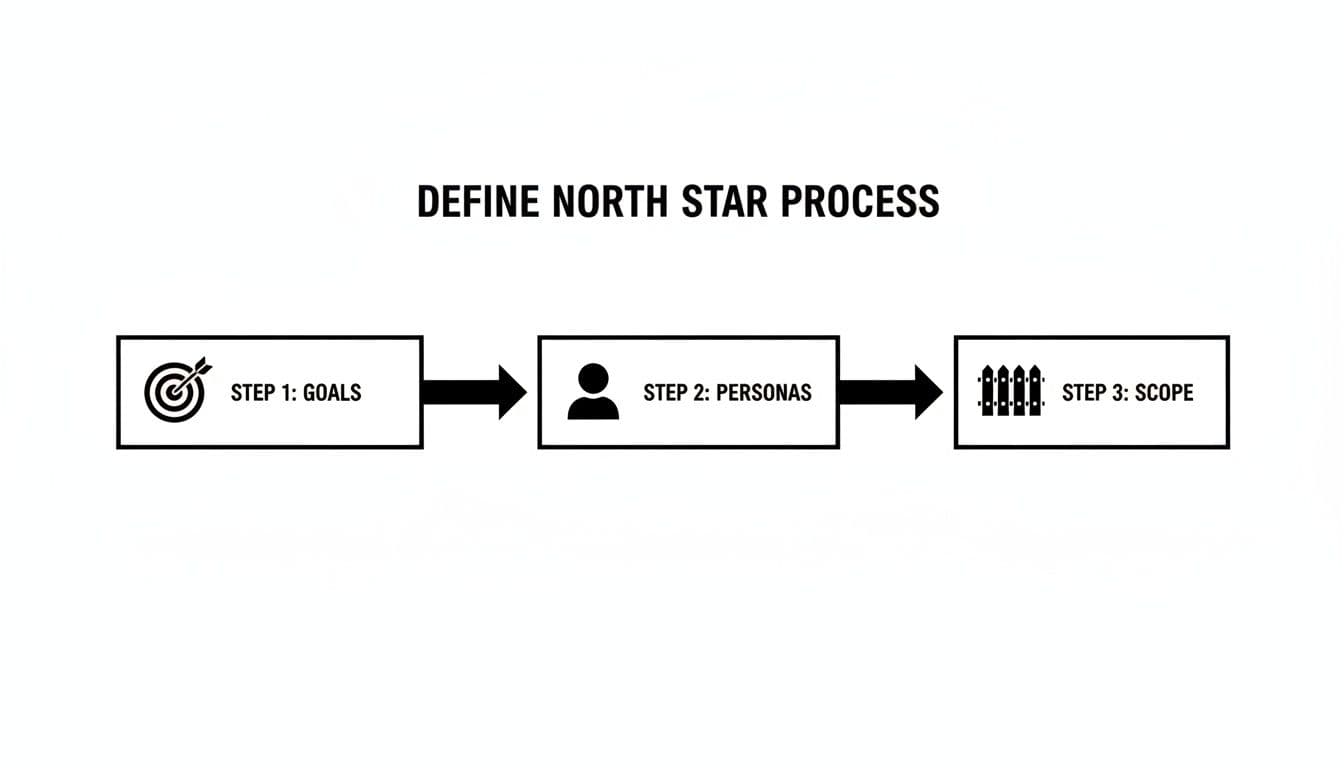
This isn't just theory; it's a practical map. Strong requirements are the direct result of a solid strategic foundation, not something you can just invent in a vacuum.
Acceptance Criteria: Your Definition of "Done"
A user story without Acceptance Criteria (AC) is just a wish. The AC are the specific, testable conditions that a feature must meet to be considered complete. Without them, you're just crossing your fingers and hoping the dev team builds what you were imagining.
Think of Acceptance Criteria as your best weapon against ambiguity. They spell out the rules of the game, creating a shared understanding of what "done" truly means.
Let’s look at a common mistake:
- Weak AC: The report should load quickly.
- Strong AC: The report must generate and display results in under 3 seconds for datasets containing up to 10,000 competitor URLs.
The second one is concrete, measurable, and testable. There's no room for debate. Mastering AC is a fundamental skill in writing product requirements that lead to predictable, high-quality outcomes. Defining these details is a crucial part of any serious user experience optimization effort.
Expert Tip: I always tell my team to think of Acceptance Criteria as a contract between product and engineering. If all the ACs are met, the story is done. Period. This simple agreement saves us from countless "is it finished yet?" debates.
Putting It All Together: A Real-World Example
Let's walk through a complete user story for a new AI feature.
User Story: As a Brand Manager, I want to generate an AI-optimized content brief for a target keyword so that I can provide my writers with clear SEO guidance.
Acceptance Criteria:
- Given I have entered a target keyword and specified a word count of 1,000 words,
- When I click the "Generate Brief" button,
- Then the system must produce a content brief that includes:
- A suggested H1 title under 60 characters.
- At least 5 relevant H2 subheadings.
- A list of 10-15 semantically related LSI keywords.
- The generated brief must be downloadable as a .docx file.
- The entire generation process must complete in under 20 seconds.
This level of detail leaves nothing to chance. Your engineering team knows what to build, your QA team knows what to test, and your stakeholders know exactly what they're getting. This is the tactical heart of product requirements that drive real results.
Defining Functional and Non-Functional Requirements
Once you’ve hammered out your user stories, it's time to get into the nitty-gritty. This is where we zoom in on the system’s specific behaviors and qualities, drawing a clear line between what the system must do (functional requirements) and how the system must be (non-functional requirements). Getting both right is the difference between a product that just works and one that users genuinely love.
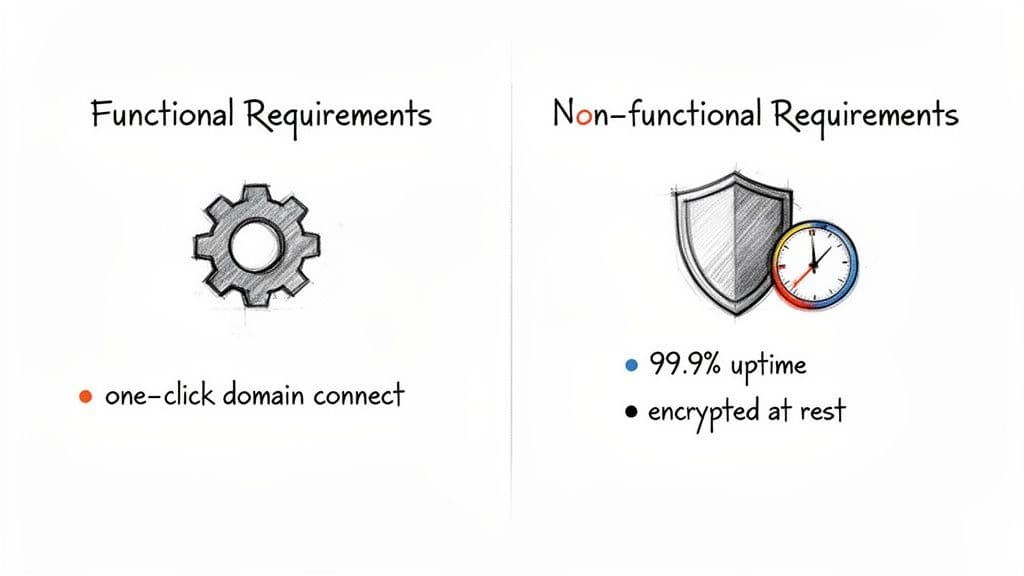
Functional requirements are the tangible actions the system needs to perform. They're the "what" of your product—the specific features, the clicks, the interactions. Think of them as the verbs of your system.
For instance, at a company like Attensira, we wouldn't just say "users should be able to connect a domain." That's too vague. A proper functional requirement is direct and, most importantly, testable: "The system must allow a user to connect their domain via a one-click authentication process with their domain registrar." An engineer can build that, and a QA analyst can verify it. No ambiguity.
Unpacking Non-Functional Requirements
Non-functional requirements (NFRs) are all about the system's character. They define how well the system does what it's supposed to do. These are the adjectives that color the user experience: is it fast? Secure? Reliable? Intuitive?
While everyone focuses on shiny new features, I've seen NFRs become the silent killers of user satisfaction time and time again. A feature can technically work, but if it's painfully slow or feels insecure, it’s effectively broken. This is especially true in the B2B world, where performance and security aren't just nice-to-haves; they are absolute table stakes. When you're managing critical business data, trust is everything—a principle we bake into our enterprise content management solutions.
Here are the key categories of NFRs you can't afford to ignore:
- Performance: How snappy is the system? This covers everything from page load times to how quickly a report generates. A good NFR isn't "the dashboard should be fast." It's: "The main dashboard must load for users with up to 5,000 tracked keywords in under 2 seconds."
- Security: How are you protecting user data? This is non-negotiable. An example might be: "All user data must be encrypted at rest using AES-256 and in transit using TLS 1.3."
- Usability: How easy is it for the intended user to get the job done? You can make this measurable: "A non-technical brand manager must be able to complete the initial setup in under 5 minutes without consulting support docs."
- Reliability: Is the system available when users need it? This is often captured as an uptime percentage: "The system must maintain 99.9% uptime, measured on a monthly basis."
Neglecting non-functional requirements is like building a car with a powerful engine but no steering wheel. It might have all the right features, but it will inevitably crash. Define these qualities upfront to ensure you build a product that is not only functional but also trustworthy and pleasant to use.
The Real Cost of Vague Requirements
Failing to document both functional and non-functional aspects has real, painful consequences. Without clear, detailed requirements, product teams face scope creep in 52% of cases. That can lead to 30-50% of engineering effort being completely wasted on rework or features that miss the mark. In regulated industries like healthcare or finance, that precision is even more critical; well-defined requirements can lead to 62% fewer audit failures by ensuring compliance with standards like HIPAA.
A Practical Comparison
To really see the difference, let’s look at how both types of requirements apply to a single feature—say, a competitive analysis report.
See how that works? The functional requirements define the actions (selecting, exporting), while the non-functional requirements define the qualities of those actions (speed, accessibility). Both are essential to create a complete picture, ensuring nothing is left to chance or interpretation.
Aligning Your Team With Prioritization and Reviews
So you've written a detailed set of product requirements. That’s a huge milestone, but let's be honest—a document on its own doesn't build a product. Now comes the hard part: turning that document into a shared commitment through ruthless prioritization and a structured review process. This is where a list of ideas transforms into a strategic roadmap, making sure every ounce of your team's effort is spent on what truly matters.
Without a solid framework, prioritization meetings can easily spiral into a mess of opinions and gut feelings. To make objective, data-informed trade-offs, you need to move beyond simple "high/medium/low" labels. Two of the most effective methods I’ve used are the MoSCoW framework and the Value vs. Effort matrix.
Frameworks for Smart Prioritization
The MoSCoW method is fantastic for categorizing requirements and forcing those tough conversations about what's really essential for a release. It sorts features into four distinct buckets:
- Must-have: These are the non-negotiables. Without them, the product simply won't work or be viable. For our example project, Attensira, the core ability to track brand mentions in AI responses would be a must-have.
- Should-have: Important features that add significant value but aren't critical for the initial launch. Think of things that can be deferred if you're crunched for time, like exporting reports to a PDF.
- Could-have: These are the desirable "nice-to-haves" that you'll tackle if time and resources allow. Advanced dashboard customizations might fall into this category.
- Won't-have (this time): Features you're explicitly acknowledging as out of scope for the current release. This is crucial for managing stakeholder expectations and preventing scope creep down the line.
Another go-to approach is the Value vs. Effort matrix. This is a simple 2x2 grid where you plot features based on their potential user value against the development effort they require. The beauty of this framework is its visual clarity—it instantly highlights your quick wins (high value, low effort) and helps you steer clear of money pits (low value, high effort).
Creating a Bulletproof Review and Sign-Off Process
Once your priorities are set, it’s time for formal alignment. A structured review process ensures everyone—from engineering to marketing—is on the same page before a single line of code is written. This isn't about adding bureaucracy; it's about mitigating risk.
Your goal here is to shift the mindset from your document to our commitment. Schedule a formal review meeting with all key stakeholders: the engineering lead, design lead, marketing manager, and even someone from customer support. Make sure you distribute the PRD at least 48 hours in advance and ask everyone to come prepared with specific questions and feedback.
A PRD that hasn't been challenged, debated, and formally signed off on by key stakeholders is a recipe for future conflict. The review process isn't a rubber stamp; it's a pressure test that makes the final product stronger.
After incorporating the feedback, get that formal sign-off. This can be as simple as an email confirmation or a comment in a tool like Jira or Asana. This simple act creates a powerful sense of shared ownership and holds everyone accountable.
To keep things consistent, use a simple checklist to guide every review.
PRD Review Checklist:
- Clarity: Is the language unambiguous? Could a new team member understand it without a verbal walkthrough?
- Completeness: Are user stories, acceptance criteria, and non-functional requirements all there? Have you considered edge cases and error states?
- Testability: Is every requirement measurable? Can the QA team write clear test cases from what you've provided?
- Feasibility: Has the engineering lead confirmed that everything is technically achievable within the given constraints?
Getting this alignment process right is the final, critical step in learning how to write product requirements that actually lead to successful outcomes.
Common Pitfalls That Can Derail Your Product Requirements
Even the sharpest product managers stumble into a few common traps when writing requirements. It’s part of the learning curve. But spotting these pitfalls early is the key to avoiding a world of pain for your engineering and design teams down the road. Seemingly small ambiguities can snowball, causing confusion that grinds development to a halt.
Let’s look at the most common missteps and how you can sidestep them.
Don't Prescribe the Solution, Define the Problem
The single most frequent mistake I see is when product managers write the solution instead of clearly defining the problem. It’s an easy trap to fall into. You have a vision, and you start dictating UI elements.
For instance, you might write, "Add a dropdown menu to the dashboard to filter by date range." You've just locked your team into a specific implementation. You've closed the door on their creativity and expertise before they've even had a chance to think about the best way to solve the user's actual need.
A much better approach is to focus on the why. Frame it around the user’s goal: "The Brand Manager needs to see how their mention trends change over specific time periods, like the last 30 days or the previous quarter." Now, you've handed your team a problem to solve. The best solution might be a dropdown, but it could also be a slick calendar picker or an interactive timeline. By defining the problem, you empower them to find the best answer.
Vague Language Is Your Worst Enemy
Another classic blunder is leaning on vague, subjective language. Words like "fast," "robust," "intuitive," or "user-friendly" are essentially meaningless in a requirements document. They’re subjective black holes. Everyone on the team will have a different interpretation, which inevitably leads to arguments during UAT about what "done" actually means.
Your job is to be the translator—turning those fuzzy business desires into concrete, measurable outcomes. So, instead of "the dashboard needs to load quickly," get specific: "The dashboard must fully render in under 2 seconds for users tracking up to 5,000 keywords." See the difference? That's not just a requirement; it's a testable contract.
Here’s a quick look at how to transform vague requests into actionable specs:
Don't Forget the Unhappy Path
It's natural to focus on the "happy path"—the ideal scenario where the user does everything perfectly. But products live in the real world, where things go wrong all the time. Forgetting to define error states and edge cases is like building a car with an accelerator but no brakes. It’s going to end badly.
A truly great PRD anticipates and accounts for failure. It proactively answers the tough questions: What happens when an API call fails? What specific message does the user see if they upload the wrong file type? How does the system behave if their internet connection drops mid-process?
Thinking through these non-ideal scenarios is what separates a fragile feature from a resilient one. For example, a requirement should explicitly state: "If the user’s domain authentication fails, display the error message: 'We could not verify your domain. Please check your registrar settings and try again.'"
Avoiding these common mistakes will elevate your requirements from a simple feature list to a precise, actionable blueprint that sets your team up for a successful build.
Got Questions? We've Got Answers
When you're deep in the trenches of writing product requirements, a few common questions always seem to pop up. Let's tackle some of the most frequent ones I hear from product teams.
How Long Should a Product Requirements Document Be?
Forget about a magic number. The real goal is clarity, not a specific page count. For most features in an agile environment, you're probably looking at a lean 5-10 pages. The focus should always be on giving the team everything they need to build the right thing without creating confusion.
If you're tackling something complex, a longer document that leaves no stone unturned is infinitely better than a short one that forces developers to make assumptions. Never sacrifice clarity for brevity.
A PRD's job is to create a shared understanding. If it does that, it’s the perfect length.
What's the Difference Between a PRD and User Stories?
Think of it this way: the PRD is the "why," and user stories are the "how."
A Product Requirements Document provides the strategic foundation. It outlines the customer problem we're solving, the business objectives, the target users, and the overall scope. It's the big picture.
User stories are the tactical, bite-sized pieces of work that live within that PRD. Each one captures a specific user need and its desired outcome. The PRD is the master plan for the house; user stories are the detailed instructions for framing the walls, installing the windows, and wiring the electricity.
Who's Actually in Charge of Writing and Owning the PRD?
Officially, the Product Manager is the author and owner. But—and this is a big but—writing a PRD should never be a solo flight. It's a team sport.
A skilled PM doesn't just write; they synthesize. They pull together critical insights and perspectives from all corners of the business to create a holistic plan. This means working closely with:
- Engineering: To gut-check technical feasibility and spot potential roadblocks.
- Design: To ensure the user experience is coherent and solves the core problem.
- Marketing: To make sure the feature aligns with our go-to-market plans.
- Customer Support: To bring in valuable feedback straight from the front lines.
The PM might hold the pen, but the most successful PRDs are born from collective wisdom and shared ownership across the entire team.