Discover how to measure brand equity with practical frameworks, metrics, and insights to boost your brand value.
Trying to measure brand equity can feel like trying to nail jelly to a wall. It’s a mix of hard financial data and squishy customer perception, but it’s far from just a fuzzy concept. It’s a real asset you can and should track by looking at things like the price premium you can command, customer loyalty, and your slice of the market pie.
Why Measuring Brand Equity Is a B2B Game Changer
Let's get one thing straight: brand equity is not some soft, feel-good marketing metric. For a B2B company, it's a hard asset that directly feeds your sales pipeline, gives you pricing power, and drives long-term customer value.
A strong brand does more than just look good on a slide deck; it greases the wheels of a long and often complex B2B sales cycle. When decision-makers already trust your name before you even walk in the door, sales conversations begin from a place of credibility, not skepticism. That trust inherently shortens sales cycles and chips away at customer acquisition costs.
The Problem with Outdated Measurement
The old ways of measuring brand equity just don't cut it anymore. Relying on annual surveys and the occasional focus group gives you a static, rearview-mirror snapshot in a world that operates in real-time. This is a massive blind spot, especially as AI-driven search completely changes how B2B buyers find and evaluate solutions.
Your brand's value is no longer just what people find on your website; it's what generative AI models say about you when asked, "Who is the best provider for X?" If you're not visible in these new channels, you're becoming invisible to your market.
This fundamental shift requires a modern measurement framework. You need a system that not only captures the traditional metrics but also tracks your brand’s footprint where it now matters most. It’s about drawing a straight line from brand health to bottom-line business outcomes. A robust brand can:
- Command a Price Premium: We see companies with high brand equity successfully charge 5-15% more than competitors for very similar solutions, all because their perceived value is that much higher.
- Improve Customer Retention: Strong brands don't just create customers; they cultivate loyal advocates, which has a massive impact on lifetime value.
- Attract Top Talent: A well-respected brand is a magnet for the best minds in your industry, and that talent becomes a powerful, self-sustaining competitive advantage.
Preparing for the AI-Driven Future
Ultimately, knowing how to measure your brand equity is a matter of survival and growth. Without a clear, current picture of where your brand stands, you're just making strategic decisions in the dark. A great first step is building a solid foundation in what drives recognition in the first place, which you can dig into with our guide on how to improve brand awareness.
This is where platforms like Attensira become indispensable. They provide the visibility you need to track and strengthen your brand's presence in this new reality, ensuring your message isn't just heard but actively recommended.
Building Your B2B Brand Measurement Framework
Before you even think about dashboards or KPIs, you have to lay the groundwork. Jumping straight into data collection without a solid plan is a recipe for disaster—you end up with a mountain of numbers that look impressive but don't actually tell you anything useful.
A proper measurement framework is your blueprint. It connects every piece of data you gather back to a core business purpose, ensuring your efforts lead to real decisions, not just pretty reports.
Start with Your Strategic Objectives
First things first: what are you actually trying to accomplish? This is the most critical question, and the answer will shape everything that follows. Vague goals like "improve our brand" are useless here. You need to get specific.
Are you trying to convince the board that your marketing budget is paying off? Or maybe you're sizing up a competitor before a major sales push? Perhaps you've just acquired another company and need to gauge how the newly merged brand is landing with customers.
A B2B SaaS startup trying to carve out market share will have completely different objectives than an established industrial manufacturer focused on retaining its high-value clients. One needs to prove it's gaining traction, while the other needs to understand the strength of its existing relationships.
Think about the high-level business goal your brand equity measurement will support:
- Justifying Marketing Spend: Do you need to connect brand-building activities to hard numbers, like a shorter sales cycle or higher-quality leads?
- Competitive Benchmarking: How do you stack up against your main rival on key attributes like perceived quality or innovation? Understanding this is a core part of effective competitive intelligence.
- Gauging Brand Health: Are you looking for a baseline read on your brand's strength before a big product launch or expansion into a new market?
- Post-Merger Integration: How is the new, combined brand being perceived by both legacy customer bases after an acquisition?
A razor-sharp objective is what separates a data-driven strategy from a data-drowning report. It brings focus to your work and makes every subsequent step infinitely more meaningful.
Selecting the Right Measurement Model
With clear objectives in hand, it’s time to choose your measurement model. Think of this as the lens through which you'll view your brand's value. While there are countless variations, they boil down to three main approaches: Financial, Customer-Based, and a Mixed-Model.
The right choice comes down to your B2B context and what you set out to achieve. This is about more than just marketing metrics; it's about connecting your brand's strength directly to business performance across sales, pricing power, and customer retention.
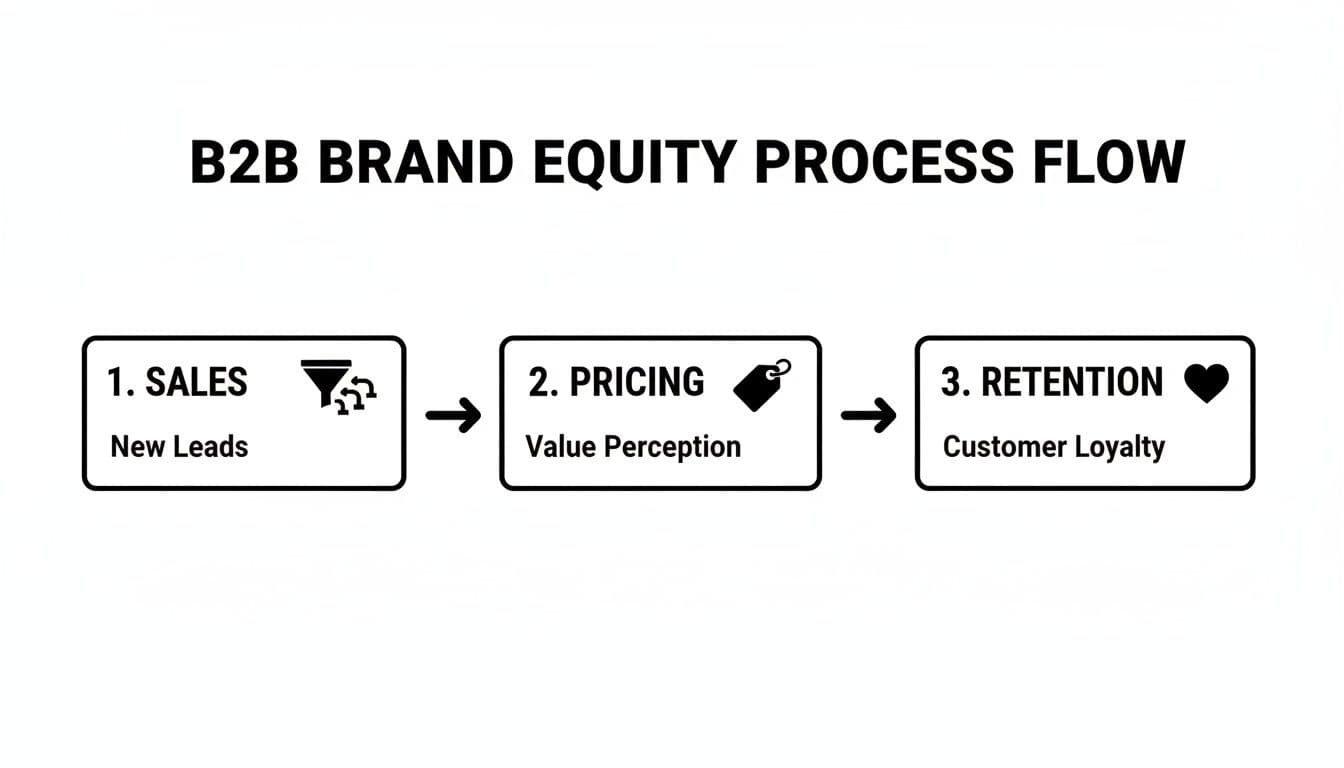
As you can see, a powerful brand doesn't just fill the top of the funnel. It gives you the leverage to command a price premium and builds the kind of loyalty that fuels sustainable growth.
Let's break down the three models to help you find the best fit.
Choosing Your Brand Equity Measurement Model
This table breaks down the three primary models for measuring brand equity, helping you choose the best fit for your B2B goals and context.
For most B2B companies I've worked with, a Mixed-Model approach offers the most complete and actionable picture.
It’s the bridge between how customers feel about your brand and how those feelings translate into real business results—like higher revenue, better margins, and a larger market share.
This balanced approach ensures you're not just tracking perceptions in a vacuum. You're understanding their direct impact on the bottom line. It gives you the story you need to show leadership that brand isn't a cost center; it's one of the most powerful engines for growth you have.
Selecting the Metrics That Actually Matter
A dashboard crammed with data isn’t just useless—it’s a distraction. When you’re trying to figure out how to measure brand equity, the goal isn't to track every number you can find. It’s about monitoring the handful of key performance indicators (KPIs) that actually tell a coherent story about your brand’s health. Without a curated set of metrics, you’re just collecting noise.
To build a measurement framework that works, we need to organize our KPIs into a few practical categories. This approach helps create a narrative, allowing you to see how different parts of your brand’s performance connect. I’ve found it’s best to focus on three core pillars: Awareness, Value Perception, and Loyalty.
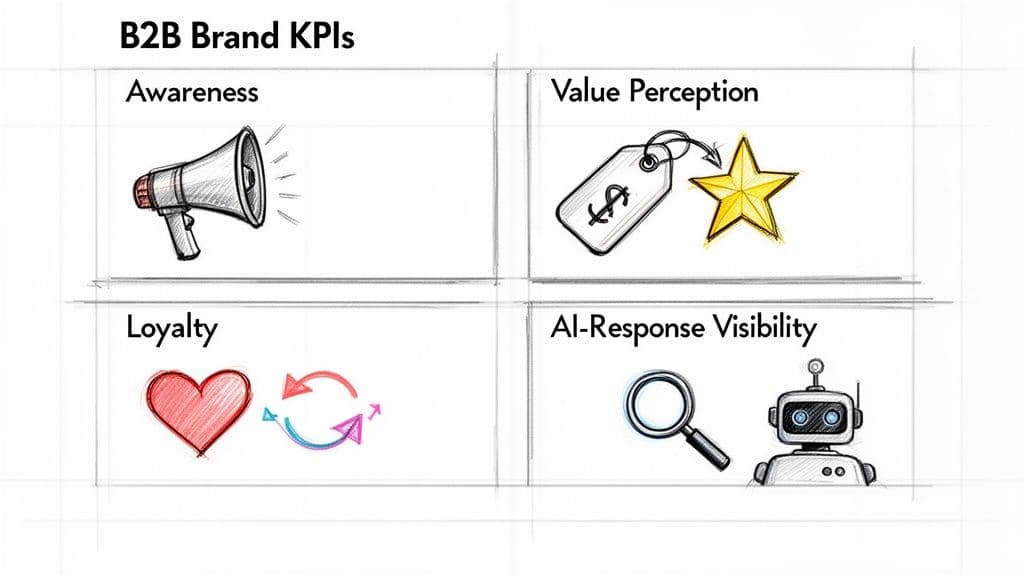
But there's also a critical new dimension that’s rapidly becoming a primary indicator of modern brand strength: AI-Response Visibility. Let's break down each one.
Gauging Your Brand Awareness
You can't have equity in a brand no one knows. Awareness is the bedrock of your measurement strategy, telling you how well your target audience recognizes and recalls your brand. It's often the very first step in a long B2B buyer's journey.
Ultimately, brand awareness is about how familiar buyers are with your brand in the markets you care about. A staggering 46% of customers are more likely to buy from brands they recognize, which shows you just how foundational this is. For example, in one major brand equity study, top-performing tech brands hit unaided recall rates of over 35% among C-suite execs, while their competitors languished around 18%.
Here are the key awareness metrics I always track:
- Brand Recall (Aided vs. Unaided): Unaided recall is the real test. Asking, "Which cloud security platforms come to mind?" reveals if you're truly top-of-mind. Aided recall—"Have you heard of Zscaler?"—is still useful for gauging general familiarity. You need both to understand your mental market share.
- Share of Voice (SOV): This is your brand’s slice of the conversation compared to competitors. We calculate it by tracking mentions across social media, news, and industry forums. A rising SOV is almost always a leading indicator of future market share growth.
Defining Your Value Perception
Once buyers know you exist, what do they think of you? Value perception metrics get to the heart of how your brand is viewed on quality, credibility, and pricing. In a complex B2B sale, perception is reality. It directly impacts your sales team's ability to close deals and protect your margins.
A strong brand doesn't compete on price; it competes on perceived value. When customers believe your solution is superior, the conversation shifts from "How much does it cost?" to "How quickly can we implement it?"
To get a handle on this, focus on:
- Perceived Quality: This is your customer's gut feeling about your product's overall excellence. You can track this with targeted survey questions, asking customers to rate your brand on attributes like reliability, innovation, and performance against specific competitors.
- Price Premium: This one is simple: can you charge more than the other guys and still win? By analyzing win/loss data against pricing information, you can see your brand’s real pricing power. If you’re consistently winning deals at a 10% higher price point, you have a strong price premium.
A huge part of building that perception comes from your content. That's why measuring content effectiveness is a surprisingly powerful indicator of brand impact. Great content is what builds the perception of expertise in the first place.
Measuring Customer Loyalty and Advocacy
Loyalty is where brand equity really starts to pay dividends. It's far cheaper to keep a customer than to find a new one, and your most loyal customers often become your best marketing channel. These metrics tell you just how strong those relationships are.
- Net Promoter Score (NPS): The classic "How likely are you to recommend us?" question remains a powerful, simple gauge of satisfaction. The real insight comes when you segment NPS by customer persona or industry—that’s where you find out where your brand truly resonates.
- Customer Retention Rate: This is a hard, financial metric that doesn't lie. A high retention rate in a competitive B2B market is a clear signal that your brand delivers on its promises, fostering the kind of trust that keeps customers around for the long haul.
The New Frontier: AI-Response Visibility
In the past, share of voice was all about social media and press mentions. Today, a new and incredibly influential channel has emerged: generative AI. AI-Response Visibility measures how often—and how favorably—your brand is mentioned by AI models like ChatGPT or Gemini when users ask relevant questions.
This isn't a vanity metric. It's the new battleground for brand discovery.
When a CIO asks an AI, "What are the top 3 solutions for enterprise data warehousing?" the answer that appears is the new "page one of Google." If you're not in that response, you're invisible to a huge and growing segment of decision-makers.
Platforms like Attensira are designed for this exact challenge, tracking your brand’s visibility across key AI platforms to give you a clear view of this emerging frontier. By monitoring these responses, you can understand how AI perceives your brand and start taking action to improve your standing. To learn more, you can read our guide on https://attensira.com/blog/ai-brand-monitoring.
By combining these four categories—Awareness, Value Perception, Loyalty, and AI-Response Visibility—you get a comprehensive dashboard that's actually useful. This toolkit moves you beyond just collecting data and empowers you to tell the complete story of your brand's health and its impact on the bottom line.
Putting Your Data to Work: From Collection to Action
You’ve laid the groundwork, defined your objectives, and picked your KPIs. Now for the fun part: getting your hands on the data that will bring your brand equity measurement to life. This is where we move from the whiteboard to the real world, turning abstract concepts into tangible numbers and feedback.
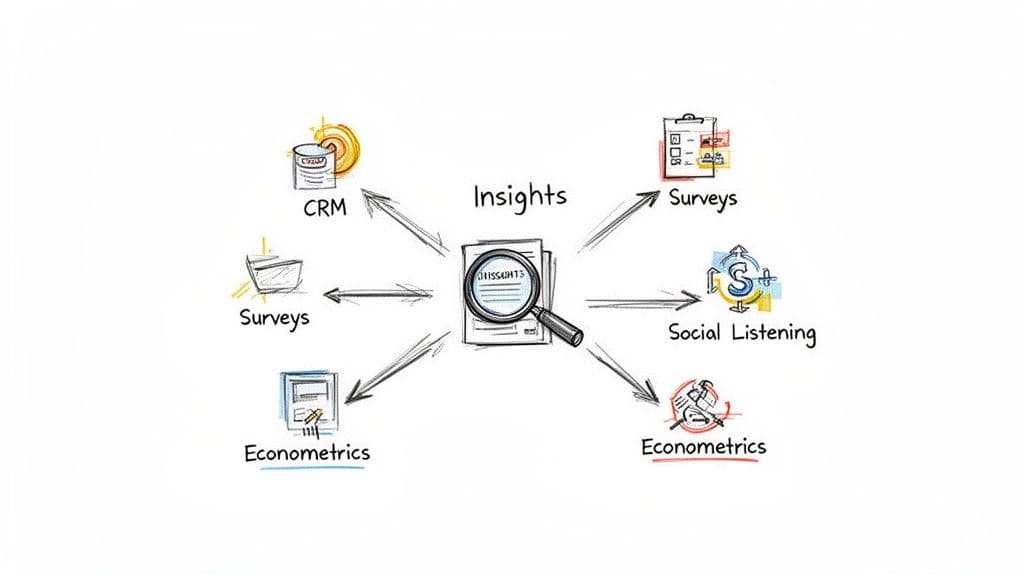
Measuring brand equity effectively is all about piecing together a puzzle. You can't just run a survey and call it a day. The real insights come from weaving together different threads of data—qualitative feedback, hard sales numbers, market signals—into a single, coherent story about your brand.
Building Your Data Collection Engine
The first order of business is designing a data collection strategy that pulls from multiple sources. If you only look at one thing, like an annual customer survey, you're flying with a blind spot. A truly robust approach blends different methods to validate what you're seeing and uncover the "why" behind the numbers.
For most B2B companies, a solid data collection plan includes:
- Customer Surveys: Indispensable for getting direct answers on perception-based metrics. This is how you measure Perceived Quality, brand associations, and your Net Promoter Score (NPS). Just keep them short and to the point—your customers are busy people.
- Ongoing Brand Tracking: This isn't a one-and-done project. You need to keep a constant pulse on digital KPIs like Share of Voice and AI-Response Visibility. Think of it as a real-time monitor for your brand's health.
- Digging into Internal Data: Don't forget the goldmine sitting in your own systems. Your CRM can tell you a story about customer loyalty, and your sales data is what you need to calculate your Price Premium against the competition.
To pull all this feedback together without losing your mind, a dedicated customer feedback management platform can be a lifesaver. These tools are built to centralize feedback and make spotting trends much easier.
Connecting the Dots Between Disparate Data
Here’s where many teams stumble. You have survey results over here, social media sentiment over there, and sales data in another system entirely. The real challenge is making sense of it all together. How does a dip in online sentiment affect new leads? Does higher brand recall actually lead to a shorter sales cycle?
Start by bringing all your metrics into one place. This doesn't have to be a fancy BI tool from the get-go; a well-structured dashboard or even a detailed spreadsheet can work wonders initially. The goal is simply to see everything at once so you can start looking for patterns.
The real magic happens when you stop looking at metrics in isolation. A powerful brand insight is rarely found in a single KPI; it's discovered at the intersection of several data points.
For example, you might see your share of voice is climbing, but your perceived quality scores are staying flat. That’s a huge clue. It tells you your awareness campaigns are getting noticed, but your core value proposition isn't landing. That’s an insight you can actually do something with.
Turning Raw Numbers into a Clear Story
With your data gathered and organized, it's time to translate it into a narrative that guides your strategy. You're looking for the story behind the numbers.
1. Spotting the Trends Start simple. Plot your key metrics over time. Is branded search volume ticking up? Is your NPS score improving each quarter? Visualizing trends is the quickest way to see if you're moving in the right direction and to catch small problems before they become big ones.
2. Benchmarking Against the Competition Your brand doesn't operate in a vacuum. You need context. How do your numbers stack up against your top two or three competitors? A 95% customer retention rate sounds fantastic on its own, but if the industry benchmark is 98%, you know you've got room for improvement.
3. Finding the Correlations This is where you start connecting the dots more formally. Try mapping your marketing spend for a specific campaign against the change in brand awareness metrics. While correlation doesn't prove causation, it definitely points you in the right direction. For those who want to go deeper, statistical methods like regression analysis can help model the direct impact of brand metrics on sales. Knowing how to track brand mentions online is a crucial first step in gathering the raw data needed for this kind of analysis.
When you dive into financial metrics, you tap into a quantitative powerhouse. For B2B tech platforms, brands with strong equity consistently command higher market shares and enjoy 15-20% premiums in profitability. One recent study even found that B2B software brands with top-tier sentiment scores grew their market share by 12% in just 18 months. And for those focused on growth, a 20% share of voice (SOV) has been shown to correlate with an 18% jump in revenue.
Turning Brand Insights Into Business Growth
Let's be honest: measurement without action is an expensive academic exercise. After all the hard work of building your framework, picking the right KPIs, and digging through the data, the real test begins. It's time to turn those insights into tangible business growth. This is the moment your brand equity program stops being a report and starts being a strategic driver for the entire company.
The data you've gathered is essentially a playbook. It lays bare your strengths, but more importantly, it shines a spotlight on your most critical vulnerabilities. The goal now is to translate those findings into specific, targeted actions that actually move the needle on business goals. It's about closing the loop between what you've learned and what you do next.
Creating Your Action Playbook
Think of your dashboard not just as a monitoring tool, but as a diagnostic one. The real magic happens when you start looking at the relationships between different metrics, because different combinations point to very different strategic moves.
Let's walk through a couple of common B2B scenarios I see all the time and decode what the data is trying to tell you.
Scenario 1: High Awareness, Lagging Perceived Quality
This one is classic. Your Share of Voice is strong, brand recall is high—everyone knows who you are. But then you dig into the survey data and see your Perceived Quality scores are flat, or worse, trailing a key competitor.
- The Diagnosis: Your top-of-funnel marketing is doing its job, but your core value proposition isn't landing. Prospects recognize your name, but they don't associate it with excellence, trust, or being the best solution.
- The Action Plan: You need to pivot hard from broad awareness campaigns to deep, credibility-building initiatives.
- Content Strategy: Go deep. Launch technical webinars, publish case studies with undeniable ROI figures, and create whitepapers that scream expertise.
- Customer Marketing: Your happiest customers are your best salespeople. It's time to amplify their voices with powerful testimonials and a robust customer advocacy program.
- Product Marketing: Re-examine your messaging. Are you clearly articulating what makes you different? Move beyond a list of features and focus on the business outcomes you deliver.
Dominating AI-Driven Search Results
One of the most powerful, and frankly urgent, insights you can get today comes from tracking your AI-Response Visibility. This metric isn't a vanity number; it's a direct indicator of whether you're winning or losing in the new era of search. If a tool like Attensira shows your visibility is low, you have a serious problem.
When an AI model fails to mention your brand as a leading solution, it's the modern equivalent of being buried on page ten of Google. You are effectively invisible to a growing wave of decision-makers who start their research with AI.
Scenario 2: Low AI-Response Visibility
Your traditional SEO looks solid, but when you check specialized tools, you find AI models almost never mention your brand when asked for recommendations in your category.
- The Diagnosis: The AI doesn't see you as an authority. Your existing content, while maybe good for old-school SEO, isn't structured or definitive enough for AI to recognize you as a category leader. It’s drawing its conclusions from other sources—and that usually means your competitors.
- The Action Plan: This calls for a laser-focused content and SEO strategy designed to "teach" the AI models about your authority.
- Create Definitive Content: Develop comprehensive pillar pages and cornerstone articles that answer the biggest strategic questions in your industry. Think "The Ultimate Guide to X" or "A Complete Framework for Y."
- Optimize for Authority Signals: Pack your content with quotes from experts, original data, and clear, structured layouts (like tables and lists) that AI can easily parse and cite.
- Build Contextual Links: Go after backlinks from highly respected industry publications and niche sites that reinforce the connection between your brand and your core topics.
Proving Your Brand's Financial Impact
Finally, all this data becomes your best ammunition for getting buy-in and budget from the C-suite. Leadership doesn't just want to see charts; they want to see how brand initiatives connect to the bottom line. This means you have to speak their language.
Don't just report that your Net Promoter Score went up. Connect that increase to a tangible improvement in your customer retention rate. When you show how a lift in Price Premium directly contributed to the company's profit margin last quarter, you're having a business conversation, not a marketing one. For a deeper look at this, our guide on how to measure marketing ROI offers a great framework for connecting those dots.
By systematically converting insights into action, you transform brand measurement from a passive reporting function into a powerful engine for sustainable growth.
Frequently Asked Questions
When you start digging into brand equity measurement, a few common questions always seem to pop up. Let's tackle some of the ones I hear most often from B2B leaders trying to put these ideas into practice.
How Often Should a B2B Company Measure Brand Equity?
There's no single right answer, but a good rhythm for most B2B companies is a major brand equity study once a year. This gives you a solid benchmark to see how you're tracking over the long haul and whether your bigger strategic bets are paying off.
But you can't just set it and forget it for 12 months. Some of your most important indicators move much faster, especially online.
For these, you'll want a much quicker pulse check:
- Share of Voice: I recommend looking at this monthly. It’s the best way to see how your conversation footprint stacks up against your competitors in near real-time.
- Social Media Sentiment: Check this weekly. A week is a long time on social media, and you need to be able to catch and react to perception shifts before they snowball.
- AI-Response Visibility: This is a new but critical one. You should be monitoring this monthly, if not weekly, to make sure you’re not becoming invisible in the new wave of AI-powered search.
The smartest approach is a hybrid model. You get the tactical, in-the-weeds view from continuous monitoring, plus the high-level strategic perspective from that annual deep dive. It’s the best of both worlds.
What Is the Single Most Important B2B Brand Metric?
If I had to pick just one, I couldn't. But if you twisted my arm, I’d say it’s a tie between Perceived Quality and the newcomer, AI-Response Visibility. They're two sides of the same coin.
Perceived Quality is your foundation. In B2B, where you’re dealing with long sales cycles and high-stakes decisions, trust is everything. If buyers don't believe in the quality of your solution, the slickest marketing campaign in the world won't save you.
AI-Response Visibility, on the other hand, is the new front door. A growing number of your buyers are using generative AI to create shortlists and find solutions. If those models don't mention you, you don't even get a chance to make your case.
Nail these two, and you’ll almost always see positive effects ripple across your other metrics, like customer loyalty and willingness to pay a premium.
A brand can't be chosen if it's never considered. In today's world, AI-Response Visibility is the new cost of entry for being part of the conversation.
How Can We Measure Brand Equity on a Tight Budget?
You don't need a Fortune 500 budget to get started. The trick is to be scrappy and zero in on a few core metrics you can track reliably without breaking the bank.
Focus on the free or low-cost tools you probably already have access to.
- Track Branded Search Volume: Jump into your Google Analytics and Google Search Console accounts. See how many people are searching for your company by name. If that number is trending up, it’s a fantastic sign.
- Monitor Social Mentions: You can set up free alerts to keep an eye on brand mentions and get a raw, unfiltered look at how customers and prospects are talking about you online.
- Run Small-Scale Surveys: Use affordable tools like SurveyMonkey or Typeform to send out a quick survey. You can get a baseline Net Promoter Score (NPS) and ask a couple of targeted questions about your perceived quality.
When it comes to AI visibility, you can start by manually asking AI models some questions. But to do it properly and at scale, specialized platforms offer a surprisingly accessible way to track this crucial new metric without a huge upfront investment.
Ready to stop guessing and start measuring your brand's visibility where it matters most? Attensira provides the critical insights you need to see how your brand appears in AI responses, helping you optimize your content and dominate the new era of search. Discover your AI-Response Visibility today.