

Discover how to increase website traffic with our practical B2B playbook. Actionable SEO, content, and AI optimization strategies for sustainable growth.
Getting more traffic to your website isn't just about playing the old Google game anymore. The real key is creating genuinely authoritative, well-structured content that answers questions, whether they're typed into a search bar or asked in a conversation with an AI like ChatGPT. This balanced approach is what makes a brand visible everywhere an audience is looking for solutions.
Rethinking Traffic in the Age of AI Search
Driving B2B website traffic used to be a straightforward climb up Google's rankings. That's changed. Now, a smart strategy requires focusing on classic search engines and the new wave of AI 'discovery engines' like Perplexity and ChatGPT. People are finding answers not just in a list of blue links, but through direct, conversational AI responses. Sticking only to old-school SEO tactics is a losing game.
This shift means you have to start thinking about AI visibility as a brand new, critical channel for B2B growth. The core principles of good SEO—quality, authority, clarity—are still as important as ever. But now, they need to be adapted to feed AI models that are constantly searching for clear, factual, and trustworthy information.
Your Audience’s Search Habits Are Changing
How people find information is evolving right before our eyes. Organic search is still a giant, but it's no longer the only game in town.
Across the globe, google.com pulled in a staggering 95.4 billion monthly visits in December 2025, which proves its dominance isn't going anywhere fast. At the same time, AI platforms are the fastest-growing destinations online, with tools like ChatGPT rocketing past 5 billion visits in 2025.
For any B2B brand, the message is clear: "search optimization" now has to include getting your content featured in AI-generated answers. It's a real, measurable traffic source.
The breakdown of where traffic comes from is starting to look a little different.
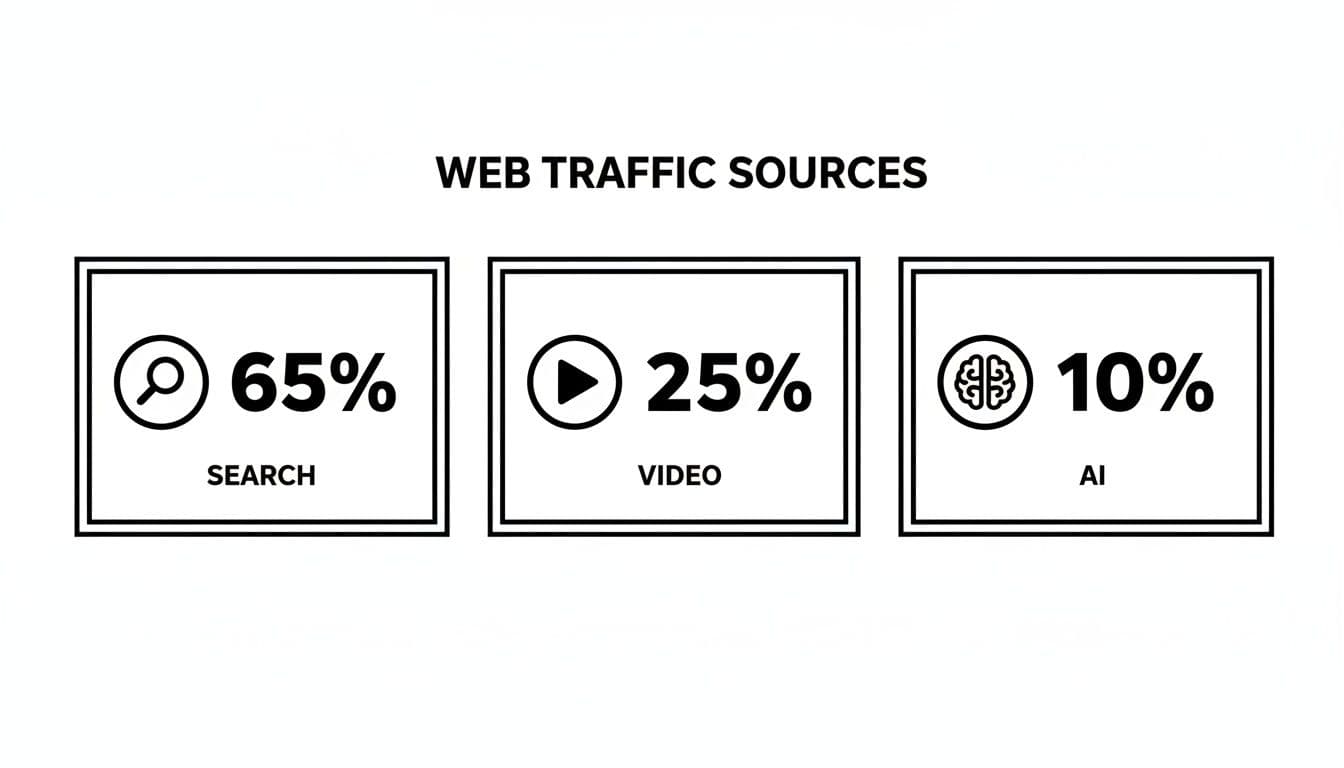
As you can see, traditional search still holds the lion's share, but AI is quickly carving out its own significant piece of the pie.
Why a Dual-Focus Strategy Isn't Optional Anymore
To build a modern, resilient traffic strategy, you have to optimize for both worlds. A dual focus lets you capture the audience that sticks to traditional search while positioning your brand as a go-to source for AI assistants.
For B2B companies, being the trusted source an AI cites is the new thought leadership. It's not just about ranking; it's about becoming the definitive answer.
This new reality demands a more sophisticated approach to how you create content. Your material has to be technically perfect for search crawlers while also being semantically unambiguous for AI models. It’s a new skill set, and you can learn more about it in our guide on how to improve your AI search visibility.
To put it simply, the channels we rely on for discovery are expanding. Here’s a quick look at how they stack up.
Modern Traffic Channels at a Glance
This table underscores the need for a multi-front strategy. Relying on just one channel leaves you vulnerable, while embracing both traditional and AI-driven search builds a far more durable foundation for growth.
Building Your SEO Foundation for Long-Term Growth
If you're serious about increasing website traffic, especially in a world where AI-driven search is becoming the norm, you need a rock-solid SEO foundation. I've seen too many businesses chase fleeting trends and ignore the fundamentals. Think of it like building a house—without a proper foundation, everything you build on top is destined to crumble.
Sustainable traffic doesn't come from a single viral hit. It’s the result of consistent, foundational work that quietly builds your site's authority over time. This means getting inside your audience's head to understand what they're searching for and then structuring your website so search engines can easily connect your answers to their questions.
Modern Keyword Research Is All About Intent
Let's start with keyword research, but not the old way of just chasing high-volume terms. Today, the real magic is in understanding user intent. You have to dig into the why behind every search. Is someone looking to buy something right now, or are they just trying to learn?
For example, a search for "CRM software" is incredibly broad. But when someone types "best CRM for small sales teams," their intent is crystal clear. Targeting these longer, more specific phrases—what we call long-tail keywords—brings in a much more qualified audience that's closer to making a decision.
This focus on intent is also critical for AI visibility. Conversational AI tools are built to answer very specific questions. When you create content that targets these intent-driven queries, you're not just optimizing for Google; you're positioning your content as a go-to source for AI assistants.
Nail Your On-Page Elements
Once you've zeroed in on intent, you need to send clear signals to search engines through your on-page SEO. These are the basic, non-negotiable signposts that explain what your content is about.
- Title Tags: This is your page's headline in the search results. It has to include your primary keyword and, more importantly, be compelling enough to make someone click. "Our Services" is useless. "AI-Powered SEO Audit Services for B2B Tech" tells the user exactly what they're getting.
- Meta Descriptions: Think of this as your ad copy in the search results. While it doesn't directly impact rankings, a great meta description summarizes the page's value and includes a clear call-to-action that boosts your click-through rate.
- Headers (H1, H2, H3): Headers are for more than just looks; they create a logical hierarchy. Your H1 is the main title, and the H2s and H3s break down subtopics, making the content easy to scan for both people and search crawlers.
A well-optimized page does more than just rank; it communicates value instantly. If a user can’t figure out what your page is about in three seconds, they’re gone. That bounce signals to search engines that your content missed the mark.
Build a Logical Site Architecture
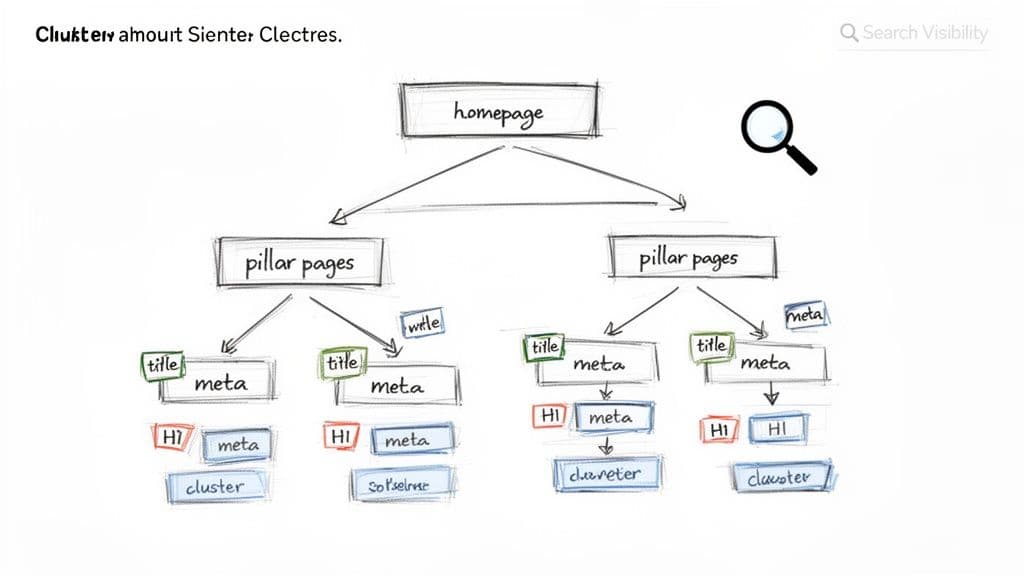
How your pages are organized and linked together is a huge, often overlooked, factor in driving traffic. A smart site architecture, usually built on a "pillar and cluster" model, makes your site much easier for Google to crawl and helps spread ranking authority across your pages.
Here’s how it works. Let's say your most important topic is "B2B Content Marketing." You'd create a massive, in-depth pillar page covering that topic from top to bottom. Then, you'd publish several cluster pages on related subtopics, like "Creating B2B Case Studies" or "B2B Video Marketing Strategy."
Every one of those cluster pages links back to the main pillar page. This web of internal links tells Google that your pillar page is the definitive resource on the subject, which helps it rank for those big, competitive terms. It also creates a better user experience, guiding visitors to related content and keeping them on your site longer. A messy internal structure is a red flag, and it's one of the first things you should check when you conduct an SEO audit for your website.
Optimizing Content for AI Answer Engines
Having a solid SEO foundation is table stakes. But if you want to seriously accelerate website traffic now, you have to pivot your strategy to win in the new arena of AI answer engines. This isn't some far-off concept anymore; it's happening today. The brands that adapt their content to be easily understood and trusted by AI models will become the go-to sources cited in generated answers, capturing some of the most qualified traffic you can get.
This isn’t about tricking an algorithm. It's about creating content that is so clear, authoritative, and factually sound that AI models prefer it over everything else. The goal is to make your website the most reliable source of information in your niche. Period.
Speak the Language of AI
At their core, AI models are information processors. They absolutely thrive on clarity, structure, and language that leaves no room for misinterpretation. To optimize for them, you need to ditch the marketing jargon and complex sentences in favor of direct, concise communication.
Think of it this way: you're not writing a literary novel. You're creating a definitive encyclopedia entry for your topic. Every statement should be verifiable and every definition precise. This approach helps AI models parse your content quickly and accurately, which dramatically increases the chance they'll use it to formulate an answer.
This doesn't mean your content has to be bland. It just means prioritizing clarity over cleverness. For example, instead of saying, "Our synergistic solutions empower dynamic operational paradigms," you just say, "Our software helps teams work more efficiently." The second version is instantly understood by both people and machines.
Structure Your Content for Easy Parsing
Beyond clear language, the structure of your content is everything. AI models look for logical patterns and hierarchies to figure out how different pieces of information relate to each other. This is where structured data and smart formatting become your secret weapons.
Here are a few actionable ways to tighten up your content's structure:
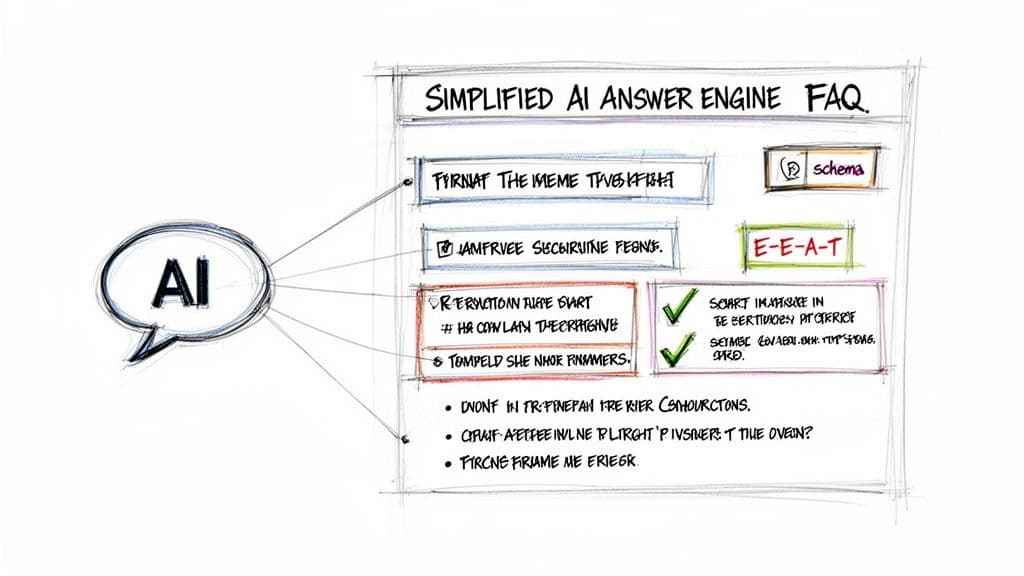
- Implement FAQ Schema: This is one of the most powerful tools in your arsenal. By marking up a question-and-answer section with FAQ schema, you’re literally telling AI and search engines, "Here is a direct question and its definitive answer." This makes your content a prime candidate for being featured.
- Use Descriptive Headings: Break down complex topics with clear H2 and H3 headings. A heading like "Common Challenges in Project Management" is far more useful to an AI than something vague like "What's Next."
- Lean on Lists and Tables: Bullet points, numbered lists, and tables are fantastic for organizing information into easily digestible chunks. This formatting helps AI models extract key facts, statistics, and process steps with ease.
By adopting these structural elements, you're essentially creating a roadmap for AI crawlers, guiding them directly to the most important information on your page.
AI answer engines aren't just looking for content; they're looking for confidence. Structured data like schema provides a layer of verification that tells the AI your information is organized, intentional, and trustworthy.
Amplify Your E-E-A-T Signals
E-E-A-T—Experience, Expertise, Authoritativeness, and Trustworthiness—is the bedrock of Google's quality guidelines, and it's even more critical for AI. These models are designed to avoid misinformation, so they actively seek out sources that demonstrate strong E-E-A-T signals.
This is where your brand's overall authority really comes into play. You need to prove you're a credible source of information, not just another random website.
To strengthen these signals, get serious about:
- Author Bios and Profiles: Clearly state who wrote the content and why they are qualified. Link to their social profiles or other publications.
- Citing Authoritative Sources: Back up your claims by linking out to respected industry studies, government reports, or academic papers. This shows your content is well-researched.
- Showcasing Social Proof: Nothing builds trust like third-party validation. Weave in case studies, testimonials, and client logos to prove your expertise.
For a deeper dive into this emerging field, you can learn more about the specifics of Answer Engine Optimization in our detailed guide.
A Practical Scenario: B2B Software
Let's put this into practice. Imagine a B2B SaaS company that sells project management software. Their dream is to be recommended when a user asks an AI, "What is the best project management tool for remote engineering teams?"
To make that happen, they create a pillar page titled "The Ultimate Guide to Project Management for Remote Engineering Teams."
On that page, they include:
- A crystal-clear, concise definition of remote project management right at the top.
- A section with an H3 heading, "Key Features for Remote Teams," that uses bullet points to list features like Gantt charts and asynchronous communication tools.
- An FAQ section at the end with questions like "How does this tool integrate with Slack?" all marked up with FAQ schema.
- The article is authored by their Head of Product, whose detailed bio and credentials are featured prominently.
- It cites third-party reports on remote work productivity to support its claims.
By creating this kind of structured, authoritative, and fact-based resource, the company positions itself as the definitive source. When an AI model scours the web for the best answer, this page's clarity and strong E-E-A-T signals make it a top contender to be cited, driving highly relevant traffic directly to their site.
Turn a Great User Experience into a Traffic-Driving Machine
Let's be blunt: all the brilliant SEO and content work you do can be thrown out the window in about three seconds. That's all the time it takes for a user to get frustrated with a slow, clunky, or confusing website and hit the back button. This isn't just about annoying people; a poor user experience (UX) actively signals to search engines that your site isn't worth the visit.
Think of it this way: your content might be the amazing invitation that gets someone to your party, but your site's performance is the party itself. If they show up and the lights are flickering, it’s impossible to find the drinks, and the whole place feels unstable, they're leaving. Fast. Search engines see that high bounce rate and low time-on-page and decide to stop sending people to your party.
Translate Core Web Vitals into Real Traffic
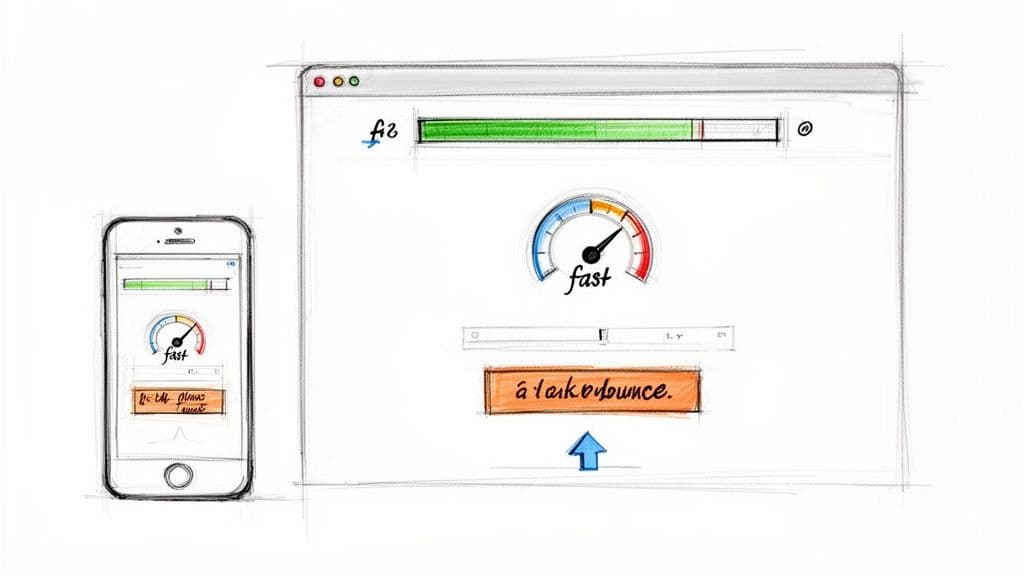
When Google rolled out its Core Web Vitals, it was basically shouting from the rooftops that user experience is a direct ranking factor. These aren't just abstract metrics for your dev team; they're direct measurements of how a real person experiences your site.
- Largest Contentful Paint (LCP): How long does a user have to stare at a blank or half-rendered screen before your main content appears? Too long, and they're gone.
- First Input Delay (FID): When someone clicks a button, how long does it take for something to happen? Any noticeable delay feels broken and is incredibly frustrating.
- Cumulative Layout Shift (CLS): Does your content jump around as images and ads load in? This is the digital equivalent of trying to read a book while someone keeps shaking it, often causing people to click on the wrong thing.
Improving these scores isn't about appeasing an algorithm. It's about respecting your visitors. A faster, more stable site directly leads to lower bounce rates and better rankings, which is the technical foundation for increasing website traffic.
The Unforgiving Reality of Mobile
If your site isn't exceptional on mobile, you're willingly ignoring more than half your potential audience. It’s that simple. With 54.4% of all website traffic coming from mobile devices, you have to assume most people are not on a desktop.
And mobile users have zero patience. Research shows that a staggering 88.5% of people will abandon a website if it doesn't load quickly. That’s nearly nine out of ten potential leads or customers vanishing before they even read your headline.
The connection between speed and revenue is undeniable. Pages that load in just one second can see conversion rates as high as 40%, a number that plummets with every fraction of a second you add. You can dig into more of the hard numbers in these website performance trends.
In a mobile-first world, your website's speed is its first impression. A slow-loading page is like a weak handshake—it instantly tanks your credibility and kills any chance of a real connection.
Fixing the Simple Mistakes That Kill Usability
Beyond raw speed, some common usability flaws can completely sabotage your traffic. It's time for a brutally honest audit of your own site.
Is Your Navigation a Maze? A new visitor should land on any page and immediately know where they are and how to get where they want to go. If they have to spend more than a few seconds hunting for your services or contact info, you've already lost them.
- Use simple language: Stick to obvious labels like "Services," "About Us," and "Contact."
- Be consistent: The menu should look and feel the same on every single page.
- Make search obvious: If you have a search bar, make sure it’s easy to find and delivers accurate results.
Are You Breaking the Mobile Experience? A "responsive" site is more than just shrinking your desktop version. It needs to be genuinely usable on a small touchscreen.
- Tiny text: Can you read your content easily without pinching and zooming?
- Fat-finger-proof buttons: Are your buttons and links spaced far enough apart for someone to tap them with a thumb without hitting the wrong one?
- Obnoxious pop-ups: Does a pop-up take over the entire screen with a close button that's impossible to find? This is a guaranteed way to make someone leave.
Fixing these fundamental UX problems is one of the highest-impact things you can do. A fast, stable, and intuitive website creates a powerful feedback loop: users stick around, search engines notice the positive engagement signals, and your traffic grows.
Creating High-Impact Content That Attracts Links and Leads
In the frantic race for more website traffic, the default strategy has become a numbers game: publish more. More blog posts, more updates, more noise. But this high-volume, low-impact approach is a fast track to diminishing returns in a world already drowning in content.
The numbers don't lie. We're looking at a web with over 1.09 billion websites, and another 252,000 popping up every single day. Yet, traffic to the top sites has actually dropped by over 11% in the last five years. The signal-to-noise ratio is getting worse. Simply adding to the noise isn't going to get you noticed. For a deeper dive into these trends, check out the latest website statistics on emailvendorselection.com.
To really move the needle, you have to shift your focus from quantity to quality. I'm talking about creating authoritative pillar content—the kind of deeply researched, high-value asset that solves a major customer problem so completely it becomes a magnet for both links and leads. One definitive guide can easily outperform dozens of generic blog posts combined.
Identify and Own Your Pillar Topics
First things first, you need to pinpoint the core problems your audience has that you are uniquely qualified to solve. These aren't just keywords; they are the broad, foundational topics your business is built on. For a company selling sales software, a perfect pillar topic might be "Sales Pipeline Management."
What questions do your sales reps answer over and over? What are the biggest challenges your customers bring up? That’s where you’ll find your gold. Once you land on a pillar topic, the mission is simple: create the single best resource on that subject on the entire internet.
This means you have to go deeper than anyone else has. Your content should be the definitive source, often taking one of these forms:
- A long-form guide: A comprehensive A-to-Z manual that walks a user through a complex process.
- Original research: A unique study or survey that brings new data and insights to your industry.
- An ultimate resource hub: A meticulously curated page that points to the best tools, articles, and resources on a topic.
This kind of depth doesn't just impress search engines looking for comprehensive answers; it's also precisely the type of definitive resource that AI models are designed to find, trust, and cite.
Structure Content for Authority and Links
Just creating a massive article isn't enough. It has to be structured for maximum impact. A well-organized pillar page acts as a central hub, with smaller, related "cluster" articles branching off from it. Crucially, these cluster posts link back to the main pillar. This internal linking structure is a powerful signal to search engines that your pillar page is the authoritative source on the topic.
For example, your "Sales Pipeline Management" pillar page would link out to cluster posts like "Best Sales Pipeline Software," "How to Conduct a Pipeline Review," and "Common Pipeline Bottlenecks."
The real power of pillar content is its natural ability to attract backlinks. When you create the most thorough and useful resource on a topic, other websites, journalists, and industry blogs will link to it as a reference, building your domain authority without manual outreach.
To make the most of this, it pays to focus on effective link building strategies that have a proven track record of delivering results.
A Real-World Scenario in Action
Let’s put this into practice. Imagine a cybersecurity firm wants to attract enterprise-level IT managers. Instead of churning out 20 small blog posts on different security threats, they go all-in on a pillar page titled, "The 2025 State of Enterprise Cybersecurity."
This single asset is packed with value:
- Original survey data from 500 IT managers.
- In-depth analysis of emerging threat vectors.
- An interactive checklist for conducting a security audit.
- Direct quotes from respected industry experts.
Suddenly, they have a link-worthy asset. Other tech blogs will cite their research, journalists will reference their findings, and IT managers will share it with their teams. It ranks high in search, gets cited by AI, and generates highly qualified leads—all from one concentrated, high-impact effort. This is how you stop chasing traffic and start earning it.
Let's Tackle Your Biggest Traffic Growth Questions
Even with the best strategy laid out, the day-to-day work of growing website traffic always brings up new questions. Let's dig into some of the most common ones I hear from B2B marketers and move past the theory to get you some practical answers.
How Long Does It Really Take to See More Website Traffic?
I wish there was a magic number, but the honest answer is you should be thinking in months, not days. For foundational SEO and new content, you can often spot early signs of life—like improved keyword rankings—within 3-6 months.
But for that significant, sustainable traffic growth you're after? That usually takes a solid 6-12 months to really kick in and compound. The single biggest factor here is consistency. Your timeline will also depend on how competitive your industry is, your website's starting authority, and the resources you're putting in. Keep a close eye on your analytics to see what's working and don't be afraid to adjust your plan.
Should I Focus on Organic Traffic or Paid Ads?
This is a classic "it depends" scenario, but the smartest B2B strategies use both for very different reasons. I like to think of it as a sprinter versus a marathon runner—you really need both on your team.
- Paid Ads: This is your sprinter. It delivers immediate, highly targeted traffic. It’s perfect for testing a new offer, getting the word out about a product launch, or reaching a specific audience segment right now. The catch? The traffic disappears the second you turn off the spending.
- Organic Traffic: This is your marathon runner. It’s a long-term asset you build through great SEO and genuinely helpful content. It takes more work upfront, but it creates a compounding engine for leads and authority that pays off for years to come.
For most businesses, a balanced approach is the way to go. Use paid ads for specific, short-term goals while you consistently invest in your organic presence for scalable, long-term growth.
The goal isn't just to get clicks; it's to build an audience that trusts you. Organic traffic, earned over time, is a powerful indicator that you are a credible authority in your space, which is invaluable for B2B sales cycles.
What Are the Most Important Metrics to Track?
Just looking at "Total Visits" won't tell you much—it’s a classic vanity metric. To really understand if your efforts are paying off, you need to look at metrics that signal traffic quality and actual engagement. For a comprehensive look at attracting visitors who actually matter, check out these proven strategies to increase website traffic that converts.
For B2B marketing, these are the metrics that truly matter:
- Organic Traffic from Non-Branded Keywords: This tells you that you're successfully reaching new people who don't know your brand name yet but are searching for solutions you offer. It's pure discovery.
- Conversion Rate on Key Pages: Are visitors actually doing what you want them to do? Track demo requests, content downloads, and contact form submissions to see the real business impact.
- Bounce Rate & Average Time on Page: These are your best proxies for content quality. If people leave immediately (high bounce rate) or don't stick around (low time on page), your content probably isn't hitting the mark.
- Keyword Ranking Improvements: Keep an eye on your position for your most important business terms. A steady climb up the search results is a fantastic leading indicator of future traffic growth.
- Mentions in AI Responses: This is a newer one, but it's becoming critical. Start tracking when and how your brand is mentioned in AI-generated answers. It’s a forward-looking metric that signals your growing authority.
By focusing on these more nuanced numbers, you get a much clearer picture of what's working, allowing you to double down on your wins and fix what isn't.
Ready to stop guessing and start measuring your brand's visibility in the new age of AI search? Attensira provides the actionable insights you need to optimize your content, track your presence across major AI platforms, and ensure your brand is the definitive answer your customers are looking for. See how you appear in AI-driven answers and start building a more resilient traffic strategy today. Learn more at https://attensira.com.