
how to check keyword ranking: learn tools, simple steps, and data-driven tips to boost your site's SEO performance.
So, what does "checking your keyword ranking" actually mean? It’s simply the process of figuring out where your website shows up in Google's search results for the keywords you care about. You can do this with free tools like Google Search Console, dedicated SEO platforms, or even our own tool, Attensira. This check gives you a direct, no-nonsense measure of your content's visibility and whether it's actually doing its job of bringing in organic traffic.
Why Keyword Rankings Are Still a Core SEO Metric
With all the talk about complex algorithms and AI search, it's easy to get lost in the noise. But let's be clear: tracking your keyword rankings isn't some outdated SEO habit. It’s a vital health check for your website's visibility and one of the most reliable benchmarks you have in an industry that's always in flux.

You can't improve what you don't measure. Knowing where you stand is the absolute first step in building an SEO strategy that gets ahead of the curve, not just reacts to it. Ultimately, it’s the metric that tells you if you're in the game for capturing organic traffic.
The Modern Importance of Rank Tracking
The debate over which SEO metrics matter most is never-ending, but keyword ranking has firmly re-established its importance. A recent survey of over 1,000 SEO professionals showed that keyword ranking has actually surpassed metrics like click-through rate (CTR) as the number one indicator of SEO success.
This renewed focus is happening for a reason. With constant algorithm updates and the rise of AI—which 36.3% of SEO pros see as the biggest disruptor on the horizon—having a stable, tangible metric is more crucial than ever. You can read more about these trends in the latest research from Exploding Topics.
Think about a real-world scenario. A B2B software company sees their ranking for "enterprise project management tool" slide from position 3 to 8. It might not sound catastrophic, but that small drop can mean a huge loss in high-intent leads. Because they were monitoring it, they can react fast—maybe by refreshing their content or building a few new links—to win back that valuable real estate. Broader metrics like overall organic traffic would have never given them that specific, actionable insight.
Your keyword ranking is the most direct signal of your content's relevance and authority for a specific query. While other metrics provide context, rankings tell you if you’re winning or losing the visibility battle.
From Data Points to Strategic Decisions
At the end of the day, knowing your position isn't just about feeding numbers into a dashboard. It's about making smart business decisions that fuel real growth.
When you analyze your rankings, you can:
- Spot competitive threats: Get an immediate alert when a competitor overtakes you for a money-making keyword.
- Find new opportunities: Uncover those "striking distance" keywords lingering on page two that just need a little push to become major traffic drivers.
- Measure content ROI: Draw a direct line between the content you create and optimize and the ranking improvements that follow.
These data points are the foundation for understanding what’s really moving the needle. To get into the specifics of the different methods and tools, you can learn how to check keyword ranking accurately. Of course, it also helps to understand the many search engine ranking factors that determine these positions in the first place.
Mastering Google Search Console for Free Rank Tracking
Before you even think about opening your wallet for a paid SEO tool, let's talk about the most powerful, and completely free, resource at your disposal: Google Search Console (GSC). This isn't just another analytics platform; it's your direct line to Google, offering the ground truth on how your site actually performs in the wild.
Too many people just give the main GSC dashboard a quick look and move on. The real gold, however, is buried in the 'Performance' report. This is where you graduate from vanity metrics and start making strategic moves based on solid data straight from the source.
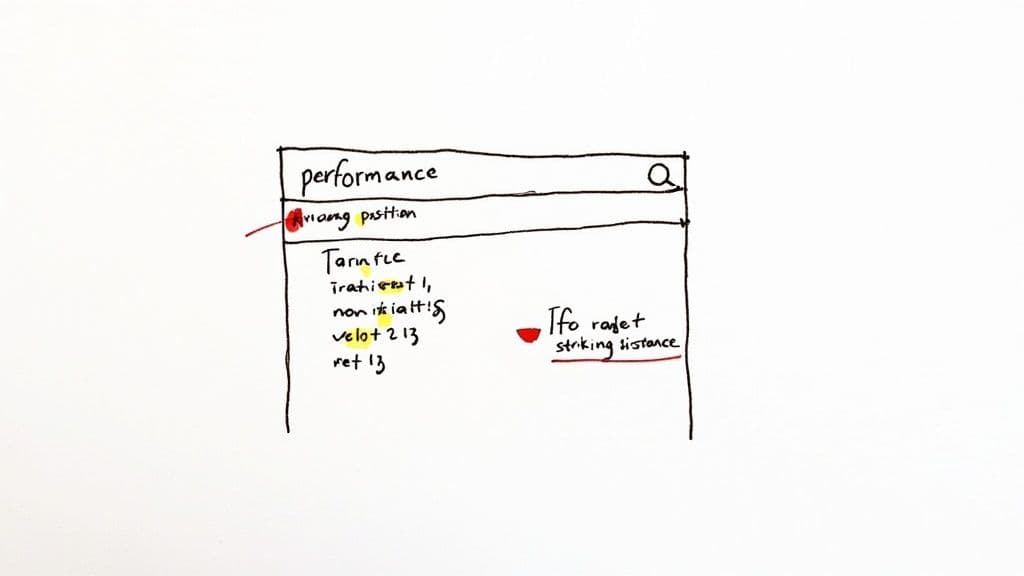
This report gives you a high-level view of your total clicks, impressions, average click-through rate (CTR), and average position. But the real magic happens when you start slicing and dicing this data with filters. That's how you uncover the specific keywords pulling their weight.
What “Average Position” Actually Tells You
One of the most valuable—and frequently misunderstood—metrics in GSC is Average Position. It’s not a perfect, static number. Instead, it reflects the typical rank of your URL for a query over a period.
Think of it this way: a keyword with an average position of 11.5 is what I call a "striking distance" keyword. It's teetering right on the edge of page one. That's a huge opportunity. A little nudge, maybe through some on-page tweaks or a few new internal links, could easily push it onto the first page and dramatically increase its traffic. That's the low-hanging fruit you should be looking for.
Using Filters to Find Actionable Insights
Looking at a giant, unfiltered list of queries is overwhelming and often useless. The real power of GSC is in its filtering capabilities, which let you ask specific, targeted questions about your performance.
Here are a few ways I regularly use filters to dig for insights:
- Zero in on a specific page: Pick a critical blog post or landing page and filter the report by its URL. This will show you every single query that page is getting impressions for. You’ll almost always find it’s ranking for long-tail keywords you never even thought to target.
- Investigate a specific keyword: If you're focused on a core term like "B2B content strategy," filter for queries containing that phrase. This reveals all the variations and related searches people are actually using, which is invaluable for content planning.
- Compare performance over time: Did your rankings for a money keyword suddenly tank? Use the 'Compare' feature to look at this week's performance against last week's. This helps you pinpoint the exact day the drop occurred, so you can cross-reference it with site changes or known Google algorithm updates.
By mastering GSC's filters, you shift from being a passive observer to an active investigator. This is how you unearth real, actionable insights that tell you what to do next—whether that's refreshing old content or pouring more resources into a winning strategy.
GSC as Your First Responder for Ranking Issues
Beyond finding new opportunities, GSC is your first line of defense when things go wrong. Let’s say a key landing page suddenly dries up and stops generating leads. What's your first move?
Don't guess. Head straight to the Performance report. Filter by that page's URL and check its keyword positions over the last 7 to 28 days. If you spot a sharp, undeniable drop in average position for its main keywords, you’ve confirmed it’s a ranking problem, not a conversion issue on the page itself.
From there, your investigation has a clear direction. Was there a technical glitch? A recent content update that backfired? A new competitor suddenly dominating the SERPs? Without that initial check in GSC, you’d just be guessing in the dark.
Using Dedicated SEO Tools for a Competitive Edge
Google Search Console is your foundational source of truth, offering a solid look at how your own site performs in search. But if you’re serious about getting ahead of the competition, you need to move beyond Google's rearview mirror. This is where dedicated SEO platforms like Semrush, Ahrefs, and Moz change the game.
These tools don't just show you where you've been; they give you the intelligence to map out where you're going. Think of them as an investment in a proactive SEO strategy, transforming the simple act of checking rankings into a powerful competitive advantage.
Automated and Granular Rank Tracking
One of the biggest wins with a dedicated SEO tool is putting your rank tracking on autopilot. You can monitor your most important keywords every single day. Even better, you can track them at a granular level—down to a specific city or country—which is an absolute necessity for local businesses or international brands.
This daily pulse gives you immediate feedback. Let’s say you publish an optimized blog post. With a tool like this, you might see its ranking jump from position 45 to 22 in under a week. That kind of rapid validation is something GSC’s aggregated, slightly delayed data simply can't provide. It confirms your strategy is working almost in real-time.
Unlocking Deep Competitor Insights
Knowing your own rankings is just one piece of the puzzle. The real power of these platforms is their ability to spy on your competitors. You can see exactly which keywords they’re ranking for, which pages are bringing them the most organic traffic, and even where they're getting new backlinks.
Imagine you run an e-commerce store in a crowded market. A tool like Ahrefs can send you an alert the moment a competitor cracks the first page for a high-intent keyword you've been fighting for. This isn't just a vanity metric; it’s a direct threat to your bottom line. Armed with this knowledge, you can act immediately—maybe by beefing up your own content or launching a targeted link-building campaign.
Here’s a perfect example from our work with a client. We saw their traffic for a crucial service keyword start to dip. Hopping into Semrush, we used the historical rank data to see their position had slipped from #3 to #9. A quick look at the SERP history for that day revealed a competitor had launched a massive, 10,000-word guide on the topic just two days earlier. That insight let us build a counter-strategy within a week, rather than scratching our heads for months over a slow decline in traffic.
Monitoring SERP Features and Share of Voice
Today's search results are far more than ten blue links. They're a dynamic mix of SERP features like Featured Snippets, People Also Ask boxes, image packs, and video carousels. Dedicated SEO tools are built to track your visibility inside these features, which often capture a huge percentage of clicks.
They also calculate a metric often called "Share of Voice," which gives you a high-level view of your overall visibility in the search results for a group of keywords compared to your main competitors. It helps answer the big question: "Are our combined SEO efforts actually making our brand more prominent?" When you're trying to break through on tough keywords, understanding the competitive pressure is critical. You can learn more about how to evaluate SEO keyword difficulty in our complete guide.
For those operating on specific platforms, such as Shopify, partnering with a Shopify SEO expert can be a smart move. These specialists leverage advanced tools to find platform-specific opportunities and competitive angles that a more general approach might overlook.
A Practical Comparison of Popular Rank Checkers
Choosing the right tool often comes down to your specific needs, team size, and budget. While many platforms offer similar core features, their strengths and pricing structures vary. Here’s a quick breakdown to help you compare some of the top contenders.
Ultimately, the "best" tool is the one that aligns with your strategy and provides the data you'll actually use. Most offer free trials, so it’s always a good idea to test a couple of them out to see which interface and data set works best for you and your team.
How to Turn Ranking Data into Actionable Insights
So you've got the data. Great. But collecting keyword rankings is just the starting point. The real work—and where the value is—lies in turning those numbers into a smart, strategic response. Raw data doesn't tell you what to do next; you have to learn to read the story it's telling.
First things first, you need to learn the difference between background noise and a real signal. It's completely normal for rankings to bounce around a bit day-to-day. But if you see a steady downward slide over a week, or a high-value keyword suddenly tumbles more than five spots, that’s your cue to pay attention. Something’s up.
This whole process is really a continuous loop: you track the data, you analyze what it means, and then you react.
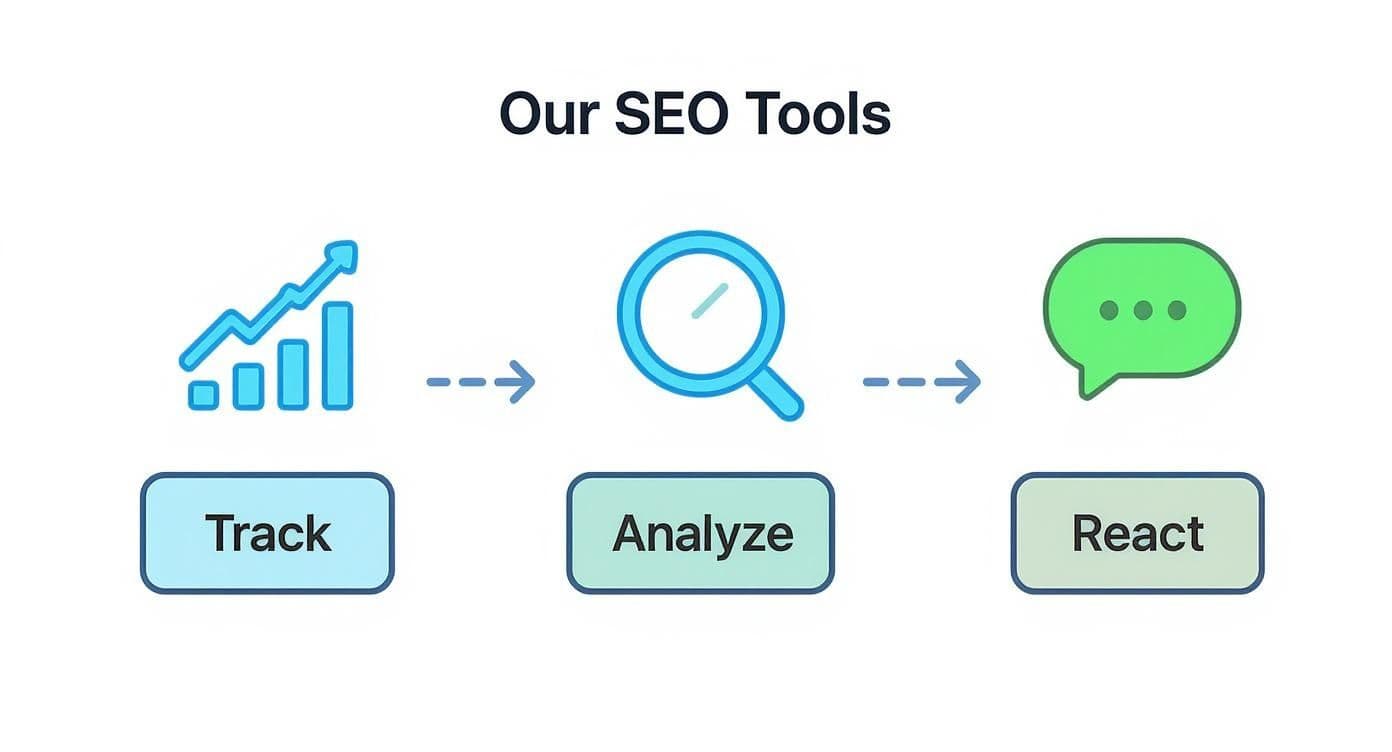
This workflow is key. It reminds us that data is only useful when it triggers analysis and action, creating a cycle that helps you get better over time.
Connecting Rankings to Causes
Once you've spotted a significant shift, it’s time to put on your detective hat. The goal here is simple: connect the ranking change to a cause. Think back on your recent activity. Did you just launch a new piece of content, give a landing page a facelift, or maybe land a killer backlink? These internal actions can absolutely move the needle.
Of course, the cause might have nothing to do with you. Maybe a major competitor just dropped a massive new content hub, or Google confirmed another algorithm update that shook up the results. This is why you always have to cross-reference your ranking data with competitor monitoring and industry news. It's the only way to see the full picture.
A drop isn't always a failure, and a rise isn't always a victory. Understanding the "why" behind the change is what separates a reactive SEO from a strategic one. It allows you to either fix what's broken or double down on what's working.
Building Your Diagnostic Checklist
Let's walk through a real-world scenario. Your top money-making keyword just dropped from position #4 to #11. That’s a code-red situation because it knocks you right off the first page, where almost all the clicks happen. Don't panic. Instead, work through a checklist.
Here’s a solid approach to figure out what went wrong:
- On-Page Content: Take a hard look at the page. Has the content gone stale? Did a recent edit accidentally remove your target keywords or muddy the page's focus?
- Technical Health: Run a quick technical audit. Is the page still indexable? Check Google Search Console for new crawl errors. Has the page speed taken a nosedive?
- Backlink Profile: Did you lose any important backlinks pointing to that page? A quick link audit can tell you if your link equity has taken a hit.
- SERP Analysis: Who's ranking now? Go look at the pages that jumped ahead of you. Is their content more in-depth? Is their user experience better? Do they have a stronger backlink profile?
Following a methodical process like this turns gut feelings into a repeatable strategy. You start building an instinct for how to protect and grow your search presence, which is non-negotiable in today's market. After all, with Google owning over 90% of the search market, every single position is a battle. The first organic result alone pulls in nearly 40% of all clicks, so even a small jump can mean a massive boost in traffic.
Ultimately, this entire process is one piece of a much larger puzzle. To see how it fits into your overall strategy, our guide on monitoring SEO performance can give you that broader perspective.
Common Rank Tracking Mistakes and How to Avoid Them
Knowing how to track your rankings is one thing, but knowing what not to do is just as important. I’ve seen countless well-meaning SEOs and marketers fall into the same traps, leading to bad data, wasted time, and strategies built on a shaky foundation.
Let's walk through some of the most common pitfalls so you can steer clear of them.
https://www.youtube.com/embed/L-f9oD3itRg
One of the easiest traps to fall into is obsessing over daily fluctuations. Keyword positions are rarely static; they bounce around all the time. Seeing a keyword dip from position #4 to #5 overnight isn't a reason to panic. It’s just noise.
Instead, zoom out. Look at your weekly and monthly trends. That’s where the real story of your performance is told.
Another classic error is relying on manual checks in an incognito browser window. It feels like you're getting a raw, unbiased look, but you're not. Even in incognito mode, Google uses signals like your general location and device to tailor the results. You’re simply not seeing what your average customer sees.
Ignoring Mobile and Local Rankings
Here's a massive blind spot for many: thinking of a "ranking" as a single number. The reality is far more complex. A huge chunk of your audience is on their phones, and for any business with a physical footprint, location changes everything.
If you aren't tracking mobile and geo-specific rankings, you’re flying blind with a massive segment of your audience.
- Mobile-First is the Standard: Google primarily uses the mobile version of your site for indexing and ranking. Only looking at desktop data means you're missing the main event.
- Local Intent is King: For a query like "best coffee shop," the search results are intensely localized. Your national rank is meaningless. What truly matters is where you show up for someone searching from a few blocks away.
The question isn't just "Where do I rank?" It's "Where do I rank for my target customer, on the device they are using, in the location they are searching from?" Neglecting this context gives you dangerously incomplete data.
Tracking the Wrong Keywords
Finally, the mistake that can waste the most time and money is tracking the wrong keywords. It’s easy to get caught up in vanity metrics, chasing a number one spot for a broad term that has no real connection to your business goals.
Your keyword list shouldn't be a random collection of high-volume terms. It needs to be a strategic asset, with each keyword mapping directly to a business objective. Focus on terms with clear user intent—whether it's informational, commercial, or transactional.
When you track the right terms, an improvement in your rankings directly translates to an improvement in your business. This is the core of learning how to check keyword ranking with purpose.
Your Keyword Ranking Questions, Answered
Once you get into the nitty-gritty of checking your keyword rankings, you'll inevitably run into a few specific questions. Let's tackle some of the most common ones I hear from clients and colleagues to clear up any confusion.
How Often Should I Be Checking My Rankings?
For most businesses, checking in on your keyword performance once a week is the sweet spot. This frequency is enough to catch important trends and see how your competitors are moving without getting bogged down by the minor, day-to-day fluctuations that are perfectly normal.
Of course, the "right" frequency really depends on your specific goals and industry:
- Daily: If you're in a cutthroat market or in the middle of a big, time-sensitive campaign (like a product launch), daily tracking might be necessary. You'll definitely need an automated tool for this.
- Weekly: This is the standard for most of us. It’s perfect for keeping an eye on your core money-making keywords and tracking the overall health of your SEO efforts.
- Monthly: This works well for broader, informational content or for long-tail keywords that aren’t tied directly to immediate sales.
The key is to look for the bigger picture. Don't panic over a small drop on a random Wednesday. What matters is the overall trajectory of your rankings over weeks and months—that's what should inform your strategy.
Why Are My Keyword Rankings So Unstable?
First off, if your rankings are constantly bouncing around, welcome to the club. This kind of volatility is just part of the modern SEO landscape. A huge reason for this is that Google is constantly tinkering with its algorithms. We hear about the big, core updates, but there are hundreds of smaller, unannounced tweaks happening all the time.
Beyond Google's own changes, your rankings can swing due to competitors pushing out new content, shifts in search intent (what people are actually looking for), or even technical hiccups on your own website. And don't forget that search results are heavily personalized and localized now. Your rank can look different to someone in another city or someone with a different search history.
The trick is to learn to separate the signal from the noise and focus on long-term trends.
Can I Check Rankings for a Specific City?
Yes, you absolutely can—and if you run a local business, you absolutely must. What good is a high national ranking if you're invisible to the customers searching just a few blocks from your front door?
Most serious SEO platforms, like Semrush and Ahrefs, have built-in geo-specific tracking. This lets you zero in on your keyword positions at a super-local level, even down to a particular city or ZIP code. It's the only way to get a real, honest look at your local search performance, which is where the money is for any brick-and-mortar or service-area business.
Ready to move from simply tracking rankings to predicting them? Attensira provides the AI-driven insights you need to see where your content will rank and how to optimize it for maximum visibility in an AI-powered search world. Start making smarter SEO decisions today at https://attensira.com.