Explore google ai overview optimization with actionable tips to boost your AI search visibility and stay ahead of the curve.
When we talk about optimizing for Google's AI Overviews, we're talking about a fundamental shift in strategy. It's no longer just about ranking in the top ten blue links. The new goal is to structure your content so clearly and authoritatively that Google's AI directly cites you in its generated answer summaries.
This means you need to become the primary, trusted source the AI relies on. It’s a game of creating factual, well-organized content that gets straight to the point and answers user questions with precision.
The New Search Landscape of Google AI Overviews
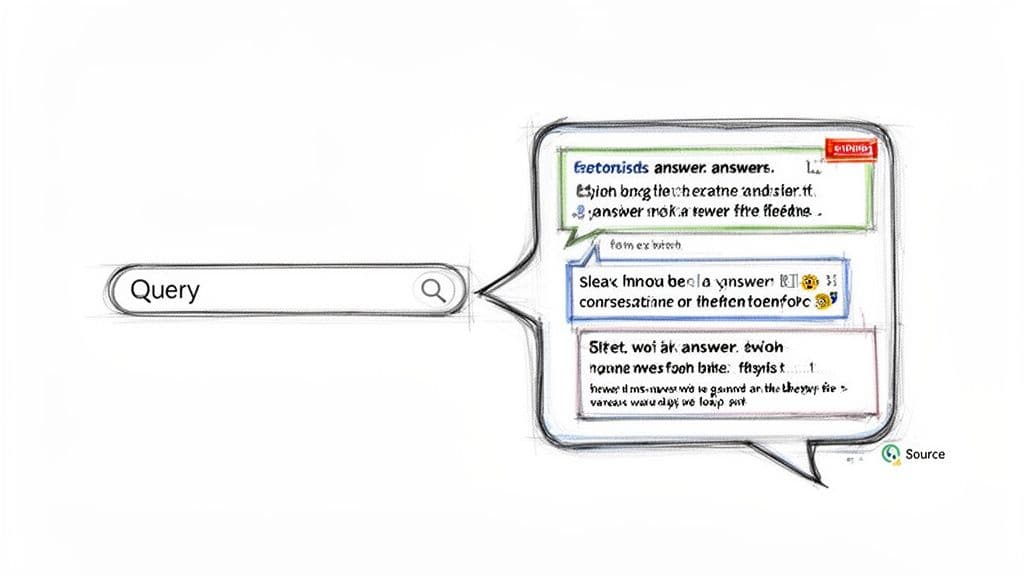
Think of search moving from a static list you have to sift through to a dynamic conversation with an expert research assistant. That's the reality Google's AI Overviews are bringing to the SERP. This isn't just a minor tweak; it completely changes how users find information and discover brands. We're going from a self-directed scavenger hunt across multiple websites to getting a synthesized, direct answer right at the top.
For any B2B enterprise, this shift poses a critical question. When a potential customer asks a complex question about your industry, will your brand be the one the AI assistant quotes? Or will you be buried below the fold in the traditional results, essentially invisible to a huge chunk of users who now get their answer without ever scrolling down?
The End of the Ten Blue Links
For over a decade, SEO success was a straightforward numbers game: get on the first page, preferably within the "ten blue links." That era is quickly drawing to a close. AI Overviews have inserted a new layer at the very top of the SERP, intercepting queries and delivering instant gratification.
The implications for organic traffic are massive. If the AI fully answers a user's question, their motivation to click any of the organic links drops dramatically. Clicks aren't going away, but their purpose is evolving. A click will now often be for deeper validation, to find more granular detail, or to directly engage with the brand that the AI just cited as an authority. Getting a handle on AI search engine optimization for local services can offer some valuable context for this new environment.
The core objective of modern SEO is no longer just to rank, but to be cited. Your content must be so clear, authoritative, and well-structured that Google's AI selects it as a foundational piece of its generated answer.
Why B2B Enterprises Must Adapt Immediately
The B2B world feels this change more acutely because of the long, research-heavy customer journey. B2B buyers ask nuanced, complex questions—the exact kind that are perfect for an AI-powered summary.
Here are a few things B2B brands need to get ahead of:
- Authority is the New Currency: AI models are built to find and prioritize information from sources that radiate expertise and trustworthiness. Being cited in an AI Overview is an instant stamp of approval that positions you as an industry leader.
- The Rise of Zero-Click Searches: A lot of top-of-funnel informational queries will now be completely answered in the SERP. Your content has to be built to provide value and build brand awareness even if it doesn't earn a click.
- Owning Complex Queries: AI Overviews are great at tackling long-tail, multi-part questions. This is a golden opportunity for specialized B2B companies to provide definitive answers that generic content mills simply can't match.
The rules for digital visibility are being rewritten as we speak. Getting ahead means taking a proactive approach to Google AI Overview optimization and ensuring your expertise becomes the bedrock for the answers Google provides. To dig deeper into how these summaries are built, check out our detailed guide on the AI Overview and its mechanics.
How AI Overviews Are Rewriting the Rules of SEO
Remember the good old days of the "ten blue links"? That predictable SERP layout is quickly becoming a relic. A new, dynamic interface is taking its place, one where answers, not links, are the main event. Google's AI Overviews are fundamentally changing the game by acting as a powerful new layer between a searcher and your website.
It used to be enough to rank on the first page. Now, the goal is to become the source for the AI's synthesized response. This is easily the biggest shake-up in search in the last ten years. Instead of users sifting through multiple links to piece together an answer, Google is doing that work for them, serving up a neat summary right at the top of the page. While that’s great for users, it’s a massive hurdle for brands who count on organic traffic. The entire competitive landscape has been re-drawn around a new kingmaker: the AI itself.
From Ranking to Citation
The old game was about climbing a ladder. The new game is about earning a citation.
Think of it like an academic paper. The most credible, well-supported, and articulate sources are the ones that get referenced in the final draft. Google's AI works in a strikingly similar way, scanning billions of pages to find the most trustworthy information to construct its answers. Your content is no longer just a destination; it’s a potential data point.
This distinction is the key to any real Google AI Overview optimization strategy. The focus has to shift from just targeting broad keywords to answering very specific questions with absolute clarity and authority.
And this isn't some niche change happening in the corner. Google's AI Overviews have exploded, now reaching 2 billion monthly users across more than 200 countries as of 2025. Data shows these overviews appear in 15% or more of searches, which has a direct and immediate impact on click-through rates. For B2B companies especially, becoming a cited source isn't just a nice-to-have anymore—it's essential for staying relevant.
The Amplified Importance of E-E-A-T
If you think of the AI as a diligent researcher, then E-E-A-T (Experience, Expertise, Authoritativeness, Trustworthiness) is its grading rubric. These signals were always important, but in an AI-first search world, they are absolutely non-negotiable. Google’s systems are built to surface reliable information and minimize risk, so demonstrating your credibility is paramount.
Here’s why each element matters more than ever:
- Experience: The AI is being trained to spot genuine, first-hand knowledge. Content like original research, detailed case studies, and articles written by practitioners with verifiable backgrounds gets a serious leg up.
- Expertise: You have to prove you know your stuff, inside and out. This means creating comprehensive content that tackles a topic from every angle, backed up by data and explained clearly.
- Authoritativeness: Your brand and your authors need to be seen as leaders in your field. This is built over time through consistently high-quality content, industry recognition, and getting cited by other reputable sources.
- Trustworthiness: Security, transparency, and accuracy are deal-breakers. The AI is far less likely to pull from a source that seems biased, has factual errors, or is hosted on an unsecured site.
A strong E-E-A-T profile is your ticket to the game. Without it, your content is likely to be seen as too much of a risk for Google's AI to use in an overview, no matter how well it answers the question.
Getting a handle on this fundamental shift is the first step. For a more practical look at navigating this new landscape, resources like the guide on AI SEO: How to Rank in LLM Answers offer direct insights. This new reality demands a strategic pivot, and if you want to dive deeper, our own guide on AI search engine optimization and its core principles is a great place to start. The brands that adapt now won’t just survive—they’ll become the new trusted authorities in the age of AI-powered answers.
Actionable Tactics for AI Overview Optimization
Alright, let's move from theory to action. Getting your content featured in a Google AI Overview isn't about some secret algorithm hack. It's about methodically structuring your content to be the most logical, authoritative, and helpful answer for Google's AI.
Think of it this way: you need to make your content not just easy for a person to read, but effortless for a machine to understand and cite. This means anticipating the kind of direct questions the AI is trying to answer and serving up the perfect, well-supported response on a silver platter.
Here are the core tactics that actually work.
Frame Content Conversationally
First thing's first: start thinking in questions and answers. AI Overviews are built to provide direct answers, so your content needs to mirror that structure. If you align your content with the specific questions your audience is asking, you’re speaking the AI's language.
It’s a simple but powerful shift. Take each section of your content and frame it as a direct response to a potential search. Instead of a generic heading like "Our Platform's Features," rephrase it as a direct question: "What Are the Key Features of [Platform Name]?" This simple switch makes your content’s purpose crystal clear, helping the AI instantly parse its value.
This approach makes your information a perfect match for how real people search and how AI models pull together their answers.
Create Prompt-Friendly Snippets
With a conversational structure in place, the next step is to create what I call "prompt-friendly snippets." These are short, self-contained nuggets of information that an AI can easily grab and feature. Long, dense paragraphs are the enemy here.
Here's how to craft them:
- Be Obvious with Headings: Use clear, descriptive H2s and H3s that leave no doubt about what the following text covers.
- Lead with the Punchline: Start each major section with a one or two-sentence summary that gets straight to the point. This gives the AI a perfect, pre-made abstract to work with.
- Use Lists, Always: Break down complex ideas, features, or steps into bulleted or numbered lists. This highly organized format is a goldmine for AI models.
A prompt-friendly snippet is the perfect marriage of human readability and machine parsability. It delivers a quick, clear answer that satisfies a user's intent while being structured enough for an AI to confidently cite it as a source.
This shift in focus—from just ranking to actively earning citations—is central to the new SEO playbook.
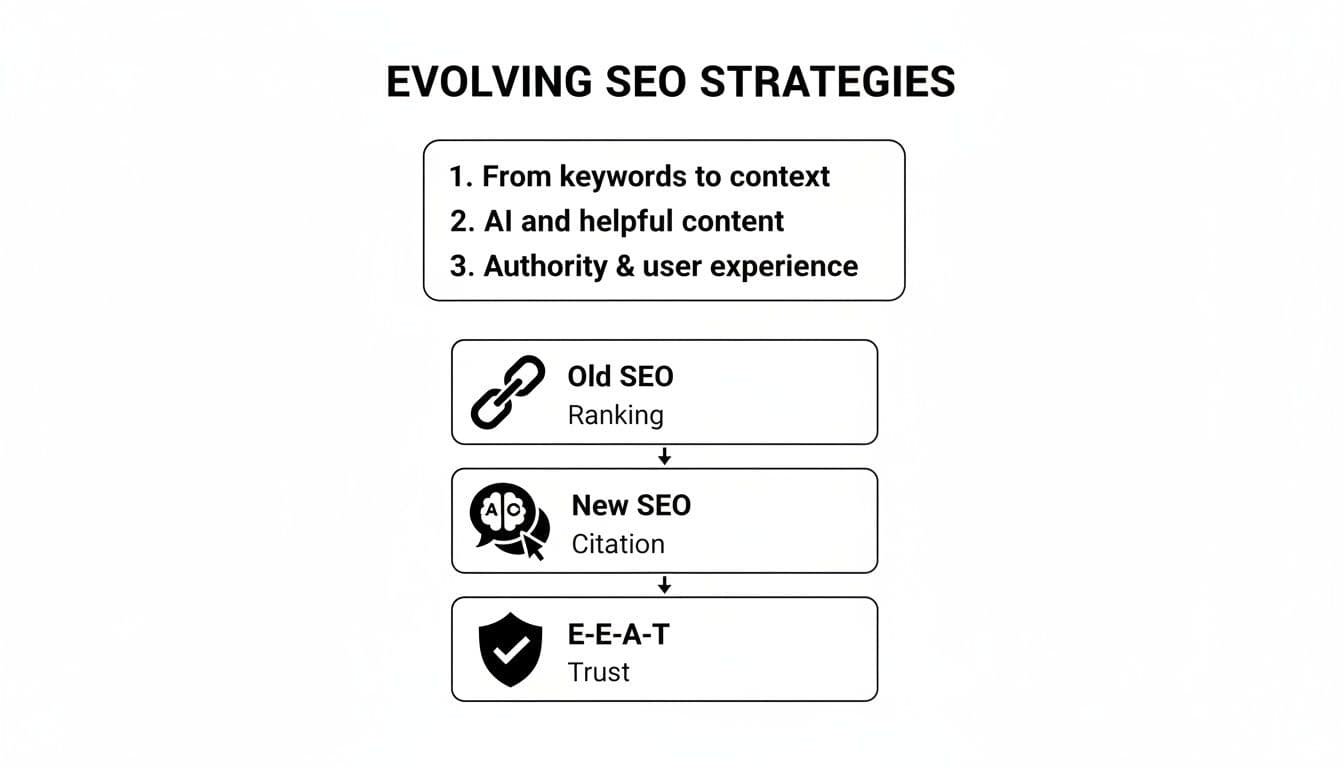
As you can see, while traditional ranking factors aren't going away, earning a spot as a trusted, citable source is now the primary driver of visibility in AI-powered search.
Use Advanced Schema Markup
Schema markup is the technical translator between your content and search engines. For AI Overviews, it's absolutely critical. It’s like putting little labels on all your information so the machine knows exactly what it's looking at—a person, a company, a question, an answer.
While basic schema is SEO 101, you need to go deeper to give the AI the rich context it craves.
AI Optimization Tactic Comparison
Choosing where to focus your efforts first can be tough. The table below compares these key tactics to help you prioritize based on your team's resources and goals.
Implementing advanced schema like FAQPage, Article, Person, and Organization removes any ambiguity about your content's credibility. It helps Google's AI verify who you are and why you're a trustworthy source, making it much more likely to feature your information.
Build Powerful Attribution Signals
Finally, you have to prove your content is trustworthy. AI models are programmed to be risk-averse; they will always favor a source that is verifiable and authoritative over one that isn't. Vague claims from anonymous writers just won't cut it anymore.
Here's how to build the signals that scream "authority":
- Give Authors a Face: Every article needs a named author with a detailed bio. That bio should link out to their professional profiles (like LinkedIn) and clearly state their credentials and real-world experience.
- Cite Your Sources: Back up your claims by linking to authoritative third-party sources—think academic studies, government data, or respected industry reports. This shows the AI your information is well-researched and not just an opinion.
- Create Original Data: Nothing builds authority faster than becoming a primary source. Publishing original research, surveys, or unique data sets makes you the go-to source of information, a signal that is incredibly valuable to an AI.
By weaving these tactics together, you create a robust framework for Google AI Overview optimization. You’re no longer just writing articles; you're engineering them to be the definitive answer. To dive deeper into adapting for Google's newest AI, check out our guide on how to increase visibility in Gemini and other generative models.
Real-World Examples of Successful AI Optimization
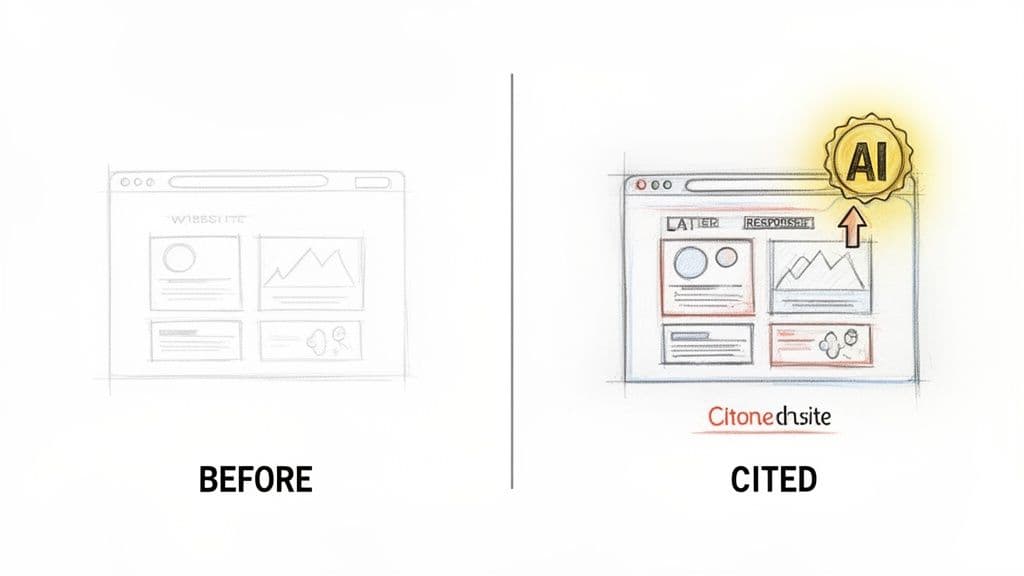
It’s one thing to talk about the tactics for Google AI Overview optimization, but it’s another thing entirely to see them actually work. The theory comes alive when you look at how real businesses are putting these ideas into practice to get a leg up on the competition. These examples show a clear "before and after," providing a solid blueprint for what success looks like.
Let's walk through two realistic scenarios where B2B companies managed to shift their content strategy and started earning those valuable citations in AI Overviews, effectively moving from internet noise to a trusted source in the eyes of Google's AI.
The SaaS Company That Mastered Conversational Content
Imagine a mid-sized SaaS company selling project management software. Their website was pretty standard—product pages loaded with marketing speak and dry feature lists. They were doing okay, even ranking on page one for a few keywords, but they were completely invisible in AI-generated answers for high-stakes queries like "best software for agile teams."
Their whole approach was rooted in an older SEO playbook, focused on keyword density and basic on-page factors. The content was written for a search algorithm from five years ago, not for the conversational AI that’s here today.
So, they decided on a complete content overhaul, guided by modern AI optimization principles. The difference was night and day.
The Transformation Strategy The team re-engineered their most important product pages and blog posts to follow a simple question-and-answer structure. They started by pinpointing the top 20 questions that potential customers were asking on sales calls and posting in online communities.
- Before: A key page had a generic heading like "Powerful Features."
- After: They swapped it for a direct, user-focused question: "What Features Make the Best Agile Project Management Software?"
From there, every feature was framed as a direct solution to a common problem, explained with simple language and easy-to-scan bullet points. They intentionally created "prompt-friendly snippets"—short, direct answers at the top of each section—that the AI could easily lift. For example, their section on integrations began with a single sentence summarizing the core benefit, making it the perfect soundbite for an AI Overview.
The payoff? Within three months, their brand started showing up in AI Overviews for 45% of their target comparison queries. They achieved this because they stopped just describing their product and started answering the exact questions their customers were asking.
This pivot didn't just boost their AI Overview visibility; it also resulted in better, more helpful content for their human audience. This kind of foundational work is critical, especially when building a wider strategy. For more on creating content that connects, guides like this one on content marketing for startups offer a great starting point.
The Professional Services Firm That Built Verifiable Authority
Next, consider a boutique consulting firm specializing in supply chain logistics. Their problem was different. They were up against massive, well-known corporations with huge marketing budgets and brands that had been around for decades. Their deep, genuine expertise was getting completely drowned out.
Their website had some incredibly insightful articles, but they were all published anonymously under the company name. There were no author bios, no links to external research, and no original data to support their claims. To an AI trained to look for E-E-A-T signals, they were a ghost.
Building Definitive Trust Signals Their optimization campaign was laser-focused on one thing: building verifiable authority and trustworthiness around their content.
- Author Credibility: They built out detailed author pages for each senior partner, highlighting their credentials, industry awards, academic backgrounds, and links to their LinkedIn profiles. Suddenly, every article was backed by a real, verifiable expert.
- Proprietary Research: The firm conducted its own small-scale industry survey and published the findings in a report. This original data quickly became a source that other blogs and news sites cited, building powerful backlinks and establishing them as an authority.
- Strategic Citations: They went back through their existing articles and added outbound links to respected academic studies and government data, proving their insights were grounded in well-established facts.
The results were massive. By making their expertise easy to verify, they gave Google’s AI the confidence it needed to cite them as a credible source. They began appearing in AI Overviews for very specific, long-tail queries where their niche knowledge could outshine the generic content from their larger competitors.
Their success is a perfect illustration that for Google AI Overview optimization, proving who you are is every bit as important as what you say.
How to Measure Success in an AI-Driven Search World
In a world increasingly dominated by AI Overviews, the old SEO dashboard just doesn't cut it anymore. Metrics we've relied on for years, like keyword rankings, are starting to feel incomplete. They still provide context, of course, but they don't tell the whole story.
When the new measure of success is being cited by an AI instead of just earning a click, how do you actually track the ROI of your Google AI Overview optimization? It's a question every marketer is asking. The answer lies in shifting our perspective and adopting a new analytics framework—one that tracks your brand’s influence within AI-synthesized answers and connects that visibility to real business goals. Without this, you're essentially flying blind.
Shifting from Rankings to Influence
First things first: we have to accept that "visibility" has a new meaning. A top-ten ranking is still good, but being the definitive source an AI quotes to answer a user's question? That’s a whole new level of authority. This demands a new set of key performance indicators (KPIs) built for the AI era.
These aren't just vanity metrics. They move past simple SERP positioning to measure your brand’s actual influence on the information users get straight from Google, giving you a much clearer picture of how your content is truly performing.
Here are the essential KPIs you need to start tracking now:
- Citation Frequency: This is your new North Star. It’s a simple count of how often your domain is cited as a source within AI Overviews for your target queries. A high frequency is direct proof that Google's AI trusts your content.
- Share of AI Voice: Think of this as your market share in the AI answer space. It calculates the percentage of AI Overviews in a given topic cluster where your brand is mentioned versus your competitors. If your Share of AI Voice is growing, you’re on your way to becoming the go-to authority.
- Branded Mentions in AI Responses: This metric tracks every time your brand or product name appears in an AI Overview, even if there isn't a direct link. These mentions are gold for building brand recall and signaling to both users and Google that you’re a major player.
Connecting AI Visibility to Business Outcomes
Tracking these new metrics is only half the battle. The real magic happens when you connect them to the outcomes your stakeholders actually care about—things like lead quality, brand authority, and market position. This is how you transform a cool SEO tactic into a core business strategy.
For instance, you can start drawing lines between your efforts and results. Does an increase in Citation Frequency for bottom-of-funnel keywords correlate with a jump in qualified MQLs? Does a higher Share of AI Voice lead to more people searching directly for your brand over time?
By demonstrating a clear line between being featured in AI Overviews and achieving core business goals, you transform AI optimization from an experimental SEO tactic into a strategic business driver.
To get a better handle on linking your work to meaningful results, check out our broader guide on digital marketing performance metrics.
Building the Business Case for AI Optimization
Once you’ve got the data, you need to tell a story that resonates with leadership. Your goal is to show that investing in Google AI Overview optimization isn’t just about keeping up with the latest trend; it’s about seizing a powerful competitive advantage.
Here's a straightforward framework for making your case:
- Establish the Baseline: Start by measuring your current performance with a tool like Attensira. Show everyone where you stand today using these new AI-centric KPIs.
- Highlight the Opportunity: Pinpoint important queries where your competitors are getting cited but you’re invisible. Frame this as low-hanging fruit—a clear chance to capture high-intent visibility you're currently missing.
- Project the Impact: Don't just show problems; propose solutions with projected outcomes. For example, show how boosting your Citation Frequency by 15% could realistically lead to a measurable lift in brand searches or inbound demo requests.
- Define the Resources: Be specific about what you need to get it done. Outline the necessary resources, whether it’s more budget for content creation, dedicated technical SEO support, or access to specialized tools.
By presenting a data-backed narrative, you can clearly show why adapting to an AI-first search world is critical, ensuring your efforts get the funding and recognition they deserve.
Your Top Questions About AI Overview Optimization, Answered
As we all wrap our heads around this new search reality, questions are bound to come up. Moving from the familiar world of blue links to one centered on AI-generated answers is a big leap, so a bit of uncertainty is completely normal. Here, we'll tackle the most common questions we hear from B2B marketers and SEO strategists about Google AI Overview optimization.
The idea is to clear up any confusion and double down on the strategies that actually work. These are straight answers, based on what we're seeing in the trenches of today's search results.
What's the Real Difference Between Traditional SEO and AI Overview Optimization?
The biggest shift is in the end goal. For years, traditional SEO has been a race to the top 10 rankings on a results page. The prize was simple: earning a click. Success was built on a familiar foundation of keywords, backlinks, and solid technical health.
Google AI Overview optimization, on the other hand, is playing for a totally different prize: getting your content cited directly inside the AI-generated answer at the very top of the SERP. The goal isn't just to rank anymore; it's to become a trusted source that the AI itself relies on. This requires a pivot toward creating authoritative content that directly answers specific questions in a natural, almost conversational way.
You're no longer just trying to rank a page. You're trying to become the origin of the answer. This means you have to go all-in on demonstrating verifiable E-E-A-T signals and use structured data to leave zero room for misinterpretation by the machine.
Are AI Overviews Going to Kill All My Organic Search Traffic?
It's extremely unlikely that AI Overviews will make organic traffic disappear entirely, but they are definitely changing the game. For quick, informational searches—the "what is" or "how to" type queries—clicks will almost certainly drop. Why click a link when you get a perfectly good answer right there?
But for the kind of complex B2B research that happens before a major purchase, people will still want to dig deeper. They’ll click through to the cited sources to get more context, validate the information, and see the full picture. This means your content now has to do two jobs at once: give the AI a perfect, concise snippet for the overview, and give the human user a compelling reason to click your link for the full story.
How Can a Niche B2B Business Possibly Compete with Huge Enterprises?
This is where niche B2B businesses actually have an edge. Your secret weapon is deep, specific expertise. While big companies might have broad authority across a ton of topics, Google's AI is being trained to value firsthand experience—that all-important "E" in E-E-A-T.
You can outmaneuver the giants by creating hyper-specific content that answers the nuanced, long-tail questions in your corner of the industry. Here's how to make it happen:
- Publish Detailed Case Studies: Nothing beats showing your expertise in action. A real-world case study is something a generalist competitor simply can't fake.
- Generate Proprietary Data: Conduct your own research or surveys. When you become the primary source for a key statistic, everyone else has to cite you.
- Lean on Credentialed Authors: Put your experts front and center. Feature content written by people with verifiable credentials and years of hands-on experience in the field.
By owning your niche, you become the go-to authority on topics the big players overlook, making your content the perfect candidate for an AI citation.
Where Does Technical SEO Fit into AI Optimization?
Technical SEO is more important than ever. Think of it this way: before Google's AI can recognize how brilliant your content is, its crawlers have to be able to find, index, and understand it flawlessly. Your technical SEO is the foundation for your entire content strategy.
A few key elements are simply non-negotiable for getting seen by AI:
- Robust Schema Markup: Use specific schema like
FAQPage,Article,Person, andOrganizationto spoon-feed context to search engines in a language they understand perfectly. - Blazing-Fast Page Speeds: A slow site is a bad signal, period. AI models will naturally favor sources that are quick and easy to access.
- Clean Site Architecture: A logical site structure helps crawlers understand the relationships between your content and reinforces your topical authority.
- Flawless Mobile Experience: With most searches happening on phones, a responsive design isn't a feature; it's a basic requirement for being in the game.
Without a rock-solid technical setup, even the most authoritative content in the world will be invisible to the AI models looking for answers.
Ready to stop guessing and start measuring your brand's visibility in AI Overviews? Attensira provides the actionable insights you need to track citation frequency, analyze your Share of AI Voice, and optimize your content to become a trusted source. See how you stack up against the competition and build a data-driven strategy for success. Learn more and get started at attensira.com.