Discover how a generative engine optimization service can secure your brand's visibility in an AI-powered search landscape. Learn the strategies that work.
A generative engine optimization service is a specialized strategy that gets your brand seen and trusted inside AI-generated search results, like Google's AI Overviews. It's a layer on top of traditional SEO, specifically designed to get your content understood and directly cited by the Large Language Models (LLMs) now powering modern search.
The New Search Landscape of Generative AI

For years, we all played the same game: get your website to the top of the ten blue links. That predictable results page is now being completely upended by generative AI. Search is shifting from a simple list of links into an active conversation, where the engine itself synthesizes and delivers the primary answer.
This move from a directory to a direct answer is powered by systems like Google's Search Generative Experience (SGE) and other answer-focused platforms. They don't just point users to information anymore; they consume it, process it, and generate a brand-new summary right at the top of the page. Suddenly, old SEO tactics don't carry the same weight.
From Indexing to Influencing
Let's break it down with an analogy. Traditional SEO is like creating a flawless index for a massive library. Your job is to ensure your book is listed perfectly under every relevant topic so that when someone looks up "marketing automation," your book is the first one they see.
Generative Engine Optimization (GEO), on the other hand, is like personally teaching the head librarian—the AI—about the ideas inside your book. You're not just getting on a list. You're building trust, so the AI librarian is confident enough to recommend and quote your work directly when someone asks a question.
That distinction changes everything. When the search engine is the answer, being the source of that answer is the new number one spot. A dedicated generative engine optimization service is what gets you there.
The Widespread Adoption of AI in SEO
This isn't some far-off trend; it's happening right now. As of 2025, a staggering 86% of SEO professionals have already folded artificial intelligence into their daily strategies. The move is paying off, too, with 65% of businesses reporting significantly better SEO outcomes after bringing AI into the mix.
The practical use cases are everywhere. You can see clear examples of how ChatGPT is being used for SEO to accelerate everything from content creation to technical audits. It's a clear signal that a specific, AI-focused strategy isn't just a nice-to-have anymore.
Preparing for the Answer-First Future
The fundamental question for marketers has changed. It's no longer just, "How do I rank number one?" Now, it’s, "How do I become a trusted source for the AI's answer?" This requires a deliberate focus on a few key areas:
- Entity Recognition: Making sure the AI understands precisely who you are, what you specialize in, and the concepts you own.
- Structured Data: Feeding information to LLMs in a clean, machine-readable format they can easily digest and verify.
- Conversational Content: Crafting content that directly answers the complex, multi-layered questions people are asking these new AI engines.
This is all part of a much bigger shift in how people find information, a dynamic we explore in our comparison of Perplexity vs Google. As search engines become conversational partners, our optimization has to evolve right alongside them.
What Exactly Is a GEO Service?
Let's be clear: a generative engine optimization (GEO) service isn't just a new coat of paint on traditional SEO. It's a completely different discipline, built from the ground up for the age of AI search. We're witnessing a fundamental strategic shift, moving away from simply ranking a link to becoming a primary, trusted source for the AI itself.
Think about it like this. For years, SEO has been about making your website easy for a search engine to find and index. A GEO service goes a step further. Its core mission is to make your website’s information so clear, authoritative, and well-structured that a Large Language Model (LLM) can confidently pull from it to construct its own answers and AI-generated summaries.
Ultimately, this service ensures your brand's expertise is properly understood, synthesized, and cited directly within the AI-driven results—the very first thing a user sees, long before they ever get to a list of blue links.
Shifting Focus From Keywords to Concepts
For a long time, the SEO world revolved around keywords. While they aren't going away, a generative engine optimization service elevates the strategy to focus on entities and concepts.
So what's an entity? It's anything an AI can clearly define—a person, a company, a product, or a specific topic. A concept is the network of relationships and ideas connected to that entity. A GEO service works to establish your brand as the authoritative entity for the concepts that drive your business.
This is about optimizing for the AI's understanding of the world, not just for matching simple strings of text.
A generative engine optimization service isn’t about tricking an algorithm. It's about earning the trust of a synthetic intelligence by providing verifiable, high-quality, and contextually rich information that helps it generate better, more accurate answers for users.
It marks a necessary move from a tactical, keyword-driven game to a more holistic, authority-based strategy.
The Core Philosophy: Authority and Structure
The entire philosophy of GEO is built on two pillars: demonstrating undeniable authority and providing flawless structure. LLMs are specifically trained to identify and reward sources that show deep, trustworthy expertise. A generative engine optimization service is designed to build this authority methodically.
This philosophy breaks down into a few key components:
- Verifiable Expertise: The service focuses on creating and interlinking content that proves your brand's deep experience and knowledge, always referencing data, credible sources, and expert insights.
- Structured Data Implementation: It uses advanced schema markup to essentially translate your content into a language that LLMs can instantly understand. This clarifies the relationships between all the different pieces of information on your site.
- Conversational Relevance: Content is intentionally crafted to directly answer complex, intent-driven questions, which perfectly mirrors the conversational way people now interact with generative AI.
This combined approach makes sure that when an AI engine like Google's SGE or Perplexity scans the web to build an answer, your content isn't just visible—it's usable, credible, and perfectly primed for synthesis.
Beyond Traditional Metrics
Where old-school SEO often obsessed over things like keyword density and the sheer number of backlinks, a GEO service prioritizes a more sophisticated set of signals. Backlinks are still valuable, of course, but their context and the authority of the domain linking to you matter far more now.
Instead of measuring success just by a link's position on a page, a GEO service is far more concerned with how often your brand gets mentioned or cited within the AI's direct response. This is an evolution, not a replacement. It's a critical layer built on top of a solid SEO foundation—one that prepares your digital presence for an answer-first world. The goal is to ensure you're not just on the list, but an integral part of the conversation itself.
The Core Components of a Modern GEO Service
A professional generative engine optimization service isn’t about flipping a single switch. It's a disciplined, multi-layered practice—more like conducting an orchestra than playing one instrument. The goal is to build such undeniable authority that your brand becomes a foundational source for AI-generated answers.
These strategies work in concert to ensure you're not just seen, but cited. It’s a major shift from old-school digital marketing, zeroing in on how Large Language Models (LLMs) actually find, process, and piece together information to create their responses.
Entity and Knowledge Graph Optimization
At the very core of GEO is entity optimization. Think of an "entity" as any distinct thing an AI can understand: your company, your products, your CEO, or even the core ideas you own. A smart GEO service starts by nailing down and solidifying your brand's most important entities.
The objective is to build a rich, interconnected knowledge graph around your brand. It’s like creating a detailed, living Wikipedia entry for your business that exists across the entire web. This makes it incredibly easy for AI to grasp who you are, what you do, and why you're a legitimate authority. This process includes:
- Consistent Branding: Making sure your name, address, and core business descriptions are identical everywhere online. No variations allowed.
- Structured Data Implementation: Using advanced schema markup to spoon-feed AI the details, defining your entities and their relationships right in your website's code.
- Authority Building: Linking your brand entity to other trusted entities through high-quality citations, press mentions, and collaborative content.
This groundwork makes your brand a known, verifiable source that an LLM can reference with absolute confidence.
Advanced Content and Semantic Structuring
Content is still king, but its structure now holds the keys to the kingdom. A modern GEO service is obsessed with structuring content semantically—that is, organizing it around topics and what the user actually wants, not just stuffing in keywords. AI engines need content that is not only well-written but also laid out so logically that its meaning is unmistakable.
The whole point is to make your content so clear and contextually rich that an AI doesn’t have to guess what you’re talking about. Every heading, list, and data point should act as a signpost, guiding the LLM straight to the most important information.
This often means breaking down big, complex topics into smaller, more digestible pieces. For example, instead of one monster article, a GEO strategy might create a central "pillar" page supported by numerous in-depth articles that explore specific sub-topics. This "topic cluster" approach screams comprehensive expertise—a signal that AI models are actively looking for.
Conversational Query and Intent Analysis
People talk to generative AI differently than they type into a search box. Their queries are longer, more natural, and often framed as complex questions. A crucial part of any real GEO service is digging deep into these conversational queries.
This is worlds away from traditional keyword research. It’s about figuring out the intent behind the question. Is someone looking for a simple definition, a product comparison, a step-by-step guide, or a direct solution to a problem? The service then creates content that directly answers these very specific needs.
- FAQ-Style Content: Crafting direct, concise answers to the questions your audience is already asking.
- How-To Guides: Developing detailed, step-by-step tutorials that solve real-world problems.
- Comparison Articles: Building content that objectively weighs products, services, or ideas, helping users make smart decisions.
By aligning your content with the way people actually talk and think, you position your brand as the most helpful source for an AI to pull from. It's a proactive strategy that gets you into the conversation from the very start. To get a better sense of the technology behind this, check out our guide on the best generative engine optimization tools on the market.
The Strategic Shift from SEO to GEO
To really see how much things have changed, it helps to put the old and new approaches side-by-side. The game has moved on from pleasing technical web crawlers to building genuine trust signals for a synthetic intelligence.
Here’s a look at that fundamental shift.
Traditional SEO vs Generative Engine Optimization Focus
As the table shows, a generative engine optimization service isn't just a new line item for your marketing budget. It represents a fundamental rethinking of how to earn visibility in a world where search engines give you the answer directly.
How a Generative Engine Optimization Project Unfolds
It's one thing to understand the theory behind Generative Engine Optimization (GEO), but it’s another to see how it actually works. So, how do you go from a concept to a real-world strategy? Let's walk through the typical workflow.
A professional generative engine optimization service isn't a one-time task you just check off a list. It’s a methodical, multi-phase process designed to build durable authority with AI models. Each step builds on the one before it, systematically teaching AI engines to recognize, trust, and ultimately cite your brand as a go-to source. It’s a deliberate journey from initial discovery to long-term performance tracking.
Phase 1: Discovery and Entity Auditing
Every good GEO project kicks off with a deep dive into your digital footprint. This isn't your standard SEO audit focused on keywords and backlinks. Instead, we conduct an entity audit, which is all about mapping out how AI search engines currently see your brand, your products, and your key people.
We analyze your existing knowledge graph to pinpoint any inconsistencies in how your brand shows up across the web. The goal is simple: find the gaps and contradictions that could confuse a large language model.
This phase answers some crucial questions:
- Does the AI actually get who you are and what you do?
- Is there conflicting information about your company floating around online?
- How tightly is your brand entity connected to your core business topics?
Getting clear answers here gives us a solid baseline and shapes the entire strategy that follows.
Phase 2: Conversational Query Analysis
Once we have a firm grasp of your entity, the focus shifts to your audience. We move far beyond traditional keyword research and into conversational query analysis. This means we’re digging into the complex, multi-part questions your customers are actually asking AI assistants like Google’s AI Overviews and Perplexity.
Think about it: people talk to AI differently than they type into a search bar. They use natural language, they ask follow-up questions, and they expect detailed, nuanced answers.
A generative engine optimization service has to anticipate these conversational journeys. The aim is to map out the entire ecosystem of questions around a topic—not just a few primary keywords—to make sure your content can satisfy a user's complete line of inquiry.
This analysis gives us a blueprint of the exact language and intent of your audience, showing us precisely how to create content that speaks directly to their needs.
The process flow below shows how these initial phases of defining your entity, structuring the data, and aligning with user conversations all fit together.

As you can see, it’s a clear progression from defining who you are (Entity) to making that information machine-readable (Structure) and finally matching it to what users are asking (Conversational).
Phase 3: Content and Data Structuring
This is where the rubber meets the road. Using the insights from the first two phases, we get to work optimizing your digital assets. This happens along two parallel tracks: content enhancement and data structuring.
- Content Enhancement: We start by refining your existing content and creating new pieces specifically designed to answer the conversational queries we uncovered. This content is built logically, with clear headings, lists, and direct answers that make it incredibly easy for an LLM to parse and pull from.
- Data Structuring: At the same time, we implement advanced schema markup. Think of this code as a translator for the AI. It explicitly defines the entities on your pages—like your company, products, or services—and clarifies their relationships. It’s like putting little descriptive labels on all your information so the machine has zero doubt about what it’s reading.
This two-pronged approach ensures your content isn't just valuable for people, but also perfectly formatted for AI consumption.
Phase 4: Performance Monitoring in AI Snapshots
Finally, a GEO project is never really "done." The last phase is all about continuous monitoring and refinement. We track how often your brand gets cited in AI Snapshots, AI Overviews, and other generative results for your target concepts.
This requires specialized tools that look beyond old-school rank tracking. We measure things like citation frequency, the sentiment of the mentions, and even the click-through rate from links that appear inside AI-generated answers. This data provides direct, actionable feedback on how well the strategy is working, allowing us to make ongoing adjustments to grow your visibility as a trusted AI source.
Measuring Success in the Age of AI Search
How can you tell if your investment in a generative engine optimization service is paying off? When the ultimate prize is a citation in a single, definitive AI answer, old-school metrics like keyword rankings start to feel a little hollow. The classic SEO playbook of fighting your way from position #10 to #1 just doesn't apply in the same way.
To get a real sense of performance, you need a fresh set of Key Performance Indicators (KPIs) built for this new world. Success isn't just about driving clicks to a webpage anymore; it's about directly influencing an AI's knowledge and becoming a trusted source it relies on for its answers. This means we have to shift our focus from rank position to direct influence within AI-generated content.
Moving Beyond Traditional SEO Metrics
The rise of generative AI has made the competitive landscape a lot more interesting. While some folks predicted AI would kill search traffic, the reality has been far more nuanced. A recent study from Exploding Topics found that a surprising 99% of generative AI users still use regular search engines. People are using them as complementary tools, not replacements.
This dual-usage behavior means you can't abandon traditional SEO, but you absolutely have to measure your GEO efforts with a different yardstick. For GEO, we need metrics that actually quantify our influence on the AI models themselves.
New KPIs for a New Era
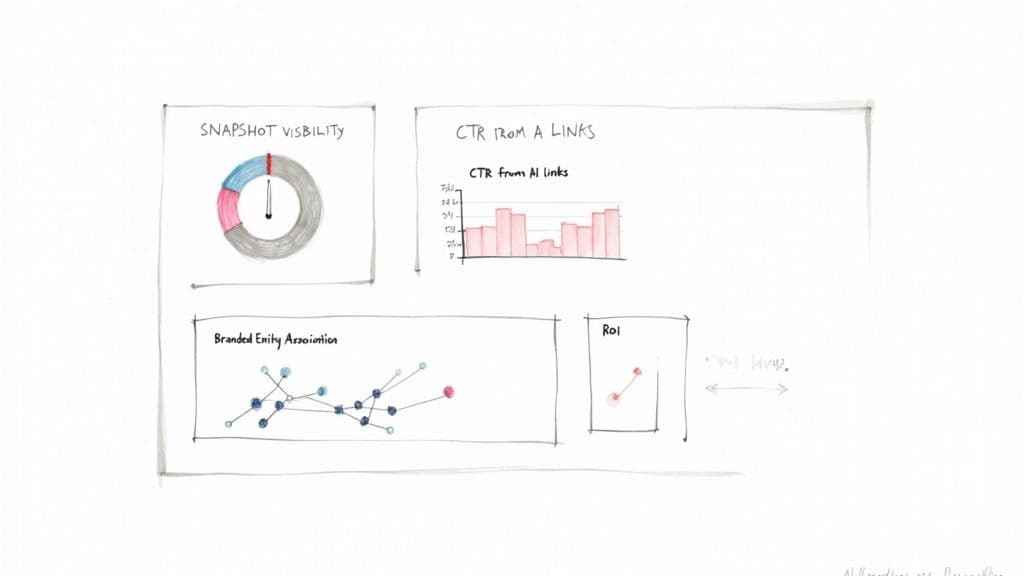
To measure the true ROI of a generative engine optimization service, we have to adopt a new generation of performance indicators. These metrics paint a clear picture of how AI systems perceive and use your brand.
Here are the core KPIs that matter now:
- Snapshot Visibility Rate: This is the big one. It measures how often your brand, product, or content gets cited in AI Overviews and other generative answers for your target queries. Think of it as the new "impression share," but for the age of AI.
- Branded Entity Association: This KPI tracks how strongly an AI model connects your brand (the "entity") to key concepts in your industry. A high score here means that when a user asks about "enterprise cybersecurity solutions," the AI is far more likely to mention your company as a leader.
- Click-Through Rate (CTR) from AI-Generated Links: When an AI does include a link to your site in its answer, how many people actually click it? This metric measures the trust and authority your citation commands.
These new metrics shift the focus from a simple ranking number to a more meaningful measure of authority and influence. They directly answer the question: "Is the AI learning that we are the expert?"
Tools for Tracking GEO Performance
Measuring these advanced KPIs requires more than what Google Analytics can offer. You need specialized software to peek inside the "walled gardens" of AI responses and monitor your brand's presence. These platforms are built to track mentions, analyze sentiment, and report on your visibility across different Large Language Models (LLMs).
Tracking these metrics is the only way to refine your GEO strategy and prove its value. If you're looking to explore the software that makes this possible, our guide on the best LLM tracking tools to monitor AI search in 2025 offers a detailed look at the leading options. By embracing these new measurement frameworks, you can confidently navigate the AI search landscape and deliver tangible business results.
How We Implement Best-in-Class GEO
At Attensira, our generative engine optimization service isn't just theory—it's a disciplined, data-driven practice. We blend deep technical SEO with a sharp understanding of how Large Language Models behave, all to build undeniable brand authority for our clients. Our process is designed to do more than just get you ready for the future of search; it puts you at the front of the line.
Our whole philosophy is built on proprietary tools and a methodical, step-by-step process. We don't just tweak content. We engineer your entire digital presence to be perfectly understood, trusted, and ultimately cited by AI. Getting this right often means leaning on robust Artificial Intelligence integration services to weave AI capabilities directly into your existing systems.
Proprietary Entity and Knowledge Graph Analysis
Our work kicks off with a rigorous entity audit. Using our own specialized tools, we map out how major AI models currently see your brand’s knowledge graph. This lets us pinpoint the exact inconsistencies and weaknesses that are diluting your authority. This goes way beyond keywords; it's about turning your brand into a clean, verifiable data source.
From there, we build a comprehensive knowledge graph strategy. This is a meticulous process of structuring your website's data and making sure every single piece of content reinforces your core expertise. The end goal is simple: to make your brand synonymous with the concepts you need to own.
Our method is designed to teach AI models that your brand is not just a source of information, but the definitive source. We build a web of interconnected, authoritative content that an LLM can reference with high confidence.
This structured approach ensures that your expertise isn't just claimed—it's proven through a network of verifiable data points that AI can trust.
A Focus on Verifiable, Authoritative Content
Every article, guide, or resource we help create is constructed to be an authoritative asset. We concentrate on producing material that is not only well-written but packed with verifiable facts, clear citations, and original insights. This creates an incredibly powerful signal for LLMs, which are explicitly trained to prioritize sources that demonstrate genuine, provable expertise.
Ultimately, this process turns your website into a reliable library of information that generative engines can draw from with complete confidence.
Case Study: A B2B SaaS Success Story
Let’s walk through a real-world example. A B2B SaaS client in the logistics software space came to us with solid organic traffic, but they were completely invisible in AI-generated answers for critical industry questions.
Our process broke down into three distinct stages:
- Entity Solidification: The first thing we did was clean up their digital footprint. We ensured their company info and product details were perfectly consistent everywhere, from their own website to niche industry directories.
- Content Structuring: Next, we completely overhauled their blog content, organizing it into logical topic clusters. We created a central pillar page on "Supply Chain Automation" and surrounded it with detailed articles that answered very specific questions. We then implemented advanced schema markup to explicitly define these relationships for AI.
- Authority Signals: Finally, we went to work securing citations and mentions in reputable logistics trade publications. This directly linked their brand entity to authoritative conversations already happening in their industry.
The results? Within six months, the client started showing up as a primary source in AI Overviews for high-intent searches like "best software for warehouse inventory management." This drove a stream of highly qualified traffic and, just as importantly, positioned them as an industry leader in the minds of both potential customers and AI.
Frequently Asked Questions About GEO Services
It's natural to have questions as we all adapt to AI-driven search. Getting a handle on how this all works is the first step toward making the right call for your business. Let's tackle some of the most common questions we hear about GEO.
Is Generative Engine Optimization Replacing Traditional SEO?
Not at all. Think of GEO as an evolution of SEO—a new layer built for the age of AI, not a replacement for what already works.
The fundamentals of traditional SEO are still critical. Things like technical site health, a great mobile experience, and quality backlinks build the foundation of trust that AI models look for. A generative engine optimization service simply adds to that foundation, layering on specific strategies to make sure your content is perfectly structured for Large Language Models to find, understand, and cite.
How Long Does It Take to See Results from a GEO Service?
Much like traditional SEO, GEO is a long-game, not an overnight fix. You can often see early signs of progress, like better indexing of your structured data or appearances in AI-generated snippets for niche questions, within the first 3-6 months.
But for broader, more competitive topics, earning consistent visibility takes more time—usually in the 6-12 month range. It's a methodical process of building a reputation as an authority with the search engine's AI. It's gradual, but the results are built to last.
The real goal of a generative engine optimization service is to make your brand a cornerstone of truth for an AI. That kind of authority requires consistent, dedicated effort over time.
Can I Do Generative Engine Optimization Myself?
You can certainly get started with the basics. Creating clear, well-structured content is a great first step that aligns with core GEO principles.
However, a full-blown strategy requires a much deeper technical skillset. We're talking about implementing advanced schema markup, mapping out entity relationships, and constantly analyzing how LLMs are behaving. A specialized generative engine optimization service brings the dedicated tools and hands-on experience needed to handle that complexity, which is why it's a more reliable path for businesses serious about getting results.
Ready to make your brand an authority in the age of AI search? Attensira provides the expertise and tools you need to become a trusted source for generative engines. Learn more and start your journey with Attensira today.