Generative Engine Optimisation for Startups: Uncover AI-Driven Tactics to Accelerate Growth and Boost Efficiency
If you're running a startup, your goal with content should be to make sure it's the go-to source for AI platforms like Google's AI Overviews and ChatGPT. This is the essence of Generative Engine Optimisation (GEO). It’s a shift from just trying to rank on a results page to becoming an authoritative source for the models themselves.
In a world where customers get direct answers from AI instead of clicking through links, mastering this is a matter of survival.
Why GEO Is Your Startup's New Growth Engine
Let's be blunt: the way customers find you has fundamentally changed. Search isn't just a list of blue links anymore; it's a direct conversation with an AI. Sticking to old-school SEO is a high-risk gamble that could make your startup completely invisible to your next wave of customers.
The conversation inside sharp marketing teams has already shifted. It's no longer, "Are we publishing enough?" It's now, "Is our content actually shaping the answers buyers get from AI?" This new reality demands a new playbook. We're moving from Search Engine Optimization to Generative Engine Optimisation.
The End of Search As We Knew It
For the past twenty years, the startup growth manual had one core chapter: rank on Google. But today's AI-powered search engines—Google's AI Overviews, Perplexity, and others baked into the tools we use daily—are tearing up that chapter. They pull information from multiple sources to cook up a single, neat answer right at the top of the page.
If your startup isn't one of the sources they trust, you're invisible for that search. This isn't some far-off future; it's happening right now. The big change is the pivot from links to language.
- Traditional SEO: Visibility was all about ranking high on a results page. It was a game of keywords, backlinks, and site health. Success was measured in clicks.
- Generative Engine Optimisation: Visibility now means getting cited or referenced directly inside an AI-generated answer. Success is measured by reference rates and your share of voice within the model's output.
To really get a handle on this shift, it's worth understanding The Future Of SEO In The Time Of Generative AI, which breaks down how content discovery is being completely rewired.
The new paradigm is emerging, one driven not by page rank, but by language models. We’re entering Act II of search: Generative Engine Optimization (GEO).
Your Strategic Advantage in an AI-First World
As a startup with limited resources, this probably sounds intimidating. But here's the good news: GEO actually levels the playing field.
Unlike traditional SEO, where legacy domains with huge backlink profiles have a massive head start, GEO rewards clarity, authority, and well-structured information. An AI model doesn't care about your domain age; it cares about how well you communicate your expertise.
Thinking of GEO as a strategic advantage, not just a technical task, is the key. Your mission is to build a "corpus of trust"—a body of content so good that it establishes your brand as the undeniable authority in your niche. By getting this right early on, you can build a competitive moat that bigger, slower companies will struggle to cross.
As you start piecing together your plan, our guide on content marketing for startups can help you align all your efforts for the best results.
Auditing Your Startup's AI Visibility
Before you can even think about optimizing for generative AI, you have to know where you stand. Guesswork is your enemy here. The very first step is a comprehensive AI visibility audit—think of it as a diagnostic to see how engines like ChatGPT or Google's AI Overviews currently see and talk about your brand.
Without this baseline, any strategy you develop is just a shot in the dark. You need to know: Are we even being mentioned? Is the information accurate? And how are we positioned against our competitors in this new, conversational search world?
Kicking Off Your Manual Audit
The easiest way to start is to put yourself in your customers' shoes. Go directly to Google AI Overviews, Perplexity, and ChatGPT and start asking the questions your ideal buyers would.
Let's say you're a project management startup called "FlowTask." You’d want to test queries like:
- "best project management tools for small remote teams"
- "FlowTask alternatives for enterprise companies"
- "what are the key features of FlowTask"
- "is FlowTask better than Asana for agile development"
Document everything. I mean it—take screenshots of the answers. Pay close attention to whether you’re mentioned, the context of that mention, and which competitors show up time and again. This initial deep dive is often an eye-opening, and sometimes frustrating, experience.
You might find an AI model is pulling old pricing from a G2 review from two years ago, or completely misrepresenting your core value prop. These are the fires your GEO strategy needs to put out first.
This manual approach gives you a fantastic qualitative feel for your presence, but it’s not scalable. To build a real, defensible Generative Engine Optimisation strategy, you have to systematize the process and track your performance over time.
Systematizing Your AI Visibility Tracking
One-off checks are a good start, but a repeatable system is what turns those initial observations into hard, actionable data. The goal is to move from sporadic searches to a structured audit that constantly monitors your brand's footprint across the entire AI ecosystem. This is where dedicated platforms become absolutely essential.
The game is changing fast. By March 2025, AI Overviews were already showing up for 10.4% of keywords, a massive 72% jump in just two months. This isn't a minor tweak; it's a seismic shift causing some sites to report organic traffic drops between 20-40% because users get their answers without ever clicking.
This rapid evolution is precisely why you can't afford to "set it and forget it." Continuous monitoring helps you spot misinformation before it spreads and tells you which of your content assets are actually influencing AI responses. You can get a head start by learning more about how to track your brand's visibility in ChatGPT and other top LLMs.
This image shows just how much the game has changed, moving from old-school SEO to this new GEO-focused world.
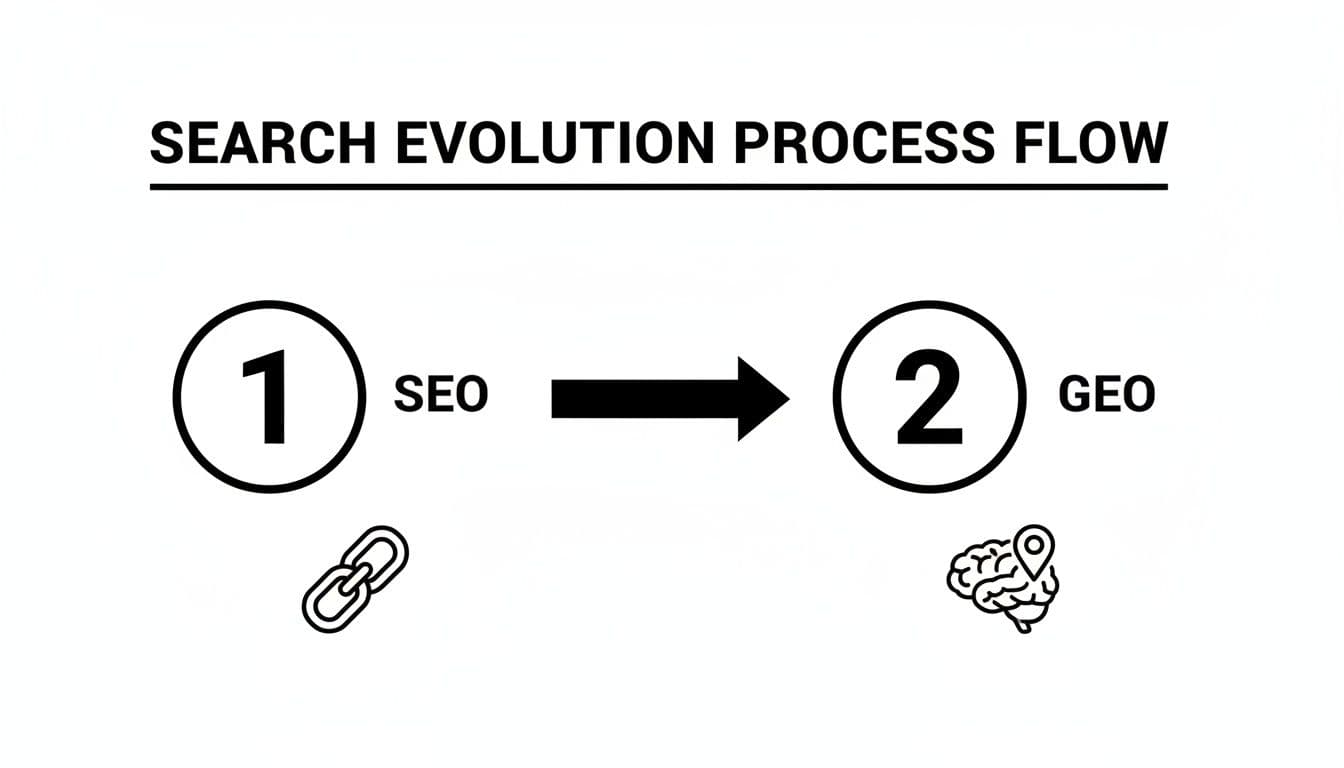
The flow is clear: we've moved from optimizing for clicks and links (SEO) to optimizing for direct inclusion and accurate representation in AI answers (GEO). For a startup, making this pivot is non-negotiable.
Establishing Your Baseline Metrics
A proper audit isn't just about discovery; it's about setting the benchmarks you'll measure every future effort against. It turns vague goals into concrete KPIs. The output of your audit should be a crystal-clear snapshot of your current performance, highlighting both the fires you need to put out and the opportunities you can seize.
This checklist can guide your initial audit, ensuring you cover all the critical bases.
AI Visibility Audit Checklist
By completing this checklist, you're not just gathering data; you're building an evidence-based roadmap.
With this baseline established, your path forward becomes incredibly clear. You now know which informational gaps to fill, which negative narratives to counteract, and which competitive advantages to amplify. Your audit is complete, and the real work of optimization can finally begin.
Tuning Your Content for Generative Engines
Once you've mapped out your current AI visibility, it's time to get your hands dirty. The goal is to create content that AI models don't just stumble upon, but actively trust and use as a source. This goes way beyond the old advice of "just write great content." We're talking about specific, actionable frameworks for Generative Engine Optimisation for Startups—the kind that makes your startup the go-to authority for the questions your customers are asking.
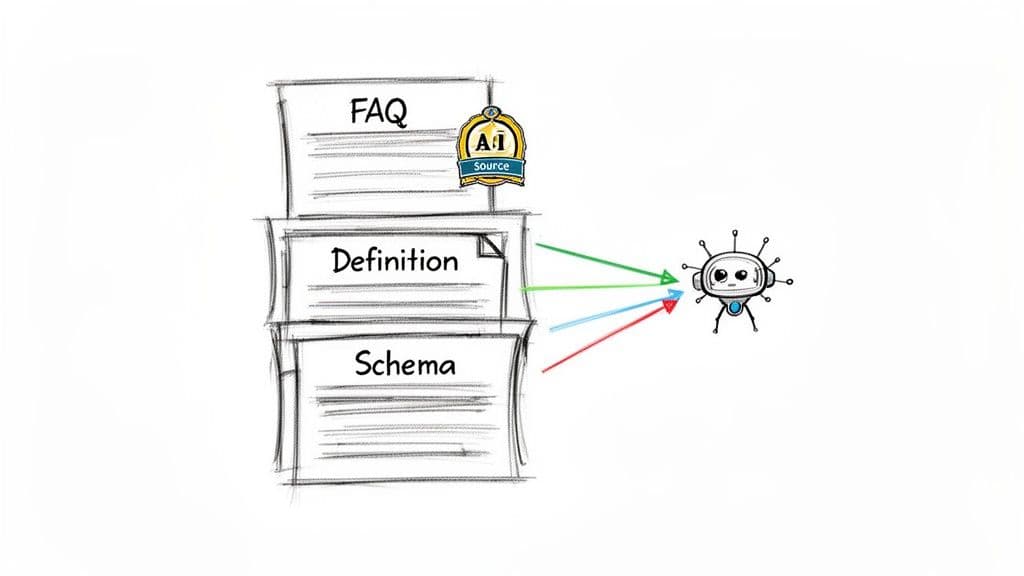
The difference between a generic blog post and one built for AI citation is night and day. Generative engines are built to reward clarity and structure; they prioritize content that is well-organized, factually dense, and easy to parse. Keyword stuffing is out; precision is in.
Building a Corpus of Trust
Your mission is to build what I call a "corpus of trust." Think of it as your company's public-facing knowledge base, designed for both humans and AI to consume. Each article, guide, or FAQ needs to be a definitive resource on a single, focused topic.
This shifts your entire strategy from chasing broad, high-volume keywords to truly owning specific concepts. Generative engines construct answers by pulling information from multiple sources. When you become the most reliable source for a cluster of related concepts, you dramatically increase your odds of being cited.
And the payoff is real. We're seeing startups that are adapting their content for AI search getting huge returns. Traffic from AI search is up an incredible 527% year-over-year from January-May 2024 to 2025. Even better, these visitors are converting at 4.4x the value of traditional organic traffic. Suddenly, a handful of visits can turn into major revenue wins. You can see more data on this trend in recent AI SEO statistics from Semrush.
How to Structure Content for AI Comprehension
AI models don't "read" your content like a person does. They process it, looking for facts, entities, and the relationships between them. This means how you structure your content is just as crucial as the words you choose.
Here are three practical structures I always recommend:
- Definitional Posts: Dedicate articles to clearly defining core terms in your industry. Kick things off with a direct, one-sentence definition (e.g., "Generative Engine Optimisation is the practice of...") before you dive into the details.
- Comparative Analysis: Pit your product directly against a competitor or an alternative solution. Use simple tables and clear headings to lay out the comparison—this makes it incredibly easy for a machine to understand the differences.
- FAQ Schemas: Build out dedicated FAQ pages that tackle the most common questions about your product, your space, and the problems you solve. Make sure to use proper FAQ schema markup to explicitly tell search engines, "Hey, this is a question and this is the answer."
This structured approach is a key part of what many now call Answer Engine Optimization. If you want to go deeper on that, we've put together a full guide on Answer Engine Optimization.
For a startup, every piece of content should be engineered to answer a question or define a concept with absolute clarity. The AI is your primary audience; if it understands you, it will show you to your human audience.
The Power of Factual Density and Defining Entities
Generative engines are designed to find and deliver accurate, factual answers. The easiest way to align your content with this is to boost its factual density. This isn't about writing more words; it’s about packing more verifiable facts, data points, and specific details into every sentence.
Instead of a vague statement like, "Our software helps teams be more productive," get specific: "Our software reduces project completion time by an average of 18% for teams of 10-50 users, according to our Q2 2024 user data." The second version is loaded with specific entities and verifiable information that an AI can latch onto.
Here’s a simple table to show what this looks like in practice:
Each optimized example contains clear entities—5-minute, $5k/year, 2022, B2B fintech—that an AI can extract, verify, and use to build a more accurate picture of your brand. This systematic approach turns your marketing copy into a reliable data source for generative AI, positioning your startup as the authority you need to be to win in this new era of search.
Building Authority with Technical Signals
If you think great content is all it takes to win in this new AI-driven search world, think again. That's only half the story. For a generative engine to actually trust and cite your startup’s content, it needs to be underpinned by a rock-solid technical foundation. These technical signals are the machine-level votes of confidence that prove you're a legitimate, authoritative source.
Think of it this way: your content is the expert testimony, but your technical setup is the expert's credentials. Without those credentials, even the most brilliant testimony gets dismissed. We're moving beyond simply writing answers; we're engineering trust.
Reinforcing Expertise with Structured Data
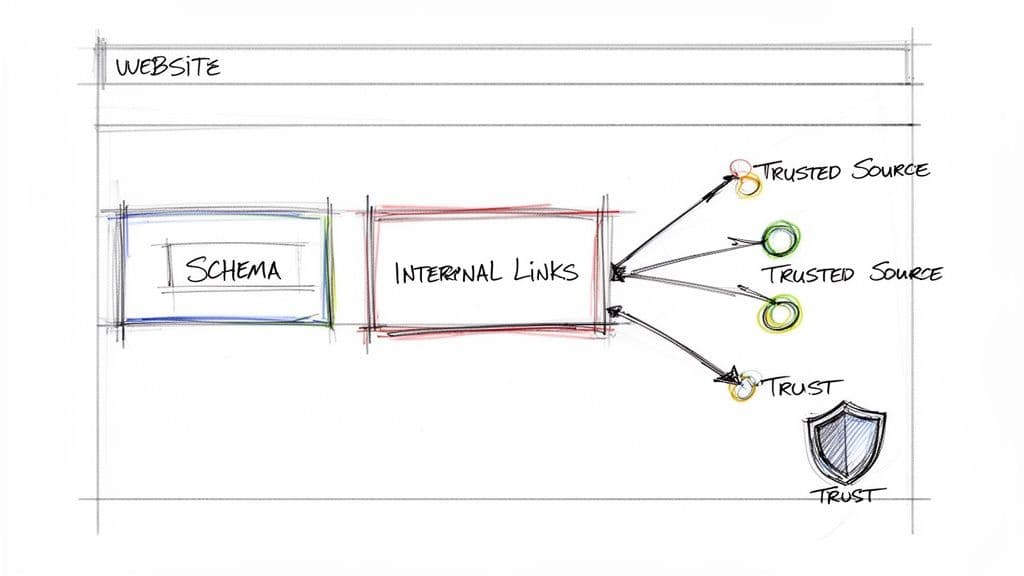
One of the most potent tools in your GEO arsenal is structured data, which you probably know as schema markup. This is a specific vocabulary you add to your website's code to tell search engines and AI models exactly what they're looking at. It removes all the guesswork.
Instead of leaving an AI to infer what your page is about, you can use schema to explicitly label key entities. You can tell it things like:
- "This is our company's official name."
- "This number is our product's price."
- "This text is a direct answer to a frequently asked question."
This is a massive advantage for a startup. You’re essentially feeding the AI clean, reliable data, directly influencing how it perceives your brand, product features, and expertise. A sharp schema strategy is your direct line of communication to the machine.
The New Role of Links in a Generative World
In traditional SEO, backlinks were the currency of authority. In GEO, their role evolves but they are every bit as critical. High-quality citations and links from reputable, contextually relevant sources are powerful endorsements that AI models absolutely notice.
A link from a respected industry journal or a citation on a Wikipedia page is powerful third-party verification. It signals to the AI that other trusted entities vouch for your information. And to establish real authority today, you need to show your expertise runs deep—for instance, by demonstrating a core understanding of how AI systems use efficient storage like modern vector databases.
Internal linking is just as vital. A smart internal linking strategy creates a logical web of knowledge across your site. When you link your foundational blog posts to your feature pages and comparative guides, you're not just helping users—you're showing AI models the relationships between concepts, building a dense, interconnected corpus of trust. This is fundamental to entity recognition, something we dive into deeper in our guide to the https://attensira.com/blog/google-knowledge-panel.
In the GEO era, every high-quality backlink is a training data point that tells an AI model, "This startup knows what it's talking about." It's less about link volume and more about the quality and context of the citation.
Creating a Data-Driven Feedback Loop
Here's the thing: implementing these technical changes isn't a "set it and forget it" task. The final, crucial piece is building a feedback loop to see how these adjustments are actually impacting your visibility in AI-generated results. This is how you turn hopeful guesses into a dynamic, data-driven process.
The AI landscape is shifting constantly, so you have to keep your eye on the ball. Consider that 86% of SEO professionals are already using AI tools to get 65% better outcomes. With AI Overviews poised to show up in up to 55% of searches and potentially cut organic traffic by as much as 34.5%, a GEO-focused strategy is no longer optional.
This is where a platform like Attensira becomes invaluable. You can track changes in your brand's citation frequency, sentiment, and accuracy in AI responses right after you deploy new schema or land a key backlink. This allows you to:
- Identify what works: See which technical signals are having the biggest positive impact.
- Refine your approach: Double down on successful tactics and adjust those that aren't moving the needle.
- Prove ROI: Connect your technical efforts directly to measurable improvements in AI visibility.
This feedback mechanism keeps your startup agile, ensuring you can adapt your technical foundation to stay ahead in the constantly evolving world of generative search.
Measuring GEO Success and Proving ROI
How do you measure success in a world with fewer clicks? This is the million-dollar question that has most startups hesitant to go all-in on Generative Engine Optimisation. We're all comfortable with our old dashboards—keyword rankings, click-through rates, organic traffic. They're familiar. But they don't tell the whole story anymore.
To prove the value of GEO, you have to start speaking a new language. The conversation with leadership has to evolve from "How many clicks did we get?" to "How are we shaping the answers our customers see?" This isn't just about vanity; it's about drawing a clear, undeniable line from your brand's presence in AI answers directly to business outcomes.
Shifting From Clicks to Citations
The first mental hurdle is realizing that traditional SEO metrics are now lagging indicators. By the time you notice a dip in organic traffic, you’ve already lost the visibility battle inside AI Overviews. The new leading indicators are the ones that measure your influence before a user ever gets a chance to click.
This means turning your focus to metrics that actually quantify your brand's authority and footprint within the AI models themselves. These are the KPIs that truly matter in the era of Generative Engine Optimisation for Startups.
Let's look at how the old metrics stack up against the new ones you should be obsessed with.
Traditional SEO vs GEO Metrics
The metrics we've relied on for years are becoming less relevant for measuring top-of-funnel influence. Here's a direct comparison of the old versus the new.
Adopting this new measurement framework is crucial. It gives you a data-backed way to demonstrate progress long before it ever trickles down to your Google Analytics reports. For a deeper dive, check out our guide to digital marketing performance metrics.
Connecting GEO Metrics to Business Outcomes
Tracking your AI Share of Voice is a great start, but it doesn’t directly pay the bills. The real challenge—and where you truly prove your worth—is connecting these GEO metrics to tangible business results. You have to draw a straight line from more citations to more high-quality leads.
So how do you actually do it? You start by correlating your GEO performance with core business indicators over time.
For example, maybe you spent two months pushing content to establish your brand as an authority on "agile development tools." Suddenly, you see a sharp increase in direct traffic from people searching your brand name. That’s no coincidence. They saw your brand recommended in an AI Overview, trusted it, and came straight to you.
A strong presence in AI answers acts like top-of-funnel brand marketing at scale. It builds trust and drives high-intent traffic, even if it doesn't generate a direct click from the search result itself.
Building a Compelling Business Case for GEO
To get leadership on board, you need more than a new dashboard—you need a story backed by data. Don't just show them the numbers; explain what the numbers mean for the business.
Here’s a simple narrative structure I've used that works wonders:
- Establish the Baseline: Start with your initial AI visibility audit. Show where you were—low share of voice, competitors dominating the conversation, maybe even some misinformation floating around. This sets the stage and highlights the risk of inaction.
- Demonstrate Progress with GEO Metrics: Next, show your wins. Present the improvements in Share of Voice, how often you’re being cited, and the positive shift in sentiment. This proves your tactics are working.
- Correlate to Business KPIs: This is where you connect the dots. Show how a 15% increase in AI Share of Voice during Q3 coincided with a 10% lift in MQLs from un-attributed or direct sources.
- Forecast Future Impact: Finally, project the potential ROI. Frame it like this: "Based on these results, if we double our citation frequency in the next six months, we project a corresponding 20% increase in direct-to-site conversions."
With this approach, GEO stops being an abstract marketing experiment and becomes a measurable engine for growth. You’re no longer just optimizing for bots; you’re building a resilient brand that wins in the new era of search.
Burning Questions Every Startup Leader Asks About GEO
When I talk with startup founders and marketing leads about Generative Engine Optimization, the same practical, high-stakes questions always come up. Forget the abstract theory for a moment. People want to know what this actually means for their team, their budget, and their timeline.
So, let's tackle those questions head-on. My goal here is to give you the clarity you need to move forward with confidence, even when you're working with the classic startup constraints of limited time and resources.
How Is This Really Different From Our SEO Work?
This is always the first question, and it's a fair one. Is GEO just a new buzzword for SEO? Not at all. While they both aim for visibility, the arena and the rules of the game are completely different.
SEO is a battle to rank high on a list of blue links. GEO is a campaign to become a trusted source cited directly within a generative AI's answer.
Let me put it another way:
- SEO is like writing a book and fighting for a top spot on the bookstore shelf. Success is about placement and being seen.
- GEO is about having that book’s core concepts quoted directly by an expert during a lecture. Success is about being cited as an authority.
This shift in focus changes the work itself. Your team's attention moves from just keywords and backlinks to things like structured data, factual density, and building a verifiable corpus of trust. The fundamental skill of creating great content is still paramount, but you're now optimizing it for machine comprehension, not just human scanners.
SEO gets your website noticed by a person scrolling a results page. GEO gets your knowledge woven into an answer by an AI. That distinction changes everything.
What’s a Realistic Timeline for Seeing Results?
Everyone wants to know how long this takes. Unlike a paid ad campaign where you can see results almost instantly, GEO is a long game. You're methodically teaching AI models that your website is a reliable source of truth for your specific niche. It's an investment in your brand's authority.
Managing expectations is crucial for keeping your team motivated and stakeholders bought in.
- Months 1-3: The Foundation. This is all about groundwork. You’ll be running your AI visibility audit, spotting content gaps, and starting to update your most important pages with better structure and factual depth. You probably won't see big wins yet, but this phase is non-negotiable.
- Months 4-6: Early Signals. Here, you should start seeing the first green shoots. Maybe your brand gets mentioned in answers to more specific, long-tail questions, or you notice the AI describes your product more accurately. This is when you analyze what's working and double down.
- Months 7-12+: Tangible Impact. After consistent effort, you should see a measurable lift in your AI Share of Voice for your core topics. This is when you can begin connecting your GEO work to bottom-line metrics like better inbound leads and an uptick in direct traffic.
This timeline can vary, of course, but it’s a realistic framework. The key is consistent, focused work over a sustained period.
Can a Small Startup Actually Compete Here?
This is the big one for founders looking at their burn rate. Can a small team really go up against the giants? The answer is a resounding yes. In fact, GEO can be the great equalizer.
Large, established companies might have huge SEO moats, but they’re also often weighed down by mountains of unstructured, outdated content. As a startup, your agility is your superpower. You can build your entire content and technical foundation with a GEO-first approach from the beginning—a massive advantage.
To win, you have to be ruthless with your focus:
- Own a Niche. Don't boil the ocean. Pick a very specific corner of your industry and aim to be the absolute best, most comprehensive source of information on it. Go deep, not wide.
- Target "Money" Queries. Start by optimizing for the questions that potential customers with high purchase intent ask. Think comparisons ("YourBrand vs. Competitor"), pricing details, and implementation guides.
- Nail the Technicals. Make sure your core product and landing pages have flawless schema markup. This is a high-leverage activity that gives you a big bang for your buck without requiring a content factory.
By being smart and strategic, even the leanest startup can carve out a defensible position and win visibility right where it counts.
Ready to stop guessing and start measuring your brand's true visibility in AI? Attensira provides the tools to track your share of voice, monitor accuracy, and turn GEO insights into a real competitive advantage. Start your journey at https://attensira.com.