Unlock growth with our complete guide to Generative Engine Optimisation for SMBs. Learn practical strategies to audit, optimize, and measure your AI visibility.
Generative Engine Optimisation (GEO) is all about crafting content that AI models—think ChatGPT and Google's AI Overviews—can easily find, understand, and then recommend. For a small or medium-sized business, this is a massive opportunity. It's a way to get seen by directly answering customer questions right inside AI-generated results, often sidestepping the traditional search rankings entirely.
Why GEO Is the New Competitive Edge for SMBs
The way customers find businesses has fundamentally changed. It's no longer just about getting on a list of blue links. Search is becoming a real conversation, and if your business isn't part of that dialogue, you're effectively invisible. Before we jump into the nitty-gritty, it’s helpful to understand the basics of what is Search Engine Optimization and its role, as GEO is built on many of those same foundational ideas.

This isn't some far-off trend; it's happening right now. As of January 2025, AI Overviews were already driving 30% of all Google searches. Even more telling, a staggering 84% of search queries are now influenced by AI-generated results. This data signals a huge shift in how people find information and decide what to buy. The AI summary is fast becoming the main event.
To really grasp this shift, it's useful to see how this new approach stacks up against the old one.
Table: Traditional SEO vs Generative Engine Optimisation
The table makes it clear: we're moving from a game of visibility to a game of authority.
Leveling the Playing Field
For years, SMBs have been in a tough spot, trying to outrank enterprise giants on Google. Big companies with deep pockets could dominate keywords simply by producing a massive amount of content and acquiring backlinks. GEO completely flips that script.
AI models are engineered to find the best answer, not just the website with the most authority signals. They give top priority to content that is:
- Clear and direct: It gets straight to the point without the fluff.
- Authoritative: It shows you actually know what you're talking about.
- Well-structured: It uses headings and lists that an algorithm can easily understand.
This creates a brand-new opening. A nimble SMB can create one perfectly targeted piece of content that answers a customer's specific question and get featured in an AI response, effectively leapfrogging competitors who've held the #1 spot for years.
An AI doesn't care about the size of your marketing budget. It cares about the quality and clarity of your information. This is the single biggest advantage SMBs have in the new era of search.
Beyond Clicks to Direct Recommendations
The whole point of traditional SEO was to earn a click. With GEO, the goal is to earn a recommendation.
Imagine a potential customer asking an AI, "What's the best local accounting software for a small retail shop?" You don't just want to be on a list; you want the AI to mention your brand by name.
This kind of visibility is incredibly powerful because it acts as a trusted, third-party endorsement. Instead of just showing up, your business is presented as the solution. Achieving this requires a focused strategy, which is what this guide is all about. We'll walk through how to get started with AI search engine optimization by building a digital presence that signals expertise and trust directly to the algorithms shaping modern commerce.
How to Audit Your Current AI Visibility
Before you can start climbing the ranks in AI-generated answers, you need to know where you stand today. For a small or medium-sized business, auditing your visibility in AI isn't about getting lost in complex dashboards. It’s about rolling up your sleeves and asking the same questions your customers would, directly to the AI.
The best place to begin is with simple, manual checks across a few major platforms, like ChatGPT and Google's AI Overviews. This hands-on approach gives you immediate, unfiltered insight into what these models are telling people about you right now. Think like someone looking for a solution and start asking questions.
Get Your Hands Dirty with Manual Queries
The whole point here is to mimic how real people search for answers. Don't just type in your brand name. Instead, probe the AI with questions that should lead a potential customer straight to your doorstep.
Try a mix of different query styles to see the full picture:
- Problem-Based: "What is the best software for managing inventory in a small boutique?"
- Head-to-Head: "Compare [Your Brand] vs [Competitor A] for B2B services."
- Solution-Hunting: "How can I improve my team's project workflow on a tight budget?"
- Localised: "Find a reliable marketing consultant in Austin, Texas."
As you go, document everything. A simple spreadsheet will do. Note whether your brand was mentioned, how it was mentioned (was it positive, negative, or just neutral?), and which of your competitors showed up instead. This document is the bedrock of your entire strategy. For a more detailed process, our guide explains how to systematically track your brand's visibility in ChatGPT and other top LLMs.
What you're really looking for are the "aha!" moments—the high-intent questions where you're a perfect fit, but the AI doesn't mention you at all. Those gaps are your golden tickets.
Moving Beyond Manual Spot-Checks
Manual queries are a fantastic starting point, but they’re hard to keep up with consistently. Seeing AI as a new referral channel has prompted 50% of SMBs to start monitoring their AI mentions, a figure that jumps to 70% for larger SMBs. This isn't just a passing trend; it's a fundamental shift in how businesses need to think about their online presence, as detailed in these eye-opening AI SEO statistics.
This is where automated tools really shine. A platform like Attensira can give you a continuous, 360-degree view of your AI footprint, saving you hours of manual work.
Think about the difference. Instead of one-off searches, a dedicated platform provides a persistent, data-backed view of how your brand, products, and even key team members are being represented across the most important AI models.
This transforms your audit from a static checklist into a dynamic, strategic function. You can spot trends over time, see if your content updates are actually making a difference, and keep a close eye on what your competitors are doing, all in near real-time.
Building Your GEO Content Strategy
An audit tells you where you are, but a strategy tells you where you’re going. This is where the real work begins—turning those raw audit findings into a concrete plan of attack. For any small business, this isn't about creating content for content's sake. It's about being ruthlessly efficient and prioritizing the content gaps that will actually move the needle for your business.
Your goal is to pinpoint the exact questions and topics where AI engines are currently recommending your competitors, and then strategically swoop in with better, more comprehensive answers.
Prioritizing Your Content Gaps
First things first, you need to make sense of the gaps you’ve found. Don't just make a random to-do list. I've found the most effective way to do this is with a simple prioritization matrix. You’re essentially plotting each content gap based on its potential business impact versus the effort it’ll take to create it.
A high-impact, low-effort piece should jump to the very top of your list. Think about updating an existing service page to answer a specific query about how you stack up against a competitor. That’s a quick win. On the other hand, a high-effort project, like a massive, from-scratch ultimate guide, needs a much stronger business case before you dive in.
This quick exercise forces you to be deliberate and ensures every piece of content you create has a clear purpose.
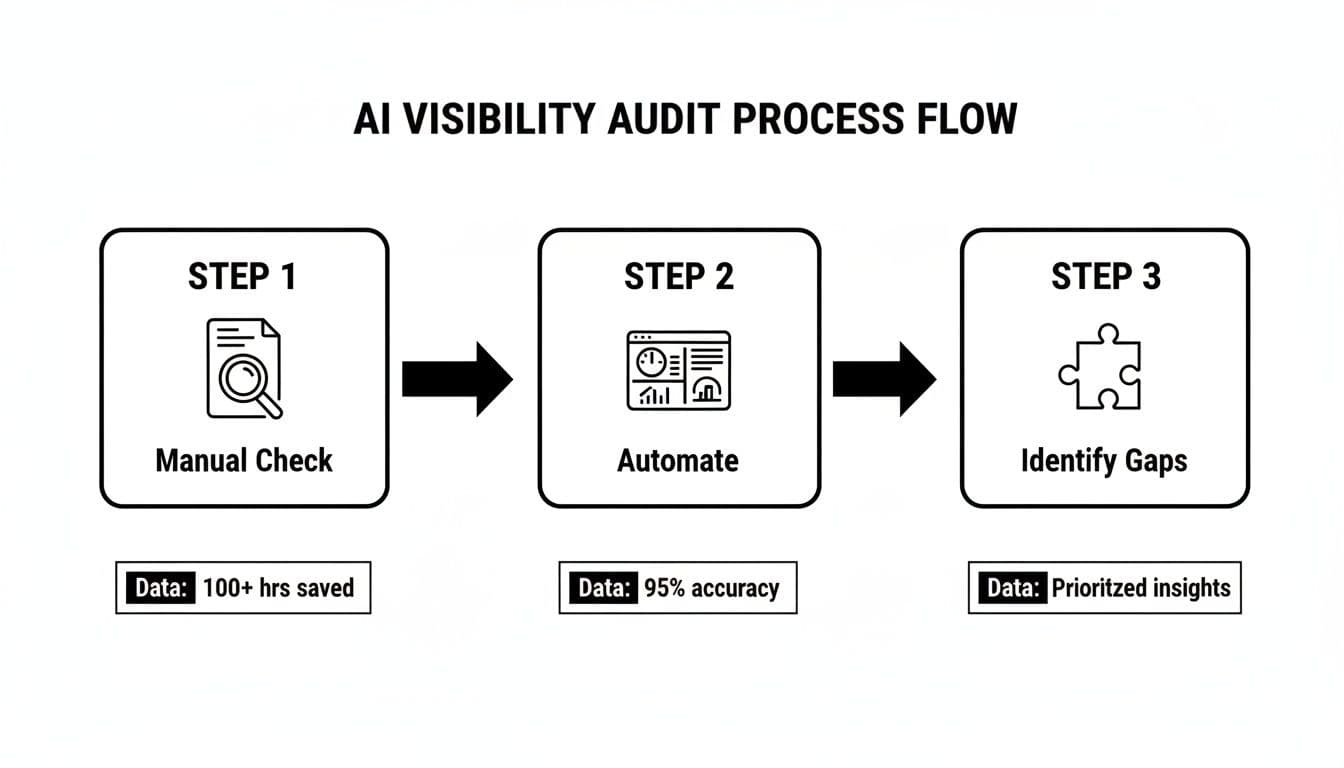
This workflow—manual checks, automated monitoring, and gap identification—is the repeatable process that underpins a solid GEO strategy. It keeps you focused on real-time data about how you're showing up (or not showing up) in AI-powered search.
The urgency here can't be overstated, especially when you look at the data. Projections show that only 40.3% of U.S. Google searches will result in an organic click by March 2025. That’s a drop from 44.2% just a year earlier. As traditional clicks become scarcer, getting cited directly in AI responses becomes incredibly valuable.
GEO Content Gap Prioritization Matrix
To make this prioritization process even more tangible, here's a simple framework. Use this matrix to sort your identified content gaps and build a realistic roadmap for the next quarter.
This table isn't just a theoretical exercise; it's a practical tool to help you allocate your limited time and budget where they'll have the greatest effect, ensuring you're not just busy, but productive.
Uncovering and Filling Entity Gaps
Your strategy needs to go deeper than just answering questions. You have to think about "entity gaps." An entity is just a fancy term for any distinct person, place, thing, or concept that an AI model can recognize—like your company name, your founder, your flagship product, or a unique process you've developed.
If your content doesn't clearly define these things, AI models will have a hard time understanding who you are and why you're an authority. They won't be able to connect the dots and recommend you with confidence.
Generative Engine Optimisation for SMBs isn't just about answering questions; it's about teaching AI who you are, what you do, and why you are the definitive expert in your niche.
A robust strategy pulls from multiple disciplines. The on-page GEO tactics we're discussing here are most effective when they're part of a bigger picture. To see how this fits into a broader plan, check out this guide on how to develop a content marketing strategy.
And remember, you can't build a great house on a weak foundation. Foundational SEO practices are critical. A smart plan for any SMB should also include proven white-hat link building strategies to build domain authority. This holistic approach ensures your GEO efforts have the support they need to deliver real results.
Getting Tactical with Prompts and Schema
Now that you have a strategy, it's time to roll up your sleeves and get into the two technical pillars of making this work: prompt-level and schema-level tweaks. They might sound intimidating, but for a small business, it just means making your content more conversational and easier for machines to read. It's less about code and more about strategic clarity.
Prompt-level work is all about structuring your content to directly answer the kinds of questions your ideal customers are firing into AI chatbots. This requires a small but important mental shift. You're moving away from writing broad, keyword-heavy articles and toward creating focused, genuinely helpful resources that feel like a natural conversation.
Think less like you're writing a formal textbook and more like you're patiently explaining a concept to a new customer over coffee.
Shaping Content for Conversational AI
Generative engines are built to understand and reply to human language. So, logically, your content needs to speak their language. The best way I've found to do this is to get ahead of the curve and anticipate the "prompts"—the actual questions—people will use.
A simple, powerful tactic is to use clear, question-based headings in your articles. For example, instead of a vague heading like "Our Services," get specific with something like, "What Types of Financial Audits Do You Offer?" This structure makes it ridiculously easy for an AI to grab that exact section and serve it up as a direct answer.
The real goal here is to make your content the most logical, complete, and helpful source for an AI to cite. You’re essentially doing the hard work of summarizing for the model before it even gets there.
Another trick that works wonders is using bullet points and numbered lists to break down complex ideas. AI models absolutely love well-structured, scannable information. Why? Because it’s simple to parse and reformat into the kind of concise summary a user wants. We dive deeper into this in our guide on how ChatGPT indexes content.
Making Sense of Schema for Better AI Comprehension
If prompt optimization helps the AI with the what of your content, schema markup helps it understand the who and the why. Think of schema as a set of digital labels you attach to your content. It doesn't change how it looks to a human, but for search engines and AI models, it provides crystal-clear context.
You don't need to be a developer to get started.
Many popular WordPress plugins, like Yoast SEO or Rank Math, have built-in tools that let you add the most important schema types with just a few clicks. If you’re just starting out, focus on these three high-impact types:
- Organization Schema: This clearly defines your business name, logo, address, and contact details. It's your digital business card.
- Article Schema: This simply identifies your content as an article and can specify things like the author and publication date, adding a layer of credibility.
- FAQ Schema: Perfect for structuring question-and-answer sections, making them prime real estate for AI-generated answers.
This simple act of labeling is more important than it sounds. It tells an AI that you are a legitimate entity and your content is organized and authoritative. What's truly interesting is that we're seeing AI models pull recommendations from websites far beyond Google's top 10 rankings. This gives smaller brands a rare opportunity to gain visibility they might not otherwise earn through traditional SEO. By combining conversational content with these clear technical signals, you’re not just helping AI understand your expertise—you're making it confident enough to recommend you.
Putting Your AI Content Strategy Into Action
Once you've got your strategy mapped out, it's time to roll up your sleeves and execute. This is where we shift from planning to producing content specifically built for AI consumption—and then, just as importantly, tracking how it actually performs.
This isn't just a minor tweak to your usual SEO content process. We're talking about a fundamental shift in focus. Instead of just chasing keywords, the goal is to build informational density and demonstrate expertise in a way that large language models can instantly understand and trust.
Every piece you create or update should be a self-contained resource that answers the questions you uncovered in your audit. Make the AI's job easy. The more confidently a model can pull a clear, factual, and genuinely helpful answer from your page, the higher the chance it will cite you as a source.
From Draft to AI-Ready Asset
Writing an AI-optimised draft means you're really writing for two distinct audiences at the same time: a human looking for a solution and a machine algorithm looking for clarity. It's a balancing act.
To get it right, you need to build your content with a few key structural elements that appeal to both. Think of them as AI-friendly building blocks for your articles.
- Lead with the Answer: Don't bury the lede. Use the inverted pyramid model by putting the most direct answer and critical information right at the top of the article.
- Keep it Factual: Ditch the marketing fluff and vague statements. Your content should be packed with clear, declarative sentences that state facts about your industry, products, or services.
- Structure Your Data: Break down any complex information into bullet points, numbered lists, or simple tables. This kind of structured data is incredibly easy for AI models to parse, understand, and use in their responses.
Adopting this mindset turns a standard blog post into a valuable, machine-readable asset that actively improves your Generative Engine Optimisation for SMBs.
Why Continuous Monitoring is Non-Negotiable
Just hitting "publish" is only half the job. GEO is absolutely not a "set it and forget it" game. The AI models are constantly being updated, and your competitors are always publishing new content. This makes ongoing monitoring mission-critical for any long-term success.
Without a feedback loop, you’re flying blind. You have no real way of knowing which content updates are actually working, what new content gaps are appearing, or how your brand is being portrayed in AI-generated answers. This is precisely where dedicated platforms become so essential.
The core of any successful GEO strategy is the feedback loop. You publish, you monitor the impact, you analyze what happened, and you iterate. Anything less is just guesswork.
Large companies are already using platforms like Attensira to monitor and optimise their AI visibility, and they're seeing a direct line between this new kind of search behavior and measurable gains in brand discovery. You can dig into some compelling findings on AI's impact on SEO to see just how significant this is becoming.
This cycle of creating, monitoring, and refining is what separates the businesses that merely dabble in GEO from those that truly master it. By consistently tracking your AI mentions and share of voice, you can prove the ROI of your efforts and make sharp, data-driven decisions that keep you ahead of the competition. It's what keeps your strategy agile and effective.
Measuring the ROI of Your GEO Strategy
Generative Engine Optimisation isn't a one-and-done project you can just check off a list. It's an entirely new business function that demands a fresh perspective on what "return" actually means. We're not just chasing keyword rankings anymore. Success here is about proving your brand's authority and carving out a presence within AI-generated conversations.
To justify the time and resources you're putting in, you absolutely have to connect your GEO work to real business outcomes. It means looking past the usual vanity metrics and focusing on what truly matters: is your brand being recommended at that critical moment when a potential customer is asking for a solution?
Key Performance Indicators for GEO
To get a real handle on performance, you need a new dashboard of KPIs built specifically for this channel. These metrics will tell you how you're showing up in AI responses and, more importantly, how that presence is creating value.
Here are the core numbers I always keep an eye on:
- AI Share of Voice: This is your north star metric. It's the percentage of relevant, high-intent AI responses that mention your brand versus your competitors. If this number is climbing, your strategy is on the right track.
- Sentiment of Mentions: Getting mentioned is one thing, but how you're mentioned is the real story. You need to track whether AI models are painting your brand in a positive, neutral, or negative light. A positive mention is essentially a trusted, third-party endorsement.
- Traffic from AI Referrals: This can be tricky to attribute directly, but it's not impossible. Look for correlated increases in your direct traffic and branded search volume as your GEO efforts ramp up. When people see you in an AI chat, their next move is often to search for you directly.
Tracking these KPIs gives you a much richer, more accurate picture of your influence than just watching your blue link move up or down a SERP.
Connecting GEO Efforts to Business Outcomes
Ultimately, the whole point is to turn that increased AI visibility into leads and sales. This is where you connect the dots between your GEO performance data and the metrics your CFO cares about. For instance, if you see your AI Share of Voice spike for a specific product line, you should be cross-referencing that with a lift in demo requests or sales for that exact product.
The most crucial part of measuring GEO is closing the loop. You have to be able to draw a credible line from a positive mention in an AI response straight to a new lead in your CRM. That’s the connection that proves the real return on your investment.
A solid framework here is all about analyzing the data and constantly refining your approach. Did that new FAQ page you published suddenly boost your mentions for a key service? Great, double down on that content format. Is a competitor suddenly owning a conversation you were in? It’s time to pull their content apart and figure out how to build something better.
This constant cycle of analysis and iteration is what will keep you ahead of the game. To put some hard numbers behind these efforts, you can use our simple framework to calculate the ROI and payback period of your marketing activities. This approach helps ensure your GEO strategy remains a nimble, data-driven engine for growth.
Your Top Questions About GEO Answered
Switching gears from traditional SEO to Generative Engine Optimisation raises a lot of good questions. Let’s tackle some of the most common ones we hear from SMBs just starting to explore this new frontier.
How Is GEO Really Different From SEO?
Think of it this way: traditional SEO is about winning a spot on a list of blue links. The goal is to get someone to click through to your website.
GEO, on the other hand, is about becoming the answer itself. You’re not just trying to rank; you're aiming to have your brand, your data, and your expertise cited directly inside an AI-generated summary. The focus shifts from optimizing for clicks to optimizing for a direct recommendation.
It's a whole different game that involves structuring your content for conversational queries and proving your authority in a way that AI models can process and trust.
Realistically, How Long Until I See Results?
This is the million-dollar question, and the honest answer is: it depends. For a highly targeted piece of content in a less competitive niche, you might see your brand mentioned in AI-generated answers within a few weeks of publishing.
But building the kind of authority that makes you a go-to source for AI is a marathon, not a sprint. This isn't a one-and-done task. You're building a reputation with an AI, and that requires a steady, consistent effort over several months.
It helps to think of GEO like relationship building. You have to consistently show up with valuable, trustworthy information. Over time, that effort compounds, and the AI begins to see you as a reliable source it can recommend again and again.
Do I Need to Buy a Bunch of Expensive Tools to Get Started?
Not at all. In fact, you can get a surprisingly clear picture of where you stand with zero budget.
Just start by asking chatbots like ChatGPT and Google's AI Overviews the same questions your customers would. See who they cite. See if you show up. That’s your baseline, and it costs nothing.
While specialized tools eventually give you much deeper insights and automate the tracking, the core principles don't require them. You can make huge progress just by focusing on creating clear, authoritative content and using solid structured data. The most valuable tool you have right now is your own strategic thinking.
Ready to stop guessing and start measuring your AI visibility? Attensira provides the automated monitoring and actionable insights you need to build a winning GEO strategy. See how your brand stacks up by visiting https://attensira.com today.