Boost local presence with chatgpt visibility landscapers - a practical guide to optimizing content, schema, and strategy for AI-driven answers.
Getting your landscaping business recommended by ChatGPT is the new word-of-mouth. It’s about making sure that when someone asks an AI for a local expert, your name comes up first. This all comes down to optimizing your website's content, its underlying technical structure, and your local business signals so that AI models can easily find, understand, and trust what you have to say.
Your New Digital Curb Appeal
The way people find landscaping services is fundamentally changing. It used to be a simple Google search, a flip through the Yellow Pages, or a chat over the fence with a neighbor. Now, millions are bypassing traditional search and asking AI assistants directly. They're not just searching "landscaper near me." They're having full-blown conversations, asking things like, "Who is the best landscaper in San Diego for drought-tolerant garden design?"
This shift is a huge deal. If your business isn't set up to be the answer to these questions, you're essentially invisible to a growing wave of customers who are ready to hire.
Why You Can't Ignore AI Visibility Anymore
Let's be clear: ChatGPT dominates this space. As of 2025, it holds a staggering 81% market share among AI chatbots and search tools. Its growth was historic—it hit 100 million users just two months after its 2022 launch, making it the fastest-growing consumer app ever. These numbers aren't just trivia; they show that ChatGPT is now a primary gateway for people looking for information, including local services.
This isn't some far-off trend. It's happening right now. AI models sift through mountains of data from websites, reviews, and online directories to deliver one confident, synthesized recommendation—not a list of ten blue links.
For a local business, having ChatGPT recommend you is like getting a direct referral from the most trusted expert in town. It cuts through the noise and puts you right in front of a customer who is ready to make a decision.
Connecting with a New Type of Customer
If you don't adapt, you're going to miss out on clients who now use AI for everything, from garden planning to finding the right contractor to build their dream patio. A great way to get inside their heads is to check out the best AI landscape design apps and websites they're already playing with.
Optimizing for AI isn't some mystical, complex task. At its core, it's about clearly and authoritatively showcasing your expertise online in a way that both humans and machines can understand. This guide will give you the practical, actionable steps to get there. For an even more detailed look, check out our complete guide on how to increase ChatGPT visibility.
The end goal is simple: to make your landscaping business the most logical, credible, and helpful answer for any question a potential customer throws at an AI.
Translating Keywords Into Conversational Questions
The biggest mental shift you need to make for AI visibility is moving from short-tail keywords to full, conversational questions. For years, SEO has trained us to think in terms of phrases like "lawn care Dallas" or "hardscape contractor." But AI engines like ChatGPT don't just match keywords; they act more like a human research assistant, pulling together context to give a direct, helpful answer.
If you want your business to be the answer, your content has to perfectly mirror how real customers ask for help. It's no longer enough to just target a keyword. You have to anticipate the full question a homeowner would type or speak into a chatbot and then answer it better than anyone else. Your website needs to become a library of clear, direct solutions.
This whole process is about understanding how AI connects a user's need with a local business.
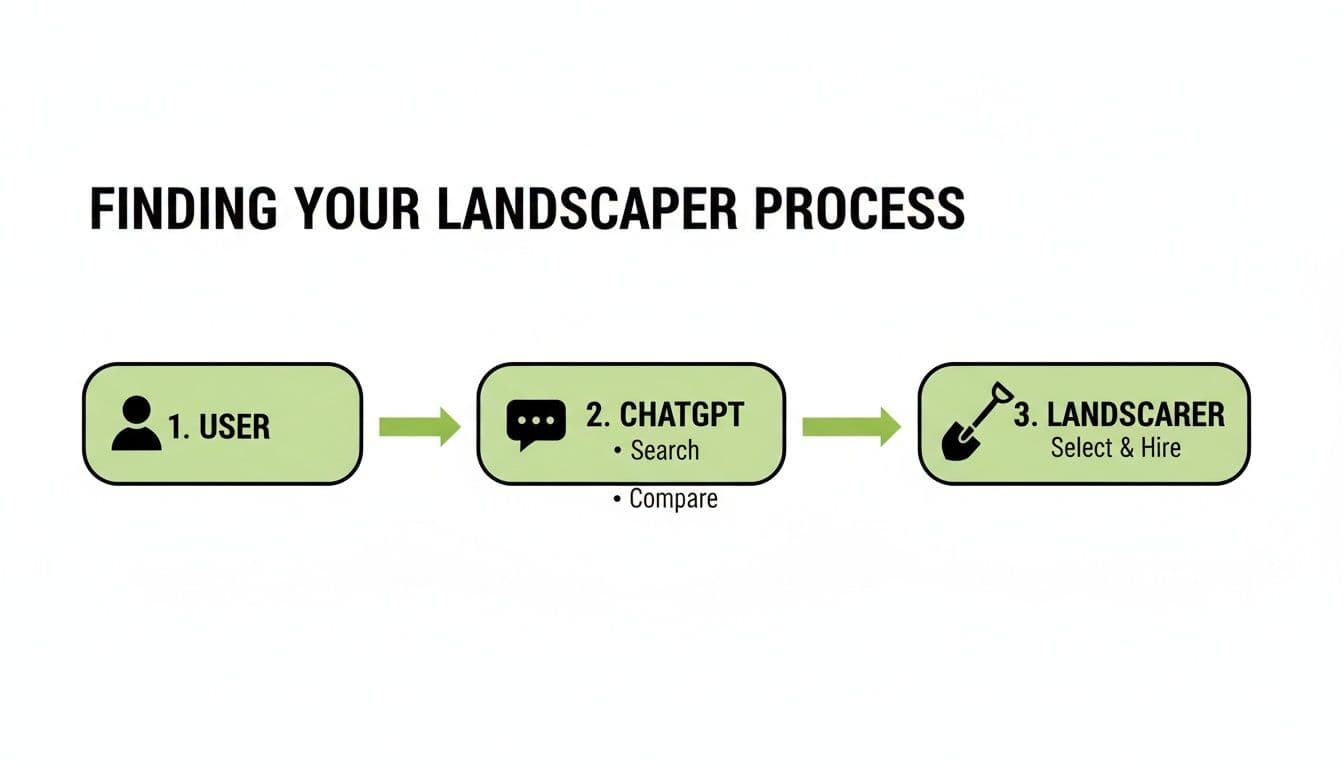
As you can see, the AI is the new middleman. It interprets what the user really wants and then scans the web for the business that proves it can solve that problem with authoritative content.
From Keywords to Queries
Thinking in questions is all about empathy. You have to get inside your customer's head. A homeowner in Austin isn't just thinking "xeriscaping." They’re wondering, "How can I create a beautiful, low-water garden that survives the Texas heat?" Your content has to nail that specific, nuanced query.
Here’s a simple way to reframe common landscaping keywords into the kinds of questions that AI models are built to understand:
- Instead of: Patio Pavers
- Think: "What are the most durable and affordable patio paver options for a small backyard?"
- Instead of: Sprinkler Repair
- Think: "How do I know if my sprinkler system has a leak, and who can I call to fix it?"
- Instead of: Sod Installation Cost
- Think: "What is the average cost to install new sod for a 1,000-square-foot lawn in my area?"
This doesn't mean keywords are dead. Far from it. They're simply the foundation. You use them to build comprehensive, question-based content that shows you're a genuine expert, not just another company with a website.
Mapping Questions to Your Service Pages
The next move is to strategically align these conversational questions with your website's structure. Every single service you offer needs its own dedicated page that serves as a deep dive, answering not just one question but a whole cluster of related ones. This is how you turn a basic service page into an authoritative resource.
Let’s be honest, a generic "Lawn Maintenance" page is weak. An AI-optimized page, on the other hand, is built to satisfy multiple user intents at once.
To be seen as an authority by an AI, your content must do more than just list a service. It must comprehensively solve the problems and answer the questions that lead a customer to seek that service in the first place.
Take your "Tree Trimming" service page, for example. Instead of one short paragraph, think of building it out with distinct sections that answer specific questions. Each one becomes a potential hook for an AI-generated recommendation.
Example Service Page Structure: Tree Trimming
- Main Question: How often should I have the oak trees in my yard professionally trimmed?
- Here, you'd dive into the ideal trimming frequency for specific tree species common in your local area.
- Problem-Solving Question: What are the signs that a tree branch is dead and needs to be removed?
- This is a perfect spot for a visual guide or a simple checklist for homeowners.
- Cost-Related Question: What factors determine the cost of tree trimming services?
- Break down your pricing based on things like tree size, accessibility, and overall health.
- Safety Question: Is it safe to trim large tree branches near power lines myself?
- Use this to gently but firmly explain the importance of hiring a professional, insured service.
When you structure your content this way, you create multiple pathways for an AI to see your website as the most relevant source for a whole range of user questions. This tactic doesn't just improve your chatgpt visibility for landscapers—it builds real trust with potential customers by giving them genuinely helpful information. Every question you answer reinforces your expertise, making your business the logical choice for both algorithms and people.
2. Use Structured Data To Speak AI's Language
If you want an AI like ChatGPT to recommend your landscaping business, you have to make it dead simple for it to understand who you are, what you do, and where you operate. Good content on your site is the starting point, but the real heavy lifting happens behind the scenes with something called structured data, or Schema markup.
Think of it as a secret language just for machines. It's a layer of code you add to your website that translates your human-readable content into a format that AI models and search engines can instantly digest. You're not changing how the site looks to a visitor; you're just adding explicit labels. You're telling the AI, "Hey, this string of text is our business address," "This number is our star rating," and "This page is about our 'Sod Installation' service."
Without these labels, the AI is left to guess. And when it guesses, your chances of getting recommended plummet.
For a local service business like a landscaper, two types of Schema are absolute game-changers for getting noticed in AI answers: LocalBusiness and Service.
Define Your Business With LocalBusiness Schema
First things first, you need to establish your identity. The LocalBusiness schema is essentially your digital business card for AI. It confirms your name, location, and key operational details with zero ambiguity. This is the foundation that tells an AI you're a legitimate, local company it can trust enough to recommend to someone in your area.
This is so much more powerful than just having your address on a contact page. It programmatically defines critical information, including:
- Your exact business name and address, leaving no room for confusion with similarly named companies.
- Your official phone number, providing a direct, verifiable contact point.
- Your hours of operation, which helps AI answer queries like, "Find a landscaper near me open on Saturdays."
- Your service area (
areaServed), letting you define specific cities, zip codes, or even a radius around your location. This is crucial for dominating hyper-local searches.
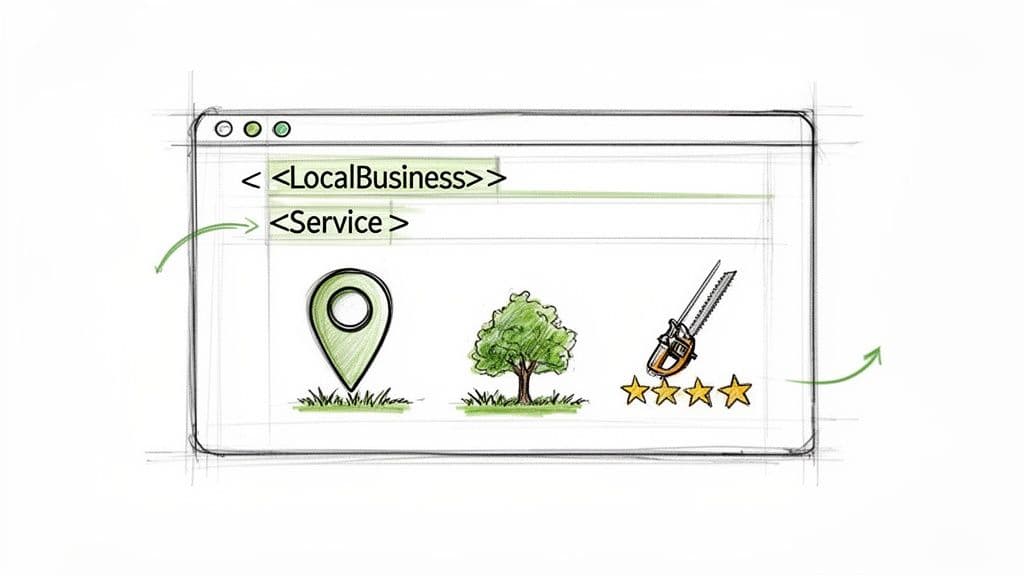
This kind of structure is precisely what allows an AI to confidently match a user's prompt—"I need a landscaper in Austin, TX that handles lawn care"—directly to your business.
By implementing LocalBusiness schema, you're creating a verified, machine-readable fact sheet about your company. You're removing all the guesswork for AI models, making your business a far more reliable source for local recommendations.
Another brilliant piece you can embed right within your LocalBusiness schema is AggregateRating. This pulls in your customer review scores and tells an AI not just that you exist, but that you’re highly regarded by actual customers. It’s a powerful layer of social proof baked right into the code. These same principles work across different AI models; for more on that, check out our guide on how to increase your visibility in Gemini.
To help you get started, here are the most important schema types to focus on.
Essential Schema Markup For Landscapers
Getting these basics in place gives you a massive advantage by making your website's information structured, clear, and trustworthy from an AI's perspective.
Detail Your Offerings With Service Schema
Once you’ve established who you are with LocalBusiness schema, it’s time to get specific about what you do using Service schema. This is where you can really pull ahead of the competition. A generic "Landscaping Services" page just won't cut it anymore.
With Service schema, you create a machine-readable entry for every single service you offer, from "Lawn Aeration" to "Retaining Wall Construction" and "Irrigation System Repair."
For each one, you can specify:
- Service Type: The name of the service (e.g., "Tree Pruning").
- Description: A clear, concise summary of what's included.
- Provider: A link back to your main
LocalBusinessprofile, connecting the service to your company. - Area Served: Reconfirm the geographic area where this specific service is available.
This level of detail is a goldmine for AI. When someone asks ChatGPT, "Who can install a French drain in my backyard in Denver?" the AI will actively look for landscapers who have explicitly defined "French Drain Installation" as a service in their schema. That direct match makes your business a far more relevant and likely recommendation than a competitor whose website just vaguely mentions "drainage solutions."
I know this might sound technical, but many modern website builders and SEO plugins like Yoast or Rank Math have built-in tools that make implementing schema much simpler. The effort is a direct investment in making your business perfectly legible to the AI assistants that are increasingly sending customers your way.
Creating Content That AI Trusts And Cites
AI models like ChatGPT are built to find and pull together the most helpful, authoritative information they can find online. If you want your landscaping business to show up in those answers, your website needs to be that source. This isn't just about basic SEO anymore; it's about proving you're the genuine expert on the ground.
Honestly, it’s a big shift in how we need to think about content. A few years ago, a simple "Services" page was enough. Now? That’s just the price of entry. The real goal is to build a resource hub on your website—a place where every single article is crafted to be citable by an AI.
This means turning a generic "Hardscaping Services" page into a genuinely useful guide that solves a real problem for homeowners in your specific area.
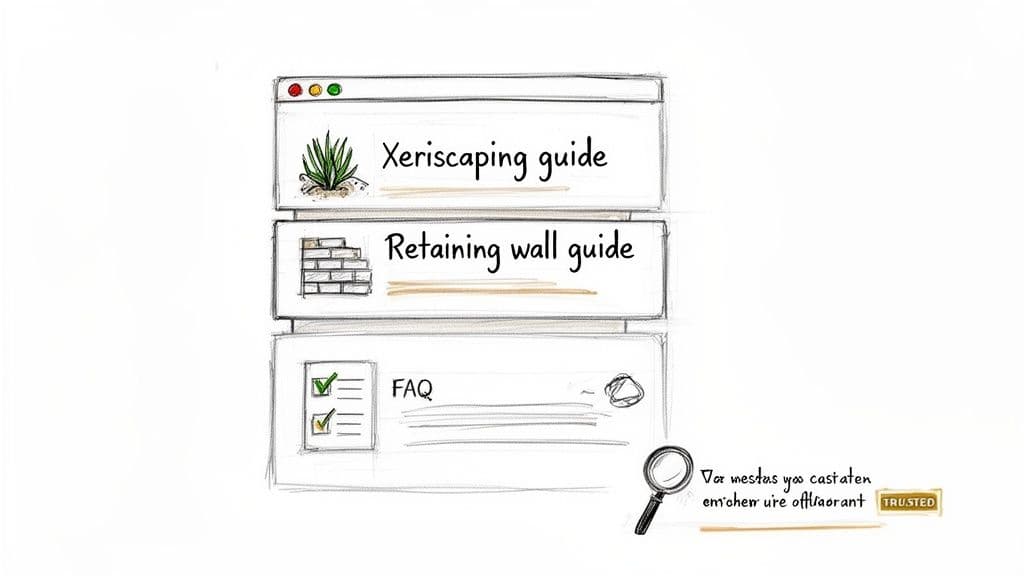
From Service Pages to Authoritative Guides
Let's be blunt: a standard service page just lists what you do. An authoritative guide proves why you're the expert they should hire to do it. That distinction is everything to an AI trying to give a credible recommendation. It’s always going to favor depth, specific details, and local context over vague marketing claims.
So, instead of a page called "Retaining Walls," you create something like "Choosing the Right Retaining Wall Material for Houston's Clay Soil." That title alone screams local expertise.
Here’s a simple framework for building these guides:
- Solve a Core Local Problem: Start with a real challenge specific to your service area. Think soil types, common pests, drainage issues, or local weather patterns.
- Compare Options Clearly: Don't just list materials or plants. Break them down with pros, cons, and ideal use cases.
- Talk About Cost: You don't have to give exact quotes, but providing realistic cost ranges or explaining the factors that influence price builds instant trust.
- Show Your Work: Embed high-quality before-and-after photos from local jobs. Visual proof is powerful.
This whole strategy is the foundation of what many now call Answer Engine Optimization. The game isn't just about ranking; it's about becoming the definitive answer. You can learn more about this approach by reading about Answer Engine Optimization.
Building Hyper-Local Content Pillars
Think of your website as the ultimate local landscaping library. Each service you offer can become a "pillar" that supports a whole cluster of detailed, localized articles. This approach shows a deep understanding of your market that a generic, national blog could never touch.
Imagine you're a landscaper in Phoenix. Here’s what that could look like:
- Pillar Topic: Drought-Tolerant Landscaping
- Guide 1: A Complete Guide to Xeriscaping in Phoenix Neighborhoods
- Guide 2: Top 10 Native Arizona Plants That Thrive in Full Sun
- Guide 3: How to Design a Low-Water Rock Garden for a Small Yard
This does more than just get an AI's attention. It provides incredible value to potential customers, building a relationship long before they ever pick up the phone.
An AI is far more likely to cite a source that provides a complete, well-reasoned solution than one that just offers a shallow overview. By creating these hyper-local guides, you’re essentially doing the research work for the AI, making your content the easiest and most reliable option to pull from.
The scale we're talking about here is massive. Enterprise adoption has exploded, with 49% of companies now using ChatGPT. The platform was handling over 1 billion daily queries in early 2024, a number expected to hit 2.5 billion by 2025. It took just nine months for over 80% of Fortune 500 companies to integrate it. This isn't a fad; AI responses are shaping how customers find and vet businesses at an incredible scale.
Optimizing for "People Also Ask" and FAQs
A huge piece of this puzzle is structuring your content for quick, scannable answers. AI models are trained on mountains of data, and that includes Google's "People Also Ask" (PAA) boxes and the FAQ sections on countless websites. Your job is to write the single best answer for these common questions.
A great place to start is by simply Googling your services and looking at the PAA box that pops up. Those are the questions real people are asking right now.
Crafting AI-Friendly Answers
Once you have a list of questions, the trick is to answer them directly and factually.
- Use the Question as a Heading: Make the exact question an H3 or H4 heading on your page. For example, "How Often Should You Aerate Your Lawn in Georgia?"
- Give the Direct Answer First: In the very first paragraph under that heading, provide a clear, two-to-three-sentence answer. Get right to the point.
- Elaborate Afterward: Once you've delivered the core answer, you can expand with more context, details, and nuance in the following paragraphs.
This format makes it incredibly easy for an AI to scan your page, find a relevant question, and extract the perfect, concise answer for a user's prompt. You're basically pre-packaging your expertise for citation, which dramatically increases your chances of being featured. It's a smart, proactive way to earn visibility that plays directly to your strengths as a local expert.
How To Measure Your AI Visibility
So, you’ve put in the work to create authoritative content and button up your structured data. That's a huge step. But without a way to measure the impact, you're essentially flying blind. To really sharpen your strategy, you have to track your success in this new AI-driven world.
Let's be clear: traditional rank tracking for keywords like "landscaper in Phoenix" just doesn't cut it anymore.
We need to start measuring something new: your AI visibility. This means actively keeping an eye on when, how, and why your business surfaces in AI-generated answers. Without that feedback loop, you’re just throwing tactics at the wall and hoping something sticks.
Moving Beyond Traditional SEO Metrics
First things first, we need a shift in mindset. Forget obsessively checking where you rank on Google for a handful of keywords. It's time to get more investigative and, honestly, a little more creative. This means manually testing prompts in ChatGPT and playing detective with the results.
This hands-on process is the only way to really grasp the nuances of how these AI models think. It lets you see the direct line between a piece of content you published and a recommendation the AI spits out.
Here’s a practical way to approach your manual testing:
- Service-Specific Prompts: Ask questions just like a potential customer would. Think, "Who specializes in installing permeable pavers in the Austin area?"
- Problem-Solving Prompts: Frame your queries around common pain points. For example, "How can I fix poor lawn drainage in a yard with heavy clay soil?"
- Competitor Comparison Prompts: Put the AI on the spot with prompts like, "Compare the best-rated landscapers in Denver for residential garden design."
By running these kinds of queries regularly, you start to gather direct evidence. You’ll see if your new guide on drainage solutions is actually getting cited or notice that a competitor is consistently recommended for paver installations—which, by the way, is a glaring sign of a content gap you need to fill.
Analyzing AI-Cited Sources
When ChatGPT mentions your business (or a competitor), the real work begins. The next step is to dig into the sources. Most AI models will provide citations or at least hint at where they pulled their information from. These citations are an absolute goldmine.
Start asking yourself some critical questions about every source you find:
- Is the AI linking to a specific blog post or a general service page?
- Is the source a big directory like Houzz, or maybe a local news article?
- What exact piece of information did the AI pull from that source?
Understanding which pages and platforms the AI deems authoritative allows you to reverse-engineer their success. If you see ChatGPT constantly citing a competitor’s in-depth case study on xeriscaping, that’s your cue to build an even better, more comprehensive resource on that very topic.
The financial stakes here are getting too big to ignore. The business model behind these platforms is staggering; OpenAI's annual revenue from ChatGPT alone shot past 1 billion** in early 2024 and is projected to hit around **3.7 billion for the full year. As you can read on elfsight.com, these numbers prove how deeply AI is becoming part of our daily lives. Landscapers who ignore their chatgpt visibility risk getting left in the dust.
Using Specialized AI Visibility Tools
While manual testing is fantastic for gut checks and qualitative insights, it's not scalable. That’s where a new breed of specialized tools comes in. Platforms like Attensira are built specifically to monitor brand mentions, track citation frequency, and benchmark your performance against the competition across different AI models.
These tools automate the tedious process of checking hundreds of different prompts, saving you a ton of time while painting a much clearer picture of your performance over time.
This dashboard from Attensira shows how it tracks visibility across different AI platforms over time.
The key takeaway here isn't just seeing if you were mentioned, but seeing how that visibility is trending and which AI engine is giving you the most love.
This continuous cycle—testing, analyzing, measuring, and refining—is the very core of a modern AI visibility strategy. It’s how you stop hoping you’ll get recommended and start systematically making your business the most logical and authoritative choice.
Common Questions About AI Search For Landscapers
As we all start to wrap our heads around this shift to AI-driven search, a lot of practical questions pop up. How fast can you actually see results? What really works? Let's dig into the most common concerns I hear from landscapers so you can focus your energy where it counts.
Getting a handle on the timeline and how all your digital marketing pieces fit together is the first step toward building a solid strategy for ChatGPT visibility for landscapers.
How Long Until I See My Business In ChatGPT?
Getting your business to show up in AI models like ChatGPT isn't an overnight win. Think of it more like cultivating a perennial garden—it gets stronger and more established each season. The whole process hinges on search engines like Google crawling and indexing the updates you make, whether it’s a new guide about native plants or fresh Schema markup on your service pages.
You might see your business mentioned in an AI answer in a few weeks, but it often takes a couple of months for that visibility to become consistent and really noticeable. The key here is consistency. These models are designed to trust websites that prove their authority over time by regularly publishing high-quality, expert content.
Think of it as building a great reputation in a new digital neighborhood. The foundational work you do today—like creating detailed local content and structuring your data—is a long-term investment that will pay off as these AI models keep learning and evolving.
It all comes down to building trust, and that trust is built on verifiable signals from all over the web.
Do Reviews On Google And Yelp Help With AI Visibility?
Absolutely. Customer reviews are one of the most powerful trust signals you have, and AI models rely on them heavily. When you have a stream of positive, recent reviews on major platforms like Google Business Profile, Yelp, or Houzz, it acts as third-party validation that you know what you're doing and you do it well.
When an AI synthesizes information to recommend a local landscaper, it's essentially trying to make the safest and most helpful choice for the user. A business with a strong portfolio of glowing reviews is a much more credible, lower-risk recommendation than one with little to no social proof.
You can even amplify their impact by embedding those reviews on your website using AggregateRating schema. This helps the AI directly connect that positive feedback to your brand.
Should I Focus On My Website Or Google Business Profile?
This is a classic question, but when it comes to AI visibility, it's not an either/or situation. It's a partnership. Your website and your Google Business Profile (GBP) are two critical pillars that hold each other up. If you neglect one, the other suffers.
- Your Google Business Profile (GBP) is your source for quick, factual data. It provides the essentials: your verified service area, hours, address, and phone number. It's the AI's first stop for logistical info.
- Your Website is where you build deep, undeniable authority. It's the home for your expert guides, portfolio case studies, and detailed service pages that answer complex customer questions in a way a GBP listing never could.
A winning strategy uses both to create a complete and authoritative digital footprint. Many folks using AI to create content wonder about detection systems; you can explore if Turnitin can detect ChatGPT content to get a sense of how originality and authority are measured. The goal is always to present a consistent, expert narrative across every platform you're on.
Ready to stop guessing and start measuring your AI visibility? Attensira provides the tools you need to track your brand's presence in ChatGPT and other AI engines, analyze competitor performance, and get actionable insights to dominate your local market. See exactly where you stand and discover your path to the top of AI-generated answers. Get started at https://attensira.com.