
Discover 10 actionable B2B SEO best practices to drive enterprise growth. Our guide covers ABM, technical SEO, and ROI measurement for sustainable results.
The world of B2B SEO operates under a different set of rules than its B2C counterpart. The sales cycles are longer, the decision-making units are larger, and the financial stakes are significantly higher. Simple keyword targeting is insufficient; success demands a multi-faceted strategy that integrates technical precision, deep audience understanding, and demonstrable business impact. Generic advice falls short when navigating the complexities of enterprise-level search engine optimization.
This guide moves past the fundamentals to provide a prioritized, actionable roundup of B2B SEO best practices that drive measurable enterprise growth. We will dissect 10 critical pillars of a modern strategy, from integrating SEO with Account-Based Marketing (ABM) to implementing sophisticated attribution models that prove ROI. Each section is designed to be a tactical playbook, complete with concrete implementation steps, brief examples, and checklist templates tailored for complex B2B organizations. To truly master the enterprise B2B SEO landscape, it's crucial to adapt strategies effectively, especially when considering SEO for professional services firms that often operate within a B2B framework.
The objective here is not just to help you rank higher but to empower you to connect with high-value accounts, establish unshakeable topical authority, and align your marketing efforts directly with sales outcomes. This comprehensive list covers the critical areas you must master:
- Technical SEO for enterprise systems
- Intent-driven content and topic clustering
- Authority building and strategic link acquisition
- E-E-A-T optimization for trust and expertise
- Data-driven measurement and sales alignment
By implementing these advanced practices, you can build a robust, revenue-generating SEO program that delivers a distinct competitive advantage.
1. Account-Based Marketing (ABM) with SEO Integration
Account-Based Marketing (ABM) flips the traditional demand generation funnel on its head. Instead of casting a wide net to capture many leads, ABM focuses marketing and sales resources on a predefined set of high-value target accounts. Integrating this with your SEO strategy means moving beyond broad keyword targeting to attract specific decision-makers within those accounts. This alignment is a cornerstone of modern B2B SEO best practices, as it directly connects search visibility to revenue-generating opportunities.
The core principle is to use firmographic and intent data to inform your keyword research and content creation. You’re not just targeting "enterprise cloud solutions"; you're targeting the specific pain points, job titles (e.g., "CTO cloud migration challenges"), and even named-brand technology stacks used by companies on your target list. This turns organic search from a lead-generation channel into a precision-guided account engagement tool.
Why It's a B2B Best Practice
This approach excels in B2B environments with long sales cycles and multiple stakeholders. By creating highly relevant content, you attract the right buying committee members at the right time, warming them up for sales outreach. For instance, platforms like 6sense or Demandbase use predictive analytics to identify which of your target accounts are actively researching solutions like yours, allowing you to prioritize both your SEO content and sales efforts effectively.
Actionable Implementation Steps
- Develop Account-Specific Keyword Clusters: Go beyond generic industry terms. Brainstorm keywords that key personas at your target accounts would use. Think about specific software integrations, compliance standards, or industry-specific challenges they face.
- Create Hyper-Targeted Content: Build dedicated landing pages, case studies, or white papers that speak directly to a target account or a small segment of similar accounts. Mention their industry, challenges, and even direct competitors in your content.
- Align SEO with Sales Cadences: Coordinate your content promotion with your sales team's outreach. When a salesperson is about to contact an account, ensure there is fresh, relevant content ranking for terms that account's employees might be searching for.
- Track Account-Level Metrics: Shift your success metrics from keyword rankings and organic traffic to account-level engagement. Use tools that provide reverse-IP lookup to see if traffic is coming from your target companies. Measure how many target accounts visit your key pages and convert.
2. Technical SEO Optimization for Enterprise Systems
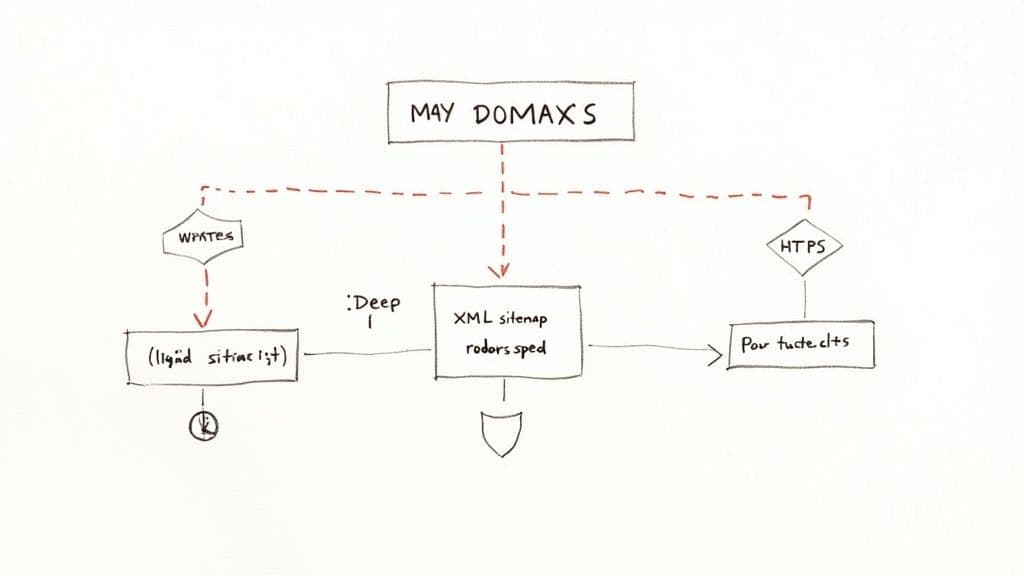
Technical SEO is the foundational layer upon which all B2B content and keyword strategies are built. Enterprise B2B websites are notoriously complex, often featuring thousands of pages across multiple subdomains, legacy systems, user-gated portals, and vast content repositories. Effective technical SEO ensures that search engine crawlers can efficiently discover, crawl, index, and understand this intricate architecture without wasting valuable crawl budget on irrelevant or duplicate pages.
This practice involves a meticulous focus on site structure, crawlability, and performance. For a B2B organization, this isn't just about pleasing search engines; it's about ensuring that high-value solution pages, technical documentation, and critical lead-generation assets are visible and accessible. A technically sound website provides a seamless user experience, which directly impacts trust and conversion rates among discerning business buyers.
Why It's a B2B Best Practice
In the B2B space, technical errors can have magnified consequences. A misconfigured robots.txt file could de-index an entire product section, while slow page speeds can deter a C-suite executive with limited time. Companies like Salesforce and IBM manage this at scale, using structured data to make their extensive product documentation digestible for search engines and optimizing crawl budget to ensure their most important pages are prioritized. Mastering technical SEO is a crucial component of any comprehensive list of b2b seo best practices.
Actionable Implementation Steps
- Conduct Regular Crawl Audits: Use tools like Screaming Frog or the site audit feature in Semrush to regularly crawl your website. Identify and fix critical issues like 404 errors, redirect chains, and duplicate content.
- Optimize Crawl Budget: Guide crawlers to your most important content. Use a well-structured
robots.txtfile to block low-value sections and ensure your XML sitemap is clean and submitted to Google Search Console. - Improve Site Performance: Focus on Core Web Vitals. Work with developers to optimize server response times (under 200ms is a great target), compress images, and leverage browser caching to enhance loading speed for all users.
- Implement a Logical Site Architecture: Organize your site with a clear hierarchy that flows from broad categories to specific product or service pages. Use strategic internal linking to pass authority and help both users and crawlers navigate the site.
3. Intent-Driven Keyword Research and Targeting
In B2B, the buyer's journey is complex and multi-layered. Intent-driven keyword research acknowledges this by prioritizing the why behind a search query over raw search volume. This B2B SEO best practice shifts focus from high-volume, top-of-funnel keywords to specific, often lower-volume terms that signal a user is actively researching, comparing, or preparing to purchase a solution. It's about meeting prospects at their exact stage of need.
The core principle is to map keywords to the distinct phases of the B2B buying cycle: awareness, consideration, and decision. For example, instead of only targeting the broad term "CRM," a more strategic approach involves targeting "CRM for small business" (consideration) or "HubSpot vs Salesforce pricing" (decision). This ensures your content directly answers the precise questions your ideal customers are asking, significantly improving lead quality.
Why It's a B2B Best Practice
This method is crucial for B2B because it filters out irrelevant traffic and attracts prospects with genuine commercial intent. High-volume keywords often attract researchers, students, or users with no purchasing power. In contrast, intent-driven keywords attract decision-makers and influencers within target accounts who are actively trying to solve a business problem. Platforms like Stripe excel at this, ranking for queries like "how to accept online payments" to capture users at the problem-aware stage.
Actionable Implementation Steps
- Segment Keywords by Intent: Classify your keyword list into informational (e.g., "what is data warehousing"), commercial investigation (e.g., "best team communication software"), and transactional (e.g., "Slack enterprise pricing") categories. Learn more about the nuances of what is search intent.
- Analyze Competitor Landing Pages: Use tools like Ahrefs or SEMrush to see what intent-based keywords your competitors rank for and, more importantly, what type of content (blog post, comparison page, product page) they use to target that intent.
- Create Content Clusters: Build pillar pages around broad topics and create cluster content that targets specific, long-tail, high-intent keywords. For example, a pillar on "Project Management" could have clusters for "Asana alternatives" or "Trello vs Jira comparison."
- Track Conversion Data by Keyword: Go beyond traffic and rankings. In your analytics, track which keywords are actually driving qualified leads and conversions. This data is the ultimate validator of commercial intent and should guide your future content strategy.
4. Enterprise Content Strategy and Topic Clustering
Enterprise B2B websites often manage thousands of pages, which can lead to disorganized content architecture and diluted authority. The pillar-and-cluster model imposes a deliberate structure by organizing content around central topics. A "pillar" page provides a comprehensive overview of a broad subject, while numerous "cluster" pages delve into specific subtopics, all interlinking back to the main pillar. This creates a powerful signal to search engines that you are an authority on that core topic.
This strategy shifts the focus from individual keywords to topical ownership, a critical move in an era of semantic search. By creating a well-organized content hub, you not only improve search engine crawlability and understanding but also provide a clear, logical user journey for visitors seeking in-depth information on complex B2B solutions.

Why It's a B2B Best Practice
The pillar-and-cluster model is uniquely suited for B2B because it mirrors the complex, research-intensive buying process. Prospects rarely make a decision after reading one article; they explore a topic from multiple angles. This structure serves the needs of different buying committee members, from a high-level executive reading the pillar page to a technical specialist exploring a detailed cluster article. For enterprises managing vast content libraries, this is one of the most effective b2b seo best practices for establishing and scaling topical authority.
Actionable Implementation Steps
- Identify Core Pillar Topics: Start by mapping your core services or solutions to 5-10 broad pillar topics. These should align directly with your primary business objectives and the main problems you solve for customers.
- Develop Cluster Content: For each pillar, brainstorm and create 10-20 cluster articles that answer specific, long-tail questions related to the main topic. Use keyword research tools to identify these subtopics.
- Establish a Strict Internal Linking Structure: Ensure every cluster page links up to its corresponding pillar page using consistent anchor text. The pillar page should also link out to its most important cluster pages.
- Scale Content Creation Methodically: For large-scale enterprises that need to build out hundreds of cluster pages efficiently, exploring strategies like programmatic SEO can automate the creation of data-driven content at scale while maintaining quality.
- Regularly Update Pillar Pages: Treat your pillar pages as living documents. As you add new cluster articles, update the pillar content to summarize and link to the new, in-depth resources, keeping it fresh and comprehensive.
5. Authority Building Through Strategic Link Acquisition
In B2B SEO, a strong backlink profile is a direct proxy for authority and trust, which significantly impacts search engine rankings. Strategic link acquisition moves beyond sheer volume, focusing instead on earning high-quality, contextually relevant backlinks from respected industry sources. This approach is fundamental to B2B SEO best practices because it validates your expertise and builds credibility within a professional niche, which search engines like Google weigh heavily.
The core principle is to create "linkable assets" and engage in targeted outreach that aligns with your brand's authority. Unlike B2C, where a wide array of lifestyle blogs might be relevant, B2B link building prioritizes sources like industry publications, research institutions, and business partners. The goal is to be cited as a definitive source, signaling to search engines that your content is a trusted resource for a professional audience.
Why It's a B2B Best Practice
This method is crucial for B2B because trust is a primary driver of purchasing decisions. A link from a reputable source like Gartner or a major industry trade journal acts as a powerful third-party endorsement. This not only boosts search rankings but also enhances brand perception and drives high-quality referral traffic from audiences already engaged in the industry. For instance, a software company earning a link from a Moz industry report gains both SEO value and direct exposure to a hyper-relevant audience of marketing professionals.
Actionable Implementation Steps
- Create Original Research and Data-Driven Content: Develop proprietary industry reports, surveys, or studies that offer unique insights. This type of content naturally attracts links from journalists, bloggers, and other companies referencing your findings.
- Analyze Competitor Backlink Profiles: Use tools like Ahrefs or SEMrush to identify high-authority sites linking to your competitors but not to you. This reveals valuable link-building opportunities and content gaps you can fill.
- Develop Linkable Tools and Resources: Create free tools, calculators, or comprehensive guides that solve a specific problem for your target audience. These practical assets often become go-to resources, earning links over time.
- Pursue Strategic Guest Posting: Contribute expert articles to reputable industry blogs and publications. Focus on providing immense value and securing a contextual link back to a relevant resource on your site, not just your homepage.
- Monitor and Reclaim Brand Mentions: Set up alerts for mentions of your brand name that do not include a link. Reach out to the publisher and politely request that they add a link to your website, turning a simple mention into a valuable backlink.
6. Optimizing for SERP Features and Rich Snippets
Ranking in the top position is no longer the only goal; dominating the entire search engine results page (SERP) is. Modern B2B search results are rich with features like featured snippets, People Also Ask (PAA) boxes, FAQ dropdowns, and knowledge panels. Optimizing for these elements allows you to capture more SERP real estate, significantly boosting visibility and click-through rates, often without needing a number one ranking. This is a critical B2B SEO best practice for establishing authority and providing immediate answers to complex user queries.
The strategy involves structuring your content and code to make it easy for search engines to understand and repurpose for these features. This means using structured data (Schema markup) to explicitly define elements like FAQs, events, or organization details, and formatting content to directly answer common questions. For B2B, where decision-makers are looking for quick, authoritative answers, appearing in these features positions your brand as an industry leader.
Why It's a B2B Best Practice
B2B buyers conduct extensive research, and SERP features provide fast, digestible information that helps them evaluate solutions. Securing a featured snippet for a query like "what is cloud data warehousing" or having your company's knowledge panel appear for brand searches builds immediate trust and credibility. It shortcuts the user's journey, delivering your answer directly on the results page. For example, Salesforce frequently captures featured snippets for core industry terms like "what is CRM," intercepting potential customers at the earliest stage of their research.
Actionable Implementation Steps
- Implement Comprehensive Schema Markup: Use JSON-LD to add Organization, Article, and FAQPage Schema to your key pages. Fully populate your Organization Schema with your logo, social profiles, and official company information to influence your knowledge panel.
- Structure Content for Featured Snippets: Identify question-based keywords your audience uses. Create concise, direct answers (ideally 40-60 words) immediately following the question as a heading. Use lists, tables, and step-by-step formats, as these are frequently pulled into snippets. Our guide on how to optimize for featured snippets provides a detailed walkthrough.
- Target "People Also Ask" Boxes: Build out sections in your content that answer a cluster of related questions. Use clear H3 or H4 headings for each question and provide a succinct answer, which increases the likelihood of being featured in PAA sections.
- Validate Your Markup: Regularly use Google's Rich Results Test tool to ensure your structured data is implemented correctly and is eligible for rich results. Fix any errors or warnings the tool identifies.
7. Multi-Regional and Localized B2B SEO Strategy
For B2B enterprises operating across borders, a one-size-fits-all SEO strategy is ineffective. A multi-regional and localized approach ensures that your content resonates with distinct markets, addressing cultural nuances, language differences, and local search behaviors. This involves more than direct translation; it requires a dedicated strategy for each region to align with local business customs and pain points.
This practice centers on signaling to search engines which content is intended for which specific audience. Through technical setups like hreflang tags and country-code top-level domains (ccTLDs), you prevent content duplication issues and serve the most relevant version of your site to users. This technical foundation, combined with a culturally adapted content strategy, is a crucial component of B2B SEO best practices for any global company.
Why It's a B2B Best Practice
Global B2B buyers expect a localized digital experience. Presenting your solution in their native language and addressing their specific market challenges builds immediate trust and credibility. For example, a regulatory compliance software company like Salesforce must tailor its messaging and features for GDPR in Europe versus CCPA in California. A localized strategy ensures you rank for the correct regional compliance terms and capture high-intent local traffic.
Actionable Implementation Steps
- Choose a URL Structure: Decide between using ccTLDs (e.g.,
yourbrand.de), subdomains (e.g.,de.yourbrand.com), or subdirectories (e.g.,yourbrand.com/de). While ccTLDs send the strongest geographic signal, subdirectories are often easier to manage from a central SEO perspective. - Implement Hreflang Tags Correctly: Use hreflang tags in your HTML
<head>or XML sitemap to tell Google which language and region each page is targeting. This helps prevent the wrong version of a page from appearing in search results. - Conduct Localized Keyword Research: Go beyond translating your primary keywords. Use tools like SEMrush or Ahrefs to uncover how professionals in each target country search for your solutions, identifying local terminology and industry-specific jargon.
- Adapt Content for Cultural Nuance: Localize everything from case studies and testimonials to imagery and tone of voice. A success story featuring a well-known German company will be far more persuasive to a German audience than one featuring a US-based firm.
- Build Local Backlinks: Earn links from reputable, country-specific industry publications, directories, and partners. These local signals significantly boost your authority and relevance within that specific market.
8. Data-Driven ROI Measurement and Attribution Modeling
Proving the value of B2B SEO requires moving beyond vanity metrics like traffic and rankings to demonstrate a clear impact on revenue. Data-driven ROI measurement connects organic search performance directly to business outcomes. It involves implementing a robust tracking infrastructure and using attribution models to understand how organic touchpoints contribute to the entire buyer's journey, not just the final conversion. This is a critical B2B SEO best practice for securing budget and aligning marketing with sales.
The core principle is to create a seamless data flow from the first website visit to a closed-won deal in your CRM. Instead of just seeing that organic traffic generated 100 leads, you can attribute specific revenue amounts, track lead quality, and analyze the influence of SEO on sales cycle length. This transforms SEO from a marketing cost center into a quantifiable revenue driver.
Why It's a B2B Best Practice
In B2B, sales cycles are long and involve multiple decision-makers interacting with your brand across various channels. Last-click attribution, which gives 100% of the credit to the final touchpoint, is notoriously misleading. Multi-touch attribution models provide a more accurate picture by distributing credit across several interactions, highlighting SEO’s role in initial discovery, mid-funnel research, and final consideration. For instance, a B2B SaaS company can see how a blog post drove an initial trial sign-up that later converted into an enterprise contract through a sales demo.
Actionable Implementation Steps
- Integrate SEO Data with your CRM: Connect Google Analytics 4 and Google Search Console to your CRM (e.g., Salesforce, HubSpot). This allows you to track a lead's journey from their first organic search query all the way to becoming a paying customer.
- Implement Consistent UTM Tagging: Establish a strict, standardized UTM parameter system for all campaigns. This ensures you can accurately segment traffic sources and understand how different SEO efforts (e.g., guest posts, specific content clusters) contribute to conversions.
- Configure Advanced Conversion Tracking: Set up specific conversion events in GA4 for key B2B actions like demo requests, white paper downloads, and contact form submissions. Assign values to these conversions to begin quantifying their impact.
- Analyze Multiple Attribution Models: Compare different models (first-click, linear, time-decay) to understand SEO's role at various funnel stages. This data provides a comprehensive view of how organic search influences the customer lifetime value (LTV). For more on this, you can learn more about how to measure marketing ROI and its models.
9. E-E-A-T Optimization for Trust and Expertise Signals
Google's E-E-A-T framework, which stands for Experience, Expertise, Authoritativeness, and Trustworthiness, is a critical quality filter, especially in the B2B sector. Buying decisions here are high-stakes and hinge on credibility and perceived expertise. Optimizing for E-E-A-T means systematically embedding signals of your company's competence and reliability across your digital presence, proving to both users and search engines that you are a legitimate authority.
This practice goes beyond on-page SEO; it's about building a digital reputation. It involves showcasing firsthand experience through detailed case studies, proving expertise with author credentials, establishing authority with industry recognition, and building trust through transparent business practices and customer validation. For B2B buyers evaluating complex solutions, these signals are non-negotiable proof points that directly influence purchasing decisions, making this one of the most essential B2B SEO best practices.
Why It's a B2B Best Practice
In B2B, a purchase is an investment in a partnership. Prospects must trust not just the product but the people and the company behind it. Demonstrating strong E-E-A-T signals helps shorten the consideration phase of the sales cycle by preemptively answering questions about your credibility. For example, a company like Stripe prominently displays its security certifications and compliance standards, immediately building trust with developers and financial officers who require uncompromising security.
Actionable Implementation Steps
- Showcase Author Expertise: Create detailed author bios for your content creators, linking to their social profiles (like LinkedIn), and highlighting their credentials, industry experience, and publications.
- Publish Quantified Case Studies: Move beyond simple testimonials. Develop in-depth case studies that feature named clients, outline the specific challenges, detail your solution, and present quantified, data-backed results.
- Display Trust Symbols Prominently: Feature industry awards, security certifications (e.g., SOC 2, ISO), and positive customer reviews from platforms like G2 or Capterra in your website's footer, on landing pages, and on product pages.
- Build an Authoritative "About Us" Page: Your "About Us" page is a key E-E-A-T asset. Include company history, mission, values, and profiles of the executive leadership team to showcase the human expertise driving the business.
10. Sales and Marketing Alignment with Keyword and Content Collaboration
Siloing sales and marketing is one of the most significant barriers to B2B SEO success. Sales and Marketing Alignment integrates the invaluable, on-the-ground intelligence from your sales team directly into your keyword and content strategy. This practice ensures that SEO efforts are not just driving traffic, but are actively addressing the real-world questions, objections, and pain points of your most qualified prospects.
The core principle is to treat your sales team as a primary source for customer-centric keyword research. They are on the front lines, hearing the precise language prospects use to describe their problems and the specific competitors they mention. By creating a formal feedback loop, marketing can translate these insights into content that attracts, engages, and enables buyers, directly supporting the sales cycle. This synergy transforms SEO from a marketing-only function into a core component of the entire revenue operation.
Why It's a B2B Best Practice
This alignment is crucial in B2B because of the complexity and length of the sales process. Content that directly answers a prospect's mid-funnel question or handles a common objection before a sales call even happens can dramatically accelerate deals. For instance, Salesforce is known for co-creating content where sales teams provide direct input on prospect challenges, which marketing then develops into high-performing assets. This collaborative model ensures that the content produced is not only discoverable but also highly useful for sales enablement.
Actionable Implementation Steps
- Establish a Formal Feedback Loop: Schedule monthly or quarterly joint planning sessions where sales shares the top 3-5 prospect questions and objections they’ve encountered. Use a shared document or Slack channel for real-time insight sharing.
- Create a Shared Content Calendar: Give the sales team visibility into the content pipeline and solicit their input on upcoming topics. This builds buy-in and ensures the content will be used.
- Build Sales Enablement SEO Content: Use sales insights to create bottom-of-the-funnel content like competitor comparison pages, detailed implementation guides, and ROI calculators that sales can use as assets in their outreach.
- Track Content-Sourced Revenue: Move beyond marketing-qualified leads (MQLs) and track which organic landing pages and blog posts are sourcing the most sales-qualified leads (SQLs) and closed-won deals. This demonstrates the direct revenue impact of your SEO efforts.
Top 10 B2B SEO Best Practices Comparison
Integrating Your B2B SEO Strategy for Maximum Impact
Navigating the complexities of B2B search engine optimization requires more than a checklist of isolated tactics; it demands a unified, strategic framework. The B2B SEO best practices detailed throughout this guide, from technical enterprise-level optimization to nuanced E-E-A-T signal building, represent the core pillars of a high-performance program. However, their true potential is only realized when they are integrated and operate in synergy.
Technical soundness, as covered in our discussion on enterprise systems, creates the stable foundation upon which all other efforts are built. Without it, even the most brilliant content strategy will fail to achieve its maximum reach. Similarly, intent-driven keyword research is not a one-off task but an ongoing process that must inform your topic clusters, your account-based marketing campaigns, and even your sales team's discovery call scripts.
From Individual Tactics to a Cohesive Growth Engine
The transition from a siloed approach to an integrated one is what separates market leaders from the competition. Think of it as an ecosystem:
- Content and Authority: Your enterprise content strategy and topic clusters (Pillar #4) directly fuel your authority-building and link acquisition efforts (Pillar #5). High-value, comprehensive content naturally attracts high-quality backlinks, creating a powerful feedback loop.
- Data and Alignment: Rigorous ROI measurement and attribution modeling (Pillar #8) provide the objective data needed to foster genuine sales and marketing alignment (Pillar #10). When marketing can demonstrate precisely how SEO-driven content influences the pipeline, collaboration becomes a strategic imperative, not a corporate ideal.
- Trust and Conversion: Optimizing for E-E-A-T (Pillar #9) and SERP features (Pillar #6) works in tandem to build critical trust with sophisticated B2B buyers. A rich snippet that answers a key question, combined with a page that clearly demonstrates author expertise, significantly shortens the path from discovery to consideration.
The ultimate goal is to transform your SEO program from a series of disconnected campaigns into a predictable, scalable engine for qualified lead generation and revenue growth. This holistic view ensures that every optimization, every piece of content, and every technical fix contributes directly to overarching business objectives.
Your Actionable Path Forward
Mastering these b2b seo best practices is an ongoing commitment, not a final destination. The search landscape, driven by advancements in AI and user behavior, is in a constant state of flux. Your strategy must be agile, data-informed, and deeply connected to the core goals of your organization.
To begin integrating these principles, focus on creating cross-functional feedback loops. Start by scheduling a quarterly review between your SEO, content, sales, and product teams. Use this meeting to share insights on keyword performance, customer pain points discovered through search queries, and content that is successfully enabling sales conversations. By breaking down departmental silos, you embed SEO into the very fabric of your go-to-market strategy, ensuring it remains a powerful and enduring competitive advantage.
Ready to gain a competitive edge in the new era of AI-driven search? Attensira provides the critical visibility you need to understand and optimize how your brand appears in generative AI answers, ensuring your B2B SEO best practices deliver results across all search platforms. See how you can protect and enhance your brand's presence by exploring Attensira today.