Boost AI visibility for SaaS companies with our guide. Learn proven tactics to optimize content, track performance, and get cited in AI-driven search.
When we talk about "AI visibility" for a SaaS company, we're talking about a fundamental shift in what it means to be found online. It’s no longer just about climbing the ranks on a Google results page. The new goal is to have your brand, your products, and your expertise cited directly within the AI-generated answers people get from platforms like ChatGPT or in Google's AI Overviews.
You have to think of it this way: success used to be about getting the click. Now, it's about becoming part of the answer itself.
The New Search Landscape for SaaS Companies
That familiar customer journey we've all optimized for—a user types a query, scans the blue links, clicks, and lands on our site—is being completely upended. AI answer engines are collapsing that funnel. They synthesize information from multiple sources and deliver a neat, convenient response directly to the user, often making a click-through to a website unnecessary.
For any SaaS business, this is both a massive threat and an incredible opportunity. The old playbook of just focusing on keyword density and building backlinks simply isn't going to cut it anymore.
Visibility today is earned by becoming a trusted, citable authority that AI models can reference with total confidence. It’s a strategic pivot from chasing rankings to building a machine-readable reputation. This demands a much deeper investment in demonstrating true topical authority, leveraging structured data, and crafting content that provides direct, factual answers.
From Keywords to Citations
This isn't a minor tweak; it's a monumental change. Look at the numbers: in mid-2025, Google's global search engine market share actually dipped below 90% for the first time since 2015. Why? Because AI-powered search platforms exploded, collectively boosting their traffic by over 721% in just the last year.
These new players have already carved out nearly 8% of the combined search market, completely redrawing the map for how software is discovered.
This means your ideal customers are increasingly getting their tool recommendations and solutions straight from an AI, not from a list of websites. If your brand isn't woven into those critical, AI-driven conversations, you're essentially invisible.
The core challenge for SaaS marketers has changed. It's no longer just about being discoverable by people, but being citable by algorithms. Your content has to be so clear, structured, and authoritative that an AI can confidently use it as a source.
Adapting Your Strategy for AI Visibility
Adapting to this new reality calls for a different kind of playbook. You can't just think about how humans read your content anymore; you have to obsess over machine readability, too. From what I've seen, this boils down to a few key strategic adjustments.
- Obsess over Factual Accuracy: AI models are trained to prioritize content that is precise, well-sourced, and verifiably correct. Treat your product pages, help docs, and blog posts like a meticulously curated knowledge base.
- Embrace Structured Data: Things like Schema markup are no longer a "nice-to-have." This kind of structured data is a clear signpost for AI engines, helping them instantly understand the context of your content and making it far easier to parse and cite.
- Go Deep on Topical Authority: Proving you have deep expertise across your entire domain is infinitely more valuable than just ranking for a few high-volume keywords. We actually broke down how AI models like ChatGPT index content in a detailed guide that goes deeper on this.
To get a clearer picture of just how different this approach is, let's compare the old and new models side-by-side.
Key Shifts from Traditional SEO to AI Visibility
This table really highlights the transition. We're moving from a game of volume and visibility to one of trust and authority.
To navigate this new terrain effectively, many SaaS companies are now turning to specialized AI SEO services to overhaul their strategies and content. The objective is crystal clear: make sure your brand’s unique value is embedded directly into the AI-powered answers your prospects are getting every day.
Establishing Your AI Visibility Benchmark
Before you can improve your AI visibility, you need a brutally honest look at where your SaaS company stands right now. An initial audit isn't just a good idea; it's the data-driven foundation for your entire strategy. This isn't about guesswork. It’s about systematically measuring your presence—or, more likely, your absence—in the AI-generated conversations your customers are having.
The whole process starts by putting yourself in your ideal customer's shoes and simulating their query journey. You have to think beyond simple brand searches and really dig into the questions they ask at every stage. This means crafting prompts that cover everything from broad, top-of-funnel problems ("best software for remote team collaboration") to specific, feature-level showdowns ("HubSpot vs. Salesforce for small business").
This really highlights a fundamental shift in how search works, moving away from a simple keyword-and-ranking game to one focused on AI-driven citations.
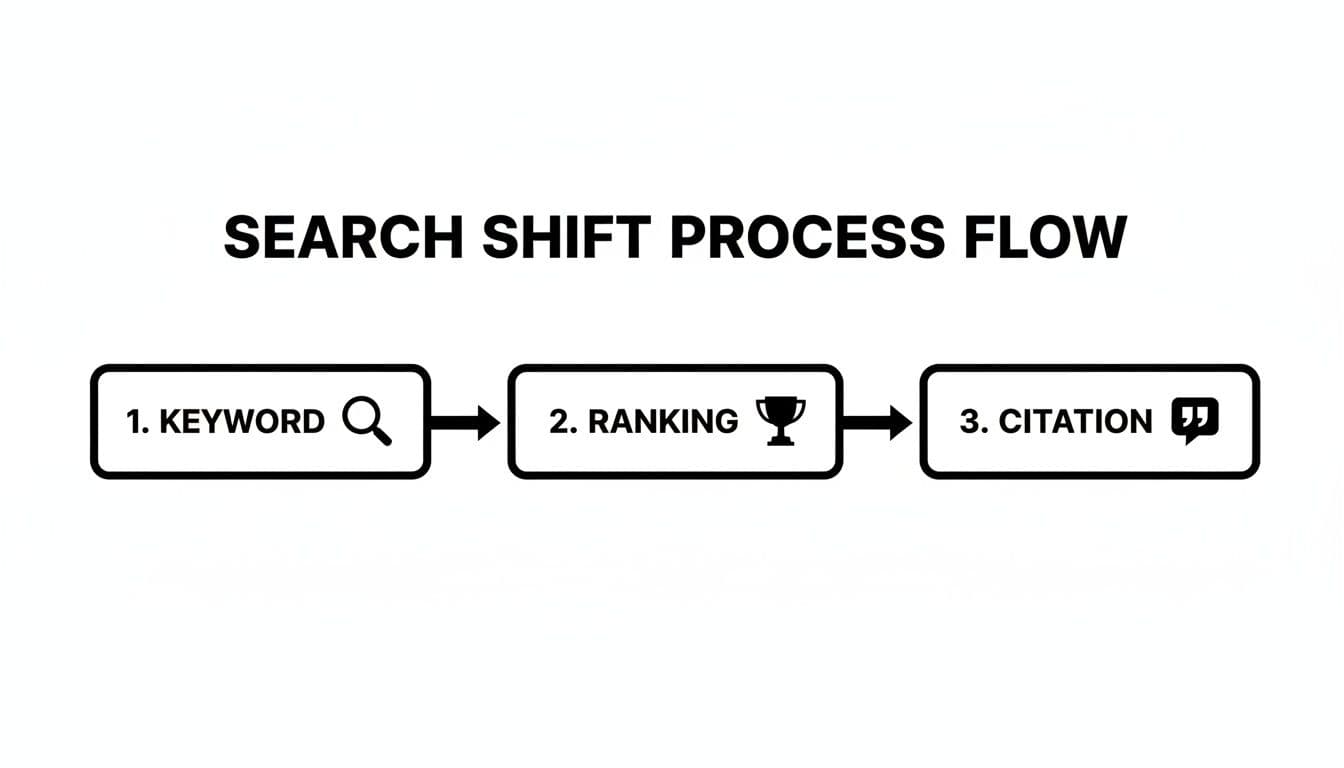
As you can see, the goal is no longer just ranking for a keyword. It’s about becoming a trusted source that AI models cite directly in their answers.
Pinpointing Your Invisibility Zones
Once you start running these queries across the big models like ChatGPT, Gemini, and Perplexity, you'll quickly uncover your "invisibility zones." These are the critical topics where your solution is a ghost, completely absent from the conversation. Your competitors are likely filling that void.
Documenting these gaps is the single most important output of your benchmark audit.
For instance, a project management SaaS might be pleased to see it appears for "best monday.com alternatives." But what if it's never mentioned in responses about "improving engineering team velocity"? That insight immediately flags a massive content and authority gap that needs to be fixed, fast.
The whole point of this audit is to replace assumptions with cold, hard data. You have to know exactly which conversations you're missing out on before you can even begin to create a plan to join them.
This new reality is backed by some serious market momentum. ChatGPT’s dominance, holding an 81% market share with 5.7 billion global monthly visits, signals a profound change. For SaaS companies, visibility is now all about being cited in these AI responses, a shift that makes traditional SEO tactics feel incomplete on their own. You can discover more insights about AI search statistics on exposureninja.com.
Setting Up Your Monitoring Framework
To make this audit more than a one-time thing, you need a repeatable monitoring system. Sure, manual checks are a decent place to start, but dedicated platforms are what allow you to track brand, product, and even key personnel mentions at scale. This gives you a continuous pulse on your ai visibility for saas companies.
Your monitoring framework should be built around a few core metrics:
- Share of AI Voice: What percentage of relevant AI responses mention your brand versus the competition?
- Citation Frequency: How often is your domain cited as a source when LLMs answer questions about your core topics?
- Mention Sentiment: When you are mentioned, what's the context? Is it positive, neutral, or negative?
By tracking these KPIs over time, you can actually measure the impact of your optimization efforts and make smart adjustments as the AI models continue to evolve. Before you jump into a massive content overhaul, it’s worth taking a moment to check your AI readiness score with our free tool to see how prepared your current assets are for this new world.
Closing Critical Content Gaps for AI Search
So, your audit revealed some uncomfortable truths—the topics where AI models are completely ignoring your brand. The next move is to methodically close those gaps. This isn't just about churning out more blog posts; it's about creating a focused content strategy specifically for AI answer engines.
Let's walk through how a B2B SaaS company can pinpoint and create the exact assets that AI systems will trust and cite.
The secret to getting cited is to replicate the formats AI engines already favor. For instance, if you notice that ChatGPT and Gemini constantly pull from customer case studies when explaining cost savings in your niche, then a dedicated savings study should be high on your to-do list.
To build a solid plan, we need to break this down into a few practical steps:
- Figure out which sources and content types the AI is already citing, then mirror their structure.
- Map the AI-driven questions to your marketing funnel to see where you’re dropping the ball.
- Analyze your competitors' content to find their weak spots—the topics you can realistically own.
Analyze What AI Models Are Already Citing
First things first, you need to compile a list of the domains and content formats that AI models are referencing for your core topics. Using a monitoring tool, pull the top five domains mentioned for queries like “best project management for remote teams.” This will quickly show you if the AI prefers citing whitepapers, in-depth blog posts, or interactive tools.
From what we've seen, around 65% of AI-driven responses lean on comprehensive guides or in-depth reports, not short, fluffy blog posts.
Once you have that list, it's time to reverse-engineer their success. Look at the assets they're creating. Pay close attention to their publishing date, how they're using schema markup, and the credentials of the author. You'll start to see patterns in how they structure headings, use bullet points, and incorporate visuals.
Map AI Queries to the Buyer's Journey
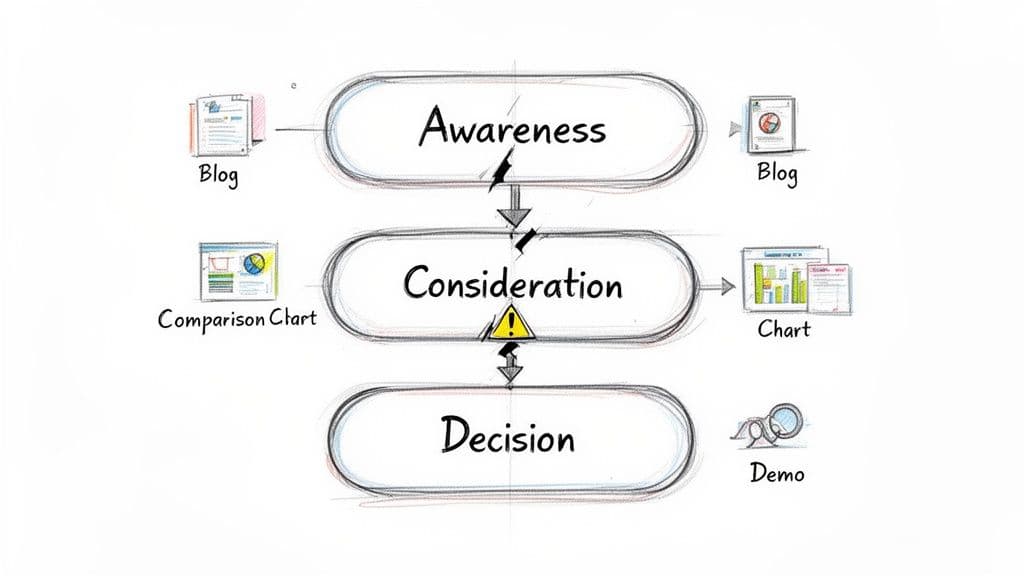
Next, you need to understand the intent behind the questions people are asking. Categorize each AI query into the classic Awareness, Consideration, or Decision stage.
For a project management tool, it might look something like this:
1. Awareness Queries
- “What is async collaboration software?”
- “Benefits of team messaging tools”
2. Consideration Queries
- “Monday.com vs Asana pricing comparison”
- “User reviews for Basecamp alternatives”
3. Decision Queries
- “Discount codes for Asana premium”
- “Onboarding API for project management”
With this map, you can audit your existing content against each stage and immediately spot the gaps. This helps your team focus resources on creating content that aligns with high-value intent.
A simple table can help you prioritize what to tackle first:
Putting these insights together is the foundation of your AI visibility for SaaS companies strategy. The goal is to produce citable, trustworthy content that's properly enriched with structured data and expert quotes.
If you want to dig deeper into the research process, our guide on SEO content gap analysis is a great next step. It details how to spot opportunities that go beyond just AI-driven search.
With a clear roadmap, you can start assigning owners for content creation and optimization. Make sure to track your progress by monitoring how often you’re cited and what your Share of AI Voice is over time. This feedback loop is crucial for ensuring your SaaS brand steadily closes those content gaps and earns citations where it matters most.
From here, it's about iteration. Review your priorities weekly, adapt based on what's working, and watch as AI answer engines start referencing your strategic assets. Don't be afraid to experiment with different formats—interactive demos, concise summaries, and expert interviews can all become go-to references for AI.
And a final pro-tip: always double-check your schema markup and metadata. The easier you make it for machines to parse your content, the better your chances of getting cited.
How to Make Your Content Citable for AI
It's no longer enough to just create great content and hope people find it. If you want AI models to pick up and cite your SaaS company, your content needs to be built for machine comprehension. This means going a step beyond traditional on-page SEO and getting serious about how algorithms read your information.
The entire game is about making your content so clear, factual, and trustworthy that an AI feels confident using it as a source. That means cutting out the marketing fluff and getting straight to the point with unambiguous language.
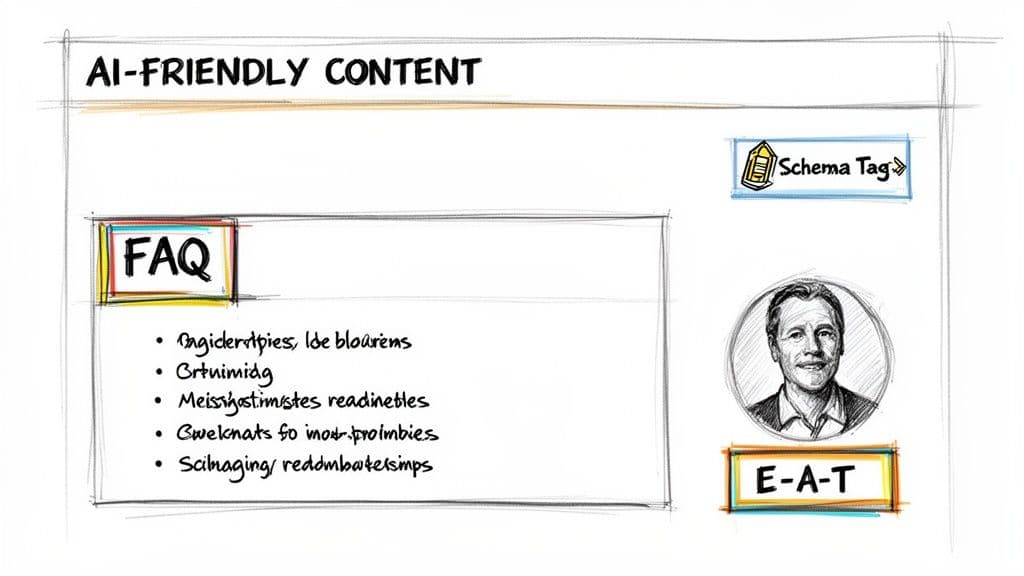
Think of it this way: you're essentially building a clean, well-organized knowledge base for an algorithm. Every article, guide, or blog post should answer a specific question with precision, using simple sentence structures and logical formatting that a machine can easily parse.
This isn't just a hypothetical shift. By 2028, website traffic from AI search is expected to overtake traditional search, with AI Overviews hitting 2 billion monthly users. For SaaS companies, this is a massive deal. AI-driven search often converts better, yet a Semrush study on AI SEO found that only 25.7% of marketers are actively tailoring their content for AI.
Build a Machine-Readable Foundation
Structured data, also known as schema markup, is probably the single most powerful tool you have for boosting ai visibility for saas companies. It’s like putting little descriptive labels on your content that tell AI engines exactly what they’re looking at.
When you implement schema, you’re helping AI models understand the context of your pages. This makes your data far more likely to get pulled into rich snippets and AI-generated answers.
- FAQ Schema: This is a must-have for any page answering common customer questions. It explicitly signals a Q&A format, which is exactly what answer engines are looking for.
- HowTo Schema: Perfect for your tutorials and step-by-step guides. This schema breaks a process down into a clear, logical sequence, making it incredibly citable for instructional queries.
- Product Schema: Absolutely essential for your product and pricing pages. It neatly packages details like features, cost, and user ratings in a standardized format.
The less an AI has to guess about what your content means, the more it will trust and cite it. Schema markup takes the guesswork out of the equation.
Imagine a feature comparison page. Instead of a long block of text, you'd structure it with H3s for each feature, bullet points for the benefits, and maybe a summary table. Then, you'd wrap that whole section in the right schema to make it dead simple for a machine to understand. If you want to dive deeper into these tactics, our guide on Answer Engine Optimization is a great next step.
Here’s a practical checklist to follow when you’re optimizing your content.
AI Content Optimization Checklist
This table breaks down the key technical and on-page elements you should implement to make your content more citable for AI models.
By systematically working through this checklist, you can turn a standard piece of content into a highly structured, trustworthy asset that AI is more likely to reference.
Prove Your Expertise, Authority, and Trust
Beyond the technical setup, AI models are getting smarter about evaluating a source's credibility. They look for signals related to Expertise, Authoritativeness, and Trustworthiness (E-A-T). For any SaaS company, this means you need to be transparent about why you're a credible voice on a given topic.
You can start by clearly showcasing the human expertise behind your content.
- Detailed Author Bios: Don't just list a name. Include clear author bios with credentials, relevant experience, and links to their LinkedIn or other publications. This proves your content is backed by a real, qualified person.
- Publish Original Data: If you can, conduct and publish your own research, surveys, or data studies. This immediately positions you as a primary source, which AI models love.
- Be Transparent with Sourcing: When you reference data from somewhere else, always link back to the original source. It’s a simple act that shows transparency and reinforces the factual accuracy of your work.
When you combine clean, machine-readable formatting with strong E-A-T signals, your content evolves from just being a webpage into a truly citable asset. This two-pronged approach is what it takes to earn a spot in AI-driven answers and secure your visibility in this new era of search.
Measuring Performance and Refining Your Strategy
Getting your brand noticed in AI answers isn't a "set it and forget it" task. It’s a continuous loop of measuring what works, testing new ideas, and refining your approach. What gets you cited today might not work tomorrow, because the AI models themselves are constantly changing. The only way to keep up is to stay nimble.
This means you have to look beyond the metrics you're used to, like website traffic. Clicks are great, but they don't tell you anything about your influence inside the AI's response. You need to shift your focus to KPIs that actually measure your brand's authority in this new channel.
Redefining Your KPIs for AI Search
To get a real handle on your AI visibility for SaaS companies, you need to track metrics that show your influence where it counts: in the AI-generated conversations. This requires a new perspective on what "performance" really means.
Start by zeroing in on these core indicators:
- Share of AI Voice: Think of this as your new primary KPI. It’s the percentage of relevant AI responses that mention your brand versus your competitors. This gives you a clear, honest look at your market share within AI search.
- Citation Frequency: How often do AI models point back to your domain or specific content as a source? A high number here is a strong signal that the models see your content as credible and trustworthy.
- Mention Sentiment: When your brand does show up, is the tone positive, neutral, or negative? Gauging the sentiment helps you understand how AI is shaping your brand's reputation.
These metrics offer a much more meaningful and actionable picture of your performance than traditional SEO analytics can provide on their own. Our guide on how to track your brand’s visibility in ChatGPT walks through exactly how to set up this kind of monitoring.
Establishing an Experimentation Framework
AI models are anything but consistent. In fact, research shows that if you ask the same prompt 100 times, you'll probably get 100 different answers. Chasing a fixed "ranking" is a waste of time. The real goal is to measure your visibility as a percentage of appearances over hundreds, even thousands, of queries.
This is why having a structured testing framework is so critical. You need a simple, repeatable system for running experiments and analyzing what moves the needle. For instance, you could pit a data-heavy whitepaper against a direct, no-fluff FAQ page on the same topic. Let it run for a month, then see which asset earned a higher citation frequency.
It's this cycle of testing, learning, and adapting that will build a sustainable, long-term presence in AI search.
Your Questions, Answered
Let's be honest: figuring out AI visibility feels a bit like navigating a new frontier. The rules are still being written, and the technology shifts under our feet. I get these questions all the time from SaaS marketers and founders trying to get a handle on it all. Here are some straight answers to the most common ones.
How Is This Different From the SEO I Already Do?
This is the big one. The fundamental difference is the end goal. With traditional SEO, you're fighting to rank on a results page, hoping to earn a click that brings someone to your website.
AI visibility, on the other hand, is about getting your brand, your data, or your product featured directly inside the AI's answer.
Think of it this way: you’re shifting from being the destination to being the source. The AI becomes your proxy. This means you have to obsess over structured data, absolute factual accuracy, and building undeniable topical authority in a way that goes beyond just chasing keywords.
How Often Should I Be Checking My AI Visibility?
This isn't a "set it and forget it" kind of thing. You can't just do a one-time audit and call it a day. AI models are probabilistic, meaning they rarely give the exact same answer twice, even for the same prompt. In fact, one study showed that out of 100 queries, AI tools almost never returned the same list of recommendations.
So, what's a practical rhythm? I'd suggest a solid review of your key metrics once a month. If you're in the middle of a targeted optimization push, you'll want to check in more frequently to see what's working.
Can I Actually Measure the ROI on This?
Yes, you absolutely can, but your yardstick has to change. You can't just look at website traffic or organic search conversions like you would with classic SEO. The KPIs for AI visibility are more about measuring your influence within the AI ecosystems themselves.
Here's what you should be tracking:
- Citation Frequency: How often is your domain cited as a source?
- Brand Mention Volume: How many times does your brand name pop up in relevant answers?
- Sentiment Analysis: When you are mentioned, is it positive, negative, or neutral? The context is everything.
Direct attribution is tricky, no doubt. But you can draw clear lines between a rise in these metrics and real business results, like a jump in better-qualified leads or stronger brand recognition. Investing in AI visibility for SaaS companies is a long game—you're building the kind of authority that shapes a buyer's perspective long before they ever think to click on your URL.
Ready to stop guessing and start measuring your AI visibility? Attensira provides the tools you need to monitor your brand's presence across AI platforms, identify content gaps, and optimize your strategy with data-driven insights. See how it works at Attensira.