
Unlock client acquisition with this guide on AI visibility for law firms. Learn to optimize your digital presence for AI search and dominate your market.
AI visibility for a law firm means optimizing your online presence so that AI-driven search engines, like ChatGPT and Google's AI Overviews, cite and recommend your practice. It’s a strategic pivot beyond traditional SEO. The goal is to make your firm the definitive answer when potential clients ask for legal help in this new, conversational search environment.
The New Digital Courtroom for Client Discovery
The way clients find legal representation has fundamentally changed. The old routine—typing "family law attorney near me" into Google and sifting through a list of links—is rapidly giving way to a more direct, conversational approach. Clients are now asking AI platforms for specific recommendations, and firms that haven't adapted are becoming invisible.
This isn't just a new piece of technology; it's a complete reimagining of the client discovery journey. The digital courtroom where firms once vied for top search rankings now has a new judge and jury: the large language models (LLMs) that power these AI tools.
From Search Queries to AI Conversations
Think about a typical scenario. A person needing a divorce lawyer used to start with a broad search, click through a dozen websites, skim a few blog posts, and maybe cross-reference some reviews. This drawn-out process gave a law firm numerous opportunities to grab their attention with ads, high-ranking content, or a compelling website.
Today, that same person might just ask an AI, "Shortlist the top-rated divorce attorneys in Miami who specialize in high-net-worth cases." The AI then synthesizes information from all over the web—legal directories, firm websites, news articles, and client reviews—to deliver a concise, authoritative answer.
This diagram shows just how much the client's search process has changed.
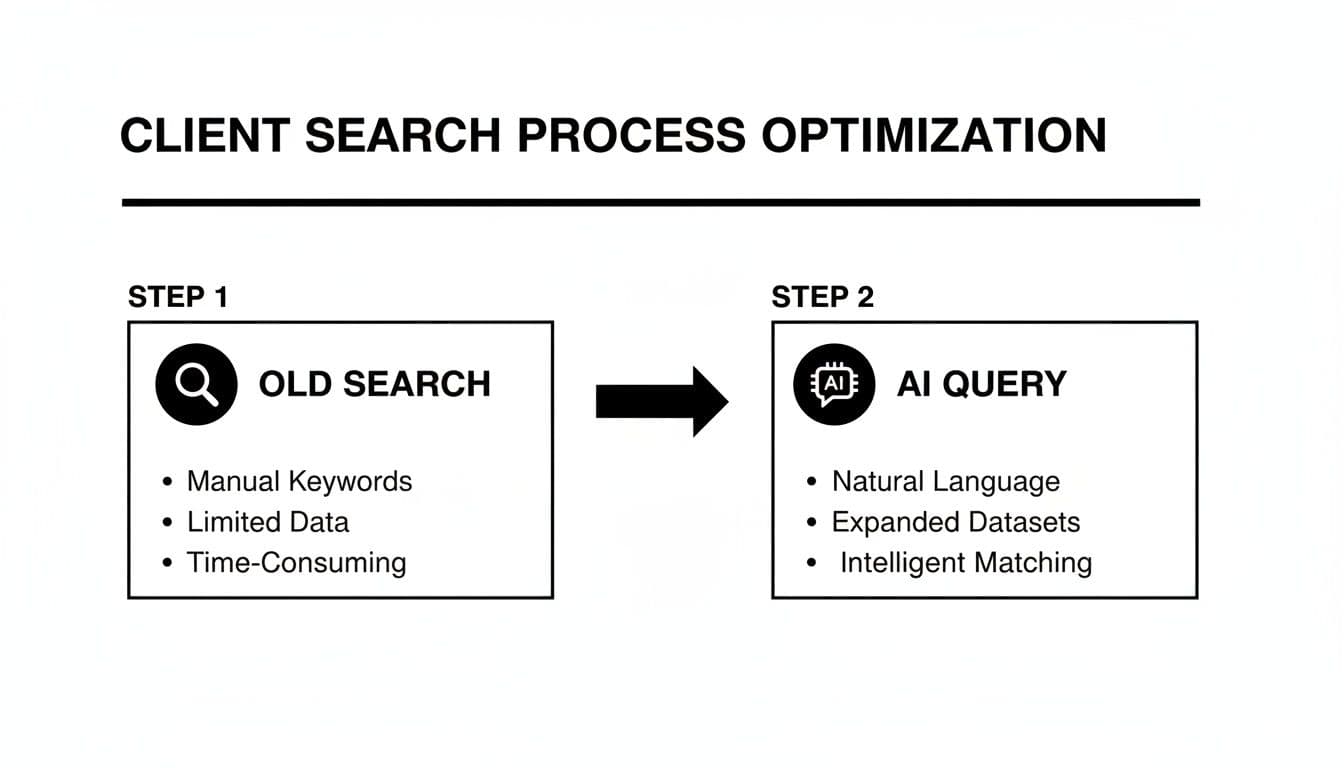
As the visual makes clear, the fragmented, multi-step journey is consolidating into a single, decisive interaction driven by AI. If your firm isn't part of that final synthesized answer, you've lost the potential client before you even knew they were looking.
Introducing Share of Model: The New Metric for Success
In this new reality, old-school metrics like "page-one rankings" are quickly losing their relevance. The crucial benchmark now is Share of Model—a measurement of how frequently your firm is mentioned, cited, or recommended within AI-generated responses to relevant legal questions. A high Share of Model means the AI considers your firm a trusted, authoritative source.
This isn't just a future problem. ChatGPT alone attracts 180 million daily users, and many are asking for direct legal guidance. LLMs lean heavily on trusted sources like Avvo, Super Lawyers, and Chambers for citations. The risk for firms that don't adapt is real. One study found that Google's AI Overviews can crater click-through rates for top organic search results by a staggering 34.5%, simply because users get their answers without ever needing to click a link.
To understand the evolution from legacy SEO to this new paradigm, consider the fundamental differences in strategy and goals.
Traditional SEO vs AI Visibility (GEO)
This shift requires a new playbook. It’s no longer enough to just have a great website; you must ensure your firm's expertise is proven through verifiable, structured data that AI models can easily crawl and comprehend.
Key Takeaway: Share of Model isn’t about ranking a webpage; it’s about becoming a foundational piece of the AI’s knowledge base. It's the difference between being a reference in a legal textbook versus just another book on the shelf.
Mastering the principles behind AI search engine optimization is no longer a "nice-to-have." It's essential for survival and growth in the legal market.
Auditing Your Firm's Current AI Footprint
Before you can start improving your firm's visibility in AI, you have to know where you stand right now. This means getting a clear, honest baseline of your current presence—or absence—in the major AI models. Think of it as the preliminary discovery phase; you can't build a winning strategy on assumptions.
The goal here is to see your firm through the eyes of a potential client who is now using AI to find legal help. This initial audit will almost certainly uncover some uncomfortable truths, but it’s the only way to find the gaps and create a benchmark to measure your progress against.

Probing Major AI Models for Your Firm
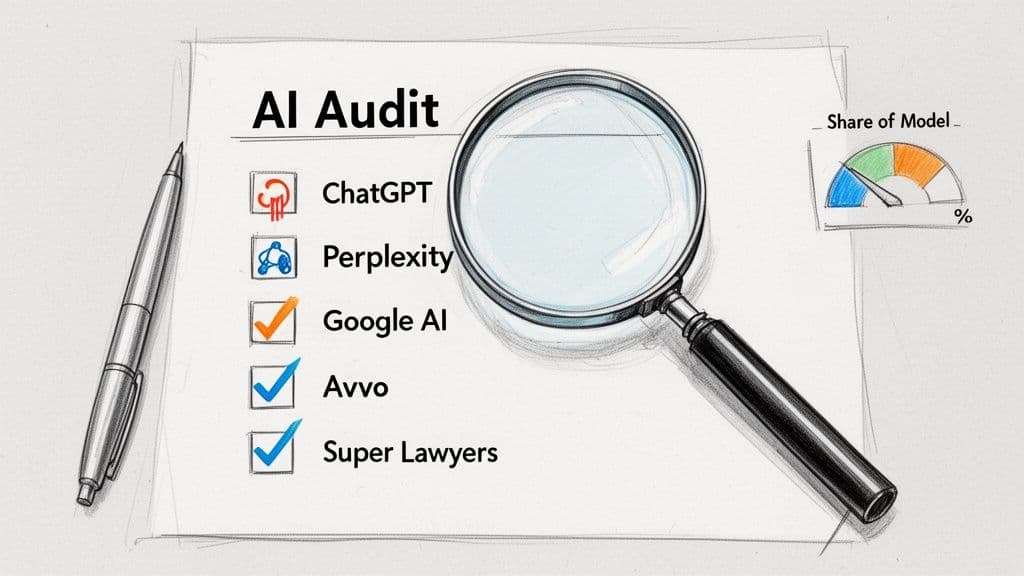
The most straightforward way to start is to simply ask the AIs. Fire up ChatGPT, Perplexity, and Google's AI Overviews and start querying them just like a potential client would. You're trying to simulate a real-world search for legal services.
To get started, try using a few different angles. Be sure to swap the bracketed info with your firm’s own details:
- Broad Practice Area: "List the top-rated [commercial litigation] firms in [Houston]."
- Specific Need: "Who are the best attorneys in [Chicago] for handling [medical malpractice] cases?"
- Reputation Check: "What is the reputation of [Firm Name] in the [New York] legal community?"
- Comparative Query: "Compare [Firm Name] and [Competitor Firm Name] for [intellectual property law]."
Don't just run these once. AI responses aren't static, so run them a few times to get a better sense of the common outputs. Make sure to document everything—screenshot the results, note when your firm is mentioned, and pay close attention to which competitors consistently show up when you don't.
Interpreting the AI's Response—Or Its Silence
What you find (or don't find) is incredibly telling. If your firm is nowhere to be seen for its core practice areas in your own city, that’s a major red flag. It’s a clear signal that the AI models don’t yet associate your brand with that expertise.
Key Insight: Silence is data. When an AI fails to mention your firm, it's not a neutral outcome; it's an indication that your digital authority signals are weaker than your competitors'. The model has chosen others as more credible sources.
Now, look at the firms that are getting recommended. What's their secret? You'll likely notice a pattern: they have deep profiles on major legal directories, a steady stream of media mentions, or highly specific, answer-focused content on their websites. This competitive analysis is your first clue to building a better strategy.
Auditing Your Foundational Data Sources
Large language models don't just invent information. They synthesize it from sources they deem credible and authoritative. In the legal world, that data comes overwhelmingly from established directories and rating services that have been mainstays for decades.
This is your next stop. You need to perform a meticulous review of your firm’s (and each key attorney's) profile on the platforms that matter:
- Avvo: Is the profile complete? Are client reviews and peer endorsements up to date?
- Super Lawyers: Are all accolades and practice areas listed correctly?
- Martindale-Hubbell: Do the peer and client ratings reflect your firm's current standing?
- Chambers and Partners: Are all rankings and recognitions properly displayed?
Incomplete bios, outdated information, or inconsistencies across these sites are more than just clerical errors; they actively undermine your AI visibility for law firms. These profiles are verifiable, third-party data points that AI models use to validate your expertise. A messy or thin presence signals low authority, making it far less likely an AI will ever recommend your firm.
You can get a quick handle on your firm's preparedness by checking your AI Readiness Score, which helps pinpoint specific weak spots. Learn more about how to evaluate your firm’s AI readiness with our specialized tool.
Structuring Legal Content for AI Engines
Once you’ve benchmarked where your firm stands, it’s time to start building content that actively improves your AI footprint. Getting high AI visibility for law firms isn't about outsmarting an algorithm. It’s about structuring your legal expertise in a way that AI models can actually understand, verify, and trust.
Think of it this way: generative engines are built to find and synthesize the most authoritative answer to a user’s question. The old playbook of creating thin, keyword-stuffed practice area pages is officially dead. AIs will just skip right over them, looking instead for content with real depth.
Shift from Practice Pages to Authoritative Guides
The single biggest strategic shift you need to make is moving away from shallow overviews and toward creating in-depth, pillar-style guides. A simple "Personal Injury Attorney in Dallas" page might still pull in some traditional SEO traffic, but it’s highly unlikely to ever be cited by an AI.
An AI is looking for provable expertise. That means your content needs to become an exhaustive resource that anticipates and answers every conceivable follow-up question a potential client might have.
So, instead of that basic page, imagine creating an authoritative guide structured something like this:
- Main Topic: A Comprehensive Guide to Texas Personal Injury Claims
- Sub-Topic 1: Understanding the Statute of Limitations in Texas
- Sub-Topic 2: The Role of Negligence and Liability in Your Case
- Sub-Topic 3: Navigating the Insurance Claim Process Step-by-Step
- Sub-Topic 4: Common Mistakes to Avoid After an Accident
This approach transforms a simple service page into a genuine educational asset. It’s a powerful signal to AI models that your firm has a deep, nuanced understanding of the subject, making your content a prime candidate for citation.
Key Takeaway: AI engines reward depth, not breadth. A single, comprehensive guide on a core practice area will do more for your AI visibility than a dozen superficial pages ever could.
Weaving E-E-A-T Signals Directly into Content
Your content can’t just explain legal concepts; it has to prove your firm's authority to discuss them. This is where Google's E-E-A-T (Experience, Expertise, Authoritativeness, and Trustworthiness) framework is absolutely essential.
AI models rely heavily on these signals to validate a source's credibility. The key is to strategically embed these proofs directly within your content, right where they're most relevant.
Putting E-E-A-T into Practice
This gives the AI models the verifiable data points they're looking for. To really get ahead, mastering effective SEO for lawyers is non-negotiable for driving targeted traffic and turning curious searchers into clients.
Designing for AI Crawlers with Schema and FAQs
Finally, all this great content needs to be technically structured for machine readability. This boils down to using clear headings (H1, H2, H3) to create a logical hierarchy and, crucially, implementing structured data like FAQ schema.
FAQ schema is a goldmine for AI. It lets you explicitly mark up questions and answers, perfectly mirroring the conversational query-and-response format of generative search.
For instance, on a guide about DUIs, you could include an FAQ section:
- Q: What is the first thing I should do if pulled over for a DUI in Florida?
- Q: Can I refuse a breathalyzer test? What are the consequences?
- Q: How can a DUI charge affect my professional license?
This meticulous structuring makes your content incredibly valuable. We're already seeing that 79% of legal professionals are using AI tools, fundamentally changing client discovery. More importantly, Google's AI Overviews, which show up for 58% of informational searches, cite deep, comprehensive pages at an 82.5% rate over superficial ones.
By combining deep content, embedded authority signals, and a clean technical structure, you’re creating assets primed for this new era of search. This is the very core of Answer Engine Optimization, a discipline that modern law firms simply can't afford to ignore.
Building Authority with Strategic Citations
Getting your law firm noticed by AI isn't just about what you publish on your own website. In fact, that's only half the battle. AI models build confidence in a source by cross-referencing its claims across many independent, authoritative platforms. It's like a digital background check—the more credible, third-party sites that vouch for your expertise, the more likely an AI is to trust and recommend your firm.
This is why a thoughtful citation strategy and a strong off-page presence are absolutely critical. It’s not a numbers game of getting listed everywhere; it’s about weaving a rich, consistent, and detailed web of information that leaves no doubt about your firm’s authority in its specific legal niches.
Start with the Core Legal Directories
Large language models lean heavily on well-structured, reputable data sources to make sense of the legal industry. For them, premier legal directories are gold mines of verifiable information. Profiles on sites like Avvo, Super Lawyers, and Chambers are much more than online business cards; they are foundational pillars of your AI visibility.
Inconsistent or incomplete profiles send mixed signals that erode an AI's trust. If an AI sees conflicting practice areas or outdated attorney bios across different directories, it will almost certainly favor a competitor whose digital identity is clean and consistent.
To really move the needle, you need to treat each directory profile as a strategic asset. Focus on getting these elements right for every single attorney:
- Detailed Bios: Don't just list contact information. Weave in specific keywords for niche practice areas, describe notable (anonymized) case histories, and build a clear narrative of their professional journey.
- Granular Practice Areas: Get specific. Instead of just "family law," use terms like "high-net-worth divorce" or "contested child custody." Accuracy and consistency across all platforms are key.
- Awards and Recognitions: This is third-party validation at its finest. Meticulously list all awards, bar association memberships, and peer-review ratings.
- Publications and Speaking Engagements: Have your attorneys contributed to legal journals or presented at conferences? This is direct proof of thought leadership and needs to be on their profiles.
An AI model is essentially looking for consensus. The more high-authority legal directories that paint the same detailed picture of your firm's expertise, the stronger that consensus becomes. This is how you build the digital trust that fuels AI-driven recommendations.
Weave a Web of Verifiable Data Points
While legal directories are the foundation, a truly dominant strategy builds authority across the entire web. Every media mention, guest article, or even a substantive answer on a legal forum creates another data point an AI can use to confirm your firm’s expertise.
The old search paradigm, where Google held 90-95% of the market, is breaking apart. AI tools are creating new pathways for clients to find legal help, and the data reveals a massive performance gap. GEO agencies report that elite law firms now average 87 AI citations, while their SEO-focused peers lag with just 24. The result? Those elite firms are seeing 426% more direct inquiries and 78% higher conversions from AI-generated traffic.
This means you have to get proactive about placing your expertise in the public square.
- Seek opportunities to contribute to legal journals or reputable industry blogs.
- Offer expert commentary to journalists covering stories in your practice area.
- Engage in meaningful discussions on platforms like LinkedIn where legal topics are debated.
Each of these actions forges another verifiable link between your attorneys' names and their specific legal knowledge. Over time, this network of citations becomes overwhelming evidence for AI models, making your firm a go-to source. A well-optimized presence can also dramatically improve your chances of securing a Google Knowledge Panel, further cementing your authority in a highly visible way.
Monitoring and Scaling Your AI Visibility
Getting your firm cited by an AI isn't a one-and-done project. It's a discipline. The content and authority signals that make you a go-to source today will need constant attention as AI models evolve and, more importantly, as your competitors start catching on. The firms that build a durable advantage are the ones that create a system to monitor performance, spot new opportunities, and scale their efforts.
This is the point where a manual audit hits its limits. Spot-checking a few queries gives you a decent baseline, but it's simply not scalable for tracking your firm’s Share of Model across dozens of practice areas and geographic markets over time. You need a system that delivers persistent, competitive intelligence without the manual grind.
Putting Your Monitoring on Autopilot
To really get a handle on AI visibility for law firms, you need a command center. This is where platforms like Attensira come in, automating the heavy lifting and turning sporadic checks into a continuous feedback loop.
Getting started is usually straightforward. You connect your firm’s domain and tell the system which legal queries actually drive business. This simple setup creates the framework for all your ongoing analysis, letting you see exactly how you show up in the major AI models.
This dashboard, for example, shows how a platform can take a mountain of data and boil it down into something you can actually use.
At a glance, you can see citation frequency, share of voice, and how you stack up against the competition. It immediately highlights where you're strong and, more critically, where you're completely invisible.
Turning Data Into Real Opportunities
The real power of a dedicated monitoring platform isn't just in the data it shows you, but in the specific, high-value opportunities it uncovers. It’s about translating raw visibility metrics into a clear action plan. The goal is to get past knowing that you aren't being mentioned and into understanding why—and what you need to do about it.
Here’s a scenario I see play out all the time:
- The Insight: Your dashboard flags that a local competitor is consistently cited by AI for "commercial lease disputes in Boston," one of your core practice areas.
- The Analysis: You dig in and see the AI is pulling from your competitor's comprehensive blog guide on the topic, which is bolstered by their detailed profiles on several legal directories. Meanwhile, your own content is limited to a single, pretty thin practice area page.
- The Opportunity: You've just found a glaring content gap. The AI has crowned your competitor as the local authority, and you're not even in the conversation.
This is the kind of tangible, revenue-linked opportunity a robust monitoring system brings to the surface. It shifts the vague goal of "improving AI visibility" into a concrete, strategic task: "Develop an authoritative guide on Boston commercial lease disputes to capture the AI's attention and displace our top competitor."
Key Takeaway: Consistent monitoring transforms AI visibility from an abstract idea into a series of manageable, data-driven tasks. It shows you exactly where your competitors are winning and gives you the blueprint to close that gap.
Creating a Virtuous Cycle of Improvement
Once you’ve identified an opportunity, the next step is to act on it—fast. Modern platforms can even help accelerate this part of the process. For instance, after finding that content gap, you could use integrated AI drafting tools to generate a structured, optimized article based on the competitive insights you just gathered.
This creates a powerful, self-reinforcing loop:
- Monitor: The platform tracks your visibility and flags a competitor's dominance in a key practice area.
- Analyze: You pinpoint the exact content and authority signals driving their success.
- Execute: You use AI-assisted tools to rapidly develop a superior, more comprehensive piece of content to fill your identified gap.
- Measure: After publishing the new content, you use the platform to track its impact on your Share of Model over the coming weeks and months.
This agile approach lets a firm systematically find and fix the weak spots in its AI footprint. You can continuously build your authority across more and more legal niches, ensuring your firm not only catches up but stays ahead of the curve.
For a deeper dive into the nuts and bolts, you can learn more about how to track your brand’s visibility in ChatGPT and other top LLMs in our detailed guide.
Your Top Questions About AI Visibility, Answered

As law firms grapple with this new AI-driven search world, a lot of practical questions come up. It's a major shift, and it’s completely normal to wonder how this all fits together. Here are some of the most common questions we hear from managing partners and marketing directors, with straight, no-nonsense answers.
How Does AI Visibility Differ from Traditional SEO?
Think of it this way: traditional SEO is about getting your firm’s website onto the first page of Google. It's a competition for a spot in a list of blue links. AI visibility for law firms, on the other hand, is about becoming the answer itself—being the trusted source cited directly within an AI-generated response.
It’s a fundamental shift from winning a click to becoming part of the core information provided. While old-school SEO leaned heavily on keywords and backlinks to rank a page, this new approach, often called Generative Engine Optimization (GEO), puts a premium on structured data, verifiable authority from directories like Avvo, and incredibly deep, useful content that directly answers a user's question.
The goal isn't just to rank; it's to be woven into the fabric of the AI's knowledge base.
Do I Still Need SEO if I Focus on AI Visibility?
Yes, you absolutely do. Don’t throw out your SEO playbook just yet—its role has simply evolved. Strong, foundational SEO is now the price of entry for AI visibility.
Think about it from the AI's perspective. It needs to trust the sources it cites. It still relies on traditional signals of relevance and authority to figure out who the credible players are. Things like your website's technical health, logical structure, and high-quality content are non-negotiable prerequisites. An AI model is highly unlikely to cite a source that Google already deems untrustworthy or irrelevant.
SEO gets you into the library; GEO gets your work cited in the research paper. The two are inextricably linked, and one cannot succeed without the other. Strong foundational SEO makes your firm a more attractive candidate for AI models to reference.
For a deeper dive into the mechanics, this resource on How to Rank in AI Search Engines provides some excellent, practical guidance.
Can AI Just Replace Our Firm's Marketing Team?
Not a chance. What AI can do is act as a powerful force multiplier for your marketing team, but it will never replace them. It’s brilliant at speeding up research, analyzing data, and even generating a first draft of an article. But the human element, especially in a field like law, is irreplaceable.
Here’s where human oversight is absolutely critical:
- Legal Accuracy: Every piece of AI-generated content must be reviewed by a qualified attorney. The risk of factual errors or ethical missteps is just too high to leave to a machine.
- Strategic Direction: An AI can execute a command, but it can't set your firm's brand strategy, pinpoint a subtle competitive advantage, or build a real relationship with a potential client.
- Authentic Brand Voice: Your firm has a unique perspective and tone. An AI can mimic it, but it can't genuinely replicate the human expertise and empathy that builds client trust.
Let AI handle the repetitive, data-heavy tasks. This frees up your human team to focus on what they do best: high-level strategy, creative thinking, and client engagement.
What Is the Single Most Important Action for AI Visibility?
If you do only one thing, make it this: create and maintain meticulously detailed, accurate, and consistent profiles for your firm and every single attorney across all major legal directories. I’m talking about Avvo, Super Lawyers, Martindale-Hubbell, Chambers, and others.
These platforms are goldmines of structured data for Large Language Models (LLMs). They provide verifiable, third-party proof of your firm’s location, practice areas, attorney credentials, awards, and peer reviews. When this information is complete and uniform everywhere it appears, you’re handing the AI models the high-confidence signals they crave to recommend your firm as a legitimate, authoritative source.
Honestly, it’s the lowest-hanging fruit with the biggest potential impact.
Ready to stop guessing and start measuring your firm’s Share of Model? Attensira provides the command center you need to track your AI visibility, uncover competitor strategies, and turn insights into action. Discover your AI readiness score today.