Boost your AI visibility for cybersecurity firms with this playbook. Learn how to master AI search, secure citations, and drive growth in 2026.
Getting your cybersecurity firm's brand, products, and threat intelligence featured in AI-generated answers is the new frontier of digital marketing. We're talking about direct citations and recommendations inside responses from ChatGPT, Google's AI Overviews, and other assistants. This goes far beyond traditional SEO, demanding a focus on becoming a trusted, authoritative source that AI models rely on to inform users.
The New Digital Battlefield for Cybersecurity Brands
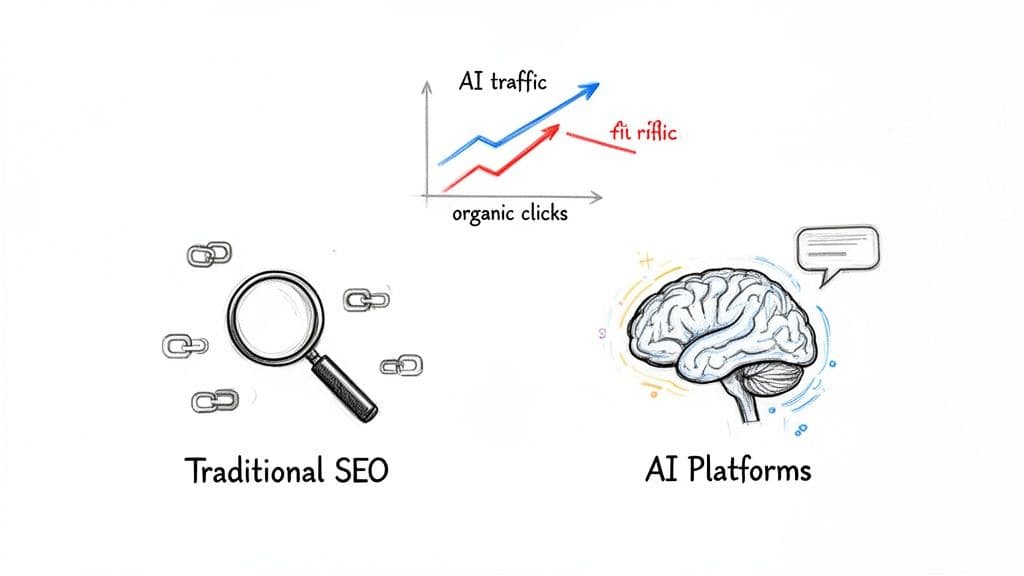
The game has completely changed. For years, the goal for cybersecurity firms was simple: rank high on a Google search results page. That's no longer enough. The real fight for authority and high-quality leads is now happening inside the conversational responses of AI.
Platforms like ChatGPT, Perplexity, and Google’s AI Overviews have become the new information gatekeepers. They don’t just link to your website; they digest it, summarize your findings, and present a synthesized answer directly to the user. If your firm isn't the source material for that answer, you effectively don't exist for a huge and growing part of your target audience.
The Numbers Don't Lie: A Visibility Crisis is Here
This isn't some far-off trend; it's a present-day reality backed by startling data. By early 2026, ChatGPT is projected to hold an incredible 80.1% of the AI search engine market share. For major players like CrowdStrike or Palo Alto Networks, showing up in a ChatGPT response is no longer a "nice to have"—it's a critical component of brand authority.
Consider the speed of this shift:
- From 2024 to 2025 alone, AI search traffic exploded by 527%.
- AI assistants now generate over 1.13 billion referral visits every single month, a staggering 357% jump from the previous year.
The most alarming part? While nearly 69% of all websites are seeing at least some traffic from AI, our analysis shows specialized B2B industries like cybersecurity are often falling behind. This gap represents both a serious threat to laggards and a massive opportunity for first-movers.
To put these figures in context, here is a breakdown of the statistics that are reshaping the B2B competitive landscape.
Key AI Search Metrics Impacting Cybersecurity Firms
These numbers confirm that the ground has shifted beneath our feet. Relying solely on old-school tactics is a recipe for being left behind.
Why Your Old SEO Playbook Is Failing
Traditional SEO, designed for a world of blue links and organic rankings, simply can't keep up. The problem is that your potential customers—from security analysts vetting tools to CISOs developing strategy—are now asking AI assistants highly specific, complex questions.
They aren't just typing "EDR solutions." They're prompting, "What are the best EDR solutions for a mid-sized financial services firm?" or "Compare the latest threat intelligence reports on ransomware-as-a-service groups."
If your threat reports, solution briefs, and expert analysis aren't structured in a way that AI models can easily synthesize, you'll be ignored. The AI will cite a competitor who has done the work. To compete, marketers must also develop new competencies. For instance, knowing how to detect AI in video, audio, and text is becoming a crucial skill, not just for your security products but for your own marketing intelligence.
For any cybersecurity firm looking to grow, achieving "AI visibility" is the single most important new metric. It’s about making sure your expertise becomes the foundation for the answers AI gives, cementing your brand as the go-to authority in this new digital arena.
Auditing Your Firm's Current AI Footprint
Before you can even think about improving how AI search engines see your cybersecurity firm, you need a clear, unvarnished look at where you stand right now. You simply can't map out a strategy without knowing your starting position. This means systematically querying the major AI platforms to see your brand, your products, and your competitors through the eyes of a potential customer.
Your first move is to open up ChatGPT, Perplexity, and Microsoft Copilot. These aren't just the flavor of the month; they represent a massive slice of the AI query market. The goal here isn't a vanity search. It's raw competitive intelligence, simulating the exact questions that security analysts, IT managers, and CISOs are asking as they evaluate solutions.
Crafting Your Audit Prompts
To pull out anything meaningful, your prompts have to be sharp and varied. A solid audit isn't just about asking "What is [Your Firm's Name]?". It requires you to probe from multiple angles, mirroring a prospect's entire journey from problem awareness to vendor comparison.
Think about organizing your queries into a few key categories:
- Brand-Specific Queries: Go direct. "What are the pros and cons of [Your Firm's Name]?" or "Summarize recent reviews for [Your Product Name]."
- Competitor Comparisons: Pit yourself against the usual suspects. "Compare [Your Firm's Name] vs. CrowdStrike vs. SentinelOne for endpoint detection."
- Solution-Category Questions: See who owns the category conversation. "What are the best EDR solutions for a mid-sized financial services firm?" or "List the top companies for zero-day threat intelligence."
- Problem-Oriented Prompts: Get to the root of your customer's pain. "How can I protect my organization from phishing-resistant MFA bypass attacks?"
For instance, a prompt like, “Summarize the key findings from the CrowdStrike 2026 Global Threat Report,” is a fantastic way to test if an AI can recall and correctly synthesize your firm's most valuable intellectual property. If it fails, or worse, gets the facts wrong, you’ve just found a major content gap.
A thorough audit isn't a one-and-done job. These AI models are constantly being updated. What's true this month could be completely different next month. You have to build a routine around this process to maintain any kind of durable visibility.
Analyzing the AI's Response
Once you have the outputs, the real work begins. Don't just scan for a mention of your company and call it a day. You need to dissect these responses to find actionable intelligence. For a much deeper dive into the methodology, our complete guide on AI search monitoring offers some advanced techniques.
As you review the AI’s answers, you’re looking for answers to a few critical questions:
- Presence vs. Absence: Are you even in the conversation for relevant, high-intent questions? If not, you're invisible where it counts.
- Accuracy and Sentiment: When your firm is mentioned, is the information correct? Is the tone positive, negative, or just neutral? A single piece of misinformation can be far more damaging than being absent.
- Source Citations: Check the footnotes. Is the AI citing your own website as a source? Earning those direct citations is the gold standard, as it signals to the model that your domain is an authority worth referencing.
- Competitive Placement: Who is showing up? Pay close attention to the competitors who appear consistently and try to figure out what content of theirs is being surfaced.
This initial audit gives you the hard data you need to build a real strategy. It takes you out of the realm of guesswork and into a world of evidence, clearly showing you where the quick wins are, what misinformation you need to fight, and what your long-term content priorities must be to win in this new era of search.
Once you’ve finished auditing your current AI footprint, the real work begins. It’s time to re-engineer your content, turning it into the exact kind of raw material that AI models are built to consume. Winning at AI visibility for cybersecurity firms isn’t about pumping out more blog posts; it's about publishing smarter content. You have to shift your mindset from a traditional SEO to that of a data librarian curating a collection for large language models.
Think about it: AI models don't "read" articles like a person does. They parse, categorize, and hunt for clean, factual signals that scream expertise and authority. Your job is to structure your firm’s deep knowledge so clearly that it becomes the most efficient, reliable source for an AI to pull from when answering a user's question about zero-day exploits or SOC-as-a-Service.
Emphasize Clarity and Factual Density
Long, narrative-heavy whitepapers and landing pages choked with marketing jargon are poison for AI synthesis. These models are looking for direct, factually dense, and logically structured content they can easily understand.
For example, a brilliant technical analysis of a new ransomware strain is incredibly valuable, but it’s almost impossible for an AI to quickly pull a specific statistic from the middle of a dense paragraph. That deep-dive content needs to be broken down into more accessible formats.
- Build out dedicated FAQ pages. Go straight for the "who, what, why, and how" questions your audience is asking. A page titled "What Is the BlackCat Ransomware?" with clear, concise answers has a much higher chance of being cited than a sprawling report.
- Lead with definitions. Start key paragraphs with simple, definitional statements. For instance, "Endpoint Detection and Response (EDR) is a cybersecurity solution that monitors and collects endpoint data to identify and respond to threats." This is a bright, clear signal for an AI.
- Use formatting to highlight data. Don't bury statistics or process steps in prose. Pull them out into bulleted lists and tables. This kind of structured data is simple for a model to parse, verify, and reuse.
This simple workflow—check, analyze, and identify—is the core of making your information not just discoverable, but truly citable for AI models.
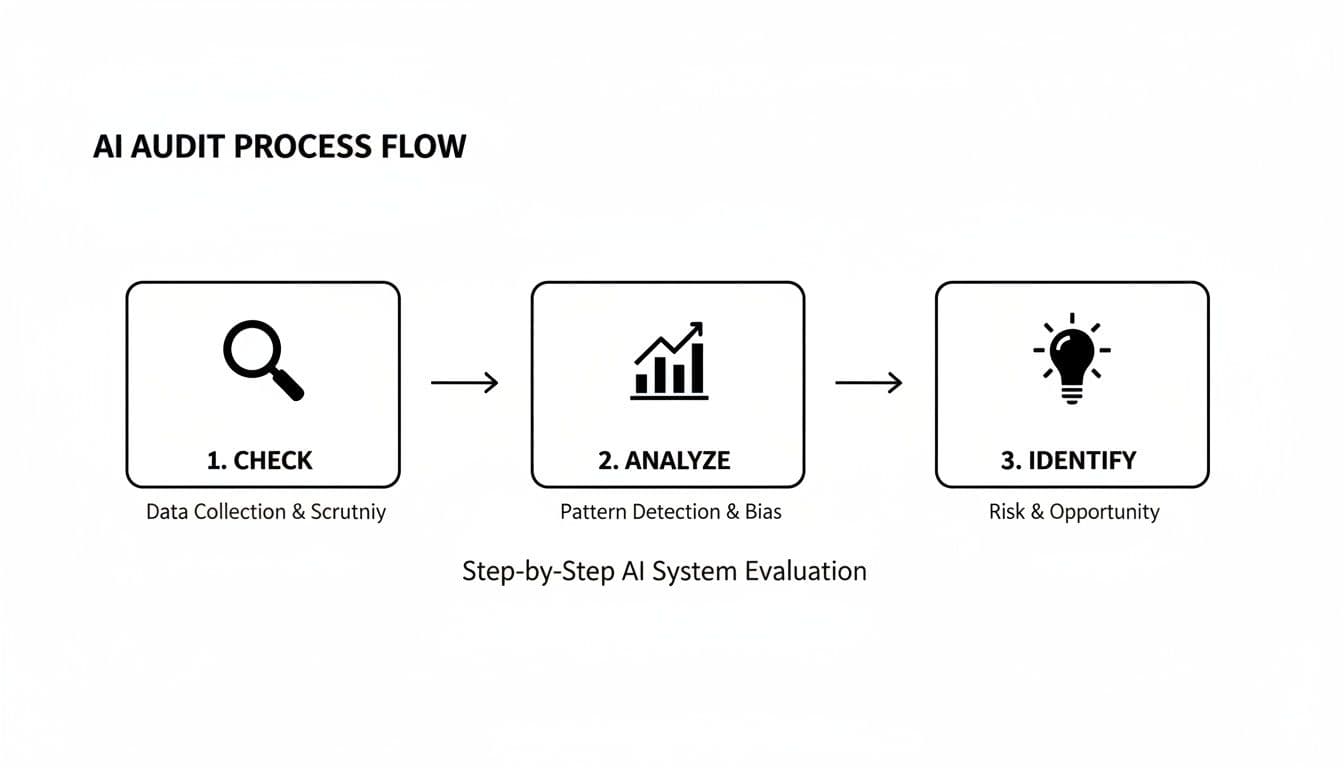
This process isn’t a one-time task; it’s a continuous loop that keeps your content aligned with how AI models are evolving.
Structure Your Content for Machine Consumption
Beyond the words on the page, the technical structure of your content is critical. This is where you can practically hand-feed AI models the correct information about your company, its expertise, and its services. The most powerful tool for this is structured data, often called schema markup. If you want to get into the weeds, you can explore our full guide on how ChatGPT indexes content.
For a cybersecurity firm, this means getting specific with schema:
- Service Schema: Clearly define your services like "Penetration Testing" or "Managed Detection and Response." This tells an AI exactly what you do, leaving no room for interpretation.
- Organization Schema: Lock in your official company name, logo, and social media profiles. This helps prevent brand confusion and ensures the AI attributes information to the correct entity.
- FAQ Schema: Mark up your FAQ pages to explicitly link questions with their answers. This makes them perfect, pre-packaged fodder for AI-generated responses.
By implementing schema, you are essentially opening a direct line of communication with AI crawlers. You’re telling them, "This is the definitive, verified information about my company and its offerings." It strips away ambiguity and dramatically increases your chances of being cited accurately.
This work has become urgent. Cybersecurity firms are facing a 527% year-over-year explosion in AI-driven traffic, a trend that demands entirely new visibility strategies. With ChatGPT controlling 80.49% of the chatbot market and rocketing to become the world's 5th most visited site, its influence is massive. AI already impacts 68.94% of all websites, yet many B2B cybersecurity leaders are getting left out because their content isn't built for AI synthesis. This data highlights a clear mandate: your content must be more than just human-readable; it has to be machine-synthesizable.
Building a Proactive AI Visibility Strategy
A one-time audit gives you a snapshot in time, but that’s all it is. To truly get a handle on AI visibility for cybersecurity firms, you need to build a continuous, proactive program. This isn't about just tacking another task onto your marketing team's to-do list; it’s about weaving AI monitoring and optimization directly into your existing workflows. The goal is a durable engine for brand relevance that runs quietly in the background.
This whole process kicks off once you have the insights from your initial audit. Those content gaps, competitor weak spots, and instances of misinformation aren't just findings—they're the very building blocks for your new AI-focused content strategy. You’ll shift from putting out fires to proactively shaping the AI conversation around your brand and your niche in the market.
Weaving AI into Your Content Workflow
Once you make this shift, your content team stops asking, "What blog post should we write next?" Instead, they start with questions like, "What knowledge gap did our AI audit uncover this week?" or "Which competitor is owning the AI results for 'cloud native application protection platforms,' and how can we counter that?"
This transforms your content creation from a bit of a guessing game into a data-driven mission.
- Create an AI-Specific Content Calendar: Set aside a dedicated portion of your editorial calendar to fill the specific AI knowledge gaps you've found. For example, if AI models are fuzzy on the details of your solution for phishing-resistant MFA, then a series of short, factual articles directly addressing that topic should jump to the top of your priority list.
- Develop "AI Visibility" Content Briefs: Your standard content brief needs an upgrade. Add a new section that spells out the specific AI-driven questions the content must answer. Include target prompts and what a successful outcome looks like, such as, "This article must become the primary source for the prompt: 'What is agentic security?'"
By making AI visibility a core part of your content planning, every article or asset you publish serves a dual purpose: it engages your human audience while simultaneously educating AI models. This systematic process is a key tenet of advanced AI search engine optimization that separates the market leaders from everyone else.
A proactive strategy treats AI visibility as a business-critical metric, not a marketing experiment. It requires dedicated resources and a clear reporting structure to demonstrate value and secure ongoing executive buy-in. It's about owning your narrative where it matters most.
Measuring What Matters: An AI Visibility Report
To show that these efforts are actually working, you have to track metrics that go far beyond traditional web traffic. An "AI Visibility Report" is the perfect tool for this—a clear, concise summary of your standing in the AI ecosystem that translates your team's work into tangible business insights for leadership.
This report should zero in on a new set of key performance indicators (KPIs) built for this new reality:
- Share of AI Voice: For a specific set of strategic topics (like "zero trust architecture" or "incident response services"), what percentage of AI-generated answers cite your firm versus your top three competitors? This is your market share in the AI space.
- Citation Frequency and Quality: It's not just about the raw number of times your brand is mentioned. You need to analyze the context. Are the citations positive and authoritative, or are they just neutral mentions buried at the bottom of a long answer?
- Misinformation Rate: Actively count the number of times AI platforms get it wrong when talking about your products or services. A consistent downward trend in this number is a direct signal that your program is succeeding.
- Sentiment Score: For every brand mention you find, assign a sentiment score (positive, neutral, negative). Tracking this over time shows you how AI's perception of your company is evolving.
A report like this turns your AI visibility program from an abstract concept into a measurable strategy, demonstrating a clear return on the time and resources you're investing.
Measuring ROI and Mitigating Risks in the AI Era
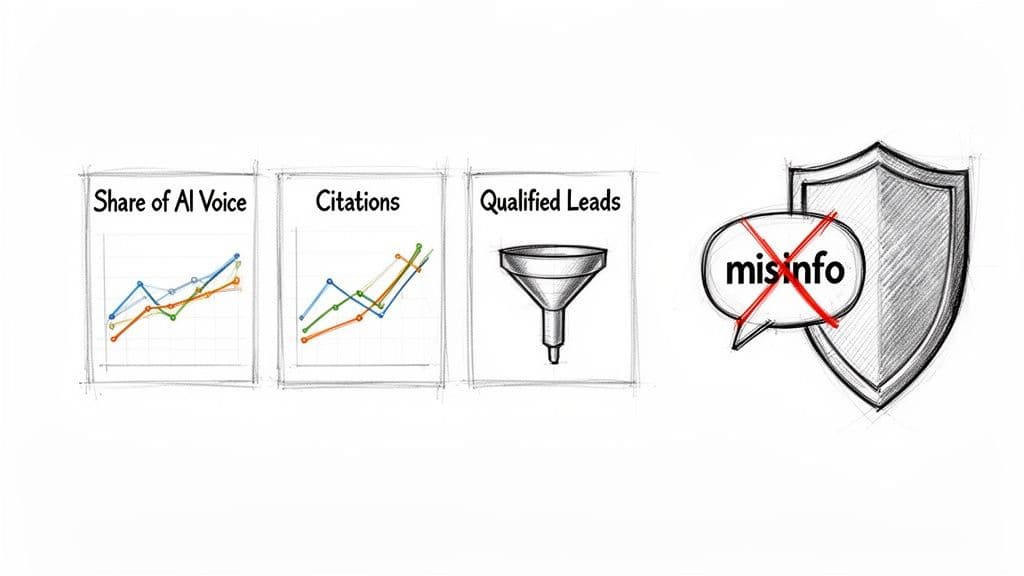
It’s easy to dismiss AI visibility as a fuzzy, abstract metric. The real challenge is drawing a straight line from getting cited in an AI response to hitting core business goals like generating qualified leads and lowering customer acquisition costs.
This isn’t just about getting your name mentioned. It's about proving how those mentions directly contribute to your growth pipeline.
A good starting point is to track referral traffic coming from AI platforms. Yes, many AI interactions are "zero-click," but a surprising number still drive traffic through source links. By monitoring these specific referrals, you can start to see a clear correlation between your AI visibility efforts and the inbound demo requests you're getting.
Calculating the Business Impact
To get budget and buy-in, you have to translate AI metrics into an ROI story that resonates with leadership. This isn't just a marketing report; it's a business case that justifies the resources needed to improve your AI visibility for cybersecurity firms.
Think about the impact across the entire funnel:
- Lead Quality: Are the leads coming from AI referrals converting at a higher rate? In my experience, prospects "pre-educated" by an AI that cites your firm are often more qualified and move through the sales process much faster.
- Reduced Acquisition Costs: When AI models consistently treat your firm as a trusted source, you build powerful organic authority. This can naturally reduce your dependency on paid search and social channels, bringing down your cost per lead.
- Sales Enablement: Imagine your sales team being able to point to a generative AI response that validates your solution. That kind of impartial, third-party credibility can be a powerful tool for shortening sales cycles and overcoming objections.
The fragmentation of search is already hitting cybersecurity growth pipelines. AI platforms are on track to surpass traditional search traffic by 2028, but the zero-click environment—with 93% in Google’s AI Mode—can bury content. Brand managers leveraging tracking can secure mentions in the 80.49% of responses dominated by ChatGPT and see real gains, as 70% of AI-SEO users report positive ROI. Failing to adapt means fading into algorithmic obscurity. Discover more insights on AI search trends from Exposure Ninja.
A Playbook for Mitigating AI-Generated Risk
Beyond chasing ROI, you have to play defense. Misinformation about your products or services generated by an AI can spread instantly and do serious damage to your brand’s hard-won reputation. A proactive strategy is non-negotiable.
Your first line of defense is swift and direct. Every time you find an AI spouting inaccuracies about your brand, use the platform's built-in feedback tool—the "thumbs down" or report button. It's not a silver bullet, but it's a critical first step to signal the error to the model's developers.
The real power, however, lies in a long-term strategy of pre-emptively debunking falsehoods with your own authoritative content.
- Build a "Truth Hub": Create a dedicated section on your website that acts as the single source of truth for your brand. This could be a comprehensive FAQ page, a "myths vs. facts" series, or a set of articles that directly address and correct common misconceptions.
- Write for the Machine: Structure this content with simple language, direct statements, and clear headings. For example, an H3 titled "Is [Your Product] Vulnerable to X?" followed by a concise "No, because..." is exactly what an AI model needs to find and cite the correct information.
- Stay Vigilant with Monitoring: This is not a one-and-done task. You need to keep a constant watch for new inaccuracies as they emerge. We cover this ongoing process in more detail in our guide to artificial intelligence monitoring.
This two-pronged approach—actively measuring your return while aggressively defending against misinformation—is how you build and protect your brand's authority in the new age of AI-driven search.
Frequently Asked Questions About AI Visibility
As cybersecurity marketers start grappling with AI-driven search, a lot of the same questions pop up. It’s new terrain for everyone, and it forces a shift away from comfortable SEO metrics toward something more nuanced: how your brand’s authority is perceived by AI models.
We've been in the trenches helping firms navigate this. Here are the answers to the questions we hear most often.
How Is AI Visibility Different From Traditional SEO for a Cybersecurity Firm?
This is the big one. While traditional SEO is all about getting your pages to rank on a SERP, AI visibility is about having your expertise, data, and value props cited directly within the AI's generated response.
Think of it this way: SEO is a game of clicks. You want someone to land on your page. AI visibility, on the other hand, is a game of authority. You want your content to be the source material the AI uses to answer complex questions about things like emerging threats, solution comparisons, or market leaders. This means shifting your content strategy from a pure keyword focus to creating incredibly clear, factual, and well-structured information that an AI can easily understand and trust.
The real difference is the goal. SEO wants the click. AI visibility wants your firm to be the answer, establishing you as the go-to authority even when no one clicks through.
What Is the First Step We Should Take to Improve Our AI Visibility?
Before you do anything else, you need to run a comprehensive audit of your current AI footprint. You can't map out a strategy if you don't know your starting point. And that means going straight to the source.
Open up platforms like ChatGPT and Perplexity and start asking the questions your buyers are asking. Get specific.
- "Compare CrowdStrike vs. SentinelOne for endpoint detection."
- "What are the top solutions for cloud security posture management?"
- "Summarize the findings of the latest threat intelligence reports on ransomware."
Carefully document where you show up, where you're absent, and—most importantly—whether the information about your firm is correct. Our guide on how to see brand visibility in ChatGPT and other top LLMs provides a detailed walkthrough for this. This audit gives you the hard data you need to move forward.
How Do We Handle Inaccurate Information About Our Company in AI Responses?
Finding inaccurate information about your products in an AI response is a serious risk. It can tank your credibility fast. You need a two-part plan: one for the short-term fix and another for the long-term solution.
Immediately, use the feedback tools built into the AI platform itself. Look for the 'thumbs down' icon or a feedback link and report the error. This is a direct signal to the developers that the model got something wrong.
For the long game, you have to become the source of truth. Publish clear, authoritative content on your own website that directly corrects the misinformation. A simple Q&A or a "facts vs. fiction" page works beautifully. Over time, as the AI models re-crawl the web, your content will start to outweigh the bad sources, correcting the public record and solidifying your brand's authority.
Ready to stop guessing and start measuring your AI visibility? Attensira provides the tools cybersecurity firms need to audit their brand presence across major AI platforms, identify content gaps, and optimize for the future of search. Take control of your AI narrative by visiting https://attensira.com to learn more.