Discover practical steps to boost ai visibility for coaches in 2026 with actionable tactics, real-world examples, and tools to attract more clients.
When we talk about AI visibility for coaches, we're really talking about a new frontier in marketing. It's the art and science of positioning your online presence so that AI tools like ChatGPT, Gemini, and Perplexity not only find you but also recommend and cite you. This goes way beyond old-school SEO. It’s about making your expertise so clear and trustworthy that an AI sees you as the answer for a potential client.
Why Your Coaching Practice Needs to Get Ahead of This Now
If your entire marketing plan still hinges on climbing Google's classic search rankings, you're becoming invisible to a fast-growing group of your ideal clients. The fundamental way people find information is changing right under our feet. They aren't just sifting through ten blue links anymore; they're asking AI assistants direct questions and getting immediate, conversational answers.
This is the big shift: from search engines to answer engines.
This process flow shows exactly how that journey has evolved, with AI now sitting between a person's question and the information they receive.
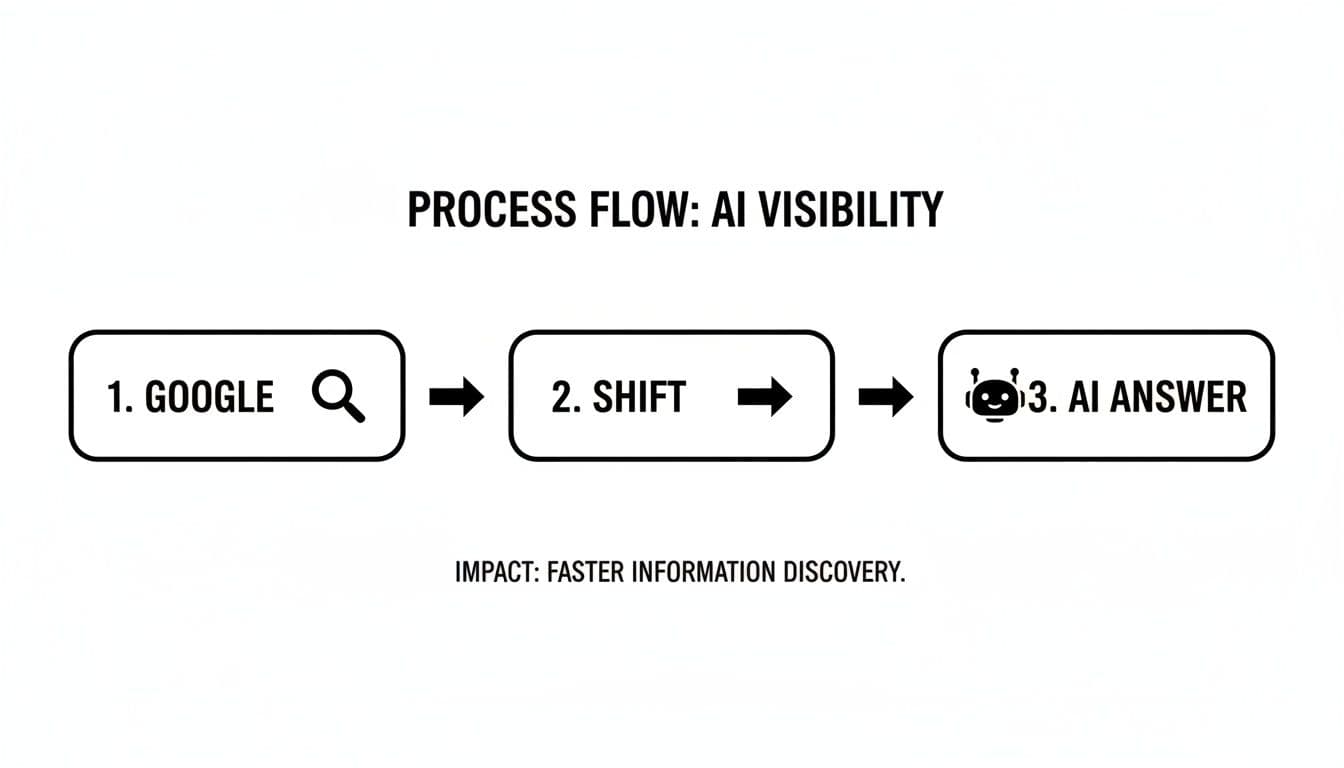
As you can see, AI models have become powerful intermediaries. They interpret what a user is looking for, synthesize information from across the web, and deliver a consolidated response, often bypassing the traditional search results page entirely.
The New Gatekeepers of Information
Think about it. When a potential client asks, "Who is the best executive coach for female founders?", an AI like ChatGPT or Gemini doesn't just hand them a list of websites. It processes massive amounts of data to formulate a direct recommendation based on what it has learned and, more importantly, what it trusts.
This is why traditional SEO just doesn't cut it anymore. That number one ranking on Google feels like a hollow victory if an AI model confidently recommends your top competitor in a direct answer. Your goal has shifted. You now need to make sure your expertise is the raw material the AI uses to formulate its recommendations. If you're looking to dive deeper into this shift, our guide on AI search engine optimization breaks it all down.
Here’s the real challenge: AI-generated answers are incredibly variable. Our research shows that asking the same question 100 times can yield 100 different ordered lists. This makes a consistent "ranking" almost impossible to track. The metric that matters now isn't position, it's presence—how often you show up in the AI's consideration set.
Seizing the First-Mover Advantage
The best part? We're still in the early days of this sea change. Most coaches and their marketing teams haven't even begun to adapt their strategies for this new reality. This is a massive opportunity for anyone willing to get in on the ground floor and master the ecosystem.
Optimizing for AI visibility for coaches is a more nuanced game. It's less about keywords and more about a holistic strategy focused on:
- Building Demonstrable Expertise: You need to create genuinely insightful content that solidifies your reputation as the definitive authority in your niche.
- Ensuring Machine-Readability: This means using structured data to spoon-feed AI models the critical details about your services, credentials, and client successes in a language they understand perfectly.
- Cultivating Widespread Trust: It’s all about securing mentions, links, and citations from a diverse set of reputable online sources that signal your credibility.
By focusing on these pillars, you're not just positioning your coaching practice to be found. You're positioning it to be endorsed by the new gatekeepers of information. You stop being just another option in a long list and start becoming the definitive answer.
How to Audit Your Current AI Visibility
Before you can start improving your presence in AI answers, you have to get an honest look at where you stand today. An AI visibility audit is your starting point—it cuts through the guesswork and gives you a data-backed snapshot of how AI models see your coaching brand right now. This isn't just about Googling your own name; it's a systematic dive into how you show up (or don't) when your ideal clients are looking for help.
Think of this audit as your foundational benchmark. Without it, any effort to boost your AI visibility for coaches is basically a shot in the dark. It helps you set realistic goals and actually measure what’s working later on.
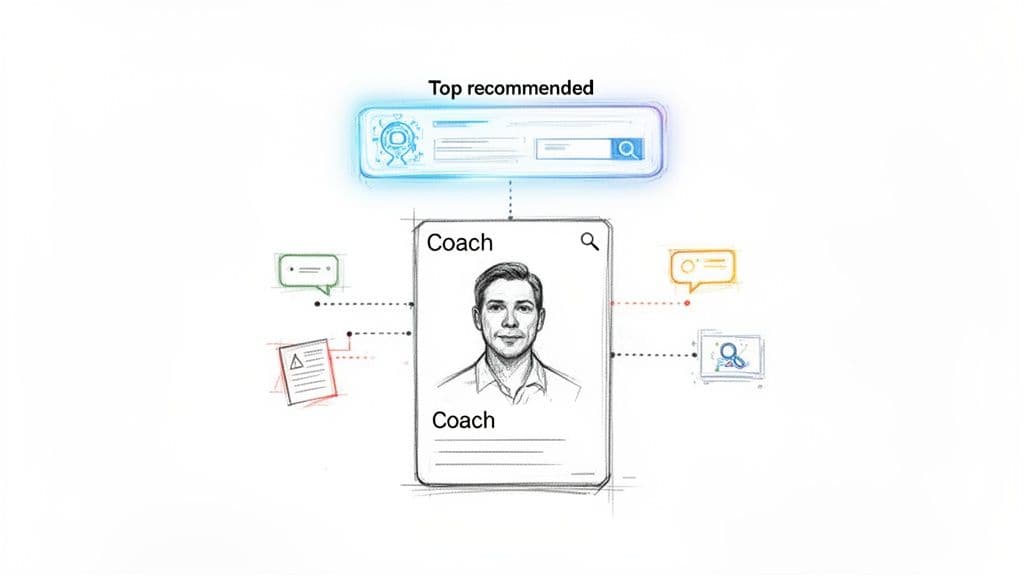
The idea is to probe these AI models with the exact kinds of questions a potential client would ask. That’s how you’ll see whose expertise is getting recommended.
Performing a Manual AI Visibility Check
The most direct way to get started is by doing some manual queries. This hands-on approach means you literally act like a potential client, asking different AI platforms the questions they'd likely pose. It’s a qualitative method, sure, but it gives you immediate, tangible feedback on how you and your competitors are currently positioned.
Your goal here is simple: gather raw data on who gets mentioned, how they’re described, and what sources the AI is pulling from.
A thorough manual check involves a few key activities:
- Create a list of client-centric prompts. Brainstorm 15-20 questions your ideal clients might ask. Make sure you cover different stages of their journey—from just realizing they have a problem to actively comparing coaches.
- Test across different platforms. Run your prompts on at least three major AI models, like ChatGPT, Gemini, and Perplexity. You’ll be surprised at how much their answers can vary, so you need a broad view.
- Document everything you find. For each prompt, log who gets mentioned—is it you, your direct competitors, or maybe an industry publication? Pay close attention to the context and any sources the AI cites.
Key Insight: Don’t just ask once. AI responses are probabilistic, so the same prompt can spit out different answers. I always recommend running your most important prompts 3-5 times to get a more reliable picture of your typical visibility.
Here are a few prompt ideas to get the ball rolling:
- Niche-Specific: "Who is the best executive coach for female founders in tech?"
- Problem-Oriented: "Recommend a life coach specializing in burnout recovery for entrepreneurs."
- Comparative: "Compare leadership coaching programs for first-time managers."
This manual process is incredibly revealing. It will quickly show you where your content has gaps and which competitors are currently owning the AI conversation in your space.
Automating Your Audit with Visibility Tools
Manual checks are great for a starting snapshot, but they're completely impractical for ongoing monitoring. This is where automated tools become a game-changer. Specialized AI visibility trackers have emerged that let coaches measure and fine-tune their presence with a level of precision we’ve never had before.
Platforms like SE Ranking and BrightEdge have started integrating features that track brand mentions inside AI-generated answers, adding a new layer of data to traditional SEO metrics. These tools do the heavy lifting by querying AI models at scale and giving you a quantitative score for your presence.
With Attensira, for instance, the platform can run thousands of relevant queries automatically, boiling it all down to a clear visibility score. This lets you track, over time, how often you’re actually showing up in AI-generated answers.
This kind of data-driven approach moves you from guesswork to a focused, effective strategy. To get a better sense of how this works, check out our guide to AI search monitoring for a deeper look at the metrics that matter.
By combining occasional manual spot-checks with a dedicated, automated platform, you get the most complete picture of your AI visibility. That’s the foundation you need to build a targeted optimization plan that gets real results.
Optimizing Your Digital Footprint for AI
Alright, you've got your baseline. Now for the real work. Getting your digital presence ready for AI is a different game than old-school SEO. It’s less about chasing keywords and more about fundamentally changing how you present your expertise, making everything about your practice incredibly easy for machine learning models to understand and trust.
This isn't about trying to trick an algorithm. It's about making your value as a coach crystal clear to the new digital gatekeepers. You have to translate your years of experience, client wins, and unique coaching philosophy into a language AI can parse, verify, and feel confident recommending to others.
Make Your Expertise Machine-Readable with Structured Data
One of the most potent tools you have, and one that's surprisingly underused, is structured data. Specifically, I'm talking about using the Schema.org vocabulary.
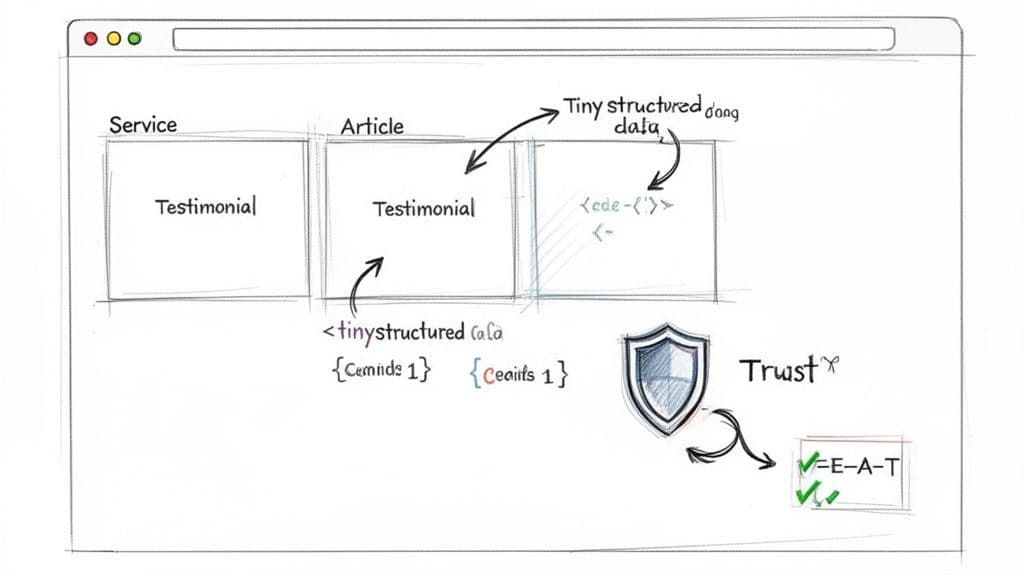
Think of structured data as a set of super-specific labels you add to your website's code. A human visitor won't see a thing, but for an AI crawler, it's a game-changer. It provides critical, organized context.
Instead of an AI model guessing that a paragraph is a client testimonial, structured data explicitly says: "This is a review, the star rating is 5, and here's the client who gave it." That clarity is everything. It removes all the guesswork and feeds AI models the hard facts they crave.
For any coaching practice, you'll want to prioritize schema for these areas:
- Coaching Services: Clearly define every service, who it's for, and the exact problems you solve.
- Your Personal Profile: Use
Personschema to lay out your credentials, specific areas of expertise, and professional history. - Client Testimonials: Mark up every single review to highlight the client's name, their feedback, and the rating.
- Articles and Guides: Implement
ArticleorBlogPostingschema to define who wrote what and when, which directly boosts your E-E-A-T signals.
Taking the time to do this makes your data far more accessible and dramatically increases the likelihood that AI will pull from your site as a primary source when it's crafting answers about coaching.
Build Undeniable Topical Authority
AI models are built to find and elevate true experts. They figure this out by looking at the depth and consistency of your content on a single topic. A one-off blog post about "leadership tips" just isn't going to move the needle anymore. For genuine ai visibility for coaches, you need to build a fortress of topical authority.
This means creating a deep well of interconnected content that explores your niche from every possible angle. Stop thinking about individual keywords and start thinking about answering entire categories of your clients' questions. Your website should become the go-to resource for your specific coaching domain.
Here's a practical way to start: Map out your core coaching pillars. If you're an executive coach for startup founders, your pillars might be fundraising, team scaling, and founder resilience. For each one, write a massive cornerstone guide. Then, support it with dozens of detailed articles, case studies, and templates that dig into every related sub-topic you can imagine.
A detailed case study showing how you helped a client overcome a specific challenge gives an AI so much more to work with than a generic services page. It shows your process, your expertise, and real results in a story format that's engaging for people and packed with contextual data for machines. This is a foundational part of modern web content creation for a modern audience.
Answer Questions Before They're Even Asked
The explosion of conversational AI has completely rewired how people search for information. They aren't just typing in a few keywords; they're asking complex, layered questions. Your content strategy has to catch up. Frankly, focusing on things like Voice Search Optimisation is a great forcing function, as it makes you think conversationally by default.
Start digging through your client notes, old emails, and call transcripts. Find the most common, tricky, and insightful questions your clients have asked you over the years. Then, create dedicated content that answers each of those questions head-on.
Structure this content with headings that are the questions themselves. Instead of a bland title like "Marketing for Coaches," you'd use a direct, question-based heading like, "What Are the Most Effective Client Acquisition Strategies for New Life Coaches?"
This does two incredibly important things for you:
- It Directly Matches AI Queries: Your content becomes the perfect, ready-made answer for the exact prompts users are feeding into AI models.
- It Demonstrates Deep Empathy: It immediately shows potential clients that you understand their specific struggles, building trust long before they ever book a call.
By systematically using structured data, building out deep topical authority, and creating content that directly answers your ideal client's biggest questions, you start to transform your website. It stops being a simple online brochure and becomes a trusted, authoritative source that AI models will be excited to reference and recommend.
Building Authority Beyond Your Website
When it comes to AI visibility for coaches, your website is really just the starting point. Think of it this way: AI models are designed to find and trust experts, and they do that by cross-referencing information from all over the web. A strong, diverse digital footprint isn't a "nice-to-have" anymore; it's the core of being seen as a credible authority by these new information gatekeepers.
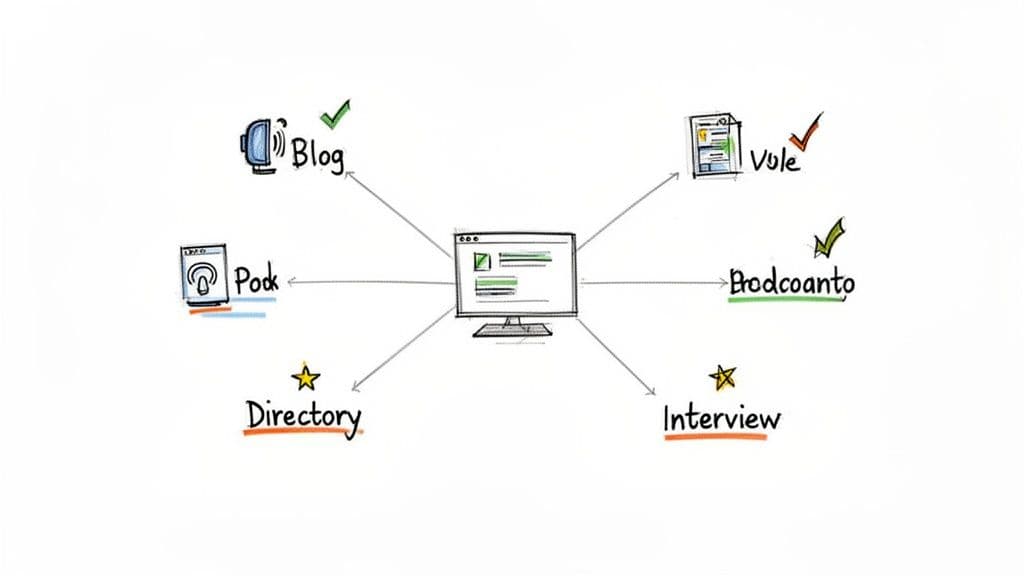
This means you have to actively build your presence on platforms that aren't your own. You're essentially creating a web of credible mentions, features, and citations that all point back to you, consistently signaling your expertise whenever an AI is researching your niche.
The strategy here is to show up where your expertise is already being discussed, verified, and amplified. Every single one of those external mentions is another data point telling AI models that you're a relevant and trustworthy voice in your field.
Where to Focus Your Off-Site Efforts
One of the biggest mistakes I see coaches make is spreading themselves too thin. You need to be strategic. A single feature on a highly respected industry publication is worth far more than a dozen mentions on low-authority blogs.
Here are the kinds of platforms that give you the most bang for your buck:
- Reputable Industry Blogs: Go after guest posting opportunities on the blogs your ideal clients are already reading. It puts your name in front of the right people and creates a powerful, contextually relevant backlink.
- Online Publications and Journals: Getting quoted as an expert in a well-known digital magazine or industry journal is a massive credibility boost. This is pure gold for building authority.
- Professional Directories: Make sure your profiles are complete and, more importantly, consistent across high-value directories. Think LinkedIn, coaching associations (like ICF), and other relevant business listings. AI relies on this consistency for verification.
- Podcasts and Interviews: Don't underestimate audio. Appearing on relevant podcasts not only introduces you to a new audience but also creates transcripts and show notes that AI can crawl for information about your expertise.
Each of these appearances helps build a richer, more verifiable digital identity, making it much easier for AI to understand who you are and why you matter. For a deeper look at building this kind of verifiable presence, our guide on securing a Google Knowledge Panel is a great next step.
Your Outreach Game Plan
So, how do you land these features? It takes a systematic approach. Blasting out generic, mass-emailed pitches just doesn't cut it. Your outreach has to be personal, showing that you actually understand the platform's audience and can offer real value.
Expert Tip: Don't just ask to "write for us." Instead, frame your outreach around a specific, compelling idea. Pitch a unique angle or a data-backed insight that solves a real problem for their readers. It immediately shows you’ve done your homework and respect their time.
Getting this right is critical because the visibility challenge has gotten so much tougher. Research from early 2026 revealed that achieving visibility in AI-driven search can be up to 30 times more difficult than in traditional Google search. An analysis of nearly 350,000 businesses found that ChatGPT recommended a tiny 1.2% of them. Compare that to Google's local 3-pack, which featured 35.9%. This data makes it crystal clear: the new game is about widespread, frequent brand mentions across countless platforms, not just fighting for a single top spot. You can see more on the findings on AI search visibility in 2026.
Here's a simple, practical outreach template you can adapt. The key is its focus on mutual value.
Example Outreach Template
Taking a methodical approach to building your off-site authority is non-negotiable if you're serious about mastering AI visibility. It’s how you transform your digital presence from a single website into a robust network of trust signals that AI models are built to find and reward.
Measuring Your AI Visibility and Proving ROI
You’ve done the hard work of optimizing your content and building authority across the web. But without a clear way to measure what’s working, you're just guessing. To really get a handle on AI visibility for coaches, we need to move past old-school metrics and focus on what actually drives business growth. It's all about connecting your efforts to real, tangible results.
This is where everything comes together. We’ll turn your strategy from a checklist of tasks into a data-driven system for growth, helping you make smarter decisions and attract better clients.
What to Track: Your Core AI Visibility KPIs
First things first, you have to define what success looks like. In this new world of AI-powered search, obsessing over keyword rankings is a fast track to nowhere. The game has changed. Your focus needs to shift to metrics that show your actual presence and influence within the AI-generated answers people are getting.
These are the numbers that tell the real story of your AI visibility:
- Visibility Score: This is your north star. It’s the percentage of relevant, targeted queries where your name, brand, or content pops up in an AI answer. A higher score means you’re seen as a go-to source in your niche.
- Source Diversity: This tracks where AI models are finding you. Are they only citing your website, or are they pulling from guest posts, podcast interviews, and directory listings? Strong diversity signals a trustworthy and robust digital footprint.
- Sentiment Analysis: It's not just about getting mentioned; it’s about how you're mentioned. Is the context positive? Neutral? This is critical for understanding how AI is shaping your brand’s reputation.
When you track these metrics, you can finally draw a straight line from your visibility efforts to actual business outcomes. For instance, you can correlate a rising Visibility Score with an increase in high-quality inbound leads, giving you a clear picture of your ROI.
This kind of tracking would be a nightmare to do manually. That's where platforms like Attensira come in, automating the process by running thousands of queries to give you a clear dashboard of your performance. This is how you stop guessing and start knowing which content and platforms are truly moving the needle.
Key Metrics for AI Visibility Success
To make this even clearer, here’s a breakdown of the essential KPIs you should be tracking as you build out your AI visibility strategy, from the foundational metrics to more advanced ones that connect directly to your bottom line.
Tracking these metrics gives you a complete, 360-degree view of your performance. You'll not only see if your visibility is growing but also understand its direct impact on your coaching practice's health and growth.
Tying AI Mentions to Your Bottom Line
At the end of the day, the only reason to chase AI visibility is to grow your coaching business. That means you have to connect these KPIs to results like lead quality and client acquisition. Traffic from AI citations is a different beast—it's often far more valuable than your typical search traffic.
The data backs this up. When a coach is cited in an AI Overview, we’ve seen that organic click-through rates are 35% higher than average. Even more impressive? Visitors from AI search convert 4.4 times better than standard organic traffic. This signals a huge shift: stop chasing volume and start securing high-quality citations, because the traffic they send is ready to take action.
By zeroing in on this high-intent traffic, you can answer some powerful questions:
- Which of my coaching services get the most qualified leads when mentioned in AI answers?
- Do clients who find me through AI have a faster journey from prospect to paying client?
- What’s the lifetime value of a client who came from an AI-driven discovery?
Answering these questions gives you the hard evidence to justify your strategy. For a deeper look at this, check out our guide on how to measure marketing ROI. Once you link your AI presence to new clients in your pipeline, it becomes an undeniable part of your growth engine.
Frequently Asked Questions
How Long Does It Take to See AI Visibility Results
You'll be happy to hear it's a faster game than traditional SEO. While classic search optimization can feel like a waiting game of six to twelve months, you can start seeing the needle move on AI visibility in as little as three to four months.
The reason for this quicker feedback is that AI models are constantly scraping the web and updating their knowledge base. So, if you're consistently publishing expert content, nailing your structured data, and building authority, those efforts will compound. Most coaches see significant gains within two quarters of dedicated work. The key is to track your progress from day one so you can spot those early wins and double down.
Do I Still Need to Focus on Traditional Keyword Research
Absolutely, but the strategy needs a serious update. It’s time to shift away from short, generic keywords and lean into long-tail questions—the kind of conversational queries your clients are actually typing into AI tools.
Your job is to get inside their heads and anticipate the exact problems they're trying to solve. Use those natural language questions to outline your content, creating genuinely helpful, in-depth answers. Keyword tools are still great for spotting core themes and search volume, but let the user's intent shape your actual writing.
Think of it this way: instead of a keyword like "executive coach," build a pillar page that fully answers, "What are the benefits of hiring an executive coach for a first-time CEO?" That level of specificity is precisely what AI models reward.
Is AI Visibility Only for B2C Coaches
Not even close. This is just as critical for B2B coaches, whether you're in executive, leadership, or sales coaching. The decision-makers you want to reach are using AI for their initial research and to vet potential partners long before they ever pick up the phone.
Imagine getting recommended by an AI for prompts like, "best leadership development coaches for a Series B startup" or "compare executive coaching programs for a remote team." That's a direct line to high-value contracts. Getting this right establishes you as a credible expert and puts you on the shortlist for major corporate accounts.
Ready to stop guessing and start measuring your AI visibility? Attensira provides the data-driven insights you need to get seen and recommended by AI. Connect your domain in minutes and see exactly where you stand.