Struggling with AI visibility for B2B software? This guide provides actionable strategies to audit, optimize, and dominate your brand's presence in AI search.
AI visibility isn't just another marketing buzzword. For a B2B software company, it means your brand, your products, and your solutions become direct citations in the answers from platforms like ChatGPT and Google's AI Overviews.
Think about that for a second. The goal is no longer just ranking in a list of blue links. It’s about becoming the source for the AI's answer. This is a fundamental shift that demands a strategy built on machine-readable content and verifiable authority.
Why Your B2B Brand Is Invisible to AI Search
The way B2B buyers research and discover solutions has completely changed. For years, we all fought to get on the first page of Google, hoping a prospect would click our link. Now, that same prospect is far more likely to ask an AI a complex question and get a single, synthesized answer. If your brand isn't in that answer, you've essentially disappeared from the most crucial part of their journey.
This isn't some far-off prediction; it's already happening.
High-intent queries like, "what's the best CRM for a mid-size manufacturing firm with complex inventory needs?" are no longer just pointing people to G2 or Capterra. AI models are actively parsing those review sites, your product documentation, case studies, and industry reports to construct one definitive response.
The core problem is simple: AI search gives the answer, not just a list of options. If your brand isn't woven into that answer, the buyer’s journey could be over before they ever even hear your name.
The Shift from Clicks to Citations
Traditional SEO was a game of attracting clicks. This new AI-driven model rewards something different: content that provides verifiable facts and clear-cut solutions. This is exactly where I see many B2B brands stumbling. Their websites are packed with marketing-speak and vague value propositions that, while potentially compelling to a human, are totally ambiguous to a machine.
AI models are built to prioritize clarity and structure. They need to find and reference authoritative sources to build trust with their users. An AI doesn't "prefer" your brand over another; it prefers the brand that makes its features, use cases, and market position the easiest to understand and verify.
Let's take a real-world example. Imagine a project management software company. Their marketing team has done a great job optimizing for "agile project management tools," and they rank well in traditional search. But then a user asks ChatGPT, "How can I integrate Kanban boards with my team's existing sprint planning process?" The AI might generate an answer that specifically cites a competitor whose documentation clearly and explicitly walks through that exact workflow.
The first company won the keyword. The second company won the conversation—and likely, the customer.
Where B2B Marketing Fails AI
The root of the problem usually lies in the content strategy. So many B2B companies are fantastic at creating top-of-funnel blog posts but completely neglect the detailed, structured information that AI models need to thrive. (If you want to go deeper on this, we wrote a guide on how ChatGPT indexes content for its knowledge base.)
Here are the most common blind spots I see:
- Jargon Over Facts: Using fluffy phrases like "next-generation synergy" instead of a factual statement like "integrates with Salesforce via API" renders your content useless to an AI trying to categorize your product.
- Buried Technical Details: Critical information—technical specifications, integration guides, pricing tables—is often locked away in PDFs or hidden behind a login wall. To an AI crawler, this content might as well not exist.
- Lack of Structured Data: Without schema markup that explicitly labels what your software is, what it does, its features, and its pricing, you're forcing the AI to guess. And it will almost always favor a competitor who provides those clear signals.
Ultimately, getting your B2B software seen by AI requires a strategic pivot. It's time to move away from just attracting attention and toward building a library of trusted, machine-readable information that establishes your brand as an unmissable authority in its space.
How to Audit Your Current AI Footprint
Before you can build a solid presence in AI-driven search, you have to know where you stand today. Auditing your current AI footprint gives you that crucial starting point, revealing how—or if—your B2B software brand shows up when prospects turn to conversational AI for answers. This isn't about traditional keyword rankings; it's about seeing your brand through the eyes of an AI.
You can't fix what you can't see. The goal here is a completely unbiased look at your brand's visibility. This means getting your hands dirty by manually querying the major platforms and analyzing every response for brand mentions, accuracy, and competitive context.
Probing the AI for Brand Mentions
The secret to a good audit is asking the right questions. The prompts you use should follow the typical B2B buyer's journey, starting with broad problems and narrowing down to specific brand comparisons. I recommend running these tests across ChatGPT, Perplexity, and Google's AI Overviews.
It helps to group your queries into three main categories:
- Problem-Aware Prompts: Think high-funnel. These are the questions a potential customer asks when they’re just beginning to understand their pain points. For instance, "What are the best ways to reduce customer churn for a SaaS business?"
- Solution-Aware Prompts: Now they know what kind of tool they need, but not which one. A great example is, "Compare the top project management tools for remote software development teams."
- Brand-Specific Prompts: These are direct questions about your brand or your closest rivals. Try things like, "What are the main alternatives to [Competitor's Software]?" or "Summarize the key features of [Your Software]."
This hands-on approach quickly reveals where you’re showing up and, more importantly, where you’re invisible. Today’s B2B buyers often start with a Google search but finish their research in a conversation with an AI.
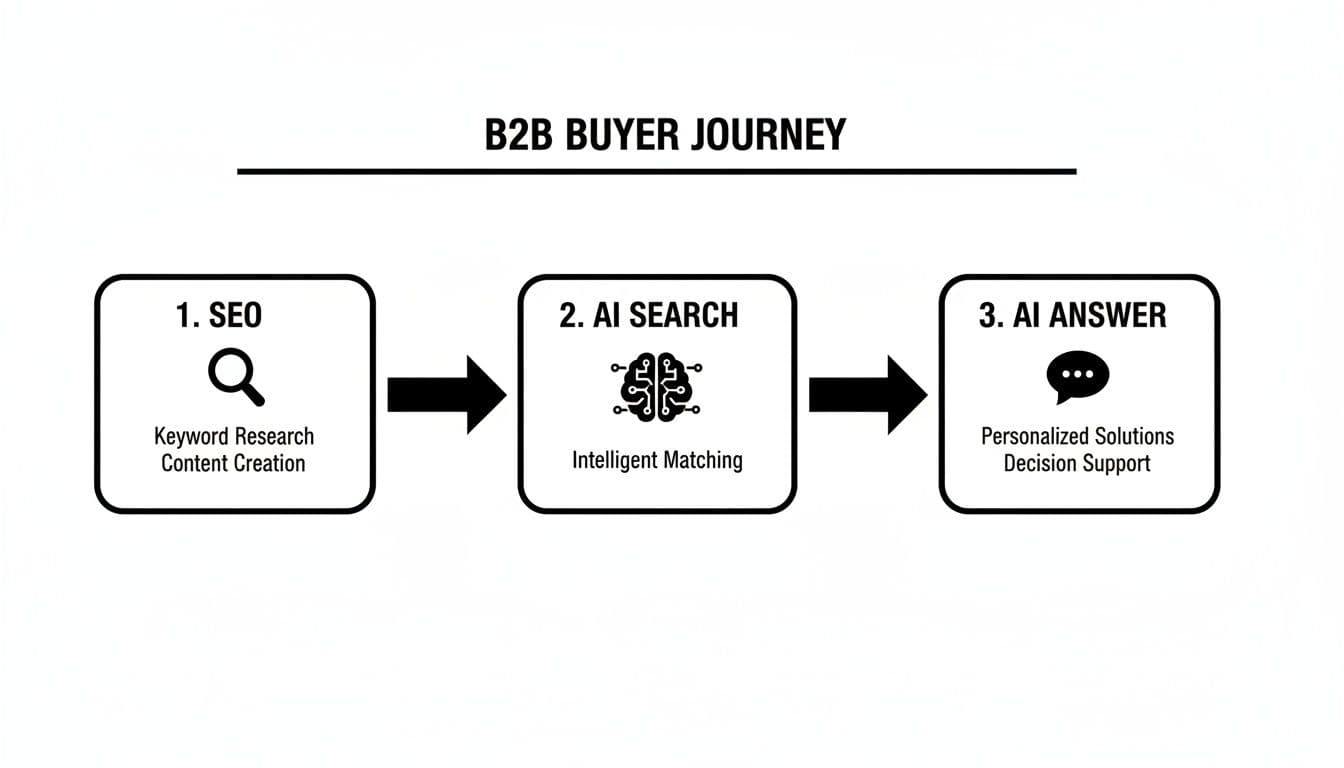
As the diagram shows, if you're not part of the "AI Answer," you're losing high-intent prospects right before they make a decision.
To guide this manual process, I've put together a simple checklist. Think of it as a framework for systematically checking your presence on the most important platforms.
AI Visibility Audit Checklist
This table provides a repeatable process for your manual checks, ensuring you cover all the critical angles of the buyer's journey.
Interpreting What You Find
As the responses come in, document everything. I'm talking screenshots, copy-pasted text, the works. Note if your brand was mentioned, if the information was accurate, and how the sentiment felt—positive, negative, or just neutral. And pay very close attention to which competitors are consistently showing up when you aren't.
An AI audit gives you a raw, unfiltered look at your brand's digital reputation. If an AI presents outdated pricing or incorrect features, it’s a massive red flag that your core website and digital assets aren't structured for machine comprehension.
This manual work takes time, no doubt about it. But the insights you gain are pure gold, forming the baseline for your entire AI visibility for B2B software strategy. The search world is already changing fast. In 2025, Google’s search market share dipped below 90% for the first time since 2015, a shift driven largely by AI. With Google's AI Overviews appearing in 13.14% of U.S. desktop searches and cutting click-through rates by an average of 34.5%, it's clear AI is capturing traffic that used to be a sure thing.
Using Automation to Get the Full Picture
A manual audit is a fantastic starting point, but it's just a snapshot in time. AI models update constantly, meaning your visibility can shift from one week to the next. For any B2B brand that's serious about this, automated monitoring is the only way to keep up.
This is where a platform like Attensira comes in. It automates the entire discovery process. Instead of you manually typing prompts, the tool continuously monitors how your brand, products, and competitors are being represented across key AI models for thousands of relevant queries.
This turns a time-consuming manual task into a strategic, ongoing analysis. You get a data-backed starting point for your strategy and a reliable way to measure your progress over time. If you're not sure where your brand stands, a good first step is to check your AI Readiness Score to get a quick assessment.
Making Your Website Machine-Readable
Once you’ve got a handle on your current AI footprint, the real work begins. The goal is to shift your website from a simple collection of marketing pages into a structured knowledge base that AI models can easily parse and, more importantly, trust.
This isn't about gaming an algorithm with keywords. It's about feeding AI the explicit, unambiguous information it needs to understand what your software does and who it helps. When you make it effortless for a machine to connect a user's problem to your solution, you're laying the groundwork for your content to be sourced directly in AI-generated answers.
Speak AI’s Native Language: Structured Data
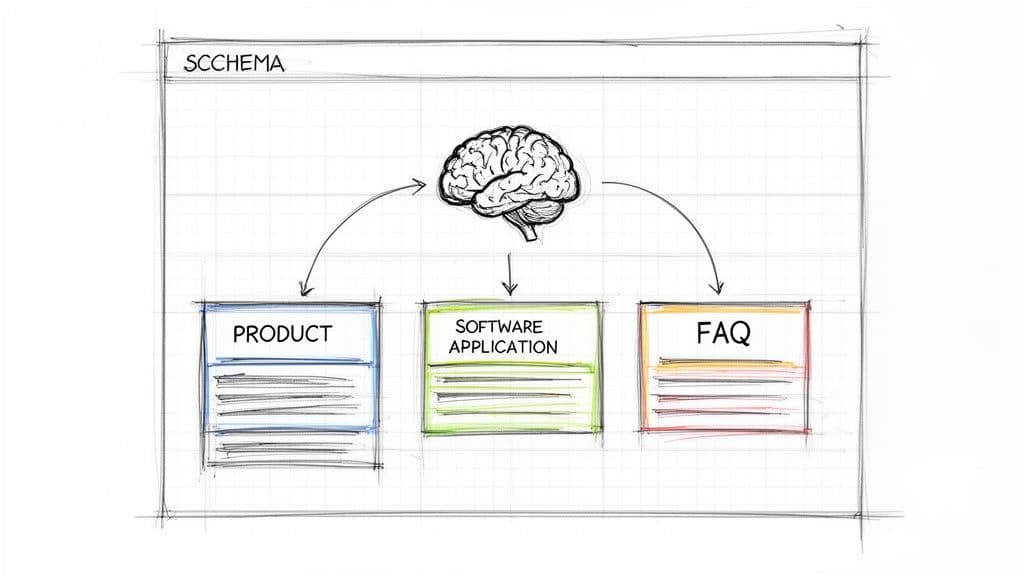
The most powerful way to communicate directly with machines is through structured data, specifically schema markup. Think of schema as a specific vocabulary you add to your site’s code to tell AI and search engines exactly what your content is about. It removes all the guesswork.
For B2B software, a few schema types are absolutely essential for boosting AI visibility for B2B software:
- SoftwareApplication Schema: This is table stakes. It lets you clearly label your product's name, compatible operating systems, category (like "BusinessApplication"), and even its aggregate user rating.
- Product Schema: Use this to spell out pricing, special offers, and key features. You can even nest this inside your
SoftwareApplicationschema to tie the product directly to its commercial details. - FAQ Schema: Any page with frequently asked questions needs this markup. It directly feeds AI models the answers to common questions about your software, which is a fast track to getting your information included in generative responses.
Implementing schema is like giving an AI a neatly organized filing cabinet instead of a messy stack of papers. It’s a direct signal of what your software is and what it does.
Build Authority with Interconnected Content Hubs
A single great page is a good start, but a network of interconnected, expert content is what truly builds authority. AI models are getting better and better at recognizing deep topical expertise, which is best demonstrated through content hubs or topic clusters.
The model is simple: a central "pillar" page covers a broad topic (e.g., "Workflow Automation for Enterprises") and links out to more granular "cluster" pages on related subtopics (e.g., "Integrating API-based Automation" or "Automating Financial Reporting"). This architecture signals to AI that you are a definitive resource.
This strategy has a direct impact on your AI visibility. When a model sees that your domain has a comprehensive library of content covering a subject from multiple angles, it begins to treat you as a primary source. You can see how this plays out by exploring modern content optimization tactics.
Cut the Jargon and Get to the Point
AI models are literal. They're trained on massive datasets of factual information, not marketing copy. The vague, jargon-heavy language common on B2B websites is a huge obstacle to machine comprehension. Phrases like "synergistic paradigm shifts" are just noise to an algorithm.
It's time to prioritize clear, factual language.
Your content needs to read less like a marketing slick and more like a well-written product manual. Be direct, be precise, and back up every claim with a clear feature description or hard data.
Google's AI Overviews make this incredibly urgent. By March 2025, these AI-powered answers were already showing up in 13.14% of U.S. desktop searches. That's double what it was just two months prior and contributed to an average 34.5% drop in referral traffic for many B2B sites. This is a brutal trend for software companies that rely on a long, considered sales cycle, as AI now answers complex questions without ever sending a user to a website.
And don't forget your multimedia content. To make sure every asset is pulling its weight, look into AI transcription apps that can turn your webinars, podcasts, and product demos into text. This makes that valuable content accessible to AI models and adds to your overall visibility.
Creating Content That AI Models Trust and Cite
Having a technically sound website is a great start, but it's only half the battle. The content living on that site is what ultimately convinces an AI model that your B2B software brand is a credible, authoritative source worth citing.
The old playbook of churning out keyword-stuffed blog posts just to chase clicks is quickly becoming a relic. The new priority is to create content assets designed for machine consumption and comprehension.
This really calls for a fundamental shift in how you think about your content calendar. Instead of asking, "What blog post will rank for this keyword?" the more strategic question is, "What comprehensive resource can we build to become the definitive answer on this topic?" The goal is to be so thorough and factually accurate that an AI has no choice but to reference your work.
What this means in practice is prioritizing depth over frequency. A single, data-rich report or an exhaustive tutorial will do far more for your AI visibility for b2b software than a dozen shallow blog posts ever could.
Build a Foundation of Factual Content
AI models are trained to find and reward verifiable facts. They thrive on clear, definitive statements and tend to get confused by marketing fluff and ambiguous claims. Your content needs to be structured to answer the fundamental questions a B2B buyer has—the who, what, why, and how—in the most direct way possible.
Every piece of content should be built around a solid core of objective information.
- Who it's for: Clearly define your Ideal Customer Profile (ICP). Don't just mention it on your homepage; weave it into relevant use-case articles and case studies.
- What it does: Use precise, unambiguous language to describe features. Instead of a vague phrase like "streamlined workflows," say "Automates invoice processing by integrating directly with QuickBooks."
- Why it's better: Back up every claim with hard data. Use customer testimonials, performance metrics, and direct comparisons to demonstrate your value proposition.
- How it works: Create detailed tutorials, implementation guides, and knowledge base articles that walk users through specific processes, step by step.
Following this approach transforms your website from a simple marketing brochure into a trusted encyclopedia for your niche.
The meteoric rise of ChatGPT redefined AI search in 2025, quickly commanding 80.1% of the AI search engine market. For informational and generative queries, its market share jumped to between 23-64%, signaling a massive shift in user behavior. For B2B software companies, this means rethinking content for AI digestion—focusing on structured data and authority signals to appear directly in ChatGPT outputs, as detailed in this Google vs. ChatGPT market share report.
From Blog Posts to Resource Centers
To truly stand out, B2B brands have to evolve beyond the traditional blog. While articles certainly still have their place, the real, lasting value lies in creating comprehensive, evergreen assets that AI models can repeatedly reference. These assets become the pillars of your authority.
For example, instead of a blog post about industry trends, what if you created a foundational content hub? Here are a few ideas to get you started:
- Data-Driven Reports: Publish original research, industry surveys, or trend analyses. Unique data is one of the most valuable assets you can have for earning citations from AI.
- Expert-Led Tutorials and Guides: Develop step-by-step guides that solve a specific, complex problem your audience faces. This is how you demonstrate true, practical expertise.
- Comprehensive Resource Centers: Build a dedicated hub on your site that organizes all your content around a central topic. This creates a one-stop-shop for anyone researching that area and signals deep topical authority.
These formats are inherently more structured and factual than a typical opinion-based blog post, making them prime candidates for AI sourcing. To ensure your content is not just found but also trusted and cited by AI, it's worth digging into specific AI SEO content optimisation strategies.
The table below breaks down the key differences between the old and new ways of thinking about content creation.
Traditional SEO Content vs. AI-Optimized Content
This shift isn't just about tweaking your current process; it's about fundamentally rethinking what "valuable content" means in an AI-driven world. The focus moves from attracting eyeballs to building a library of verifiable truth.
Identify and Fill High-Value Content Gaps
Creating this level of in-depth content is resource-intensive, so you can't afford to guess what to build. This is where a strategic, tech-assisted approach becomes essential. You need to identify the exact content gaps that, if filled, would have the greatest impact on your AI visibility.
This is precisely what platforms like Attensira are designed for. By continuously monitoring AI responses for thousands of relevant industry queries, the platform can pinpoint where your content is failing to appear and, more importantly, why. It can uncover the critical questions your competitors are answering that you aren't.
This data-driven insight allows you to move from a reactive content strategy to a proactive one. Instead of just creating content for the sake of it, you're building the exact assets needed to fill the knowledge gaps in AI models, directly fueling your visibility. You can learn more about this targeted approach in our guide to Answer Engine Optimization. This methodology ensures your team's efforts are always focused on creating content that drives measurable results.
How to Measure and Operationalize AI Visibility
You've put in the work to optimize your site and content for AI. That’s a serious investment. But if you can't measure the impact, you're just guessing. To justify the effort and actually make your strategy better over time, you need to shift from random checks to a real, systematic process for measurement.
This is where you start treating AI visibility for B2B software as a core marketing KPI. It’s the final, crucial piece of the puzzle. This means setting a baseline, tracking progress with the right metrics, and building a feedback loop that pipes AI-driven insights straight back into your marketing workflow. The goal is to make your presence in AI a predictable driver of brand growth, not just a happy accident.
Defining Your Core AI Visibility Metrics
Let's be clear: traditional SEO metrics like keyword rankings and organic traffic don't tell the whole story here. They're not built for a world where your audience gets answers, not just a list of links. You need a fresh set of KPIs that reflect what really matters in generative AI.
Here are the metrics I've found to be essential for tracking:
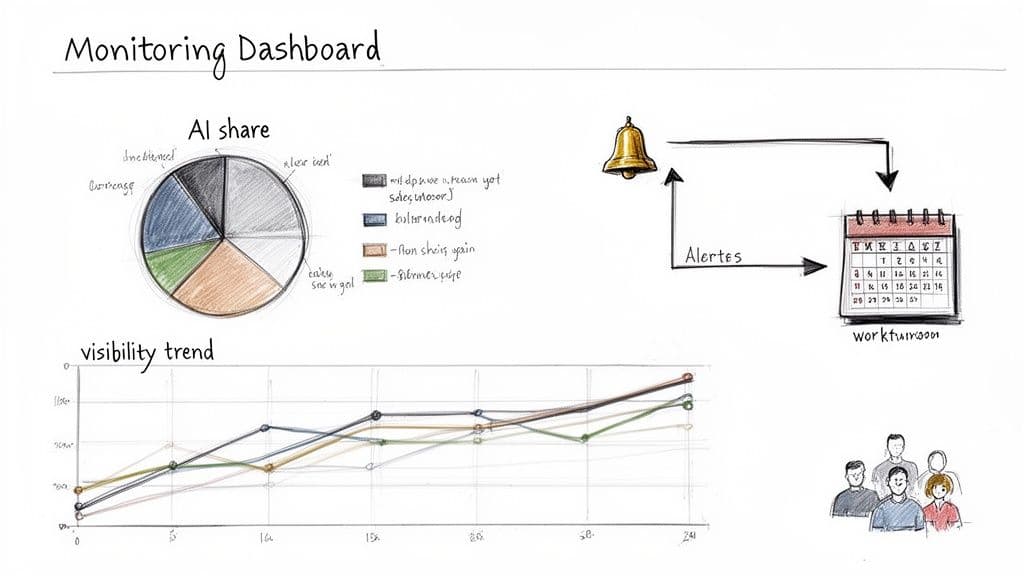
- Share of Voice (SoV) in AI Responses: This is the big one. For a specific set of high-intent questions, what percentage of the answers mention your brand versus your competitors? Seeing this number climb is a direct signal of growing authority.
- Appearance Frequency: Simply put, how often does your brand even show up when people ask about your space? Tracking this shows whether your optimizations are making you a more consistent source for the models.
- Sentiment Analysis: When your brand is mentioned, what's the vibe? Is it positive, neutral, or negative? This qualitative metric is huge for understanding how AI perceives your reputation and can flag problems like an old, bad review that a model keeps surfacing.
- Accuracy of Mentions: This is critical. Are the models getting your software, features, and pricing right? A mention that gets the details wrong can be just as damaging as no mention at all. This helps you pinpoint where your digital footprint is muddy.
Together, these metrics give you a complete picture. You move past just seeing if you're mentioned and start understanding the quality and real-world impact of that visibility.
Setting Up Continuous Automated Monitoring
Doing a manual audit of your AI footprint is a fantastic starting point. But it’s not a long-term plan. AI models are constantly being updated, meaning your visibility can change from one day to the next. The only way to get reliable data is with continuous, automated monitoring.
This is where a specialized platform like Attensira becomes your best friend. Instead of you or your team spending hours every week typing prompts into different AI tools, Attensira does it all for you. It systematically queries key AI platforms for thousands of relevant prompts, keeping an eye on your brand, your products, and your competitors.
By automating the tracking, you go from periodic, time-consuming spot-checks to having a live, continuous data stream. This lets you spot trends as they happen, react to weird changes in AI behavior, and measure the direct impact of your latest content piece almost immediately.
This kind of monitoring turns "AI visibility" from a fuzzy concept into a hard number on your marketing dashboard. It gives you the concrete data you need to show progress and prove the value of this work to your leadership team. If you're just getting started, our deep-dive on how to track your brand's visibility in ChatGPT and other top LLMs is the perfect next step.
Integrating AI Insights into Your Workflow
Collecting the data is one thing, but the real magic happens when you actually use it. The goal is to create a tight feedback loop where your AI visibility data directly informs what your marketing team does next.
Here’s how you can weave these insights into your day-to-day operations:
- Fuel Your Content Calendar: Use the monitoring data to find your most urgent content gaps. If you see a competitor is consistently cited for a topic you haven't touched, that's your next blog post or guide right there.
- Sharpen Product Messaging: Does sentiment analysis show that AI models are confused about a key feature? That’s a clear signal to go clarify the messaging on your core website pages. Make it impossible to misinterpret.
- Refine SEO and PR Strategy: When you track which sources the AI models cite, you often uncover new backlink or digital PR targets. Getting your brand mentioned on sites that AI already trusts is a powerful shortcut to boosting your own authority.
- Show Real Growth: Reporting on your AI Share of Voice and other key metrics gives you a clear, data-backed narrative to show stakeholders. It’s not just "we're doing stuff," it's "our brand's authority grew by 15% this quarter."
When you embed this process into your marketing rhythm, optimizing for AI stops being a one-off project. It becomes a core, strategic function—a fundamental part of how you build and defend your brand online.
Common Questions About B2B AI Visibility
Stepping into the world of AI-driven search naturally brings up a lot of questions. It’s a big shift, and getting clear on the fundamentals is the first step toward building a strategy that actually works. Let's tackle some of the most frequent questions we hear from B2B software marketers.
How Is AI Visibility Different from Traditional SEO?
This is the big one. While they're cousins, their end goals are worlds apart. Traditional SEO has always been about ranking a specific URL in a list of blue links. The entire game is designed to win the click and get a user onto your webpage.
AI visibility is a completely different play. It's about getting your brand's unique data, insights, and solutions woven directly into the conversational answers that AI models generate.
The objective isn't just to earn a click; it's to become a cited source or the recommended solution right inside the AI's response. This kind of interaction builds massive brand authority at the exact moment a potential customer is asking a high-intent question, even if it doesn't lead to an immediate site visit.
Can I Actually Improve AI Visibility Without Being a Technical SEO Whiz?
Yes, absolutely. While technical optimizations like structured data and schema markup are incredibly helpful for machines, don't let that stop you. A huge chunk of what drives AI visibility for B2B software comes down to creating exceptionally high-quality, authoritative, and clearly structured content.
You can make a significant impact by focusing your energy on building out comprehensive resources that give direct, factual answers to your audience's most critical questions. It's a powerful, non-technical starting point.
Any marketing team can start building a library of expert-level content today. It's also why tools like Attensira exist—they're built to be user-friendly, helping you track your presence and get content ideas without needing to be a schema expert. It closes the gap between your strategy and what you can actually execute.
How Long Until I See Any Real Results?
It’s important to set the right expectations here—this isn't like flipping a switch on a paid ad campaign. AI visibility is an organic play, and it’s all about building trust and authority over time. You might see some quick wins from on-page optimizations or a new, fact-based piece of content get picked up by an AI model within a few weeks, as they're always refreshing their data.
But to become a consistent, go-to source that AI models rely on? That takes several months of dedicated, focused work to build deep topical authority.
Here's a realistic timeline:
- Short-Term (Weeks): AI might start pulling in new, factual data like updated product specifications or a clear pricing page.
- Mid-Term (Months): After consistently publishing expert guides, you'll likely see more brand mentions for problem-focused questions.
- Long-Term (6+ Months): This is where you establish deep topical authority, positioning your brand as a primary source for a whole category of solution-related queries.
This is why ongoing monitoring is non-negotiable. You have to track your progress to see what's moving the needle and adjust accordingly.
If You Had to Pick One Thing, What’s the Most Important Factor for AI Visibility?
If I had to boil it all down to one thing, it would be verifiable authority. AI models are being obsessively trained to prioritize information from sources that are demonstrably expert, authoritative, and trustworthy (E-E-A-T).
What does that mean in practice? Your content has to be accurate, deeply researched, and logically structured. But it's not about a single great article. You need to build an entire ecosystem of interconnected, expert-level content that proves your domain is a reliable source of truth on your subject. That creates a powerful, compounding signal that AI models are specifically designed to find and reward.
Ready to stop guessing and start measuring your AI visibility? Attensira provides the continuous monitoring and actionable insights you need to get your B2B software seen and cited by AI. Discover how your brand shows up in AI today.