Your guide to ai search optimization agency new york: Compare services, costs, and essential questions before you hire.
An AI search optimization agency in New York isn't just doing the same old SEO with a new name. They focus on making your business the trusted, go-to source for answers on AI platforms like ChatGPT and Google's AI Overviews. This isn't just another channel—it's a whole new way customers find you.
Why New York Businesses Need AI Search Optimization Now
The way people discover businesses in New York City is going through a massive change, one that feels a lot like the early days of the internet. Remember when getting a website was a huge competitive advantage? We're at that same kind of inflection point now with AI-driven search.
The game is no longer about climbing a list of blue links.
We've entered a new reality powered by generative AI. Tools like ChatGPT, Perplexity, and Google's AI Overviews aren't just search engines; they're answer engines. They pull information from all over the web to give people direct, conversational answers, creating a powerful new path for customer discovery. To win, your business needs to be inside those answers.
This is where a specialized partner comes in.
The New Competitive Edge
An AI search optimization agency is built for this new landscape. Their work goes way beyond what a typical SEO agency does, concentrating on two critical areas:
- Large Language Model (LLM) Optimization: This is all about structuring your website’s content and data so AI models can easily crawl, understand, and—most importantly—trust your information. You're essentially teaching the AI that you're an authority in your field.
- Answer Engine Optimization (AEO): This is the practice of making sure your key messages, products, and services are what AI platforms use to build their answers. The goal is to become the primary source for queries that matter to you.
The real aim here is to build verifiable authority and context. LLMs care about that far more than they care about old-school keyword rankings or backlinks. For any company in NYC, this is how you build a real, defensible advantage in a market that's only getting more crowded.
The Urgency and the Data
New York businesses need to get this: Unlocking The Power Of Ai is not a future trend; it's happening right now. The numbers are impossible to ignore.
AI-driven search traffic has exploded, jumping an incredible 527% year-over-year. For B2B companies, it's not uncommon to see over 1% of all website sessions coming directly from AI platforms.
But here’s the real kicker: this traffic converts. We've seen sign-up click-through rates from AI traffic hit 1.66%, which absolutely crushes the 0.15% from traditional search.
Moving decisively now gives you a shot at capturing this high-intent audience before your competitors even know what hit them. While this new approach is critical, local fundamentals still matter, which you can learn more about in our guide on local SEO.
What A Specialized AI Search Agency Actually Does
Think of a specialized AI search optimization agency in New York as a trainer for artificial intelligence, with your brand as the star pupil. Their job isn’t just about getting you seen; it’s about making your business the trusted, go-to source that AI models like ChatGPT or Google's AI Overviews will quote directly. This is a whole new ballgame compared to traditional SEO.
Instead of fighting to rank a webpage in a blue list of links, these agencies work to weave your brand's expertise directly into the conversational answers people get from AI. They have a specific playbook of services designed for this new reality.
At the heart of their work is building verifiable authority and providing crystal-clear, structured context. Large Language Models (LLMs) care a lot more about factual accuracy and well-organized data than they do about keyword stuffing or the sheer quantity of backlinks.
Core Services That Define AI Search Optimization
The work a top-tier agency does is proactive and deeply analytical. It's all about understanding how machines consume and process information. They aren't just tweaking pages; they're engineering your entire digital identity to be AI-friendly. A specialized AI search agency also provides comprehensive services like targeted Digital Marketing for Tech Companies, blending advanced search tactics with broader growth strategies.
Here’s what you can expect them to offer:
- AI Platform Visibility Audits: This is always the first step. The agency dives deep to see how your brand, products, and key people currently show up (or don't) across major AI chat platforms. They're hunting for inaccuracies, negative sentiment, and glaring opportunities where a competitor is getting the mention that should be yours.
- Content Gap Analysis for Generative Queries: They figure out the real, conversational questions your ideal customers are asking AI. From there, they map that against your existing content to find the holes, giving you a precise roadmap of the articles, guides, or data needed to become the definitive source for those answers.
- Entity Optimization: This is a more technical but crucial service. It involves structuring your company's data—like its location, services, founders, and industry—so that AI models can understand it without any ambiguity. It’s like creating a detailed, machine-readable cheat sheet for your business that solidifies you as a legitimate entity.
This diagram illustrates the strategic shift from classic SEO to the specialized services a New York AI search agency provides.
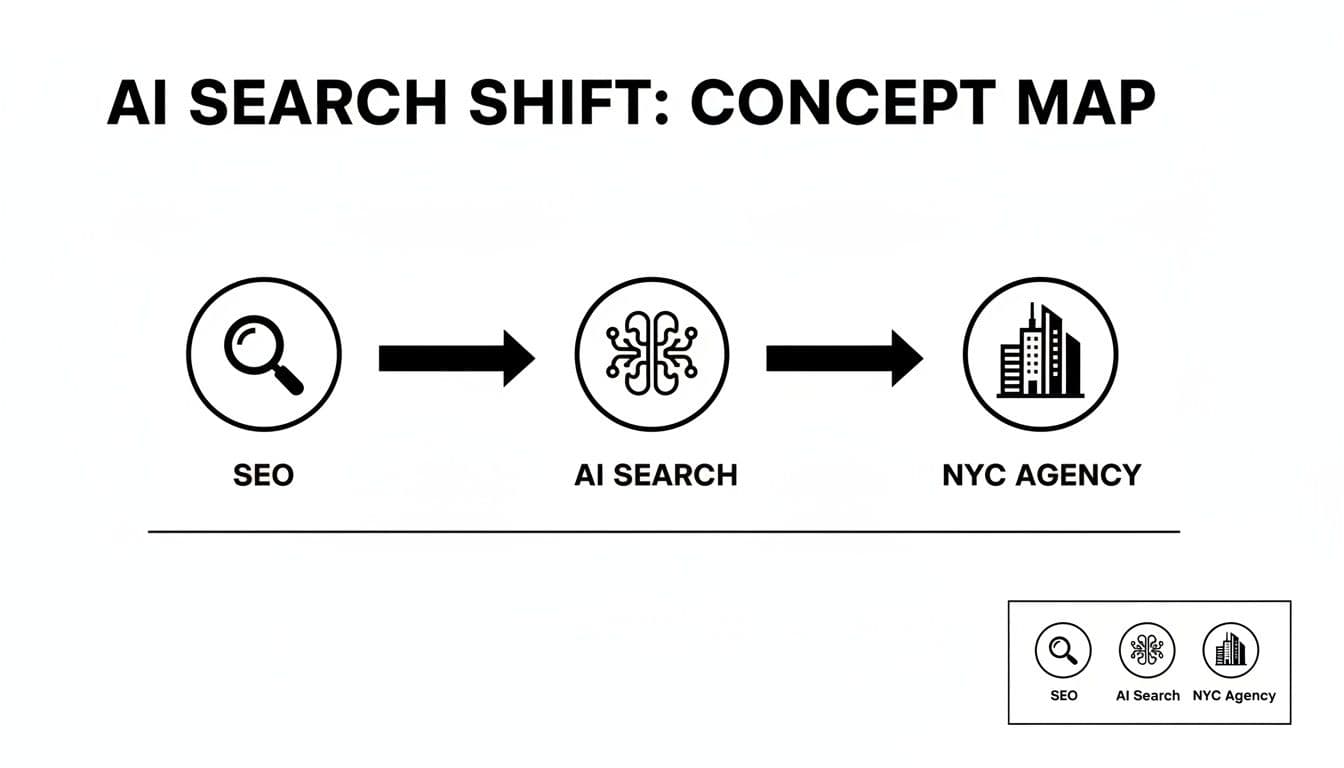
The image clarifies how the industry is evolving, positioning AI search as the critical new layer connecting optimization efforts to specialized agency expertise.
How Traditional SEO Compares to AI Search Optimization
To really grasp the shift, it's helpful to see the old and new approaches side-by-side. A traditional SEO agency's playbook is well-established, but an AI-focused one operates on a different set of principles and goals.
Table: Traditional SEO vs AI Search Optimization Services
This table highlights that while some fundamentals overlap, the focus, tactics, and what "success" looks like are fundamentally different. It's a move from winning the algorithm's favor to earning the AI's trust.
Building Verifiable Authority for LLMs
Ultimately, everything an agency does boils down to one thing: building trust with the AI. Their work involves getting your brand mentioned and cited in high-authority, third-party sources that LLMs already depend on, like major industry publications, research databases, and respected knowledge bases.
The new currency in search is verifiable trust. An agency's goal is to build a web of credible, consistent information around your brand, making it the most logical and reliable source for an AI to reference.
This is a world away from just chasing backlinks to pump up a "domain authority" score. Now, the context and credibility of every single mention matter more than ever. It’s a long-term play, but one that builds a truly durable competitive edge. For businesses curious about how agencies manage this complex process, you can see how Attensira integrates with and empowers agency workflows. This unwavering focus on authority is what separates a genuine AI search optimization agency from one that's just put a new coat of paint on old SEO services.
Connecting AI Visibility to Your Bottom Line
Showing up in an AI-generated answer isn't just a feel-good metric. For any company trying to cut through the noise in New York, it’s a direct line to real, tangible business results. Securing a spot in these answers builds serious brand authority, drives leads that are actually ready to convert, and creates a competitive advantage that’s incredibly tough for others to copy.
The whole search game has changed. It used to be about getting your link near the top of the page. Now, it's about being the answer.
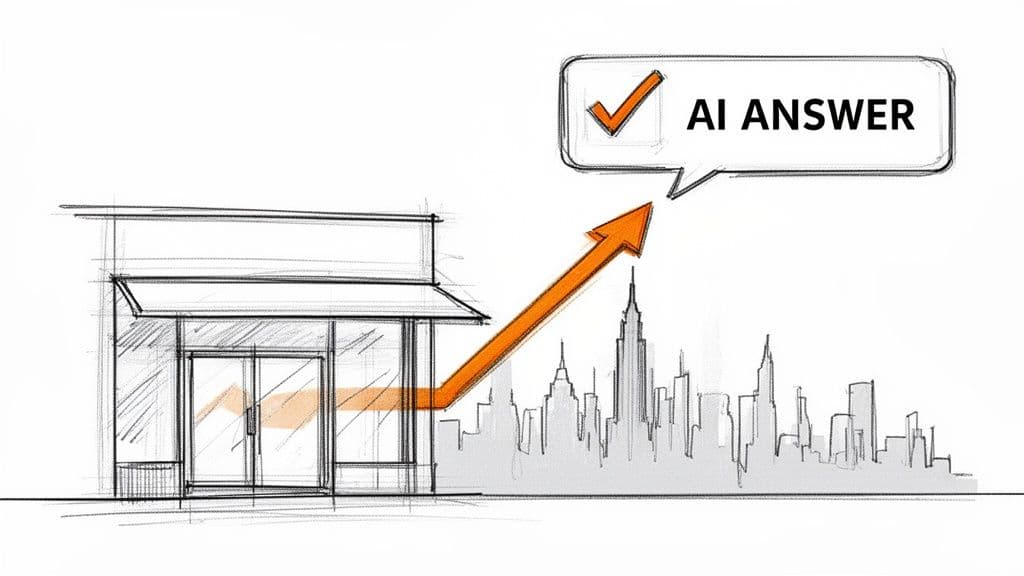
This isn't a subtle shift; it's a fundamental one. AI Overviews and other "zero-click" answers are the new normal. The battleground has moved from simple keyword ranking to earning the trust of AI models, and the payoff for winning is huge.
From Answer Engine to Revenue Engine
When an AI engine cites your company as the source for an answer, it’s giving you a powerful, implicit endorsement. That kind of visibility isn't just for show—it translates directly into business outcomes you can measure.
- Unmatched Brand Authority: Getting cited by an AI instantly positions your company as a leading expert. That kind of third-party validation builds trust faster and more effectively than any ad campaign ever could.
- Higher-Quality Lead Generation: People who ask AI complex questions are usually much further along in their buying process. They're looking for concrete solutions, not just browsing. That means the traffic you get from these sources is pre-qualified and has high intent.
- A Defensible Market Position: Unlike keyword rankings, which can swing wildly from one day to the next, becoming a trusted entity for AI models is a long-term strategic asset. It essentially builds a protective moat around your brand's authority.
Bringing in an AI search optimization agency in New York is how you get ahead of this curve, future-proofing your business and capturing these incredibly valuable customers.
The New Conversion Funnel Data
The numbers don't lie—the search landscape has been completely reshaped. Google's AI Overviews now appear in 55% of all searches. And when they do, the top organic result loses a shocking 34.5% of its clicks.
But this isn't a story about loss; it's about a massive opportunity. A recent analysis of 12 million website visits showed that while traffic from traditional Google searches converts at 2.8%, traffic coming from AI search converts at an incredible 14.2%. That’s a five-fold increase in conversion efficiency.
This data paints a very clear picture: AI might siphon off some of the window-shopping traffic, but it sends the most valuable, ready-to-buy users straight to the businesses it trusts as sources. Visibility in AI answers is the new gold standard for lead quality.
This new reality calls for a completely different way of looking at performance and ROI. You can start to map out what this means for your own bottom line with our AI traffic value calculator. It's not about the sheer volume of visitors anymore. It’s about the immense value and conversion potential packed into every single person an AI sends your way. The connection is direct: AI visibility leads to better leads, which drives revenue.
How to Choose the Right Agency in New York
Picking the right partner to navigate this new terrain is one of the most important decisions your business will make. The simple truth is that not all agencies are created equal, and many are just slapping AI buzzwords on the same old SEO services. A genuine AI search optimization agency in New York works differently, uses specialized tools, and measures success in a completely new way.
Your job is to cut through the noise and get down to specifics. The right partner won't just welcome tough questions—they'll have transparent, data-backed answers ready. Think of this section as your playbook for vetting potential agencies and finding a team that can deliver real results in this AI-first world.
Evaluating an Agency's Methodology and Tools
A modern agency's process has to be rooted in data that influences AI models, not just old-school search engine crawlers. Generic SEO workflows simply won't cut it anymore. When you start talking to potential partners, your very first questions should be about their specific approach to Answer Engine Optimization (AEO).
Ask them to walk you through their process, step by step. A credible agency will have a clear, documented methodology that probably includes things like:
- Initial AI Visibility Audit: They should be able to benchmark exactly where your brand stands right now across platforms like ChatGPT, Perplexity, and Google's AI Overviews.
- Knowledge Graph Analysis: Ask how they analyze and build out your company's "entity"—the structured, factual data about your brand that AI models rely on.
- Content Strategy for LLMs: Their content plan needs to be about factual accuracy, clear sourcing, and machine readability, not just cramming in keywords.
Then, you need to ask them about their tech stack. While standard SEO tools still have their place, a real AI search agency uses specialized software for tracking visibility inside AI, monitoring brand mentions in chat responses, and finding content gaps that generative queries expose. If they get fuzzy on the details or can't name the tools they use for these specific tasks, that's a huge red flag.
Demanding Proof Through Case Studies
Talk is cheap. Results are what matter. Any agency worth its salt will have case studies that show, in no uncertain terms, how they've influenced brand mentions and sentiment within AI-generated answers. Don't let them get away with vague success stories.
The most valuable case studies won't be about keyword rankings or traffic spikes. They will show you a clear "before and after" of a client's visibility inside AI answers, and then connect that presence to real business outcomes, like better leads.
Ask for case studies that specifically demonstrate their impact on AI-driven search. You're looking for hard evidence of:
- Increased positive brand mentions in AI chat platforms when people ask relevant questions.
- Displacement of competitors as the go-to source in AI-generated summaries.
- Improved factual accuracy and positive sentiment around their client's brand in AI outputs.
A top-tier AI search optimization agency in New York will have this proof ready to go. They’ll be excited to show you how their strategies give clients a stronger, more authoritative voice where it counts the most now.
Critical Questions to Ask Potential Partners
To help you run your evaluation, here’s a checklist of questions. The quality and depth of their answers will tell you everything you need to know about whether they're a true strategic partner or just an SEO shop in a new costume.
- How do you measure ROI in an AI-first world where clicks are becoming less important?
- You're listening for answers about share-of-voice in AI answers, the quality of referred leads, and the sentiment of brand mentions.
- Describe your process for creating content that LLMs will actually trust and cite.
- A good answer will touch on structured data, entity optimization, verifiable sources, and writing for factual clarity, not just creative flair.
- What's your strategy for getting our brand cited by high-authority sources that LLMs use for training?
- This question reveals if they understand that AEO goes far beyond your own website.
- Can you show us an actual report you use to track a client's visibility on platforms like ChatGPT or Perplexity?
- This is key. It forces them to show you their work, not just talk about it.
Making the right choice requires this level of digging. By asking the right questions and demanding concrete proof, you can confidently choose a partner who is truly equipped to secure your brand's future in the age of AI search.
What to Realistically Expect for Timelines and Budgets
Hiring an AI search optimization agency in New York is a serious investment in your brand's future. It’s not a quick fix. If you're looking for an overnight traffic boost, a PPC campaign is your better bet. But if you want to build deep, lasting authority within AI models, that’s a different game entirely—one that requires patience and a methodical approach.
Think of it this way: you're essentially building your company's reputation in a brand-new, highly influential community. You can't just show up and expect to be the center of attention. You need to introduce yourself, consistently provide value, and stick around long enough for the community—in this case, AI models—to recognize you as a trusted source.
This is a marathon, not a sprint. The real prize is creating a durable competitive edge by weaving your brand into the very fabric of the AI's knowledge base.
The Typical Project Lifecycle
Most projects I've seen follow a phased, structured path. Each stage lays the groundwork for the next, all aimed at systematically increasing your brand's authority and visibility in AI-generated answers. While the specifics will change based on your business, the general timeline usually plays out over several months.
Here’s a realistic breakdown of what that looks like:
- Phase 1: Foundational Audit and Strategy (Months 1-2) This is the discovery phase. A good agency starts by digging deep to see where you stand right now. They'll benchmark your visibility across key platforms like ChatGPT and Google's AI Overviews, poring over your content, structured data, and knowledge graph presence to spot the holes and the opportunities. This isn't just a quick scan; it's the intelligence-gathering that informs the entire roadmap.
- Phase 2: Content Development and Optimization (Months 3-6) With a clear strategy in hand, the real work begins. This is where the agency rolls up its sleeves to create new, fact-dense content and re-tool your existing assets so LLMs can easily digest them. It’s a heavy lift, involving everything from meticulously structuring your data to earning high-quality citations that act as votes of confidence for AI models.
- Phase 3: Ongoing Monitoring and Refinement (Month 7 and beyond) AI optimization is never a "set it and forget it" task. Once the foundation is built, the work shifts to a continuous loop of monitoring. The agency will keep a close eye on your brand's mentions in AI answers, track what your competitors are doing, and constantly tweak the strategy based on what the performance data is telling them. The goal here is to protect and expand the influence you've built.
Understanding Agency Pricing in NYC
In a market as competitive as New York, agency pricing reflects the strategic, long-term nature of this work. You’ll rarely find one-off projects because building and holding onto visibility requires a sustained, consistent effort.
The most important thing to remember is that AI optimization is a long-term play for brand authority. Success isn’t measured by the daily ups and downs of keyword rankings, but by a steady increase in your influence and visibility over time.
You're most likely to come across two pricing models:
- Monthly Retainers: This is the standard for AI search optimization. Expect retainers to range from 5,000 to 25,000+ per month. The final number depends on the scope of the project, how tough your industry is, and the agency’s level of expertise. A retainer model ensures you have a dedicated team focused on your long-term success.
- Project-Based Fees: This is less common for ongoing AIO, but you might see it for specific, well-defined tasks like an initial audit or a complete overhaul of your knowledge graph. These projects are scoped out in detail and priced accordingly.
Getting your financial commitment right from the start is critical. To help figure out how to plan for these kinds of strategic marketing efforts, you might find our guide to using a marketing budget allocator helpful. Choosing the right partner and the right budget is what gives you the staying power to actually win.
Using a Platform to Enhance Your Agency Partnership
Choosing the right AI search optimization agency in New York is a huge first step. But if you really want to light a fire under your results, you have to arm them with the right data. Even the best agency is essentially flying blind if they can't accurately measure how your brand shows up inside AI models. This is where a dedicated platform becomes the central nervous system for your entire AI optimization strategy.
Here’s a good way to think about it: your agency is the expert pilot, but a platform like Attensira is their advanced cockpit. It feeds them real-time data on altitude (your brand mentions), upcoming weather patterns (critical content gaps), and engine performance (overall AI visibility). That data allows the pilot to make smarter, faster decisions to get you to your destination.
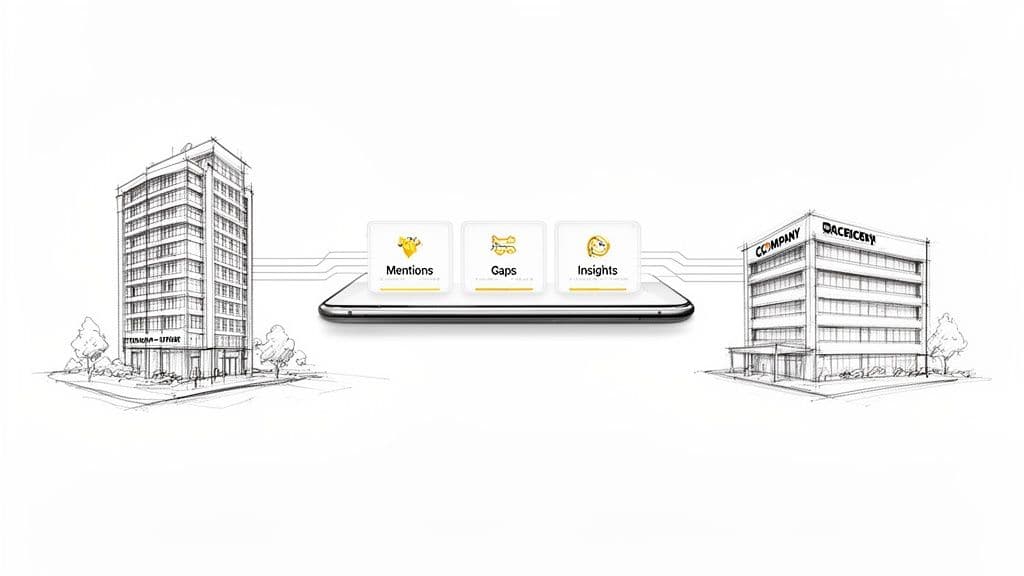
A Single Source of Truth for Accountability
When you bring a platform into an agency partnership, you instantly introduce a new layer of transparency. You're no longer just relying on the reports your agency sends over. Instead, both you and your agency have access to a neutral, third-party dashboard tracking the real metrics of AI search. Everyone is looking at the exact same data.
This setup makes it easy to answer the most important questions with hard numbers:
- Are we actually getting more brand mentions in AI answers for our target topics?
- When our brand is mentioned, is the sentiment positive?
- Are we making real progress on closing the content gaps the platform found?
A platform provides an objective, data-driven foundation for your partnership. It transforms your agency relationship from a service engagement into a true strategic alliance, where both sides are aligned on the same goals and measuring success with the same ruler.
This data-first approach cuts through the noise and focuses every conversation on performance and strategy, making your check-ins far more productive. The ability to see what's happening on specific AI models is key; you can learn more about tracking your visibility in ChatGPT and see how that specific data shapes a winning strategy.
Empowering In-House Teams and Hybrid Models
For New York companies that already have marketing talent in-house, a platform can be a complete game-changer. It gives your team a powerful, cost-effective toolkit to manage and scale AI search optimization on your own terms, often without the immediate need for a full agency retainer. You get direct access to the same quality of analytics and content tools a top agency would use.
This empowers your own team to:
- Independently track brand visibility across major Large Language Models.
- Pinpoint lucrative content opportunities based on what real people are asking generative AI.
- Simplify the creation of AI-ready content using purpose-built tools.
This also opens the door for a perfect hybrid model. Your in-house team could handle the day-to-day work using the platform, while an agency provides high-level strategic direction. This mix of internal capability and external expertise, all unified by a central data platform, often delivers the best of both worlds: cost efficiency, deep strategic insight, and total control over your brand's future in AI search.
Common Questions About AI Search Optimization
It's natural to have questions when a shift this big comes along. For business leaders, especially in a market as competitive as New York, getting straight answers about the practical side of this investment is crucial. Here are some of the most common things we hear about how AI optimization really works and what you can expect.
How Is AI Search Optimization Different From Traditional SEO?
At a glance, they might seem similar—both are about getting seen online. But their core philosophies and tactics are worlds apart. Think of traditional SEO as a race to get your website to the top of the search results list. You're fighting for that click on a blue link.
An AI search optimization agency in New York is playing a completely different game. Their main objective is to embed your brand's actual information, data, and expertise directly into the AI-generated answers and summaries. This isn't about just ranking a page; it's about becoming a trusted source for the AI itself. This requires a much deeper focus on things like structured data, provable content authority, and factual accuracy. It’s about optimizing for conversational concepts, not just keywords.
The fundamental difference is the end goal. Traditional SEO chases rankings in a list. AI search optimization (AIO) aims for direct citation and influence within the AI’s answer.
What Kind of ROI Should We Expect From an AI Search Agency?
When you step into the AIO world, the way you measure success has to change, too. We're moving beyond a singular focus on website traffic and keyword rankings. Instead, you'll start tracking metrics that show how much influence your brand has in AI-powered conversations.
You'll be looking at performance indicators like:
- Brand Mention Frequency: How often is your company actually named in AI responses?
- Sentiment Analysis: Are those mentions positive, neutral, or negative?
- Share of Voice: When the AI summarizes key topics in your industry, how much of that summary is informed by your content?
- AI-Referred Traffic Conversions: Traffic coming from AI platforms often converts at a much higher rate. This is a critical metric to watch.
The real, long-term ROI comes from establishing your brand as an unshakeable authority within the AI's knowledge base. This leads to better-qualified leads and a much stronger competitive moat.
Can Our In-House Marketing Team Handle AI Optimization?
It's definitely possible, especially if you equip your team with the right tools. New platforms are coming out that give in-house marketers the data analytics and content workflows they need to manage and track their visibility in AI.
Where an agency really proves its worth is if you're short on internal bandwidth, specialized knowledge of how Large Language Models behave, or the capacity for deep data analysis. A lot of businesses are finding a hybrid approach works best. The in-house team uses a platform for daily tasks and execution, while leaning on an agency for the high-level strategy and guidance.
How Long Does It Take to See Results From AIO?
This isn't like flipping a switch on a paid ad campaign. AIO is a strategic, long-game investment. You can get the foundational work done—like structuring your site's data and overhauling core content—within the first 1-2 months.
But to see a real, measurable impact on how often your brand shows up in AI answers, you're looking at a timeline of 4-6 months of consistent, dedicated effort. That's the time it takes for the AIs to repeatedly crawl your site, process the changes, and learn to trust your newly optimized content enough to start citing it in their responses.
Ready to see how your brand appears in AI search? Attensira provides the critical data and tools you need to build a winning strategy. See where you stand today and start optimizing for tomorrow at https://attensira.com.