Unlock brand growth with our guide to Meta AI visibility. Learn to optimize your content, get cited by Meta's AI, and reach high-intent audiences in 2026.
When we talk about Meta AI visibility, we're not just talking about another marketing channel. We're describing your brand's ability to show up in AI-powered answers across Facebook, Instagram, and WhatsApp. This is the next phase of search, and it’s a world away from a simple list of ranked links. For any brand, this is about becoming part of the natural, conversational recommendations reaching billions of people.
The New Search Frontier: Meta AI Visibility
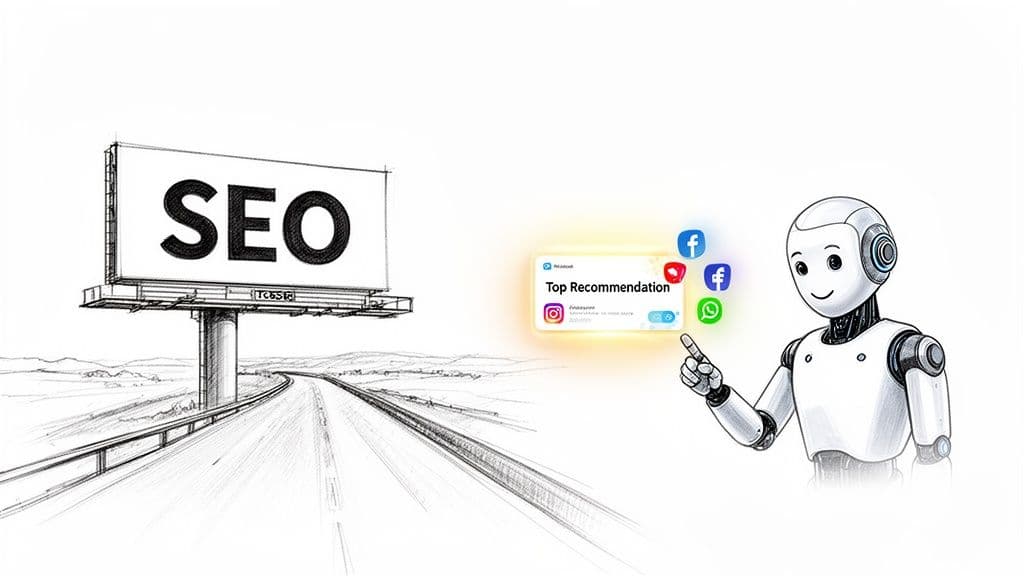
Think of it this way. Traditional SEO has always been like putting up a billboard on a busy highway. You design it to grab attention from the traffic whizzing by. Meta AI visibility, however, is more like getting a direct recommendation from a personal concierge—one who has a deep, ongoing relationship with the user.
This is a fundamental change. It's no longer about simply ranking on a page. It's about having your brand woven directly into the fabric of an AI-driven conversation.
Meta AI is quickly becoming a go-to tool for discovery, directly shaping high-intent decisions within the apps people already use for hours every day. When someone asks Meta AI for "the best CRM for a small business" or "a durable hiking boot for rocky trails," the answer they get doesn't feel like an ad. It feels like an authoritative, hand-picked suggestion.
This shift from search to conversation has completely redrawn the battleground for brand presence. The goal has evolved from just being seen to being cited and trusted by the AI itself. That requires a completely different playbook than old-school SEO, demanding a deep appreciation for the evolving landscape of AI SEO, ChatGPT, and LLMs.
The sheer scale of this change became impossible to ignore in 2024. Meta AI's usage exploded, shooting its US market share up to 31% and putting it on equal footing with ChatGPT for the very first time. That's a staggering 15-point jump from its 16% share just a year earlier, signaling a massive shake-up in the AI space.
This rapid ascent in the world's biggest AI market shows just how aggressively Meta is embedding AI into its social ecosystem. It’s fundamentally changing how users discover and interact with brands.
For B2B companies and consumer brands, this is a wide-open field of opportunity. Choosing to ignore it is choosing to become invisible on the platforms where your customers live.
The brands that will win in this new era are the ones that learn to master this conversational paradigm. Getting a handle on AI search optimization is no longer a "nice to have" for the future—it's an absolute necessity for any serious digital strategy heading into 2026 and beyond.
Here’s the rewritten section, designed to sound like it was written by an experienced human expert.
Why Your Brand Cannot Afford to Ignore Meta AI
Failing to show up in Meta AI is like building a beautiful store on the world's busiest street but refusing to unlock the front door. The sheer scale of Meta's ecosystem—across Facebook, Instagram, and WhatsApp—makes it some of the most valuable digital real estate on earth. We're not just talking about another platform; for many, this is the primary place they now go for answers and advice.
What's really happening here is that Meta's AI is creating a new discovery engine, one that often cuts traditional search engines out of the loop entirely. When someone asks a question inside an Instagram chat, they aren't looking for a page of blue links. They want a direct, conversational answer, and they want it now. If your brand isn't part of that answer, you're simply invisible.
The Shift from Chasing Traffic to Earning Trust
For years, the playbook was simple: chase high-volume traffic from search engines. It worked, but that traffic was often low-intent—people just browsing, kicking the tires, or in the very early stages of research. Meta AI completely flips that dynamic on its head.
An AI-driven recommendation carries a powerful, built-in sense of trust. Unlike a sponsored post, an answer from Meta AI feels like an objective, vetted suggestion. That perceived authority dramatically shortens the customer's journey from just looking to actually buying.
An AI recommendation feels less like a sales pitch and more like advice from a knowledgeable friend. This distinction is crucial, as it taps into a user's trust in the platform itself, making them more receptive to the brands and products the AI mentions.
The goal is no longer just about capturing clicks; it's about earning citations. A single mention inside an AI chat is an incredibly powerful endorsement, putting your brand in front of a high-intent user at the exact moment they have a problem to solve. For brand managers and CMOs, this is a new and direct line to customers who are ready to act.
The Undeniable Scale of Opportunity
The growth of Meta AI isn't some distant forecast—it's happening right now, and it's fundamentally changing how people find information.
By mid-2025, Meta AI had already pulled in roughly 1 billion monthly active users around the world. That explosive growth gave it an impressive 22.1% of the total AI search market share, second only to Google's own AI Overviews. This wasn't growth from scratch; it was fueled by Meta's massive existing user base of over 3 billion people, creating an enormous new channel for brands smart enough to get noticed.
This incredible scale redefines what it means to be discoverable. It’s no longer enough to rank on Google. You now have to compete to become the go-to source that AI models trust and reference. This need is only becoming more urgent with the rise of conversational commerce, where users can find and even buy products directly inside a chat. This trend is taking hold everywhere, which you can see in our guide exploring how users can now shop on ChatGPT.
Optimizing for Meta AI visibility isn't about jumping on a bandwagon. It's a necessary part of any modern, durable brand strategy. The companies that get this right today will build the authority and trust to lead in this new conversational world, turning AI mentions into real, measurable growth.
How to Measure Your Brand's AI Visibility
Trying to measure your brand’s visibility inside Meta AI can feel a bit like flying blind. We're all used to the familiar dashboards of Google Analytics and Search Console, but those playbooks don't apply here. So, how can you tell if your efforts are actually making a difference?
The answer is to stop thinking about clicks and rankings and start focusing on mentions and influence. It’s a lot like old-school PR media monitoring, but for an entirely new kind of media. Instead of scanning newspapers for brand mentions, you’re now tracking how an AI assistant talks about you. This requires a completely new set of KPIs built for this conversational world. Getting this right often involves a deep-dive analysis, much like traditional SEO audit services provide for search engines.
Core Metrics for AI Visibility
To get a real handle on Meta AI visibility, we need to move beyond abstract ideas and into concrete numbers. From my experience, it boils down to three key metrics that give you a clear, quantifiable picture of how your brand is performing in AI-generated responses.
- Share of AI Voice: This is your most direct measure of visibility. It simply calculates how often your brand gets mentioned for a specific set of prompts versus your competitors. A high Share of AI Voice means you're the go-to recommendation in your niche.
- Sentiment of Mention: Being mentioned is one thing, but how you're mentioned is another. This metric analyzes whether the AI's description of your brand is positive, neutral, or negative. A positive mention is a powerful third-party endorsement, while a negative one is a red flag that requires immediate attention.
- Citation Quality: When Meta AI does bring up your brand, does it point users back to your content? Citation Quality tracks if the AI is linking to your website, blog, or research papers as a source. These citations not only drive high-intent traffic but also reinforce your brand's authority.
This process is critical because, as the flowchart shows, building a presence within Meta AI isn't just about awareness—it's about becoming part of a trusted journey that guides users toward a purchase.
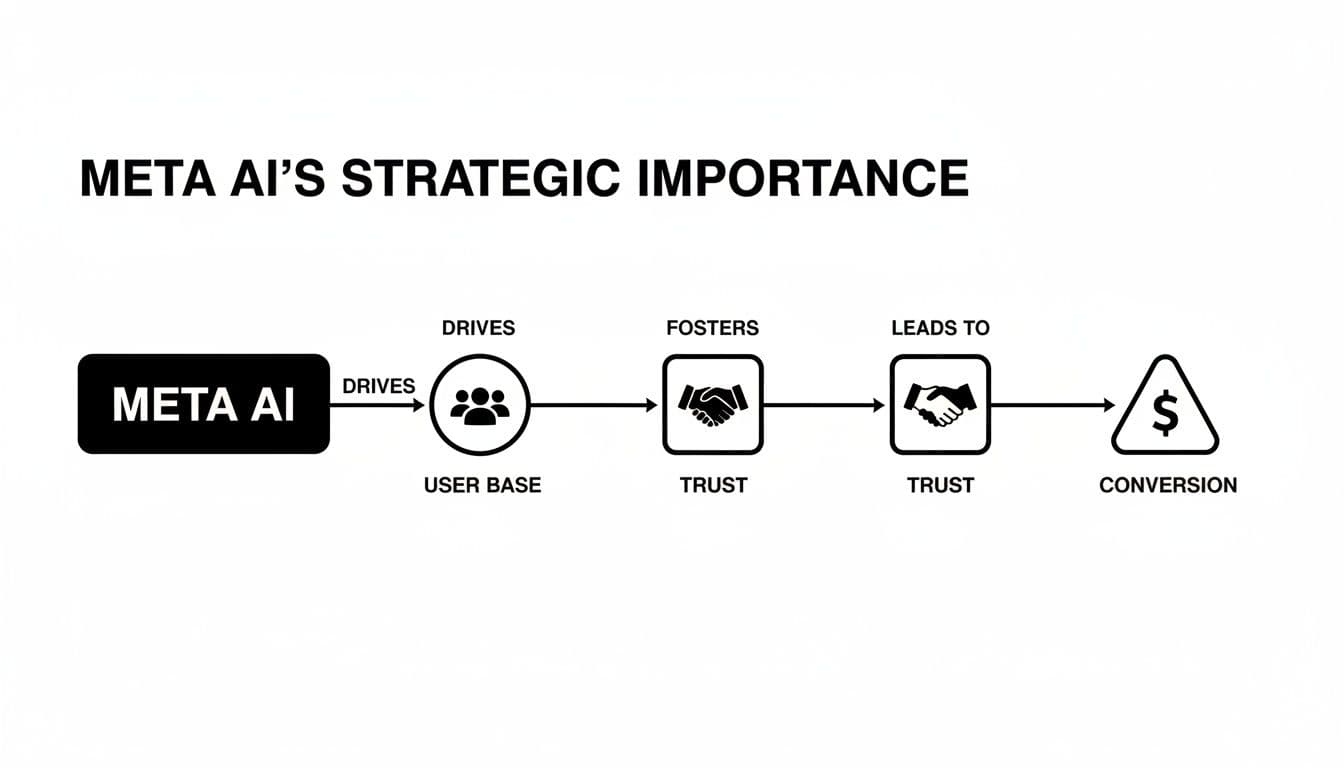
When users trust the AI and the AI trusts your brand, the path to conversion becomes incredibly direct and effective.
Traditional SEO vs Meta AI Visibility
To really grasp the shift in thinking required, it's helpful to compare the old world of search with this new AI-driven one. While some principles overlap, the objectives, tactics, and measurements are fundamentally different.
This table highlights a crucial point: in the world of AI, there is no "second place." You're either in the answer, or you're invisible.
Turning Measurement into Action
Systematically tracking these new metrics is what separates guessing from a real strategy. And it’s becoming more important by the day. With projections showing that over 50% of consumers will be actively using AI tools by 2026, establishing your brand’s presence now is essential.
The return on this effort can be huge. Some early analyses show that AI-driven recommendations can lead to conversion rates as high as 14.2%—easily outperforming many conventional marketing channels.
By consistently monitoring these KPIs, you can spot content gaps, see where competitors are getting ahead, and fine-tune your strategy to boost your Meta AI visibility. This data-first approach is the only way to win in the age of conversational search. For a more detailed look at the specific tools and methods involved, you can check out our guide on how to track your brand’s visibility in ChatGPT and other top LLMs.
Actionable Strategies to Optimize for Meta AI
Knowing where you stand with Meta AI visibility is one thing; actually improving it is another game entirely. This isn't traditional SEO where you're just trying to climb a list of blue links. To win here, you need to become the single most reliable, comprehensive source of information in your niche—so good that Meta's AI sees your brand as the definitive answer.
The mindset has to shift away from just chasing keywords and backlinks. It's now about building a deep, factual knowledge base that an AI can confidently use to answer its users' questions. Your content needs to be so clear and authoritative that you become the AI's go-to expert.
Let's break down the four pillars that will get you there.
1. Build Undeniably Factual Content
First things first: AI models are built to find and synthesize facts. They sift through countless sources to piece together the most accurate response possible. If your content is vague, full of marketing fluff, or just plain wrong, the AI will simply pass you over for a more trustworthy source.
Start thinking of every piece of content as a direct solution to a real problem. A generic blog post won't cut it. Instead, build out detailed guides, in-depth comparisons, and data-driven articles. For a SaaS company, this could be a page that not only explains your software but pits it feature-for-feature against three top competitors, complete with pricing tables.
This approach gives the AI exactly what it craves: clear, verifiable information.
2. Become the Authority on a Single Topic
AI doesn't just evaluate a single page; it looks at your entire digital presence to gauge your expertise. To really move the needle on Meta AI visibility, you have to prove you're a master of your domain, not just a jack-of-all-trades.
Here’s how you can build that deep topical authority:
- Publish Original Research: Conduct your own industry surveys or data studies. When you publish the findings, you instantly become a primary source of information.
- Create Pillar Content: Develop massive, cornerstone articles that cover a core topic from every possible angle, then internally link out to smaller, related sub-topics.
- Stay Focused and Consistent: Regularly publish high-quality content centered on your core expertise. This signals to AI that you are a dedicated and reliable resource in this specific area.
Becoming an authority isn't about covering every topic. It's about owning one topic so completely that you become synonymous with it. The AI will recognize and reward this focused expertise with more frequent and positive mentions.
3. Use Structured Data to Speak the AI’s Language
Great content is essential, but you also have to make it easy for machines to understand what it all means. This is where structured data, like Schema markup, comes in. Think of it as a special translator that adds context to your content, turning a simple string of words into a well-defined concept for an AI.
For example, you can use schema to explicitly label:
- Product details like price, stock availability, and SKU.
- Your organization’s official name, logo, and contact information.
- An FAQ section by clearly defining each question and its corresponding answer.
- Article authorship to connect your content to a credible expert.
This kind of technical fine-tuning is a cornerstone of Generative Engine Optimisation. It removes any guesswork for the AI, helping it parse your information with near-perfect accuracy and making your site a much more efficient source for it to cite.
4. Cultivate a Cohesive Digital Ecosystem
Finally, remember that Meta AI isn't just looking at your website in a vacuum. It scans the entire web—social media, review sites, press mentions, forums—to build a complete picture of your brand. Your Meta AI visibility depends on the strength and consistency of this entire digital ecosystem.
If your messaging is all over the place or your brand has a negative reputation on other platforms, it can completely undermine the authority you’ve built on your own site. A winning strategy means ensuring your brand’s story is consistent and positive everywhere. Encourage happy customers to leave reviews, jump into relevant discussions on Reddit, and keep your business listings accurate across the board.
When an AI sees a unified, authoritative presence across multiple channels, its confidence in your brand skyrockets—and so does your Meta AI visibility.
How Attensira Monitors and Enhances Your AI Presence
Knowing the strategies to improve your Meta AI visibility is one thing. Actually pulling it off is another. Trying to manually track your brand's presence across all these new AI surfaces is a losing battle—it’s like trying to catch mist with your hands. You end up with fragments of data and a lot of guesswork.
That’s the exact problem Attensira was built to solve. We created a platform that gives you a control panel for your AI presence, moving your team from hoping for the best to making data-backed decisions. Without it, you're flying blind. With it, you get a clear path forward.
From Guesswork to a Data-Driven Roadmap
Attensira takes the fuzzy idea of "AI visibility" and turns it into something you can actually measure and improve. We designed the platform to specifically track how your brand shows up in conversations on Meta AI and other AI-driven platforms, giving you one unified view of your performance.
Getting started is simple. There's no complex setup or technical wrangling. You just connect your domain, and our platform gets to work analyzing and monitoring the metrics that truly define your Meta AI visibility.
- Brand Mention Tracking: We continuously run thousands of prompts to find out how often your brand is mentioned. This lets you track your Share of AI Voice and see exactly how you stack up against your competitors.
- Sentiment Analysis: It’s not just about getting mentioned; it’s about how you’re mentioned. The platform analyzes the AI's tone, flagging whether it's describing your brand in a positive, neutral, or negative light.
- Citation Auditing: We identify every single time an AI model uses your website as a source for its answers. This gives you hard data on which pieces of content are successfully establishing your authority.
Identifying Gaps and Optimizing Content
What really sets Attensira apart is its ability to find the gaps where your brand is falling behind. The platform pinpoints the exact topics where your competitors are getting cited but you aren't. This isn’t some generic keyword list; it's a strategic map showing you precisely which conversations you need to own.
Attensira is more than a monitoring tool; it's a content strategy engine. By pinpointing where your competitors are winning, it provides the intelligence you need to create better, more authoritative content that fills those gaps and captures the AI's attention.
The platform doesn’t just point out the problem—it helps you fix it. Attensira has built-in features that guide you in drafting AI-optimized content. Think of it like a specialized SEO tool, but instead of just keyword density, it gives you recommendations for creating the fact-based, clearly structured content that AI models are trained to trust and reference.
This creates a complete, closed-loop system for managing your Meta AI visibility. You can monitor your performance, spot weaknesses, get guidance on creating the right content to fix them, and then track the real-world impact of your efforts—all in one place.
If you're ready to stop guessing and start measuring, you can see how it works for your brand by learning more about our purpose-built platform for Meta AI visibility.
The Future of Search Is Conversational
If there’s one thing to take away from our deep dive into Meta AI visibility, it’s this: we’re witnessing a seismic shift in how people find information and connect with brands. The old world of chasing rankings on a static page of blue links is quickly becoming a relic. In its place is a more fluid, conversational space where your brand has to earn its spot in AI-generated answers.
For years, the game was reactive—we’d all scramble to keep up with the latest search engine algorithm update. The opportunity today is entirely different. It’s about getting ahead of the curve and intentionally building your brand’s story into the very AI systems that millions now trust for everyday advice. The winners of tomorrow won’t be the ones with the most backlinks; they’ll be the ones with the deepest, most verifiable authority on their subject.
From Ranking to Recognition
The future of brand discovery isn't about climbing a list; it’s about being recognized as the definitive source. It’s about becoming the name the AI model trusts and cites when a user asks a question that matters to your business. To get there, you need a digital presence built on two non-negotiable pillars.
- Genuine Authority: This means moving beyond just content marketing. You need to produce information that is truly expert-led, factually airtight, and easy to understand. Think original research, incredibly detailed guides, and transparent product comparisons that position you as the undisputed expert.
- Active Management: Getting visibility in AI isn't something you can set and forget. It requires a hands-on approach—constantly tracking your Share of AI Voice, analyzing how you're being portrayed, and managing your reputation everywhere online, from your own site to obscure forums.
The companies that pull ahead will be the ones that accept this new reality. They'll be the ones creating content for actual human understanding and actively shaping how AI models perceive them.
The move to conversational search is more than just a new channel. It’s an invitation to stop chasing vanity metrics and start building real, lasting authority. It’s a chance to graduate from being just another link on a page to becoming a trusted voice in your customer's decision-making journey.
This evolution calls for a completely new playbook and a different way of thinking. It requires a partner who can cut through the noise of this new landscape and turn an abstract idea like "AI presence" into a clear, measurable strategy. This is exactly where Attensira comes in, delivering the data and clarity you need to own your visibility today and lead the conversational world of tomorrow. The future of search isn't something you should wait for—it's something you can start building right now.
Frequently Asked Questions
It's completely normal to have questions about Meta AI visibility. This isn't just a new marketing channel; it's a fundamental shift in how people find information. Let's tackle some of the big questions we hear from brands trying to get a handle on this new landscape.
How Is Meta AI Visibility Different from Google SEO?
The simplest way to think about it is this: traditional Google SEO is a race to get your link to the top of a list. Meta AI visibility, however, is about being the trusted source woven directly into the AI's answer.
You're no longer just trying to rank a webpage. The new goal is to become the authority the AI cites. This means your focus has to pivot from just hitting the right keywords to building a deep, factual knowledge base. The AI is programmed to find and synthesize trustworthy information, so your job is to be the most reliable source it can find on your topic.
Can I Track My Meta AI Visibility Manually?
You can, but it’s a bit like trying to measure a flood with a teaspoon. Manually prompting Meta AI might show you if your brand gets mentioned in that one instance, but the results are rarely consistent. The AI's answers change based on the user's conversation history and even tiny variations in how a question is phrased.
Manually spot-checking AI responses is like asking a handful of friends to visit your website and then trying to calculate your total monthly traffic. You’ll get an anecdote, not actionable data.
A single check gives you a snapshot, not a trend. To do this properly, you need a systematic way to monitor thousands of relevant questions at scale. This is the only way to spot patterns, see how your brand is being portrayed over time, and know if your optimization efforts are actually working.
What Kind of Content Performs Best for Meta AI?
The AI prioritizes content that is comprehensive, factual, and clearly answers a specific question. It’s trying to pull together a complete picture for the user, so content that helps it do that job gets rewarded. It's time to stop thinking about keyword density and start thinking about creating the definitive resource.
We're seeing the best performance from formats like:
- In-depth Guides: Think "the ultimate guide to..." that covers a topic from all sides.
- Original Research Reports: Publishing your own data makes you an indispensable primary source.
- Detailed Product Comparisons: Fair, objective, feature-by-feature breakdowns that build trust.
- Well-Structured FAQ Pages: These are goldmines because they directly map to the questions real people are asking.
How Quickly Can I See Results from Optimizing for Meta AI?
This is one of the more interesting parts. While traditional SEO improvements can take months to take hold, we've seen gains in Meta AI visibility happen much faster. If you find and fill a major content gap that the AI is trying to answer, you can get cited relatively quickly.
But don't mistake quick wins for the whole game. Building true, lasting brand authority is still a long-term play. The most sustainable results will always come from a consistent commitment to creating high-quality, trustworthy content across your digital footprint. That's why tracking your visibility from day one is so important—it helps you see which of your efforts are actually moving the needle.
Ready to stop guessing about your AI presence and start shaping it with data? Attensira provides the tools you need to monitor, analyze, and improve your brand's visibility across Meta AI and other leading platforms. Discover how you can take control of your AI narrative today.