Unlock visibility in AI search. Our guide to Bing Copilot optimization provides actionable B2B strategies for content, technical SEO, and authority.
Optimizing for Bing Copilot is all about strategically shaping your site's content and technical foundation so it gets picked up and featured in Bing's AI-powered chat answers. It’s a step beyond classic SEO because the focus shifts to conversational questions and providing the kind of clear, authoritative information that an AI model will trust and cite.
Why AI Search Is the New Front Line for B2B Brands
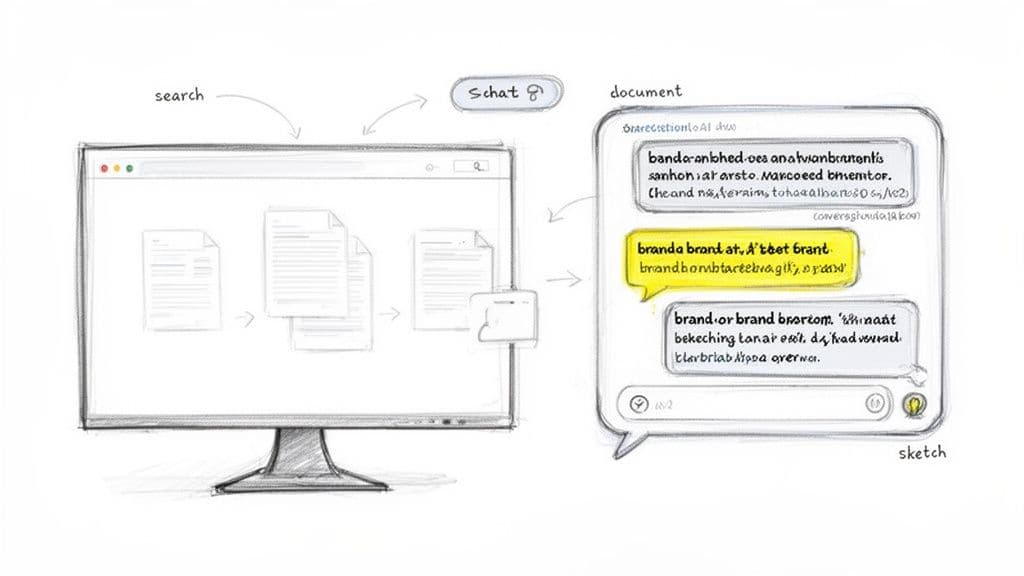
The entire B2B research process is being turned on its head. We’re moving past the simple keyword-and-click era into something far more interactive and conversational. This isn’t a small tweak; it’s a fundamental shift that requires a completely new playbook.
The Move From Keywords to Conversations
People aren't just typing "best CRM for small business" anymore. Their queries have become much more specific and layered. Think about a prospect asking, "Compare the integration capabilities of the top three CRMs for a SaaS company with under 50 employees." This is exactly the kind of complex, intent-driven question that Bing Copilot is built to answer—and your brand needs to be part of that answer.
This isn't just a gimmick or a new search feature; it's a whole new discovery layer. The adoption rate is just staggering. By late 2024, users had logged over 10 billion chats with Copilot. That's a massive jump from 1.9 billion the year before, showing just how quickly people are embracing AI to get information.
The game has changed. Bing Copilot doesn't just send traffic to your website by ranking it. It ingests your content, understands it, and then presents it as the answer. The goal is no longer just to be on the list; it's to be the definitive source.
An Integrated Discovery Channel
One of the most powerful aspects of Copilot is how deeply it's woven into the Microsoft ecosystem. It's right there in Windows, the Edge browser, and Microsoft 365. This creates a persistent discovery channel that lives inside the professional's daily workflow. Someone could be writing a proposal in Word, get a suggestion from Copilot, and find your solution without ever opening a separate browser tab to search.
For any B2B brand, this opens up some incredible doors:
- Direct Workflow Integration: Your brand can show up as a solution right inside the software your target audience uses every single day.
- High-Intent Visibility: When people turn to Copilot during their workday, they are almost always trying to solve a specific problem or make a purchasing decision. These are highly qualified leads.
- Building Authority: Getting cited by an AI assistant is a powerful form of social proof. It builds trust and positions you as an expert before a prospect even lands on your website.
To really get a feel for what’s possible, it’s worth understanding the full capabilities of tools like Microsoft AI Copilot.
Thriving in this new space demands a more sophisticated strategy. Simply tracking where you rank for a handful of keywords is no longer enough. You have to know if you're visible inside AI-generated answers. That's precisely why platforms like Attensira exist—to give you the visibility to monitor your presence, find the gaps, and seize opportunities your competitors are probably overlooking. We break down the broader strategy in our guide to https://attensira.com/blog/ai-search-engine-optimization.
For B2B companies, this isn't just another channel to manage. It's the new front line of digital discovery.
Crafting Content That AI Chatbots Trust and Cite
To get your content featured in AI search, you need a mental shift. Stop thinking like a traditional SEO and start acting more like a librarian who's organizing information for a very smart, but very literal, researcher. Bing Copilot isn't there to admire your website's design; it’s there to scan for clear, direct, and well-organized answers to very specific questions. Your content has to be engineered for easy extraction.
This process starts by rethinking how you structure your pages. Long, unbroken paragraphs are the enemy here. AI models work by parsing content into smaller, logical chunks. If your most important information is buried in a dense wall of text, the system simply can't identify, isolate, and serve it up as a trustworthy answer.
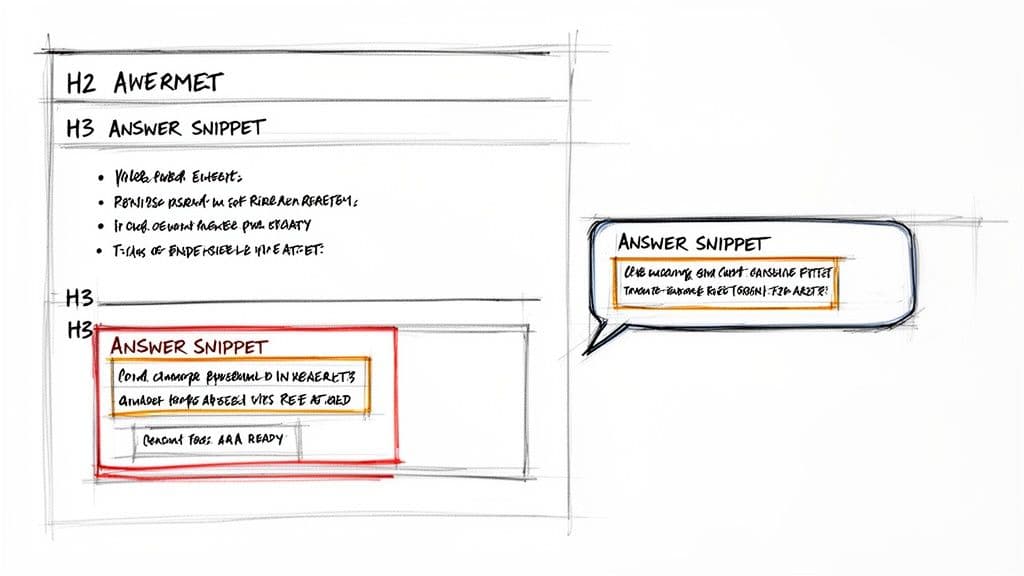
The secret is to create "answer snippets"—these are self-contained blocks of text that directly and concisely address a single concept or question. Think of them as pre-packaged meals, ready for Copilot to grab and go.
Aligning Content with Conversational Queries
Old-school keyword research just doesn't cut it for AI search. B2B buyers ask Copilot questions using natural, conversational language. They aren’t just typing "inventory management software." They're asking things like, "What's the best way to integrate inventory management software with an existing e-commerce platform without significant downtime?"
To create content that actually gets cited, you have to anticipate these complex, multi-part questions. A fantastic starting point is to dig into your own customer support tickets, listen to sales call recordings, and browse public forums like Reddit or Quora. These are goldmines for discovering the exact language your prospects use every day.
Your goal is to mirror the user's thought process. Map out their entire decision-making journey and create specific content that answers the questions they have at each and every stage.
For a deeper dive into this strategy, our guide on Answer Engine Optimization offers a practical framework for identifying and targeting these crucial user questions.
Building Scannable and Structured Pages
Once you’ve identified the right questions, the next move is to structure your pages for absolute clarity. This isn't just about good UX; it’s a critical technical requirement for Bing Copilot optimization. AI systems rely on HTML tags like H2s and H3s as signposts to understand the hierarchy and flow of your information.
A page with a single H1 tag and a giant block of text is nearly impossible for an AI to parse effectively. A well-structured page, on the other hand, uses headings to create a clear, logical outline.
- H2 Headings: Use these to introduce the main topics or questions. Something like, "How Our Platform Handles Data Security."
- H3 Headings: Break down those major topics into more granular sub-questions. An H3 under the security topic might be, "What Encryption Standards Do You Use?"
- Lists and Tables: Whenever you're presenting features, benefits, or steps in a process, use bullet points or a numbered list. This format is incredibly easy for AI to lift directly into a response.
By structuring your content this way, you’re essentially turning each section of your page into a potential "answer snippet." The AI doesn't have to guess where one idea ends and another begins—you've made it completely obvious.
Real-World Scenario: Transforming a Feature Page
Let's walk through an example. Imagine a B2B SaaS company selling project management software. Their original "Integrations" page is a typical marketing affair, with a long paragraph vaguely describing how their tool connects with other popular apps. It’s informative enough for a human, but it’s not structured for an AI.
To optimize for Bing Copilot, they would tear down that page and rebuild it. Instead of a generic description, they'd restructure the entire page into a Q&A format based on real customer queries.
Original Vague Heading:
- Powerful Integration Capabilities
New, AI-Optimized Structure:
- H2: Integrating Our Software with Your Existing Tools
- H3: Which Communication Apps Do You Integrate With?
- Answer snippet: We offer native integrations for Slack, Microsoft Teams, and Google Chat, allowing for real-time notifications and task creation directly within your chat client.
- H3: How Does the Trello Integration Work?
- Answer snippet: Our two-way Trello sync allows you to import boards, sync card statuses, and map due dates automatically. Any update in Trello is reflected in our platform in under 60 seconds.
- H3: What About Custom Integrations via API?
- Answer snippet: For custom needs, our full-featured REST API provides endpoints for projects, tasks, and users. You can find our complete API documentation here.
This new structure transforms a single marketing page into a library of distinct, citable answers. It directly maps to how people actually ask questions, making it exponentially more likely that Bing Copilot will trust and feature their content in a response.
Implementing Advanced Schema for AI Visibility
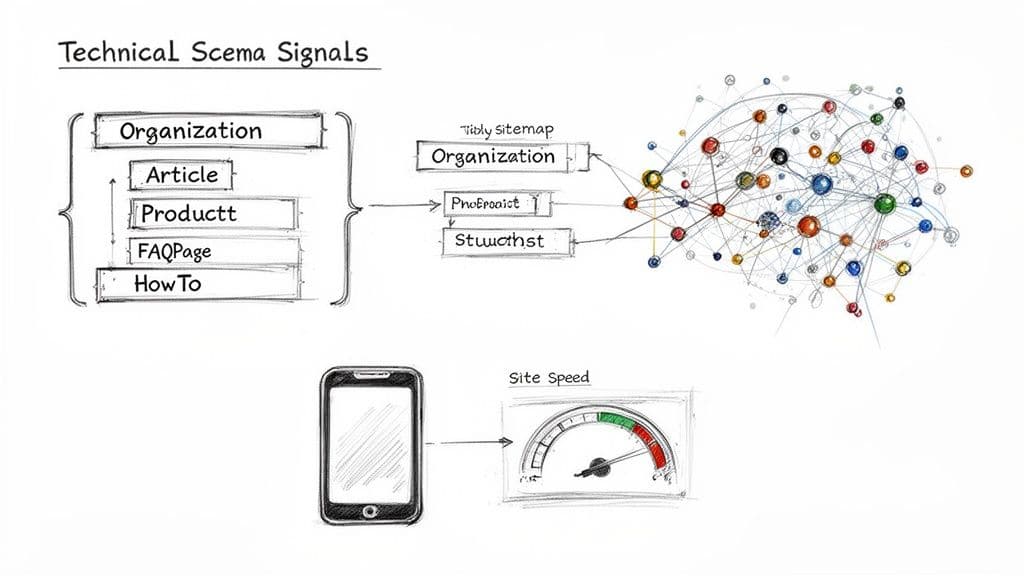
Having well-structured content is a great start, but to really stand out in Bing Copilot responses, you need to send clearer, more explicit signals to the AI. This is where structured data, also known as schema markup, becomes your most powerful technical tool. Think of it as creating a definitive "cheat sheet" for your website that Bing’s crawlers can read instantly.
Schema markup is a specific vocabulary of code you add to your site’s HTML. While it doesn't change how your page looks to a human visitor, it translates your content into a language that AI models understand with absolute clarity. Without it, the AI has to infer the context. With it, you're explicitly telling Bing, "This is a step-by-step guide," or "This number is the exact price of our software."
This level of precision isn't just a nice-to-have anymore; it's a core requirement for AI visibility. When Copilot needs to pull factual data—like your company's founding date, a product's review rating, or the steps in a complex tutorial—it will almost always prioritize sources that provide this information through clean, unambiguous structured data.
Prioritizing the Most Impactful Schema Types
While there are hundreds of schema types available, you don't need to implement them all at once. From my experience, a handful provides the most significant lift for B2B brands trying to get featured in Copilot. Getting these right creates a rich, interconnected data profile about your business and its expertise.
Here’s a look at the most crucial schema types for B2B content and why they matter for AI engines like Copilot.
Essential Schema Types for Bing Copilot Visibility
By implementing these, you're not just optimizing a single page; you're building a knowledge graph about your entire business. For a deeper dive, our glossary offers a detailed explanation of schema markup and its strategic value.
A great way to think about it is layering these signals. Copilot can connect your Product to your HowTo guides and attribute all of it back to your Organization, creating a web of trust and relevance.
Technical SEO Signals Beyond Schema
Schema is incredibly powerful, but it doesn't exist in a vacuum. It operates within a broader technical ecosystem. Copilot, much like any search engine, associates a site's technical performance with its reliability. A website that is slow, broken, or difficult to navigate is simply seen as a less credible source.
To give your structured data the best chance of being seen and used, your foundational technical SEO has to be rock solid.
I always recommend clients focus on these three areas:
- Page Speed: AI crawlers have a finite "crawl budget." A faster site allows them to index more of your content in less time. If your pages are too slow, your brilliant schema markup might never even get seen.
- Mobile-Friendliness: The vast majority of queries now come from mobile devices, and Bing knows it. It prioritizes mobile-first indexing, which means your site is judged based on its mobile experience. A clunky mobile site is a huge red flag.
- Logical Internal Linking: A smart internal linking strategy is like drawing a map for the AI. It shows the relationships between your pages, establishes a clear hierarchy, and funnels authority toward your most important content.
These technical elements work together. A fast, mobile-friendly site with robust schema markup sends a powerful, unified signal to Bing: this is a reliable, well-maintained, and authoritative source of information. Tools like Attensira can run technical audits to pinpoint pages missing crucial schema or suffering from performance issues, giving you a clear, actionable roadmap to improve your AI visibility.
Building Authority and Trust Signals for Generative AI
Think of Bing Copilot as having a built-in trust filter. It's not just hunting for content that vaguely matches a query; it's actively looking for sources it can confidently cite. To show up in its responses, you have to move beyond just keywords and prove your site is a credible, authoritative source.
This is where the principles of E-E-A-T (Experience, Expertise, Authoritativeness, and Trustworthiness) really come into play, but with an AI twist. Copilot is designed to pull information from the most reliable parts of the web. Your job is to make it undeniably clear that your content belongs in that trusted circle. This isn't about tricking an algorithm; it's about making your credibility obvious to both people and machines.
Demonstrating Credibility in the AI Era
Building authority for an AI like Copilot starts with familiar SEO foundations, but the emphasis shifts dramatically toward verifiable proof. The AI needs to be able to connect the dots between your article, the person who wrote it, and your company's reputation across the web.
You have to intentionally build a web of trust around your domain. For example, say you publish a deep-dive guide on a complex B2B software integration. Copilot immediately looks for outside validation. Are other respected industry sites linking to it? Is the author a known expert in that specific field? These signals all help the AI answer its most important question: "Can I trust this?"
This flowchart maps out the essential steps for building the kind of trust signals that AI systems are programmed to look for.
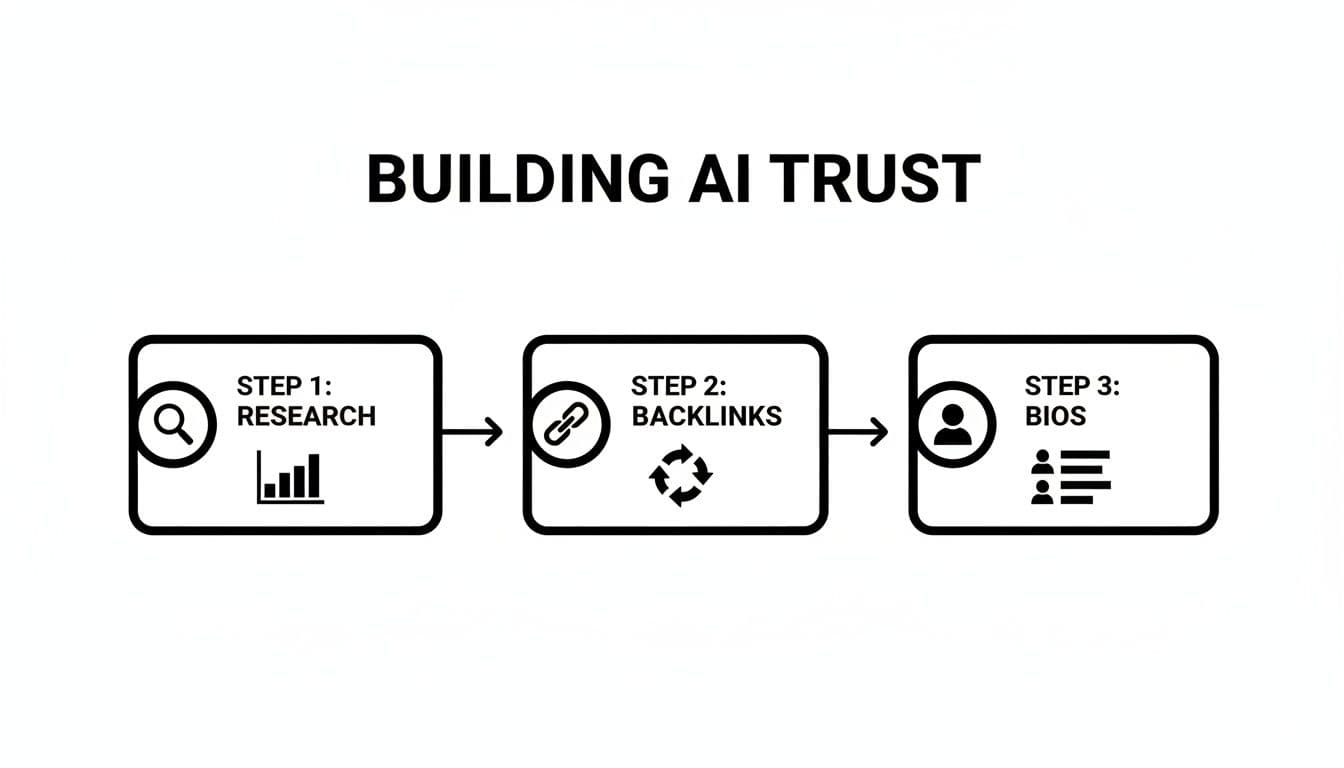
As you can see, it's a connected process. Solid research earns quality backlinks, and tying that content to credible authors completes the picture, creating a powerful signal of trustworthiness for AI.
A Checklist for Building Actionable Authority
Making your content a go-to source for Bing Copilot requires a multi-pronged strategy. It's about showcasing expertise everywhere you can and ensuring those signals are easy for an AI to find and piece together.
Here are a few of the most effective ways I've seen this work:
- Secure High-Quality Backlinks: A link from a respected trade publication is still one of the strongest votes of confidence you can get. The key is earning these mentions within content that's directly relevant to your expertise—context is everything to an AI.
- Feature Detailed Author Bios: Don't let your experts be anonymous. Create robust author pages that detail their credentials, publications, and link out to their professional profiles on platforms like LinkedIn. Using Author schema makes this connection explicit for machines.
- Publish Original Research: Nothing screams "authority" like proprietary data. Industry surveys, unique reports, and data-driven analyses are gold for Bing Copilot optimization. This content is hard to replicate, making it a natural magnet for both AI citations and backlinks.
- Cultivate Brand Mentions: Copilot’s analysis goes beyond just hyperlinks. It scans the web for unlinked mentions of your brand. Positive discussions about your company on relevant forums, news sites, and social media act as powerful social proof.
Ultimately, your digital footprint is a core part of any solid search engine reputation management strategy, and that reputation directly shapes how AI models perceive your brand's authority.
Trust is the currency of generative AI. Every backlink, every author credential, and every piece of original research you publish is a deposit into your authority bank account. The richer your account, the more likely Copilot is to 'withdraw' your content for its answers.
Real-World Scenario: SaaS Thought Leadership
Let's walk through an example. Imagine a B2B SaaS company that specializes in supply chain analytics. To establish themselves as the authority, they invest heavily in creating an "Annual State of Logistics" report, packed with proprietary data pulled from their own platform.
They don't just post it on their blog and hope for the best. They execute a full-scale outreach campaign, earning coverage and valuable backlinks from major logistics journals and business news outlets. The report's authors—the company's own data scientists—are featured in interviews and webinars, with their detailed bios and credentials on full display.
So, what happens? When a user asks Bing Copilot, "What are the key trends in supply chain management for this year?" the AI sees a powerful confluence of trust signals pointing directly at the company's report. It's referenced by trusted sources, authored by verifiable experts, and contains unique data nobody else has. This makes it an ideal source for Copilot to cite, driving massive visibility and cementing the company's status as a thought leader.
How to Measure and Refine Your Bing Copilot Strategy
So, you’ve optimized your content and dialed in the technical signals. That’s a great start, but it's only half the battle. How do you actually know if any of it is working inside Bing Copilot?
Traditional SEO metrics, like keyword rankings or organic traffic, don't give you the full story here. Copilot is a closed chat environment, meaning your standard analytics tools are completely blind to when your brand gets mentioned or cited as a source. For B2B marketers, that's a massive visibility gap.
This is where you have to shift your thinking. The goal isn't just to rank on a results page anymore; it’s about measuring your Share of Voice within the AI-generated answers themselves. You need to know if you're showing up, how you're being talked about, and who you're appearing next to.
Adopting a Modern Measurement Framework
The biggest headache is the lack of direct attribution. A prospect might see your company mentioned in a Copilot response, think "that sounds interesting," and then perform a branded search or go directly to your website. That critical first touchpoint inside the AI chat is completely lost to your analytics.
To get around this, you need a system that can actively monitor AI responses for mentions of your brand, your competitors, and the topics you care about. This is what turns optimization from a guessing game into a repeatable, data-driven process. The stakes are getting higher every day. Copilot is expected to grab about 14% of the global AI chatbot market share in 2025, a trend supercharged by its deep integration into Windows and Microsoft 365. With 54% of employees already using it through those productivity apps in 2024, its influence in the B2B world is impossible to ignore. For more data on the AI chatbot market, you can check out datastudios.org.
This is the exact problem a platform like Attensira was built to solve. It gives you the lens to see inside that AI "black box" and measure what's really driving influence.
Using Attensira for Performance Monitoring
Without a specialized tool, you're essentially flying blind. Platforms like Attensira act as your eyes and ears inside these AI environments, tracking brand visibility and competitive mentions at a scale that would be impossible to do manually.
What you're seeing here isn't just a vanity metric. It's a quantifiable look at your brand's presence, highlighting the specific conversational areas where you're winning—or more importantly, where competitors are eating your lunch.
This data is the fuel for a powerful feedback loop that constantly refines your Bing Copilot optimization strategy. Here’s how that workflow looks in practice:
Connect Your Domain and Define Your Topics
First things first, you connect your website to the platform. Then, you tell it what conversational themes, questions, and topics are central to your business. This establishes the baseline for everything that comes next.
Pinpoint Your Visibility Gaps
Once it's running, the platform starts analyzing thousands of AI responses related to your topics. The analytics will quickly show you where you're invisible. You might find that competitors are consistently cited for "enterprise data security solutions," while your brand is nowhere to be found. That’s an immediate, actionable insight.
Analyze What's Working for Competitors
Now you can dig into the why. Look at the responses where your competitors get featured. What content of theirs is being referenced? What specific questions are they answering better than you are? This gives you a clear playbook for the content and structure you need to build.
Let Data Drive Your Content Strategy
These findings should feed directly into your content calendar. If you see a major gap around "integration capabilities," your next move is clear: create the most comprehensive, well-structured guide on that exact topic. You're no longer guessing what to write; you're responding to proven demand within the AI ecosystem.
Measure, Iterate, and Repeat
After you publish new or updated content, the job isn't done. Keep monitoring. You can track whether your visibility for that target topic improves over time, giving you a clear, measurable return on your content investment.
This structured approach transforms your strategy from a series of one-off tactics into a continuous cycle of measurement, analysis, and refinement. For a deeper dive, our guide on how to track your brand’s visibility in ChatGPT and other top LLMs breaks this process down even further.
Burning Questions About Optimizing for Bing Copilot
As we all wrap our heads around this new AI-driven search, a lot of practical questions pop up. It's a genuine shift in thinking. We're moving away from just trying to rank on a results page and toward becoming a citable source for a conversational AI. It’s natural to wonder how this all actually works on the ground.
Let's break down some of the most common questions I hear from teams diving into Bing Copilot optimization.
Is This Really Different From Regular SEO?
Yes and no. Think of it as a specialized extension of the SEO work you're already doing. While core principles like domain authority and quality backlinks still provide the foundation, optimizing for Copilot demands a different layer of focus.
The biggest change is the emphasis on structure and clarity. Copilot isn't just ranking your page; it's actively reading and pulling out specific pieces of information to construct its answers. It's looking for self-contained, citable "nuggets" of information. This requires a much more modular approach to content creation.
Here’s where the two disciplines really diverge:
- Focus on Answer Snippets: Your goal is to create distinct, quotable blocks of text. Traditional SEO, on the other hand, is often more concerned with the overall relevance and authority of an entire page.
- True Conversational Intent: Forget just keywords. You need to optimize for the full-sentence, natural language questions people are actually asking the AI.
- Machine Readability is King: Structured data, like
FAQPageschema, and clean HTML (proper headings, lists) are no longer just "best practices." For an AI, they are critical signposts that make your content understandable and trustworthy.
Here's a simple way to think about it: traditional SEO gets your website noticed by the search engine. Bing Copilot optimization ensures your content gets used in the final answer. It’s a more surgical goal built on the same foundation.
How Long Until We See Any Real Results?
This is the big one, isn't it? Unlike tracking keyword rankings, seeing your content appear in Copilot is less of an on/off switch and more of a gradual process. There’s no magic timeline, but you can expect things to happen in stages.
You might notice some initial traction within a few weeks, especially after Bing re-crawls your newly updated pages. But to consistently get cited for competitive topics, you should realistically plan for a runway of three to six months—sometimes longer.
Several factors will influence how quickly you see progress:
- Your Content's AI-Readiness: How fast can you overhaul existing content and create new, properly structured articles?
- Existing Authority: If you already have strong trust signals, you have a head start. Building credibility from scratch takes time.
- The Competitive Landscape: Are your competitors already all-in on this? If so, breaking through will be a tougher, longer fight.
- Bing's Crawl Rate: How frequently Bingbot visits your site to pick up on the changes you've made.
The best approach is to treat this as an ongoing refinement process, not a one-and-done project. Consistently publishing high-quality, well-structured content will have a compounding effect over time.
What Are the Right Tools for Tracking Success?
Here’s the challenge: Copilot operates inside a closed chat environment. Your standard web analytics won't tell you a thing about when your brand gets mentioned. This creates a massive blind spot, making it impossible to prove ROI without the right tools.
A solid monitoring stack is essential. You’ll want to combine a few different types of platforms to get the full picture.
- Direct AI Monitoring Platforms: This is non-negotiable. A tool like Attensira is built specifically for this. It looks inside the AI black box to track your brand mentions, calculate your share of voice, and see how you stack up against competitors in the actual chat responses.
- Question Research Tools: To find out what people are asking, tools like AnswerThePublic or AlsoAsked are invaluable. They help you uncover those long-tail, conversational queries that feed your entire content strategy.
- Schema & Technical SEO Validators: Don't forget the basics. Use Google's Rich Results Test or the official Schema.org validator to make sure your structured data is error-free. Clean code is the bedrock of machine readability.
When you use these tools together, you create a powerful, repeatable workflow. You can find the right questions, build perfectly structured answers, and then actually measure if your efforts are paying off with real visibility inside Bing Copilot.
Ready to stop guessing and start measuring your brand's visibility in AI search? Attensira provides the actionable insights you need to monitor your performance, uncover competitive gaps, and refine your Bing Copilot optimization strategy with confidence. See how you stack up.