Learn practical steps to boost ai visibility for wedding planners with targeted content, SEO, and portfolio tips that attract modern couples in 2026.
The way couples find their dream wedding planner is changing faster than ever. It's no longer just about showing up on Google or having a stellar Instagram feed. Your next client consultation might very well start with an AI, and if you're not showing up in those conversations, you're becoming invisible.
It’s a major pivot from what we’ve always known. We’ve spent years mastering traditional SEO to rank our websites. Now, we have to think about something new: Generative Engine Optimization (GEO). This isn't about ranking a link; it's about making your brand the trusted, go-to answer when an AI assistant responds to a couple's query.
Why Your Next Client Consultation Starts with an AI
Think about the modern couple. Tech-savvy and research-driven, Millennials and Gen Z are turning to AI chatbots as their first-pass wedding consultants. Before they even think about contacting a person, they're asking complex questions to get ideas, vet options, and build a vendor shortlist.
This initial discovery phase is where the game is being won or lost. While a top spot on Google is still valuable, it’s a separate battleground. It won't help you when a potential client asks ChatGPT, "Who are the best luxury wedding planners in Napa Valley?" If your business isn't understood by the AI, you simply won't be part of the recommendation.
The New Client Journey
Picture this: a newly engaged couple, excited but overwhelmed, opens up an AI chat. Their first questions aren't to a search engine, but to a conversational assistant.
They're asking things like:
- "Can you create a 12-month wedding planning timeline for a 150-guest wedding?"
- "What are some unique, non-traditional wedding venues near Austin, Texas?"
- "Recommend three wedding planners who specialize in intimate, modern ceremonies."
If your digital footprint isn't optimized for these kinds of conversational questions, you're completely out of the running. You won't even make it to the consideration list. To get a better handle on how these platforms work, we've broken down how to track your brand's visibility in ChatGPT in another guide.
The Urgency of Adaptation
The numbers don't lie. The US wedding market is projected to be a $66.16 billion industry by 2026, and the clients driving that growth are behaving differently. AI use among couples has doubled from just 10% in 2023 to 20% this year alone.
With tech-native Gen Z now making up 41% of the market, this trend is only going to accelerate. In fact, a recent study found that 60% of couples now use AI for initial inspiration before they ever reach out to a vendor. You can discover more insights from The Knot's 2026 Real Wedding Study on kandephotobooths.com.
The risk is simple: if you're not part of the AI's answer, you don't exist for a growing segment of your target market. Adapting your marketing strategy isn't just an option—it's an imperative for survival and growth.
How to Audit Your Current AI Visibility
Before you start changing your website or marketing, you have to know where you stand. You can't improve your AI visibility without first getting a clear baseline. This isn't about diving into complicated analytics; it's much simpler. It's about stepping into your clients' shoes and asking the AI the same questions they are.
The goal here is to see the digital world through the AI's eyes. This audit will show you exactly where your business shows up and—just as importantly—where it’s completely invisible.
Putting Yourself in the Client’s Shoes
Think like a recently engaged couple. They’re not just typing "wedding planner Dallas" into a search bar anymore. They’re asking their phone, "Find me a wedding planner in Dallas who is great with modern, minimalist weddings and has amazing reviews." Your audit needs to mimic this conversational, detailed approach.
To run a solid manual check, you need to be specific. Go to platforms like ChatGPT, Google Gemini, and Perplexity, and test a range of prompts that cover the different ways a couple might search for a planner like you.
Here are the kinds of questions you should be asking to see if you show up:
- Location-Based: "Who are the top-rated wedding planners in Austin, TX?" or "Find wedding planners who serve the Napa Valley area."
- Style and Niche-Specific: "Can you recommend wedding planners in Miami who specialize in luxury beachfront weddings?" or "I'm looking for a planner in Brooklyn known for unique, non-traditional weddings."
- Budget-Oriented: "List some affordable full-service wedding planners in Chicago for a budget under $15,000."
- Problem-Solving: "Which wedding planners in Arizona can help me plan an elopement in Sedona?"
This flowchart shows exactly what this new discovery journey looks like. A couple's initial question now goes through an AI assistant before a planner is ever contacted.
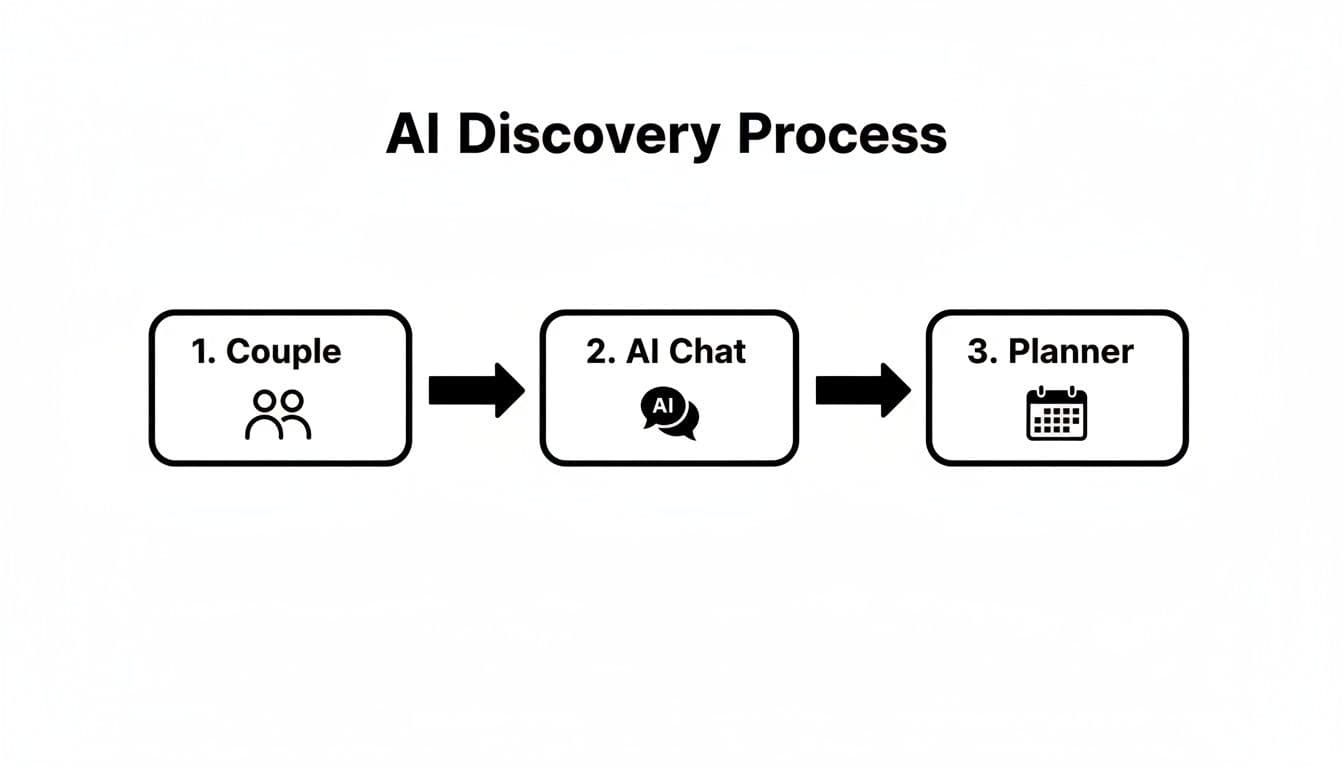
This new path—from the couple to the AI and then to you—is a critical point in the marketing funnel where your visibility can make or break a new lead.
Looking for the Gaps in Your Visibility
As you test these prompts, document everything. A simple spreadsheet will do. Track which AI you used, the exact prompt, and the full response. Note if your business was mentioned, how it was described, and which of your competitors showed up when you didn't. The silence is what you really need to pay attention to.
If your business is consistently missing from AI recommendations—especially for your core services and location—that's a major visibility gap. It tells you that the AI models don't have enough clear, high-quality information about you online to feel confident in recommending your services.
Doing this manually gives you a valuable snapshot, but it’s a lot of work to do regularly. And you need to do it regularly. AI models and their data sources are updated constantly, meaning your visibility could change from one week to the next.
For a more rigorous and sustainable approach, you need a way to monitor this automatically. You can learn more about how to track your brand's visibility in ChatGPT & other top LLMs using dedicated tools like Attensira.
These professional monitoring platforms automate the entire audit. Instead of you spending hours typing prompts, they query multiple AI models with hundreds of relevant prompts every single day. You get a central dashboard that shows you exactly where you stand, tracks changes over time, and provides the hard data you need to build a smarter strategy. It’s the most effective way to establish a real baseline and measure the results of your hard work.
Optimizing Your Digital Footprint for AI Crawlers
Alright, you've taken stock of where your business currently shows up in AI. Now for the fun part: making changes that actually move the needle. To get noticed by AI, you have to start thinking like an AI. This means structuring your online presence so Large Language Models (LLMs) can easily read, understand, and most importantly, trust your information.
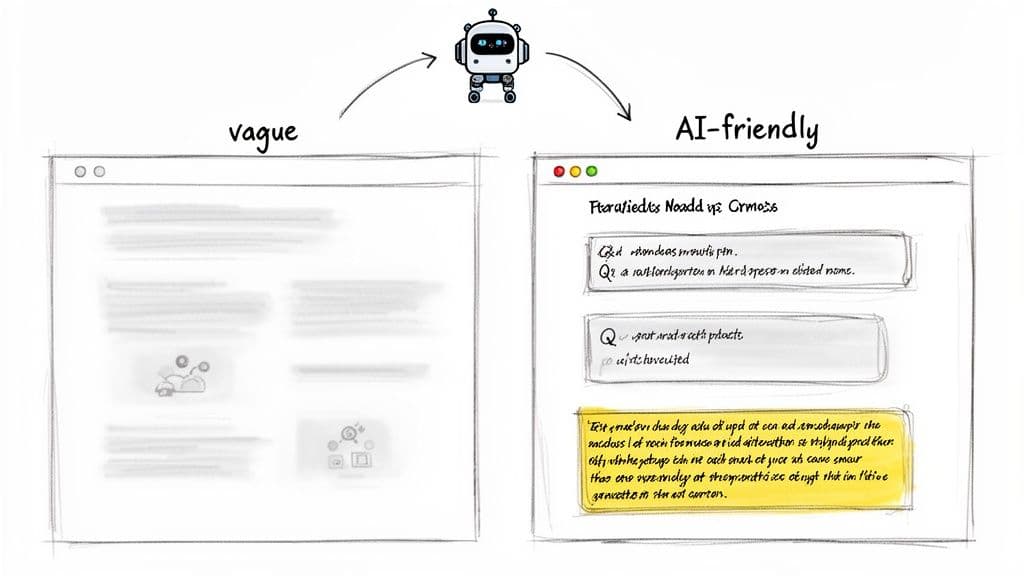
Think of it as crafting a resume for a very literal, data-hungry AI recruiter. This recruiter scans the entire web for the best possible answers, and it doesn't get impressed by flowery language. It's time to trade vague marketing copy for concrete, descriptive facts. Phrases like "unforgettable experiences" are great for a brochure, but they're invisible to an AI. It needs a steady diet of rich, factual information about who you are, what you do, and where you do it.
From Vague to Valuable Content
One of the biggest and fastest improvements you can make to your AI visibility for wedding planners is to rewrite your service descriptions. I see this all the time—planners use beautiful, emotive copy that, unfortunately, gives AI crawlers absolutely nothing to work with. You have to be explicit.
Let’s look at a real-world "before and after" for a planner's website:
- Before: "We create bespoke weddings, turning your dreams into reality with our full-service planning package. Let us handle the details for a seamless day."
- After: "Our 'Signature Full-Service Planning' is designed for couples in the greater Denver area with a guest count of 100-200 and a wedding budget starting at $80,000. This package includes vendor sourcing from our curated list of florists and photographers, complete budget management, guest list coordination, and on-site execution by two lead planners."
See the difference? The "after" version is packed with clear data points—location, guest count, budget, and specific services. An LLM can instantly grab that information and match it perfectly to a couple's search.
Building Your Content Authority
Beyond your core service pages, your blog is your secret weapon. It’s where you can create detailed, in-depth content that directly answers the complex questions couples are already asking platforms like ChatGPT and Perplexity.
By creating content that directly answers a user's question, you are essentially pre-packaging a response for the AI. If your answer is the most comprehensive and clearly structured, the AI is more likely to use it as a primary source for its own generated answer.
This means you need to get specific with your topics. Instead of a generic post on "wedding budgets," write an article titled, "What Is the Average Cost for a 100-Person Wedding in Napa Valley in 2026?" This hyper-focused approach aligns perfectly with how modern couples use AI for their wedding research. Digging into the specifics of AI search engine optimization for local services can give you a serious advantage here.
As you write these detailed posts, remember that you're not just creating blog content; you're building a knowledge base that establishes you as an expert. For a much deeper look at this strategy, our guide on AI search optimization is a great next step. This web of clear, authoritative content is what ultimately makes your brand the go-to source for AI-powered recommendations.
Mastering Local Signals and Your Visual Portfolio
While your website copy is crucial, an AI's confidence in recommending you often hinges on two things that couples are desperate to find: proof you operate in their area and proof your work is beautiful. To an AI, these aren't just details—they are core validation points. It heavily relies on local signals and visual content to understand your business, your style, and ultimately, your suitability for a searcher.
For any wedding planner, local discovery is everything. When a couple asks an AI for planners "near me," the model immediately consults local directories, with Google Business Profile (GBP) being the most important. A sparse or inactive profile is a massive red flag, making it highly unlikely you'll get a mention. Improving your ai visibility for wedding planners means treating your GBP as a primary marketing tool, not a set-it-and-forget-it task.
Fortifying Your Local Presence
Think of your Google Business Profile as an exhaustive resume for AI. It’s not enough to have your name and address listed. AI models parse every single detail to gauge your relevance and how active you are in your community.
To really strengthen these signals, here’s what you need to do:
- Drill Down on Your Services: Ditch the generic "Full-Service Planning." Get specific with offerings like "Full-Service Wedding Planning for Budgets over $100K" or "Elopement Coordination in the Rocky Mountains." Every detailed service you list is another valuable data point for the AI.
- Cultivate and Engage with Reviews: A steady flow of recent, detailed reviews is one of the most powerful trust signals you can have. When a review mentions a specific location—"She was incredible for our downtown Denver wedding!"—it powerfully reinforces your local expertise for the AI.
- Own the Q&A Section: Don't wait for people to ask questions. Proactively populate your own Q&A section with common queries. For instance, post the question "Do you plan weddings in Vail?" and answer it with a clear "Yes, we specialize in luxury mountain resort weddings..." This creates perfectly structured, easily digestible information for AI to pull from.
A detailed, active, and robust profile gives an AI the confidence it needs to recommend you for those hyper-local and highly specific inquiries. If you want to take this even further, our comprehensive local SEO checklist provides a ton of other practical steps.
Making Your Portfolio Speak to AI
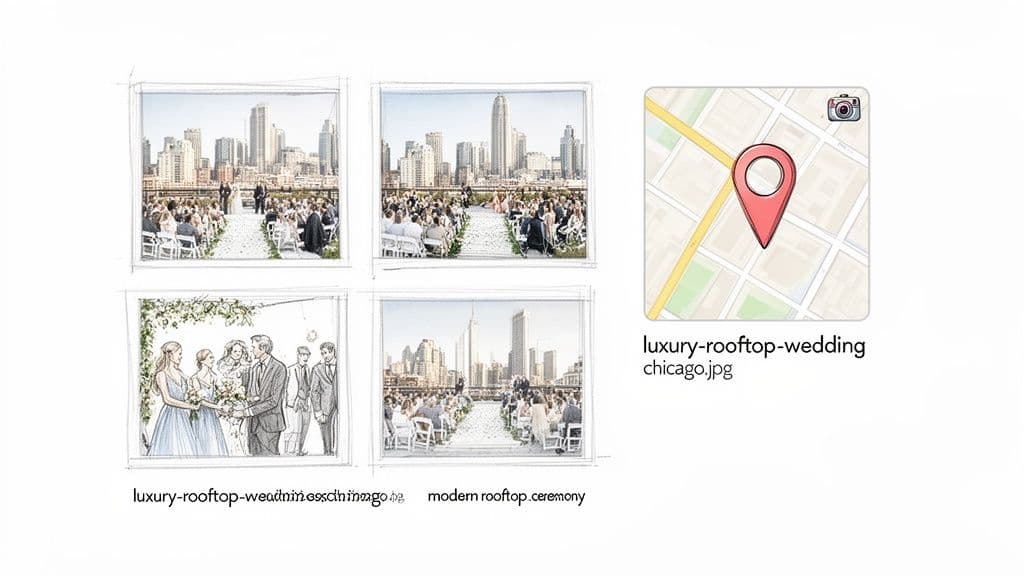
Your visual portfolio is so much more than just a collection of pretty pictures. From an AI's perspective, it’s a goldmine of data waiting to be indexed and understood. But here’s the catch: an AI doesn't "see" images like we do. It relies entirely on the text associated with them—filenames and alt text—to understand the content.
By using descriptive filenames and alt text, you are essentially captioning your work for an AI assistant. This context is critical for helping it match your aesthetic and location to a couple's request.
Think about it. A filename like IMG_9021.jpg is completely meaningless to an AI. It tells it nothing. By simply renaming your images with descriptive, keyword-rich language before you upload them, you provide invaluable context. This one small change has a huge impact.
Example of Optimized Image Naming:
- Poor:
portfolio-12.jpg - Better:
bohemian-barn-wedding-madison-wisconsin.jpg - Best:
luxury-rooftop-wedding-reception-downtown-chicago-at-dusk.jpg
This same logic applies directly to your alt text. It should clearly and concisely describe what's in the image while naturally weaving in your target keywords, such as the wedding style and location. This is how you ensure that when an AI is asked for "planners who do modern rooftop weddings in Chicago," it can connect that specific request directly to your visual proof.
Using Data to Drive Your AI Visibility Strategy
Getting your website and content optimized is a fantastic first step, but it’s just that—a start. If you really want to see your wedding planning business thrive in this new era of AI search, you have to move past a "set it and forget it" mentality. The real magic happens when you start a continuous cycle of monitoring, learning, and refining.
Without data, you’re basically just guessing. You're throwing content out there and hoping something sticks. A solid monitoring process turns that guesswork into a real, measurable strategy. It shows you exactly which of your efforts are paying off and, just as importantly, where your next big opportunity is hiding. This is what bridges the gap between simply doing SEO and truly managing your digital presence.
Turning Insights into Action
Ongoing monitoring helps you see which AI platforms are finally starting to mention your brand and where you’re still invisible. Instead of spending hours manually typing queries into different AI chats, a professional monitoring dashboard—like the one we've built at Attensira—can surface these insights for you automatically.
Picture this: your dashboard shows that you’re consistently getting mentioned for "luxury planners in Denver," which is great. But it also reveals you're a ghost when couples ask about "sustainable wedding planning." This isn't a failure; it's a road sign. You now have a crystal-clear directive for your next piece of content.
This insight-to-action workflow is incredibly effective.
- You spot a content gap. Your data points to a high-value niche where you have zero AI visibility (like that "sustainable wedding" example).
- You create targeted content. Armed with that knowledge, you write an authoritative blog post, something like, "A Planner’s Guide to Creating a Sustainable Wedding in Colorado."
- You measure the impact. Over the next few months, you use your dashboard to track whether that new post starts earning you mentions for related AI queries.
This creates a powerful feedback loop: audit your presence, optimize your content, measure the results, and then refine your strategy based on what you’ve learned.
The Data Proving the Urgency
The need to adopt this data-first mindset is becoming more urgent by the day. The wedding industry is currently going through a 'K-shaped' recovery, where planners who adapt to AI are set to pull away from the pack. The numbers don't lie.
Recent data shows AI use among engaged couples has shot up from 20% to 36% in just one year, which is fundamentally changing how vendors get discovered. In a massive $66 billion industry where 46% of couples already use AI for planning and logistics, being invisible means you're simply not in the running. You can learn more about these findings on weddingpro.com.
By consistently analyzing your performance, you turn AI visibility from a vague idea into a tangible marketing channel with clear results. It’s how you justify your marketing spend and make smarter decisions about where to focus your energy next.
This strategic cycle of action and analysis is what separates planners who are just on the internet from those who are actively shaping how they appear on it. To dive deeper into what to track, check out our guide on key content performance metrics.
Answering Your Questions About AI for Wedding Planners
Stepping into the world of AI-driven search can feel like learning a new language. It’s natural to have questions. Based on my experience helping planners navigate this shift, a few key concerns pop up again and again. Let's tackle them head-on.
Is AI Visibility Just a New Name for SEO?
That's a great question, and the answer is no, not quite. While they're definitely related, the end goal is different.
Traditional SEO is all about winning a spot for your website link on a search results page. AI visibility, sometimes called Generative Engine Optimization (GEO), is about getting your business name, advice, and services featured directly inside the AI’s generated answer.
Think of it this way: SEO gets you on the list of options. GEO makes you part of the recommendation itself. It’s about becoming a trusted source that the AI quotes, which requires a much deeper focus on proving your expertise through detailed, conversational content that an AI model can understand and rely on.
Do I Need to Be a Tech Whiz to Do This?
Absolutely not. You don't need to know how to code to make a real impact here. The most powerful strategies for improving your ai visibility for wedding planners are built on solid content and smart marketing, not technical wizardry.
You can get surprisingly far by just writing incredibly helpful blog posts, filling out every single section of your Google Business Profile, and clearly detailing your unique services and portfolio.
The heart of this work is proving your expertise in a way that resonates with both people and AI. Technical things like Schema markup definitely give you an edge, but plenty of user-friendly website plugins can handle the heavy lifting for you.
How Long Before I Actually See Results?
This is the million-dollar question. While it always varies, you can often see movement faster than with traditional SEO. AI models are constantly re-evaluating web data, so the right updates can get noticed fairly quickly.
Here’s a realistic timeline based on what I’ve seen:
- Local Profile Updates: Tweaks to your Google Business Profile—like adding detailed service descriptions or fresh Q&As—can start influencing local AI results within a few weeks.
- Content-Driven Efforts: A new, in-depth blog post that answers a specific question couples are asking might take 1-3 months to be indexed, understood, and cited by major AI platforms.
Consistency is everything. Building this authority over time is what creates lasting visibility and keeps you top-of-mind when AI assistants are making recommendations.
Will AI Make Human Wedding Planners Obsolete?
Let me be clear: no, it won't. AI is a fantastic research assistant, but it can’t replicate a planner’s creativity, human connection, vendor relationships, or ability to manage a crisis on the wedding day.
Couples will use AI for brainstorming and early-stage research. They hire a human for the artistry and execution. Your job is to use AI to get discovered during that initial research phase, positioning yourself as the expert they need to turn their Pinterest board into a reality. If you want to dig deeper into AI's evolving role in business, you can often find great articles on company blogs; for example, you can explore the meetalto.ai blog for AI insights.
Ready to stop wondering and start strategizing? Attensira gives you the hard data needed to see exactly how your brand shows up on AI platforms, pinpoint content gaps, and make your next move with total confidence.