
Dominate AI search in 2026. This guide provides actionable strategies for AI visibility for tutors to attract more students and boost your online presence.
When a student needs a tutor, their first stop isn't what it used to be. Instead of sifting through search results, they're increasingly asking AI chatbots directly. This is where AI visibility comes in. It’s about making sure that when a tool like Google’s AI Overviews or ChatGPT gets a question about academic help, your name is part of the answer.
It's a new game, and it demands a different strategy than traditional SEO. The goal isn't just to rank—it's to be cited as an authority.
The New Reality of How Students Find Tutors
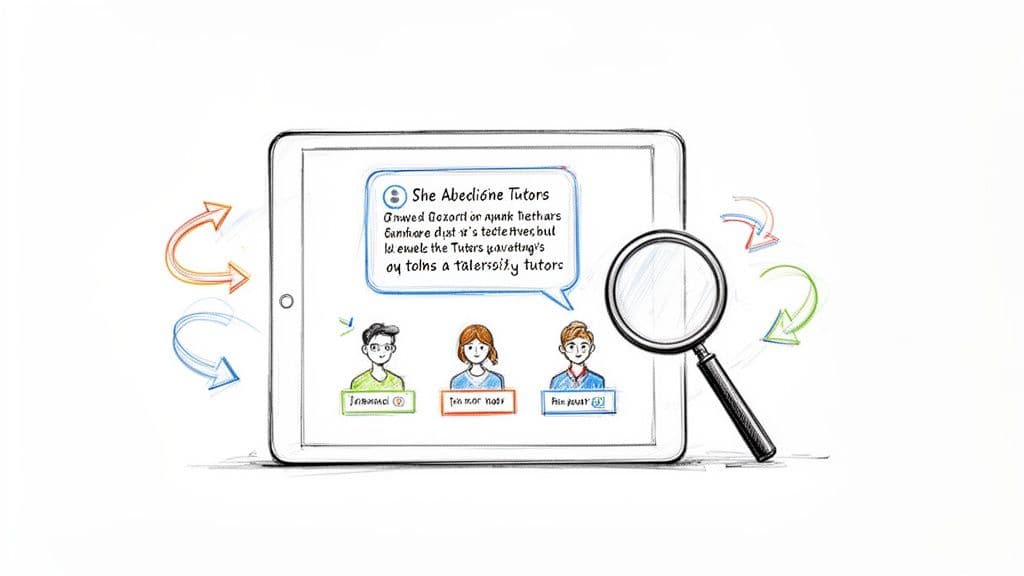
Think about it from the student's perspective. They can now skip the tedious website hopping and just ask: "Find me the best algebra tutor for high school students who offers online sessions."
That AI then acts like a lightning-fast research assistant. It scans everything it knows—websites, articles, directories, and reviews—to piece together what it believes is the most helpful, definitive answer. If your online presence is thin or poorly structured, you simply won’t make the cut. You’ll be invisible before the search has even begun.
Why This Shift Matters for Tutors
The rise of tools like an AI-powered homework helper shows just how much student habits are changing. This isn't just a minor trend; it's a fundamental shift in how your expertise gets discovered. You can either get left behind or see this as a huge opportunity.
The key is to think of these AI models as incredibly discerning researchers. They don't just find information; they evaluate and synthesize it from sources they trust. Your job is to become one of those trusted sources.
A simple website with your contact information is no longer enough. To boost your AI visibility for tutors, your digital footprint has to send all the right signals. The AI is looking for specific evidence, including:
- Expertise Signals: Your credentials, years of experience, and subject matter authority need to be crystal clear and easy to find.
- Structured Content: Your information must be organized in a machine-readable format so the AI can easily parse who you are, what you teach, and who you help.
- Authoritative Mentions: You need to be mentioned, cited, or linked to from other reputable educational platforms and websites.
If you don't adapt, you risk becoming invisible to a fast-growing portion of your potential students. For a closer look at the technical side of this new search landscape, our guide on https://attensira.com/blog/ai-search-optimization is a great place to start. The playbook we're about to walk through is your first step toward mastering this new environment.
Auditing Your Current AI Search Footprint
Before you can start optimizing your website, you need a clear picture of where you stand right now. This means you have to put on your student hat and go looking for yourself—and your competition—across the major AI search platforms like Google's AI Overviews, ChatGPT, and Perplexity. You have to think like a potential client and ask the kinds of questions they would.
This isn't about ego-surfing; it's a critical diagnostic. A vague search for "tutor" won't tell you anything useful. You need to get specific and use the exact intent-driven queries a parent or student would actually type into a search bar.
Simulating Real Student Searches
Your first task is to build a list of at least 10-15 realistic search phrases. A solid audit means running these same queries across different AI models, because each one pulls from unique data sets and can give you surprisingly different answers.
Think about the real-world problems your clients are trying to solve. Your queries should reflect that.
- Subject & Level: “best online calculus tutor for college students” or “AP physics help”
- Location-Specific Needs: “SAT prep tutor near me in Boston” or “local reading specialist for elementary school”
- Problem-Oriented Questions: “how to find a good chemistry tutor for a struggling high schooler”
- Competitor Comparisons: “top-rated algebra tutors” or “alternatives to [competitor's name]”
This process gives you the raw data to see what’s working and what isn’t. Remember to track these results over time, as AI-generated answers are notoriously unstable.
In fact, the AI search space is so fluid that recent studies show only 30% of brands hang onto their visibility in back-to-back searches. For tutors, this means one day you might be featured, and the next you’re gone. The AI models are constantly shuffling their sources, causing most brands to vanish temporarily.
Tracking and Analyzing Your Footprint
A simple spreadsheet is your best friend for this part of the audit. Set up columns for the query, the AI model you used, whether you were mentioned, which competitors showed up, and what sources the AI cited. This gives you a data-backed starting point for your entire strategy.
After running just a handful of queries, you'll start to see patterns. Maybe you show up for broad terms but vanish the moment a location is added. Or perhaps a single competitor seems to own the entire conversation around a specific subject. These are your immediate opportunities.
This audit is all about spotting your blind spots. If you're consistently absent from searches for "SAT prep," that's a huge red flag. It tells you that your website doesn't have the specific, authoritative content that AI models need to see you as an expert on that topic.
Understanding these gaps is the most important step before you start optimizing. For a more advanced approach, you can explore how to set up continuous AI search monitoring to automate this tracking. This initial audit provides the crucial "before" picture you'll need to measure the success of your efforts to improve your AI visibility for tutors.
To show up in AI-generated answers, you need to change how you think about content. It's no longer about writing for an audience; it's about writing as an authority that an AI model can trust and cite. Forget about generic blog posts. Your goal is to become the definitive source an AI turns to when piecing together a response.
This means you have to create content that directly and thoroughly answers the very specific, long-tail questions that students and parents are asking. Think less about stuffing in keywords and more about becoming the go-to encyclopedia entry for your niche—whether that's "IB Math HL tutoring" or "strategies for overcoming dyslexia."
Build Foundational Pillar Content
The bedrock of this strategy is what we call pillar content. These aren't your typical 500-word blog posts. They are massive, in-depth guides that cover a topic from every conceivable angle. So, instead of a quick "5 Tips for Better SAT Scores," you'd create something like "The Ultimate Guide to SAT Preparation," complete with sections on each test component, sample study schedules, and common mistakes to avoid.
Why go to all this trouble? Because these comprehensive resources are exactly what AI models are looking for. They provide a rich, well-structured source from which the AI can pull information, create summaries, and confidently answer user questions. When you create the most thorough guide on a subject, you make yourself the most credible source to cite.
This entire process, from understanding what people are asking to refining your content, is what drives a successful AI visibility strategy.
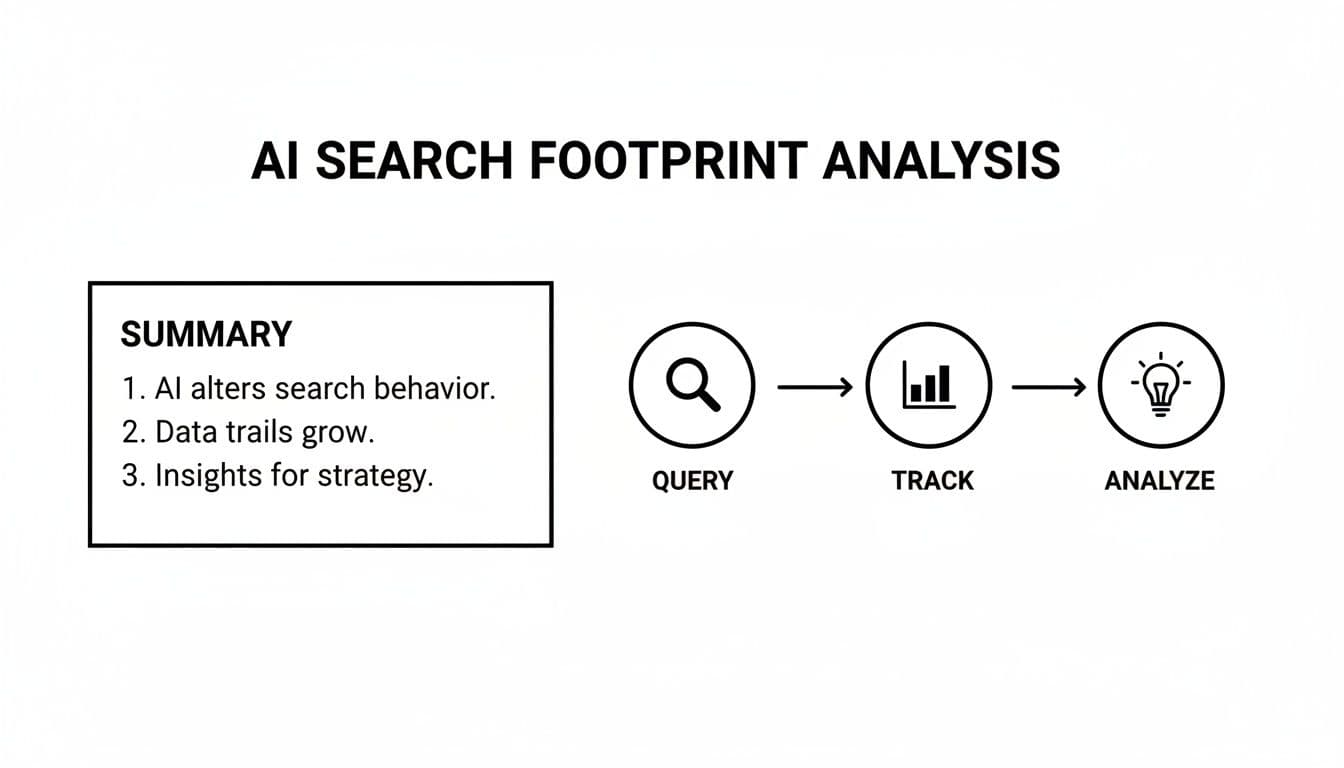
It’s a cycle of querying, analyzing, and acting on the data to constantly improve how you show up in AI-powered search.
Structure for AI and Human Readability
How you write is just as important as what you write. AI models, much like busy parents, prefer content that is neatly organized, flows logically, and is easy to scan.
Use a clear hierarchy with descriptive headings (H2s) and subheadings (H3s) to break up your text. Chop up complex ideas into bite-sized chunks using short paragraphs, bullet points, and numbered lists. This machine-readable format helps an AI quickly map out the key concepts and see the relationships within your content.
Let's look at a practical comparison:
The optimized version on the right sends clear signals of expertise and structure, making it far more useful to an AI. This technical approach is a key part of what’s called Answer Engine Optimization—the practice of getting your content featured directly in AI-generated summaries. You can dive deeper into this topic in our guide on Answer Engine Optimization.
Your goal is to make your content so clear and authoritative that an AI doesn't need to look anywhere else to verify the information. You become the single source of truth.
The payoff for getting cited is enormous. Google AI Overviews, for example, have completely changed the game. Research shows that organic click-through rates (CTR) have dropped by a staggering 61% year-over-year on queries that trigger these AI summaries. However, when a tutor is cited as a source, their organic CTR can shoot up 35% higher than their competitors who aren't mentioned. You can see more data on these AI search statistics at Position.Digital. In this new reality, being the cited source isn’t just an advantage; it's essential for survival.
Layering in Technical Signals for AI Recognition
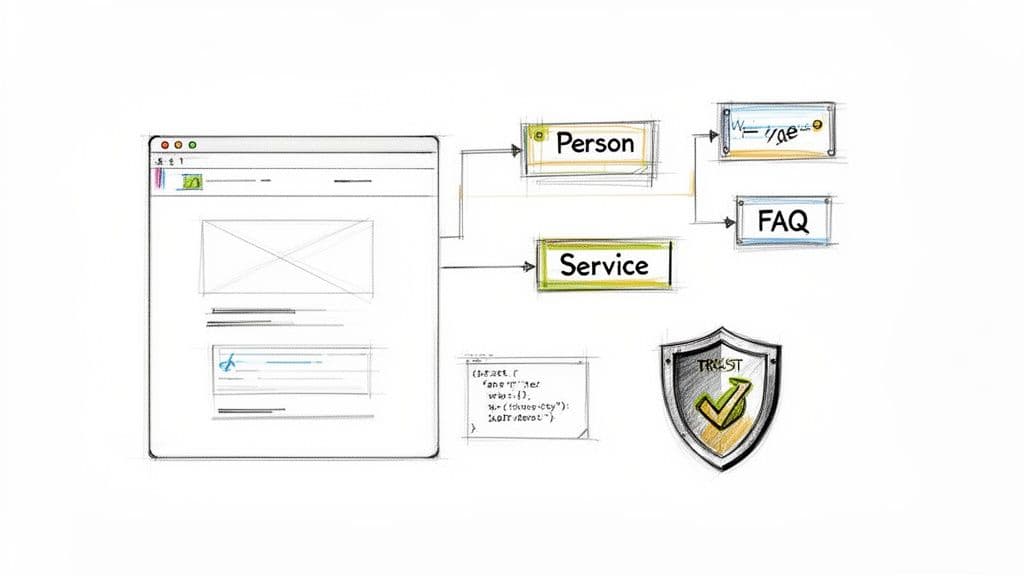
Putting together great content is a massive achievement, but it's only one piece of the puzzle. If AI models can't figure out the context of your website—who you are, what you offer, and why you’re an expert—then even the most helpful tutoring guide will get lost in the noise. This is where we need to give them a little help with technical signals.
The single most effective way to do this is with structured data, often called Schema markup. I like to think of it as creating a perfectly organized résumé for the AI. You're adding special tags behind the scenes that explicitly label your content, removing any and all guesswork. Instead of hoping an AI infers you’re a calculus tutor, you’re telling it directly in a language it's built to understand.
This simple act of clarification can be the difference between being featured as an expert and being completely overlooked.
The Essential Schema Markup for Tutors
To help AI models make sense of your services, there are a few key Schema "types" you should focus on implementing. They act like a filing system, neatly organizing your information so it can be easily pulled for search results and generative AI answers.
This table breaks down the most critical Schema types for any tutor looking to improve their digital footprint.
Implementing these isn't just a technical exercise; you are building a foundation of clarity that makes you a far more reliable source in the AI's "eyes" than a competitor whose site is a jumble of un-tagged information.
From Technical Signals to Building Trust
Beyond the code, AI models are also trying to gauge something much more human: your credibility. This is where Google’s E-E-A-T framework comes in, standing for Experience, Expertise, Authoritativeness, and Trustworthiness. These aren't just abstract ideas; they are qualities you need to actively demonstrate.
Think of it as building a case for yourself. Your digital presence must provide overwhelming evidence that you are a real, credible, and trustworthy expert. Here’s how you can translate E-E-A-T into tangible actions on your website:
- Build an Authoritative "About Me" Page: Don't just list your degree. Tell your story. Detail your teaching philosophy, share your years of hands-on experience, and list specific certifications or awards you've earned.
- Weave in Social Proof: Don't hide your glowing reviews on a separate page. Sprinkle powerful student testimonials and parent quotes directly onto your core service pages. Authentic praise is a massive trust signal.
- Cite and Link to Reputable Sources: When you write a blog post about study techniques, link out to university research or established educational resources. This shows you’re part of a larger academic conversation.
These trust-based signals and technical markups work hand-in-hand. Of course, they all need to live on a website that's easy for both AI and people to navigate. A logical site structure is another critical piece of this puzzle. For a deeper dive, check out our guide on how site architecture impacts SEO.
Building Authority and Trust Beyond Your Website
Having excellent content and a technically sound website is a great start, but AI models don't just take your word for it. They need external proof. Think of it as a background check—the AI scours the wider internet to see who else is vouching for your expertise. This is why building your authority off your website is so crucial for boosting your AI visibility for tutors.
The goal here is to create a network of credible, third-party signals that all point back to you as a specialist. When an AI sees your name and expertise pop up on trusted educational sites, it validates the claims you're making on your own platform. It’s the digital equivalent of having respected colleagues recommend you for a job; the more authoritative voices that endorse you, the more credible you become.
Target High-Authority Platforms
You have to be smart about where your name appears. A mention on a small, unknown blog simply doesn't carry the same weight as a feature in a well-regarded educational publication. You'll want to focus your efforts on places that have already earned the trust of both people and AI algorithms.
These types of platforms are fantastic starting points for building that off-site authority:
- Reputable Tutoring Directories: Getting listed on established directories like Wyzant or Care.com is an easy win. These are powerful, context-rich citations. Just make sure your profile is 100% complete with your specializations, experience, and a link back to your personal website.
- Educational Guest Posts: Writing an article for a popular education blog or a resource site for your specific subject does two things: it puts your expertise in front of the right audience and generates a high-quality backlink that AI models really notice.
- Academic Forums and Communities: Being an active, helpful voice in forums like Reddit's
r/HomeworkHelpor subject-specific Stack Exchange sites can quietly build your reputation. Even if you can't drop direct links, your consistent, expert-level answers contribute to your overall digital footprint and authority.
This is all part of cultivating strong thought leadership in your field. It’s about consistently sharing valuable insights that frame you as the go-to expert.
Securing Guest Posts and Partnerships
Landing a guest post on a high-authority site isn’t about just firing off a generic email and hoping for the best. You need a more thoughtful approach. First, do your homework on the site. Look for a content gap you're uniquely qualified to fill, and then pitch a specific, valuable idea that you know will resonate with their audience.
Pro Tip: When you reach out, always frame the pitch around the value you bring to their readers, not what you get out of it. I once landed a great guest post by starting my email with: "I noticed you have excellent guides on SAT reading and writing, but I see an opportunity for a definitive resource on the digital SAT's new math section. I've developed a unique framework for tackling these adaptive questions..."
This kind of targeted outreach immediately shows you're a serious professional who has done their research, not just someone hunting for a quick link. Every successful placement adds another layer of external validation, strengthening your profile and making you a much more prominent and trustworthy result in AI-driven searches.
How to Monitor and Adapt Your AI Visibility Strategy
Getting your tutoring business noticed by AI isn't a one-and-done project. These AI models are always learning and evolving, and so are the ways students use them to find help. A strategy that works brilliantly today could be obsolete in a few months, which means you have to keep a close eye on your performance and be ready to adapt.
This requires a system for tracking your visibility. Honestly, who has time to manually punch in search queries every week? It's not just tedious; it's an unreliable way to spot trends. Using a dedicated tool to automate the tracking of your AI visibility for tutors is a game-changer. It saves a ton of time and, more importantly, gives you consistent, actionable data.
With a regular stream of reliable information, you can stop playing defense and start thinking proactively, anticipating changes before they impact your business.
Interpreting Your Visibility Data
Once that data starts rolling in, the real work begins—turning those raw numbers into a genuine competitive edge. Your goal is to spot trends, pounce on new opportunities, and fix problems before they can put a dent in your student pipeline.
As you look through your performance reports, you should be asking yourself some hard questions:
- What content is actually resonating with AI? Pinpoint the specific pages or guides that AIs are citing most often. Look for the common threads and double down on what’s clearly working.
- Where did our visibility suddenly drop? If you were the top-cited source for "online chemistry tutor" and now you're gone, you need to dig in. Did a competitor just launch a massive new resource on the topic?
- Are students asking new kinds of questions? Pay attention to emerging queries. These are often the first sign of a new demand you can build targeted content around.
This ongoing cycle of monitoring, analyzing, and refining is what separates a short-term win from a long-term strategy. It transforms your initial optimization work into a repeatable system for attracting new students and cementing your status as an expert.
Turning Insights into Action
Data is worthless if you don't act on it. For example, if you see a visibility drop and your analysis shows the AI now favors content with video tutorials, that's your signal. It’s time to go back to your best-performing articles and embed some new multimedia.
Similarly, if your reports show you're invisible for queries around "AP test prep," that’s a clear gap you need to fill. The logical next step is to develop a comprehensive pillar content piece specifically for that subject. For a much deeper dive into this process, you should read our guide on how to track your brand's visibility in ChatGPT & other top LLMs.
This constant loop of adaptation is how your efforts build on each other, securing your position in a search landscape that refuses to stand still.
Ready to stop guessing and start measuring your AI visibility? Attensira provides the automated tracking and actionable insights you need to get cited by AI and attract more students. Connect your domain in minutes and see exactly where you stand. Learn more at https://attensira.com.