Unlock AI visibility for logistics companies with our 2026 playbook. Learn to audit your brand, optimize assets, and measure real ROI in generative AI search.
For logistics companies, being found online is no longer about climbing a list of blue links. It's about being the direct answer when a B2B buyer asks an AI for a solution. This is AI visibility, and it’s the new battleground for customer acquisition. It means ensuring your specific services and expertise are so clearly communicated online that platforms like ChatGPT and Google's Gemini recommend you by name.
Why AI Visibility Is The New Competitive Edge in Logistics
The playbook for how B2B buyers find logistics partners has been completely rewritten. Relying on old-school SEO and keyword rankings alone is a fast track to becoming obsolete. Today, a supply chain manager isn't just searching; they're asking detailed questions like, "Find me a 3PL provider that specializes in cold-chain logistics for pharmaceuticals in the Midwest with a strong compliance record."
This shift is monumental. AI-driven search synthesizes information from across the web to provide a single, authoritative answer, completely bypassing traditional search results. If your company’s data isn't part of that synthesis, you're invisible to a huge and growing pool of high-intent buyers.
This is the new buyer journey in a nutshell: a direct query leads to a curated, AI-powered recommendation.
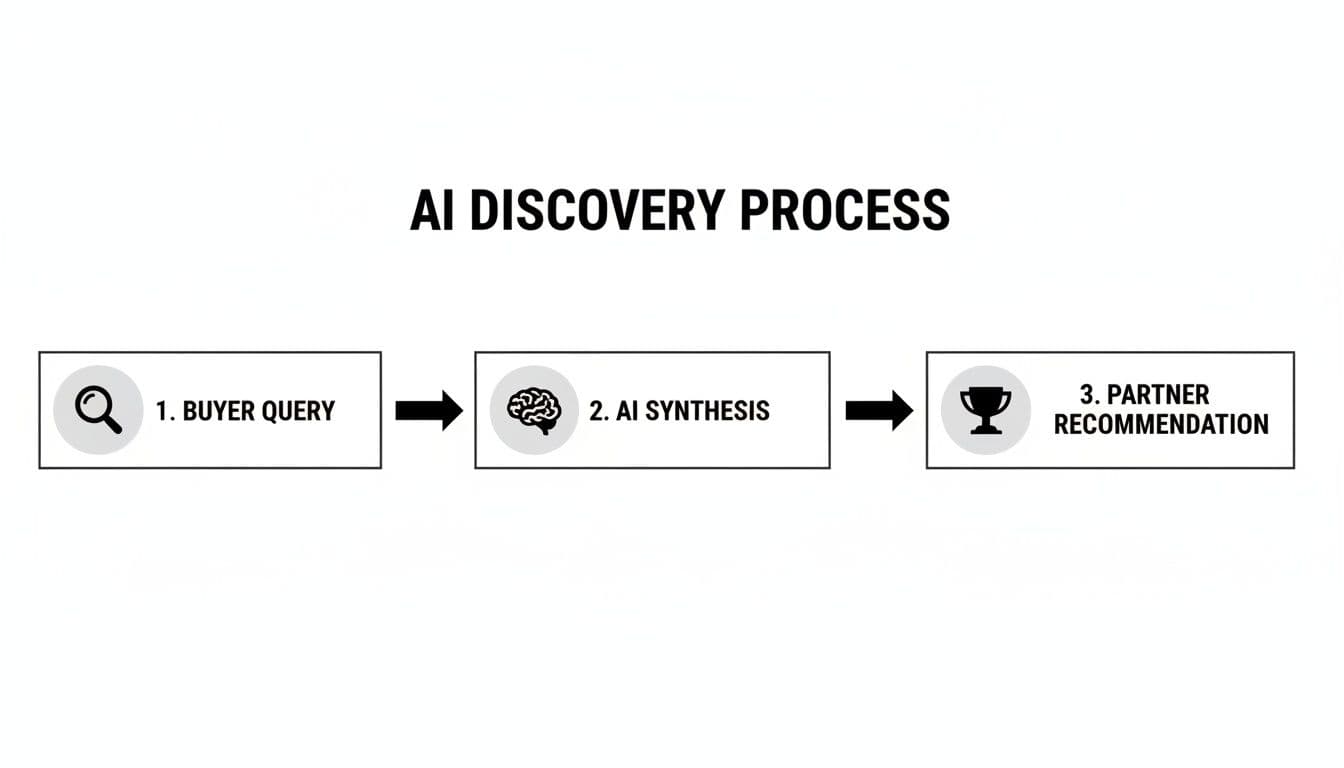
As you can see, winning here isn’t about keywords. It's about becoming a trusted, citable authority that AI models feel confident recommending.
The Clock is Ticking
This isn't some far-off trend; the change is happening at breakneck speed. The adoption of AI in business decision-making has exploded. A staggering 93% of organizations are now either actively deploying or experimenting with generative AI.
This trend is especially pronounced in our industry. Logistics firms are increasingly turning to AI to gain end-to-end supply chain visibility. If your potential customers are using AI, you need to be visible within that ecosystem.
This playbook is designed to give you a clear, step-by-step path to claim your spot. The objective is to stop chasing clicks and start earning recommendations.
In 2026, success isn't about ranking—it's about being the definitive answer. Your expertise, services, and brand narrative must be so deeply embedded online that you become the go-to solution when a potential client asks for help.
Traditional SEO vs AI Visibility Optimization
Optimizing for AI requires a fundamental shift in thinking. While the foundations of good content and technical health remain, the strategy and focus have evolved significantly. The old rules of keyword density and backlink volume are giving way to a more nuanced approach centered on authority, clarity, and structured data.
Here's a look at how the game has changed:
This table underscores a critical point: AI visibility isn't just "SEO 2.0." It's a different discipline that requires a dedicated strategy to ensure your logistics company is not just seen, but recommended.
Core Pillars of AI Visibility for Logistics
To get this right, you need a strategy grounded in a few core principles. These are the non-negotiables for earning a top spot in AI-driven answers.
- Content Authority: Go beyond simple service pages. Develop comprehensive, factual content that details your specializations, whether it's drayage services, LTL freight, or reverse logistics.
- Structured Data: You need to spoon-feed AI the right information. Implementing technical elements like schema markup gives search engines explicit context about your service areas, capabilities, and locations.
- Brand Reputation: AI models use brand credibility as a key signal. This means ensuring you have positive, authoritative mentions and citations across reputable industry sites, directories, and publications.
By building your strategy around these pillars, you can position your firm to win in this new era of search. For a broader look at how these concepts are reshaping the entire sector, explore our detailed analysis of transportation industry solutions.
Now, let's get into the practical steps for putting this into action.
Figuring Out Where You Stand With AI
Before you can get AI to recommend your logistics company, you first need a brutally honest look at what it thinks of you right now. Think of this as a reconnaissance mission. You're trying to figure out if AI models see you as a top player, a niche specialist, or worse, if you're completely invisible.
The idea is to stop guessing and start gathering real data. You have to put yourself in the shoes of a potential B2B client and ask the kinds of questions they would when they're looking for a new logistics partner.
How to Ask the Right Questions
Open up the big AI tools—ChatGPT, Google Gemini, and Perplexity. Your goal here is to be specific, mirroring the real-world problems your customers face. Vague questions get you vague, useless answers. You need to prompt them like a supply chain manager with an urgent problem to solve.
Here are a few prompt ideas to get you started:
- For specific services: "List the top 3PL companies in North America that specialize in temperature-controlled warehousing for pharmaceuticals."
- For locations: "Who are the leading drayage service providers operating out of the Port of Los Angeles?"
- To see how you stack up: "Compare [Your Company] and [Competitor A] for LTL freight services."
- For problem-solving: "What are the best logistics solutions for managing reverse logistics for a mid-sized e-commerce retailer?"
Copy and paste every single response, exactly as it appears, into a spreadsheet. Don't edit anything. This raw output is your starting point—your baseline.
Making Sense of the AI's Answers
Now that you have the raw data, it's time to dig in and see what it tells you about your company. This is more than just a simple check to see if your name shows up; you need to understand the context of every mention.
Structure your analysis around these key questions:
- Did we even show up? Is your company mentioned at all? And if so, for which specific services or locations?
- How were we ranked? When you are mentioned, are you the top recommendation, just another option in a long list, or an afterthought?
- Is the information right? AI can "hallucinate" and get things wrong. Check if it's accurately describing your services, history, and capabilities.
- What's the tone? Does the description sound positive and authoritative, or is it just neutral? Worse, does it pull in negative details from somewhere online?
- Where is it getting this info? Look at the sources the AI cites. This is gold, because it tells you exactly which websites and content are shaping its understanding of your brand.
You absolutely cannot do this in a vacuum. The real insights come from benchmarking. Run the exact same queries for your top two or three competitors. This shows you your "share of voice" in the AI world and reveals who's eating your lunch.
Often, this comparison is where you'll find your biggest opportunities. If a competitor consistently gets recommended for a service that you're a leader in, that’s a massive red flag. It tells you there's a serious content and authority gap you need to start closing, fast. For a deeper dive into the technical side of evaluating your online footprint, our comprehensive site audit checklist offers a great, structured framework.
Pinpointing Your Gaps and Opportunities
The last piece of the audit is turning all this analysis into a concrete action plan. You need to translate what you've found into a clear list of gaps that need to be filled.
Start categorizing the weaknesses you've uncovered in your spreadsheet:
- Service Gaps: The AI isn't connecting your brand with a core service. For example, you're a powerhouse in intermodal transport, but the AI only talks about your warehousing.
- Geographic Gaps: You're not getting mentioned for key cities or regions where you have a major operational presence.
- Expertise Gaps: The AI has no idea you specialize in complex logistics for industries like automotive or hazardous materials.
- Reputation Gaps: It's surfacing old, negative information, or there’s simply a lack of strong, positive third-party mentions to draw from.
This documented baseline is the foundation for everything that comes next. It’s the data-driven "before" snapshot you'll use to measure whether your efforts are actually working, ensuring you’re putting your time and money where it will count the most.
Optimizing Your Digital Assets for AI Crawlers
Now that you have your audit findings, it's time to get your hands dirty. We're moving from analysis to action, re-engineering your digital presence so AI doesn’t just see you—it understands and trusts you.
The goal here is to get way beyond simple keywords. We need to build deep, structural clarity that Large Language Models (LLMs) can process without any guesswork. Think of your website as a direct data feed for an AI. If that data is messy or unstructured, the AI will struggle. But if it’s clean, specific, and logically organized, you become a trusted, authoritative source. This is the heart of improving your AI search engine optimization.
From Vague Services to Definitive Resources
I see this all the time: a generic "Services" page that lists everything a logistics company does with a few bullet points. For an AI, that’s a dead end. Every single one of your core services—whether it’s drayage, LTL freight, or specialized warehousing—deserves its own detailed, in-depth resource page.
For example, a typical site might just have a heading for "Cold Chain Logistics." A truly optimized page, however, becomes a comprehensive hub on that topic. It needs to answer the nuanced questions a potential client is actually asking an AI, like:
- What are your specific temperature monitoring protocols for biopharmaceutical shipments?
- How do you ensure compliance with FDA regulations during transit?
- What is your documented process for handling temperature excursions?
When you build out content that directly and factually answers these kinds of questions, you're not just listing a service; you're demonstrating true expertise. You’re essentially pre-packaging the answers for the AI, making it incredibly easy for it to cite your information when formulating a response.
The Power of Structured Data and Schema
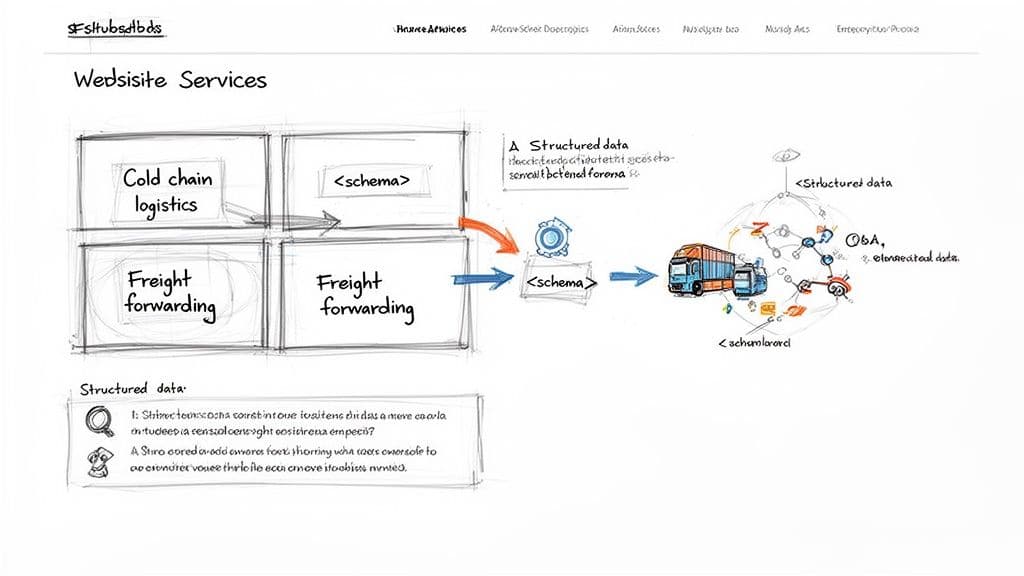
Beyond the actual words on the page, you need to give AI crawlers explicit context using structured data, often called schema markup. This is basically a specific vocabulary you add to your website’s code to tell search engines exactly what your content is about. It's like adding precise labels to your data so the AI doesn't have to guess.
For a logistics company, this is a game-changer. You can use specific schema types to define what you do with absolute precision.
- Service Schema: Clearly define each service, like
FreightForwardingorWarehousing, and include critical details like the geographic area you serve (areaServed) and a full description. - Organization Schema: This reinforces your brand identity, locking in your official name, logo, and contact info so AI models correctly attribute all this great information back to your company.
- FAQ Schema: When you mark up the Q&A sections on your pages, you're directly feeding AI models the exact question-and-answer pairs they're looking for to generate their own responses.
Implementing schema markup turns ambiguous text into structured, machine-readable information. It’s one of the most direct ways to improve how AI interprets your company’s capabilities.
By providing clear, structured data, you remove all ambiguity. You’re not just hoping the AI understands you’re a logistics provider in Houston; you’re explicitly telling it, leaving no room for misinterpretation.
Building Unquestionable Topical Authority
Your ultimate goal is to become the definitive, go-to source on the logistics topics you specialize in. If you handle hazmat transportation, your website should be a complete library of information on regulations, best practices, and industry challenges.
This proactive approach is quickly becoming non-negotiable. By 2026, AI-powered visibility will be a core part of the customer experience for logistics leaders. In fact, 93% of firms are deploying generative AI to meet the soaring demand for transparency, as customers now expect real-time ETAs and instant exception alerts. For marketing leaders in B2B logistics, showing up in AI-generated answers is paramount. As noted in a recent Interlake Mecalux analysis of logistics trends, this isn't a distant future—it's happening now.
Building this kind of authority doesn't happen overnight. It takes a sustained commitment to creating content that is not only well-written but also factually flawless, well-structured, and directly speaks to the real-world problems your clients face. When an AI crawler consistently finds that your domain provides the most accurate and comprehensive answers on a specific logistics topic, it will begin to trust and prioritize your content. That's how you earn your place as a recommended provider.
Building a Proactive Monitoring and Tracking System
Getting your digital house in order is a great start, but strong ai visibility for logistics companies isn't a "set it and forget it" project. Think of it this way: the AI models powering generative search are constantly learning. What makes you the top recommended provider today might not work tomorrow, which makes ongoing monitoring non-negotiable.
If you take a passive approach, you're going to get left behind. A competitor could drop a new whitepaper that suddenly makes them the AI's favorite source, or a model update could reinterpret your service pages in a completely new—and unfavorable—way. Without a system to track these shifts, you’re just flying blind, reacting to problems long after the damage is done instead of proactively managing your brand’s story.
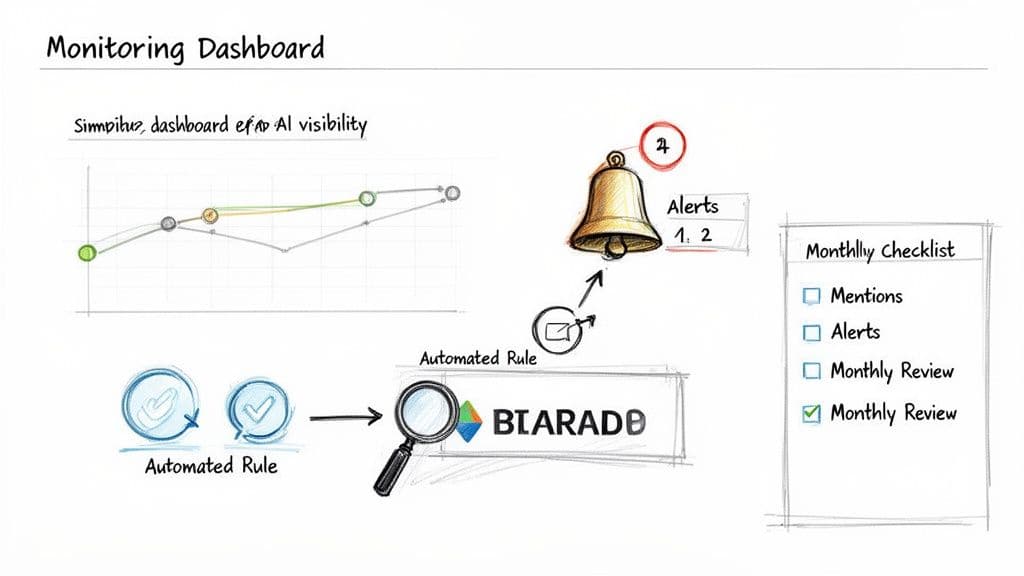
This is where a dedicated, proactive monitoring system becomes your best friend. It’s the early-warning system you need to catch both opportunities and threats before they can have a real impact on your bottom line.
Establishing Your Monitoring Rhythm
A consistent review process is key to making sure nothing slips through the cracks. While you don't need to check things daily, I've found that a monthly AI visibility audit is a solid baseline for most logistics companies. This regular check-in is your chance to spot emerging trends, measure how far you've come since your initial audit, and stay nimble.
The process is straightforward: you're essentially re-running the same types of queries you used in your initial assessment, zeroing in on your core services and keeping a close eye on your competition. The whole point is to track how AI models see and talk about your brand over time.
A monthly review transforms AI visibility from a one-off task into a continuous business process. It’s about building a sustainable feedback loop that keeps your strategy sharp and your brand protected.
For this to work, your monthly review has to be structured and methodical. A simple checklist can keep your team focused on what really matters and prevent important details from being overlooked.
The Monthly AI Visibility Checklist
Here’s a sample checklist I've used with teams to guide their monthly review. This framework helps you get a clear picture of where your brand stands and what you need to do next.
- Brand Mention Frequency: How often did your company get mentioned for core service queries this month versus last? Get a raw count.
- Context and Sentiment: When your brand pops up, is the context positive and, most importantly, accurate? Make a note of any new inaccuracies or misleading statements.
- Competitor Share of Voice: Re-run the queries for your top three competitors. Are they gaining or losing ground? Note who AI engines are recommending most often for the services you want to own.
- Source Analysis: Dig into the sources cited in AI responses that mention you or your competitors. Are there new, high-authority publications you should be targeting for mentions or partnerships?
- Misinformation Check: You have to actively look for trouble here. Run queries for things like "[Your Company] service limitations" or "Problems with [Your Company] logistics" to see what comes up.
This kind of structured approach gives you real, quantifiable data, elevating your analysis from gut feelings to strategic insights.
Setting Up Automated Alerts and Responses
Beyond the manual monthly check-in, automation is your most powerful ally. Setting up alerts for new brand mentions or specific keyword combinations lets you react almost immediately. This is especially critical for fighting misinformation. If an AI "hallucinates" and states an incorrect detail about your service area or compliance record, you need to know about it right away.
It's also worth noting that predictive AI visibility is having a massive impact on the industry's bottom line. Analysis shows that AI-driven supply chain solutions can lead to 15-20% reductions in overall logistics expenses. For B2B logistics firms, this makes visibility in AI search absolutely essential. Brand managers using platforms like Attensira can track their mentions on AI engines, spot gaps, and then create precisely targeted content to attract partners who are actively searching for these cost-saving solutions. You can see more on how AI trends are reshaping supply chains in recent industry reports.
By combining a regular review rhythm with automated tools, you build a robust system for protecting and growing your brand’s AI footprint. We cover this in more detail in our guide to AI search monitoring. This kind of active management is the only way to ensure the visibility you worked so hard to achieve isn't erased by the next algorithm update or a competitor's smart move.
Measuring the ROI of Your AI Visibility Efforts
So, how do you actually prove that all this work to improve your AI visibility for logistics companies is making a difference to the bottom line? It's time to move past fuzzy metrics like "brand mentions" and start connecting your efforts to tangible business outcomes. The real win isn't just getting an AI to notice you; it's about drawing a straight line from that visibility to real revenue, better leads, and lower customer acquisition costs.
The framework for this is actually quite simple. It all boils down to tracking the right key performance indicators (KPIs) that bridge the gap between an AI-driven search and your sales pipeline. This approach shifts the internal conversation from, "Hey, we got mentioned!" to "We generated 15 new qualified leads this quarter from prospects who found us through AI recommendations."
Key Performance Indicators That Actually Matter
To get a true read on your return on investment, you have to look beyond simple visibility and focus on metrics that signal real business impact. These are the KPIs that help you tell a compelling story about how your strategy is paying off.
You'll want to keep a close eye on a few specific things:
- Increase in AI-Sourced Leads: This is your most direct connection to revenue. It’s as simple as adding a field to your inquiry forms or training your sales team to ask, "How did you hear about us?" and including "AI search/recommendation" as an option.
- Higher Lead Qualification Rate: In my experience, leads coming from AI recommendations tend to be better informed and further along in their buying journey. If the qualification rate for these leads starts to climb, you know you're attracting the right kind of attention.
- Share of Voice in AI Responses: This one is crucial. Regularly track how often your company is recommended for your core services compared to your top three competitors. A growing share of voice is a powerful leading indicator of future lead flow.
- Reduction in Customer Acquisition Cost (CAC): As you start earning more organic recommendations from AI models, your dependency on paid advertising for those same keywords and services should naturally decrease. This leads directly to a more efficient marketing spend.
The goal here is to connect a specific action—like optimizing your LTL service page for AI—to a specific outcome, like a signed contract from a new LTL client. Without that clear connection, you're just measuring activity, not achievement.
Tracking these KPIs systematically is how you build a data-backed case for your AI visibility strategy. For anyone looking to formalize this process, the principles behind measuring ROI on your Sitecore investment offer a great parallel for tracking the impact of any major digital initiative.
How This Looks in the Real World
Let's walk through a quick scenario. Imagine "Global Transit Solutions," a mid-sized freight forwarder. Before they focused on AI visibility, they were nowhere to be found in AI-generated answers for queries like "best freight forwarders for automotive parts in the Southeast."
They launched a six-month campaign, focusing heavily on building out authoritative content and structured data around their automotive logistics expertise. Here’s how their progress looked:
- Months 1-3: Radio silence. They had 0% share of voice in AI responses.
- Month 4: They started popping up as the third or fourth recommendation. More importantly, they logged two qualified leads who specifically said they found them through an AI search.
- Month 6: Things really took off. Global Transit Solutions became the top-recommended provider in 40% of their test queries. This resulted in a 35% increase in high-value contract bids from the automotive sector, all directly attributable to their improved visibility.
By linking their targeted content efforts to hard sales data, they could clearly demonstrate the financial impact of their work. The conversation inside the company shifted from seeing this as a marketing expense to a strategic investment in customer acquisition. You can dig deeper into tying marketing activities to financial results in our guide on how to measure marketing ROI.
A Simple Framework to Get You Started
You don't need a massive analytics platform to begin. Honestly, a well-organized spreadsheet is often enough to track progress and show value to your leadership team.
Here’s a simple table to structure your thinking around the most critical metrics.
AI Visibility KPI and Measurement Framework
This kind of structured approach transforms AI visibility from an abstract concept into a measurable driver of business growth. It proves its worth in the only language that every executive understands: numbers.
Answering Your AI Visibility Questions
Whenever I talk to logistics leaders about improving their visibility in AI search, the same practical questions always pop up. How much will this cost? How long until we see a real impact? And who on my team is supposed to manage all this?
These are exactly the right questions to be asking. Before you can get the green light and the resources you need, you have to have clear, straightforward answers. Let’s tackle the big ones head-on.
What Resources Do We Actually Need for This?
The good news is you probably don't need a massive new budget or a dedicated AI department. The real investment here is less about expensive software and more about focusing the time and talent you already have.
What you really need is a small, focused team.
- A Content Strategist or SEO Lead: This is your quarterback. Someone needs to own the process—running the audits, pinpointing content gaps, and steering the optimization efforts. This is usually an existing role, just with a new, critical focus.
- Your Subject Matter Experts (SMEs): Don't overlook the goldmine of expertise you have in-house. Your operations managers, compliance officers, and trade lane specialists hold the keys. Their deep, real-world knowledge is the raw material for creating the kind of authoritative content AI models are trained to trust.
- Some Web Development Support: You’ll need a bit of technical help to get schema markup implemented and make a few structural tweaks to your site. This is typically a small, project-based ask for your current developer or agency partner.
You’re not hiring an army of data scientists. You’re simply redirecting your existing expertise to create clear, factual, and well-organized content that answers the questions your customers are asking.
How Long Until We See Tangible Results?
Let's be clear: this isn't an overnight fix. Think of it as a long-term strategic investment, not a short-term marketing campaign. From what I’ve seen working with B2B companies, a realistic timeline requires patience and consistency.
- Months 1-3: This is all about laying the groundwork. You're conducting your first audit, benchmarking where you stand against competitors, and building out a content roadmap. Honestly, you won't see much movement in AI-generated answers during this phase.
- Months 4-6: As your new, optimized content goes live and gets indexed, you should start to see the first signs of life. Your company might begin showing up as a secondary or tertiary source for very specific, long-tail queries.
- Months 7-12: If you've been consistent, this is where the real momentum builds. The goal is to become a primary recommendation for your key service areas. When that happens, you should see a measurable lift in qualified leads coming from AI-driven search.
It's all about setting the right expectations from the start. Frame this as a strategic build-out, like launching a new service line, not a two-week ad campaign. The objective is to create a lasting competitive edge.
Can We Just Use AI to Create All Our Content?
It's tempting to think you can use generative AI to crank out articles and save time, but that's a risky shortcut. AI models are fantastic at summarizing what’s already on the internet. What they can’t do is create the unique, experience-based insights that will actually make your logistics company stand out.
AI-generated content almost always lacks the specific operational details, real-world examples, and nuanced perspective that signals true authority. Use AI as a tool to help your human experts, not replace them. It's great for brainstorming outlines, polishing copy, or structuring an article, but the core knowledge has to come from your team.
Look at how a platform like AiOn is being used in logistics. It’s applying AI agents to automate 80% of administrative and operational decision-making, proving that AI's best role is supporting—not supplanting—human expertise.
What’s the Single Biggest Mistake to Avoid?
Inconsistency. Without a doubt, this is where most companies fail. They start with a ton of energy, get excited by what they find in the initial audit, and then let the project die on the vine when they don't see massive results in the first few months.
Winning in AI visibility is a marathon, not a sprint. AI models are constantly being updated, and your competitors aren't standing still. The only way to succeed is with a sustained commitment to monitoring your position, refreshing your content, and keeping a close eye on the competitive landscape. A "one-and-done" project will have you right back where you started in less than a year.
Ready to stop guessing and start measuring your company's AI visibility? Attensira provides the tools you need to track your brand mentions across major AI platforms, identify critical content gaps, and get actionable insights to improve your standing. Take control of how AI sees your brand.
Learn more and get started at https://attensira.com.