
Is your practice invisible on AI search? Learn how to improve AI visibility for chiropractors and attract new patients from platforms like ChatGPT and Gemini.
When we talk about AI visibility for chiropractors, we’re moving beyond traditional SEO. It’s about strategically positioning your practice so that AI assistants—like ChatGPT, Gemini, and Copilot—don't just find you, but directly recommend you to people asking for help. This isn't just a new marketing tactic; it's become the cornerstone of patient acquisition in 2026.
The New Reality of Patient Acquisition
For years, the game was simple: get your clinic to the top of Google’s search results. That playbook is now incomplete. Today, potential patients are skipping the list of blue links altogether and having conversations directly with AI.
They’re asking highly specific, intent-driven questions like, “Find a chiropractor near me who specializes in sciatica,” or, "Who is the best sports injury chiropractor in Austin?"
The AI doesn't return a list of ten options. It delivers a single, synthesized answer, often naming just one or two clinics it deems the most credible. If your practice isn’t the one being cited in that answer, you're essentially invisible to a huge and growing group of prospective patients. This isn't some far-off trend; it’s the new front line for attracting patients right now.
The Scale of the AI Search Shift
The numbers behind this shift are staggering. By 2026, AI-driven search platforms are now responsible for a massive 45 billion monthly sessions around the globe. That's about 56% of all search volume.
With a single platform, ChatGPT, owning 89% of that AI session traffic, it’s a channel you simply can't afford to ignore. Even more compelling is the conversion rate: AI search traffic converts at an incredible 14.2%, dwarfing Google’s typical 2.8%. You can explore more data on this trend over at Search Engine Land.
It all boils down to this: Being the source of the AI's answer is the new #1 ranking. Your old SEO strategy is no longer enough.
To understand how patients now discover chiropractors, it's helpful to compare the old way with the new.
AI Search vs Traditional Search for Finding a Chiropractor
This new model means the AI isn't just performing a simple search; it's acting as a trusted advisor, and it needs to be convinced of your authority before it will recommend you.
How an AI Recommends a Chiropractor
So, how does an AI decide your practice is the one to recommend? It doesn't just "Google" the answer. Instead, it synthesizes information from a wide range of signals to build a confident recommendation.
It looks for a convergence of three key things:
- Verified Business Data: It starts with the basics. The AI pulls your clinic's name, address, phone number, and hours from trusted sources like your Google Business Profile and other major local citations. Inconsistencies here create doubt.
- Demonstrated Expertise: The AI then scans your website content, blog articles, and service pages. It’s looking for proof that you are a genuine authority on specific conditions, not just a generalist. Do you have detailed content on treating migraines, whiplash, or pediatric care?
- Patient Trust Signals: Finally, it analyzes patient reviews, ratings, and testimonials from across the web. This is how it gauges your credibility and patient satisfaction. A strong, positive reputation is non-negotiable.
This is where tracking your performance becomes critical. You can't fix what you can't see.
A dashboard like the one above, from a platform such as Attensira, shows you exactly how your clinic is appearing (or not appearing) in AI-generated answers. It helps you pinpoint why you are being recommended for certain queries and where a competitor might be outmaneuvering you.
This kind of intelligence is what turns guesswork into a clear, actionable strategy. It's also why working with a specialized AI visibility agency for clinics can provide such a decisive advantage.
Strengthening Your Practice's Digital Identity
Before an AI like Google's Gemini or ChatGPT can recommend your clinic, it first has to trust you. These systems rely on clear, consistent, and verifiable data to determine which businesses are legitimate and relevant. If your practice's core information is a jumble of contradictions across the web, AI will simply pass you over for a competitor with a cleaner digital footprint.
Think of it like building a reputation. Every piece of information—your clinic's address, your specialized services, your hours—is a data point. Your goal is to make these points so consistent and authoritative that an AI can confidently present your clinic as the best answer for a patient in need.
This entire process hinges on the most critical asset for local discovery: your Google Business Profile.
Fortify Your Google Business Profile
Your GBP isn't just a pin on a map. It’s a primary data source for Google's AI and many other platforms. From my experience, a half-finished profile is one of the biggest missed opportunities for local practices. To really get this right, you need to optimize your Google Business Profile for modern search.
To turn your GBP into an AI-friendly powerhouse, get granular with the details:
- Fill Out Everything: It sounds basic, but it’s amazing how many practices skip this. Go beyond the name and address. Add detailed descriptions for every service you offer, list all accepted insurance providers, and specify your accessibility features (like wheelchair access or parking).
- Use Google Posts Actively: Don't let this feature sit idle. Regularly post updates about your clinic, share educational tips about conditions you treat, or even highlight patient success stories (with their permission, of course). This shows AI that your practice is active and engaged with its community.
- Build Out the Q&A Section: Don't wait for patients to ask questions. Proactively load your GBP's Q&A with common queries you hear every day—"Do you treat sciatica?" or "What should I expect on my first visit?"—and provide your own expert, detailed answers. You're essentially spoon-feeding AI the exact conversational content it needs.
This flowchart maps out how a potential patient's search flows through an AI before they ever reach a chiropractor's office.
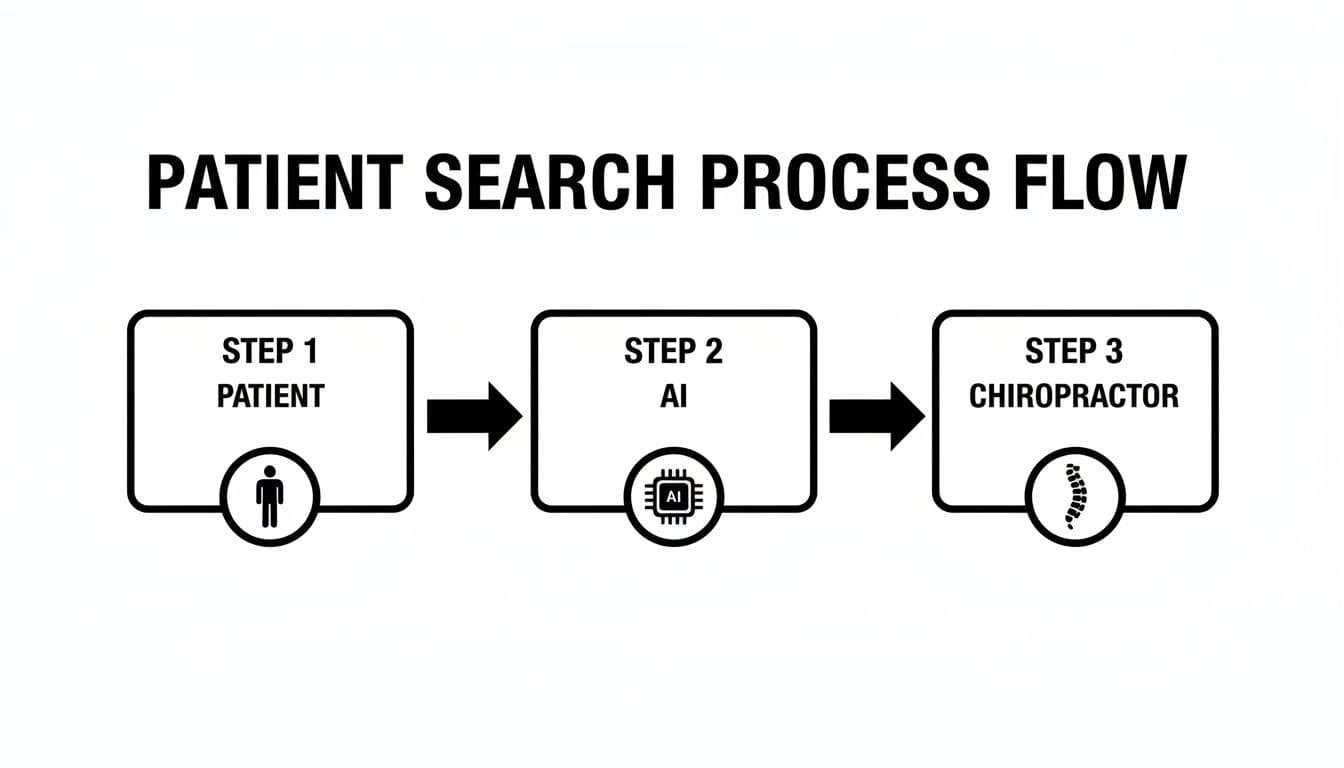
As you can see, the AI is now a gatekeeper. A strong, clear digital identity is what gets you through the gate.
Unify Your Local Citations
Beyond your GBP, AI models are constantly cross-referencing your clinic's information across dozens of other online directories, from Yelp and Healthgrades to smaller local business listings. Any inconsistency here undermines your credibility. A local citation is simply any online mention of your practice's Name, Address, and Phone number (NAP).
Here's a key insight for chiropractors: AI algorithms view NAP consistency as a powerful signal of legitimacy. A practice with conflicting phone numbers or addresses across different sites looks unreliable and is far less likely to earn a recommendation.
Ensuring your NAP is 100% identical everywhere is a non-negotiable first step. Even tiny variations, like listing "St." on one site and "Street" on another, can dilute your authority in the eyes of an algorithm. We cover the nuts and bolts of this in our guide to business listing management. This isn't just a technical chore; it's about building a unified, authoritative digital identity that AI can recognize and, most importantly, trust.
Using Structured Data to Speak AI's Language
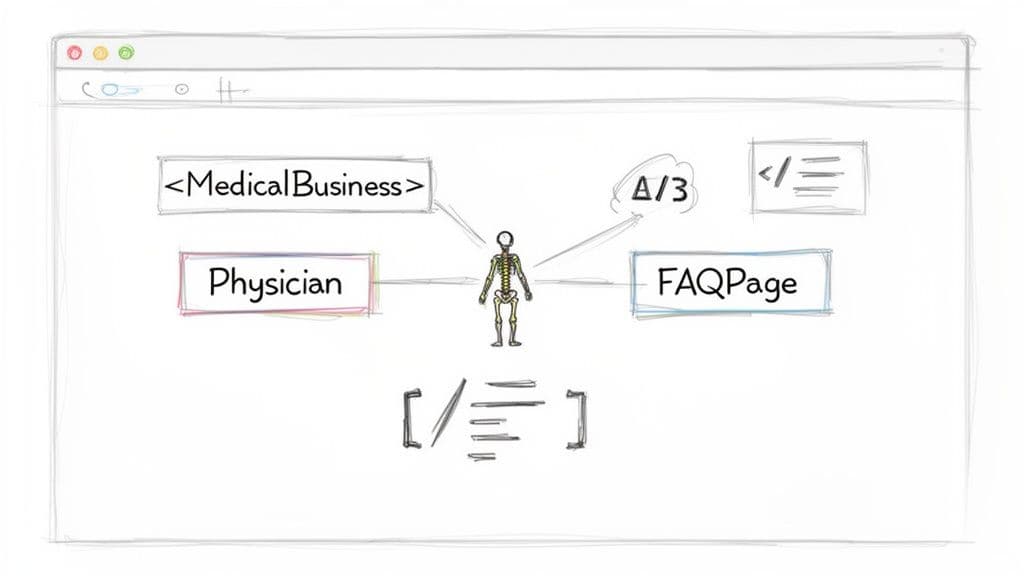
Think of structured data as the cheat sheet you provide directly to AI. It’s a special vocabulary, also known as schema markup, that you add to your website's code to tell AI models and search engines exactly what your content is about, leaving nothing to interpretation.
Without it, you’re forcing an AI to make educated guesses about your practice. With schema, you’re spoon-feeding it the precise details: who you are, what conditions you treat, and the credentials of your chiropractors. It transforms your website from a simple brochure into an organized, queryable database that an AI can trust and cite with confidence. This is no longer optional; it's a fundamental part of being visible.
Focusing on the Schema That Matters
You don't need to implement dozens of schema types to get results. For a chiropractor, the key is to be strategic and focus on the few that deliver the most clarity about your medical services and expertise.
From my experience, these are the non-negotiables:
- MedicalBusiness: This is the cornerstone. It explicitly flags your clinic as a healthcare provider and allows you to specify critical details like your official name, address, phone number, and even which insurance plans you accept.
- Physician: You should create a separate
Physicianschema for each doctor on your team. This is where you establish individual authority by detailing their specialty (Chiropractic), educational background, and professional credentials. - FAQPage: This markup is pure gold for generative AI. When you structure your most common patient questions and answers with this schema, you're essentially handing AI pre-written, expert-vetted content to use in its responses.
- Article: When publishing educational content or blog posts, this schema signals that you are the author of expert material. It’s a direct way to reinforce your E-E-A-T (Experience, Expertise, Authoritativeness, and Trustworthiness).
Correctly implementing these schema types is how you dramatically improve your ai visibility for chiropractors.
How Schema Translates to Real-World Answers
Let's walk through a common scenario. A potential patient nearby asks a chat assistant, "Does my insurance cover chiropractic adjustments for migraines?"
An AI scanning the web for an answer will find your site. It instantly recognizes the MedicalBusiness schema and sees the insurance carriers you've listed. At the same time, it spots your FAQPage schema where you’ve specifically answered a question about treating migraines.
By connecting these structured data points, the AI can confidently construct a detailed, helpful answer. It might say something like, "Yes, some insurance plans cover chiropractic care for migraines. For instance, [Your Clinic Name], a local chiropractor, accepts [Insurance Plan] and notes on their website that they treat tension headaches and migraines."
This is the real power of schema. It moves you beyond just being found online—it positions you as the authoritative source for the answer itself.
This is the technical bridge that separates clinics that are merely online from those that are fully integrated into the new world of AI-driven search. If this is new territory for you, getting a handle on the basics is a great first step. You can explore the fundamentals in our guide to schema markup in our detailed glossary article. The effort you invest in structuring your data now will put you miles ahead as more patients turn to AI for their health questions.
Creating Content That Becomes the Answer

For years, the goal of your website content was simple: get the click. But that game has changed, and the shift is fundamental. Today, your content's primary job is to be so clear and authoritative that it becomes the direct answer an AI gives to a potential patient.
Forget the old playbook of writing a generic "5 Tips for Back Pain" blog post. AI models like Google's SGE and ChatGPT are actively scanning the web for depth, expertise, and clarity to answer very specific questions. They're not looking for clickbait; they're looking for the definitive source.
If your website traffic feels a bit flat lately, this is likely why. A study from Exposure Ninja found that roughly 60% of all searches now result in zero clicks because AI is answering the question right on the results page. This trend is only picking up steam, with AI-related search traffic projected to jump by a staggering 527% between early 2024 and 2025.
Your content must evolve from a simple billboard into the actual consultation.
Reverse Engineer Patient Questions
To become the source for AI-generated answers, you have to get inside your patients' heads. Stop thinking in terms of sterile keywords and start focusing on the conversational, intent-driven questions people are actually asking their phones and smart speakers.
A patient in pain isn't searching for "cervicogenic headache treatment." They're asking, "Can a chiropractor fix the shooting pain that starts in my neck and goes behind my eye?" That's your content opportunity right there.
So, where do you find these golden-ticket questions?
- Your Consultation Room: The questions you hear every single day are your best starting point. If one patient is asking it, hundreds more are searching for it online.
- Google Business Profile Q&A: This is a public-facing goldmine. What questions have people already asked on your profile? Answer them in detail on your website.
- Free Online Tools: A tool like AnswerThePublic is fantastic for visualizing the universe of questions surrounding a topic like "sciatica" or "sports injury."
This mindset shift—from keywords to questions—is the cornerstone of what we now call answer engine optimization.
Build Dedicated Answer Pages
Once you've identified a valuable, high-intent question, don't just sprinkle the answer into a long, rambling blog post. Give it the respect it deserves with a dedicated page or, at the very least, a robust, clearly-marked section on a relevant page.
Think about it this way: instead of a generic "Services" page, you could create a highly-focused page titled "Chiropractic Care for Chronic Migraines & Tension Headaches." A page this specific makes it incredibly easy for an AI to see you as the subject matter expert.
On these pages, structure is everything. You need to make the content scannable for both a busy human and a parsing algorithm. Use clear headings, short paragraphs, and bullet points to break down complex topics. The goal is to make your information so well-organized that an AI can confidently grab it and present it as fact.
Make Your Content AI-Digestible
How you format your content is just as important as what it says. AI algorithms aren't just reading; they're analyzing structure to understand hierarchy and context. They reward clarity.
Here are a few formatting rules I always follow:
- Answer First, Explain Later: State the answer to the main question directly in your opening paragraph. Get straight to the point.
- Use Smart, Descriptive Headings: Your subheadings (H2s, H3s) should function like a mini-FAQ. Instead of "Our Process," use "What to Expect During Your First Headache-Focused Adjustment."
- Lean on Lists: Bullet points and numbered lists are your best friends. They are perfect for explaining symptoms, benefits, or step-by-step processes in a format that AI can easily understand and repurpose.
Adopting this methodical approach is how you improve your AI visibility for chiropractors. It’s the key to turning your hard-earned expertise into the definitive answers that new patients are looking for.
How to Measure Your AI Visibility
You’ve put in the work to optimize your practice for AI search. But how do you know if any of it is actually paying off? Without a clear way to measure your AI visibility for chiropractors, you're essentially flying blind. You need hard data to see what’s working, what isn't, and where to double down.
Tracking this new kind of visibility isn't as simple as checking your old Google Analytics reports. Manually typing a few queries into an AI chat is unreliable and a massive time sink. AI responses change constantly based on the user, the exact phrasing, and daily platform updates. This is where dedicated AI monitoring tools become essential.
Moving Beyond Guesswork
Platforms like Attensira were built specifically to give you the intelligence needed for this new search environment. They go far beyond just tracking ranks to paint a full picture of your practice's presence inside AI-generated answers.
This kind of platform systematically asks major AI models—think ChatGPT, Gemini, and Copilot—thousands of questions to see when, how, and why your clinic gets mentioned. The goal is to get concrete answers to the questions that really matter for your business.
- Are we even in the conversation? Pinpoint which specific patient questions and topics trigger a recommendation for your clinic.
- Who is getting the referrals we should be getting? See exactly which competitors are being mentioned for high-value services you also provide.
- Where are the wide-open opportunities? Uncover the valuable queries where no local chiropractor is mentioned, leaving the door open for you to dominate.
This data-first approach pulls you out of the guessing game and allows you to make strategic decisions based on what’s actually happening.
From Analysis to Actionable Insights
Let's walk through a real-world scenario. While reviewing an AI visibility report, you discover that a competitor is consistently recommended when a potential patient asks, "Find a chiropractor for prenatal care in my city." Your clinic, even though you have practitioners with deep experience in this area, is nowhere to be found.
That single data point is incredibly powerful. It tells you there's a major disconnect between the services you offer and how AI perceives your expertise.
This isn't just a missed opportunity; it's a critical intelligence gap that a monitoring platform exposes. You now have a specific, data-backed mandate: create or optimize content that establishes your authority in prenatal chiropractic care.
This is the feedback loop you want to create: analyze your AI visibility, identify a specific weakness or opportunity, take targeted action, and then measure the impact of that action. To get ahead of the curve and understand future patient behavior, using digital marketing predictive analytics can give your measurement strategy a significant edge.
By closing this loop from analysis to action, you can methodically improve your presence in the AI-powered conversations that lead to new patients. For those ready to dive deeper into the nuts and bolts, you can learn more about how continuous AI search monitoring delivers the data you need to refine and perfect your strategy over time. This iterative cycle is the key to sustained growth.
Answering Your Top Questions About AI Search
As chiropractors start to wrap their heads around this new world of AI-driven search, a lot of the same questions pop up. Let's walk through the ones I hear most often so you can build a strategy that actually works.
How Is This Different from the SEO I Already Do?
This is the big one. The fundamental difference is the goal. For years, traditional SEO has been about getting your website to the top of a list of blue links, hoping a potential patient clicks through.
Think of AI visibility for chiropractors differently. The new goal is to have your practice's name, expertise, and information featured directly inside the AI-generated answer.
We're seeing a huge rise in "zero-click searches," where a user gets their answer without ever visiting a website. In this new game, being the source of the answer is the new #1 ranking. It means we have to get much more serious about things like structured data, question-based content, and making sure AI models see your practice as a trusted authority worth recommending by name.
What Is the Single Most Important First Step?
If you do only one thing, start with a top-to-bottom audit and optimization of your Google Business Profile (GBP). AI models, especially Google's, rely on your GBP as the primary source of truth for real-time, local information. It's your practice's digital ID card.
Don't just fill it out; max it out.
- Services: Don't just list "Spinal Adjustment." Detail it. Add sections for "ART," "Graston Technique," or "Pediatric Care" with clear descriptions of what they are and who they help.
- Hours: This has to be perfect. If you’re closed for a holiday or have special summer hours, update it immediately. An AI won't recommend you if it thinks you're closed.
- Q&A Section: This is gold. Proactively add common patient questions ("Do you accept Blue Cross insurance?", "What should I expect on my first visit?") and provide your own detailed, expert answers.
- Photos & Posts: An active profile signals a thriving practice. Regularly add fresh, high-quality photos of your team and clinic, and use Google Posts to announce workshops or share health tips.
Your profile is how an AI decides who you are, what you're an expert in, and whether you're a trustworthy choice for a patient searching for help right now.
A meticulously managed Google Business Profile is the most powerful signal you can send to AI about your practice's legitimacy. It’s the lowest-hanging fruit with the absolute highest impact.
Can I Handle This Myself, or Do I Need a Special Tool?
You can definitely get the ball rolling on your own. Foundational tasks like optimizing your GBP, building out question-and-answer pages on your site, and cleaning up your citations across the web are all things you or your team can tackle right now. These manual efforts build a fantastic base.
But here’s the reality check: tracking whether it's actually working across multiple AI platforms like ChatGPT, Gemini, and Copilot is nearly impossible to do by hand. The answers these models give are dynamic and often personalized, so what you see isn't what a potential patient might see.
This is where a specialized tool becomes non-negotiable for serious growth. A platform built for AI monitoring is the only way to reliably track your mentions, see where competitors are being cited, spot content gaps, and actually measure your ROI. Trying to win in AI search without this data is like adjusting a patient without an X-ray—you're working in the dark.
Ready to stop guessing and start measuring your clinic's presence in AI search? Attensira provides the critical intelligence you need to monitor your AI visibility, identify competitor strategies, and find untapped opportunities. See exactly where your practice stands and get the data-driven insights to win new patients. Discover how Attensira can illuminate your path forward.