Find your ideal ai search optimization agency chicago by learning key evaluation criteria, red flags, and how to secure real ROI.
If your customers are starting to get answers from AI instead of a list of search results, you need a new game plan. An AI search optimization agency in Chicago helps you adapt your strategy for a world with Google's AI Overviews and ChatGPT, making sure your brand shows up inside the AI-generated answer, not just on a results page. This isn't a small tweak; it's a fundamental shift in how people find information online.
The New Search Landscape: Why Chicago Businesses Need AI SEO
For years, the goal was simple: get the #1 spot on Google. That era is over. Search isn't a static list of ten blue links anymore. It's becoming a conversation, with an AI providing a single, synthesized answer to a user's question. For any B2B company in a competitive hub like Chicago, this isn't some far-off trend—it's happening right now and demands a response.
Visibility today is about becoming the trusted, authoritative source that an AI relies on and cites. Just being a clickable link is no longer enough.
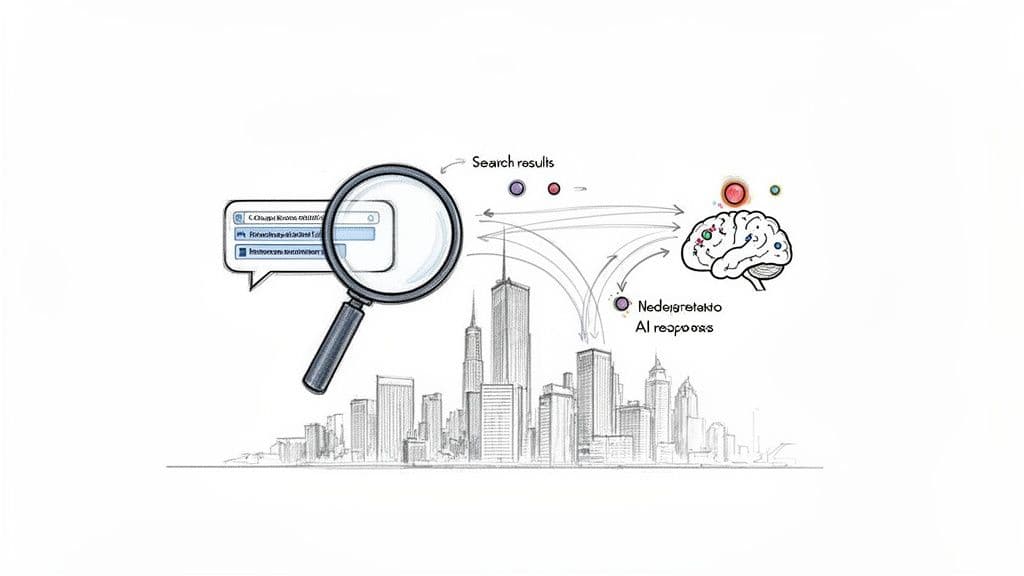
This new reality, shaped by tools like Perplexity and Google’s AI Overviews, introduces a major "zero-click" problem. Users get what they need without ever leaving the search results page. If your business isn't the one being quoted, you're essentially invisible.
The Alarming Data Behind the Search Evolution
The numbers tell a pretty clear story about how quickly things are changing. AI search traffic has skyrocketed by a staggering 527% year-over-year. This isn't just a gradual shift; it's a massive behavioral change that directly impacts your lead generation and sales funnel.
And it gets worse. When Google's AI Overviews show up for a search, the organic click-through rate for the top traditional result drops by 34.5%. You can see more of these critical AI SEO statistics on Semrush.
This trend is only going to pick up speed. Some analysts predict a 25% drop in organic traffic by 2026, but based on what we're already seeing—with CTR declines over 60% for some queries—that forecast feels optimistic.
For a Chicago-based B2B company, this means a huge chunk of your potential leads are being intercepted by AI before they ever land on your website. You either adapt your strategy to this new world, or you get left behind.
Why a Specialized Agency Is Non-Negotiable
Simply tweaking your old SEO tactics won’t cut it. Winning in this new environment requires a sophisticated understanding of how Large Language Models (LLMs) find, analyze, and present information. This is where a specialized AI search optimization agency in Chicago becomes critical.
They bring a very specific skill set to the table. An agency that truly gets it will focus on:
- Entity Optimization: They work to make sure AI models clearly understand who your company is, what you do, and why you’re an authority in your field. It’s about building a solid knowledge base about your brand.
- Structured Data Implementation: This involves using advanced schema markup to make your website’s content machine-readable. It’s like creating a cheat sheet for AI, telling it exactly what your key information means so it can be easily parsed and cited.
- Conversational Content Strategy: They help you create content that directly answers the complex, long-tail questions your customers are now asking AI assistants.
Without a dedicated partner focused on these areas, your content is just unstructured noise in an increasingly intelligent system. To get ahead, you need someone whose sole focus is making you the most credible and citable source in your industry. You can explore a deeper dive into the fundamentals of AI search engine optimization in our guide.
Finding the Right Chicago AI SEO Agency: What Really Matters
Choosing a partner to guide you through this new search frontier is a huge decision. It's not enough for a firm to simply slap "AI" onto their service list; you need an agency with deep, demonstrable technical skill. When you're vetting a potential AI search optimization agency in Chicago, you have to look past the old-school SEO metrics and zero in on the capabilities that actually drive visibility in generative AI answers.
The stakes couldn't be higher. This shift is hitting B2B companies particularly hard—a shocking 92% of brands are completely invisible in ChatGPT responses. At the same time, we've seen a 61% collapse in organic clicks for informational searches since AI Overviews rolled out. For a deeper dive, check out the 2026 generative search statistics from Fuel Online. That traffic isn't just vanishing; it's being rerouted into AI interfaces where user attention is now focused.
Core Technical Competencies
A truly capable agency won’t just talk about optimizing for Google crawlers. They’ll have a clear, repeatable methodology for making your content understandable and citable for Large Language Models (LLMs). This is a completely different ballgame. It demands a technical team that gets how to structure information for machines to consume, verify, and trust.
Their expertise should be built on three pillars:
- Advanced Structured Data: Basic schema is table stakes. Ask them about their hands-on experience with granular markup like
LegalService,Product, orPersonschema. Dig deeper and ask how they usesameAsproperties to connect your brand's digital assets to authoritative sources like industry profiles or Wikipedia. This builds a verifiable trust signal for AI. - Entity & Knowledge Graph Optimization: A top-tier agency will show you their process for establishing your brand, products, and executives as distinct, recognized entities within Google’s Knowledge Graph and other critical data ecosystems. This is how you ensure AI models can accurately understand who you are, what you offer, and why you matter.
- Content Formatting for Extraction: The agency should be able to demonstrate how they rework existing content into formats that are easy for AI to grab. Think answer-first definitions, clean comparison tables, and simple step-by-step lists. These are the building blocks of AI-generated answers.
A real AI SEO partner won't fixate on keywords. They'll talk about entities, schemas, and semantic relationships. Their entire focus is on transforming your content into the most reliable, citable, and machine-readable source in your industry.
Strategic and Analytical Prowess
Beyond the technical nuts and bolts, a great agency brings strategic vision to the table. They know this isn't a "set it and forget it" task; it's a continuous cycle of adaptation as the AI models themselves evolve. This is where their analytical skills really shine.
During your first calls, get right to the point and ask them these questions:
- How do you actually track our brand’s visibility and sentiment inside generative AI responses from platforms like ChatGPT, Perplexity, and Google’s AI Overviews?
- What’s your game plan for optimizing our content for conversational questions—the kind that don't fit neatly into traditional keyword buckets?
- Can you walk us through a case study where you provably increased a client's "Share of AI Voice" or the frequency of their citations in AI-generated answers?
Their answers will tell you everything you need to know. You'll quickly see if they're just putting a new coat of paint on old SEO tactics or if they’ve built a genuinely modern practice. While Chicago has no shortage of digital marketing firms, finding one with this specialized expertise is what will make the difference. For perspective on another major market, see our guide on choosing an AI search optimization agency in New York.
Essential Capabilities for Your AI Search Optimization Agency
Use this checklist to evaluate and compare Chicago agencies on the competencies that actually matter for AI search performance.
A thorough evaluation using these criteria will help you cut through the noise and find a partner who can deliver tangible results in this new era of search.
How to Validate an Agency's AI SEO Claims
In the new world of generative search, talk is cheap. Any agency can bolt "AI" onto their services list, but very few can actually back it up with hard data. When you're evaluating an AI search optimization agency in Chicago, your job is to cut through the fluff and demand concrete proof of what they can do.
This means looking past old-school metrics like keyword rankings and asking for evidence that shows they understand how to perform in an AI-first search environment. Don't let yourself be swayed by a case study showcasing traditional SEO wins that have been repackaged with a few AI buzzwords. A true expert will show you success using metrics that barely existed a year ago.
Scrutinizing Case Studies for Real AI Success
A forward-thinking agency should be excited to show you case studies that detail their impact on a client's visibility within AI-generated answers. When they do, you need to dig deeper than the glossy, surface-level claims.
Look for specific evidence that goes beyond a simple bump in organic traffic. A genuine AI SEO success story will include data points like these:
- Increased Brand Mentions in AI Responses: Can they show you reports detailing how often your brand is cited in answers from platforms like ChatGPT, Perplexity, or Google's AI Overviews?
- Improved "Share of AI Voice": This is a crucial metric. It measures how often your brand appears in AI answers for your industry's key topics compared to your competitors. A good agency will show you a measurable lift.
- Traffic Analysis from AI Sources: They should be able to isolate and report on referral traffic coming directly from AI platforms, proving they can drive actual users—not just bots—from these new channels.
If an agency balks at providing this kind of granular data, it’s a huge red flag. It almost certainly means they don't have the specialized tools or the right methodology to track and influence AI search performance. A solid SEO audit can set a great baseline, but AI-specific tracking is the critical next step.
Any agency can claim expertise. A true partner provides transparent, verifiable data that proves they can get your brand cited and recommended by AI. Vague promises about "future-proofing" your SEO are not enough.
The Tools and Reporting You Should Expect
The right technology stack is non-negotiable. An agency that's serious about AI search optimization will be using modern platforms built for this specific challenge. You should ask them directly: "What tools do you use to monitor brand visibility across different AI models?"
This flowchart breaks down a simple decision-making framework for vetting an agency’s claims.
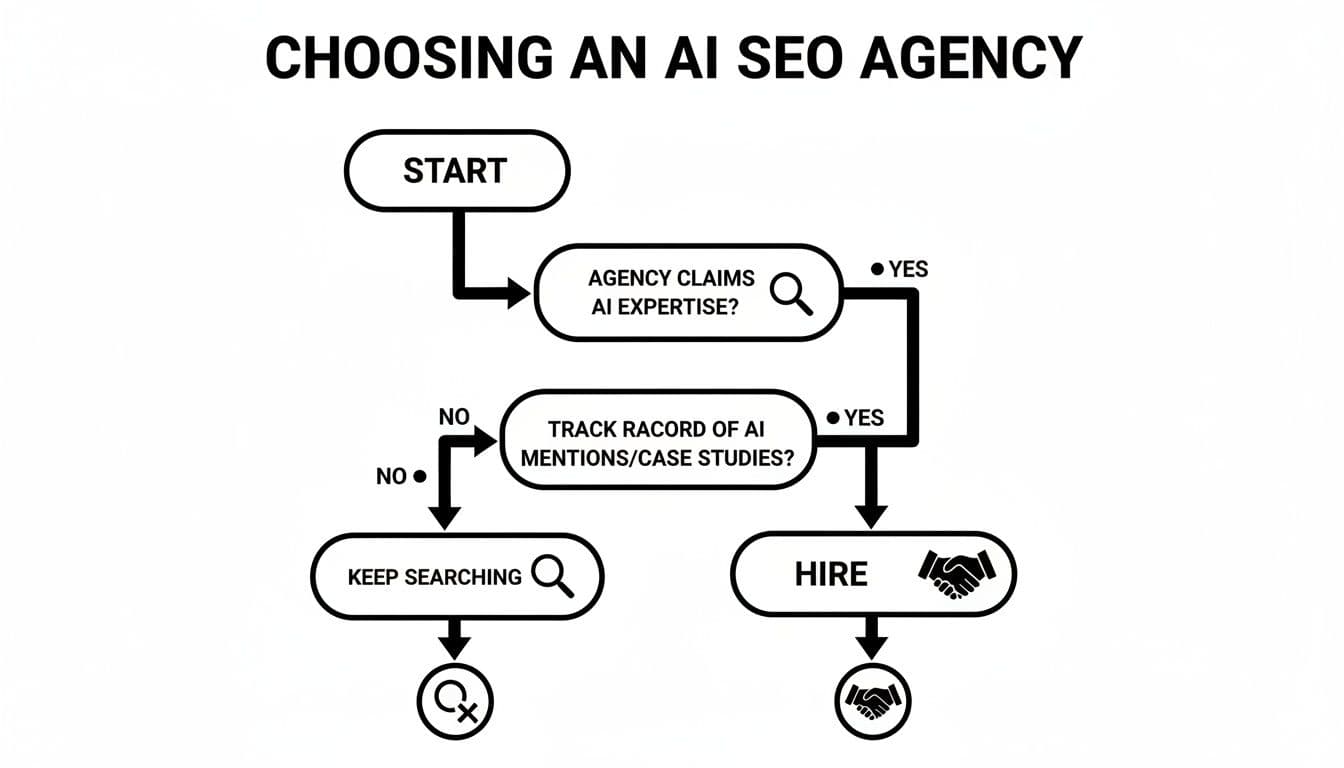
As the flowchart shows, the ability to actually track AI mentions is a critical checkpoint before you even consider moving forward with a partnership.
Their reporting needs to be just as sophisticated. Instead of getting the same old keyword ranking reports, you should be seeing dashboards that clearly visualize your "Share of AI Voice," track the sentiment of AI mentions, and pinpoint content gaps that AI models are surfacing.
This is the kind of transparency you need to make smart decisions and prove the ROI of your investment. When you find an agency that leads with this kind of data, you know you’ve found a partner who is genuinely equipped for what search looks like today.
Getting the Commercials Right: Contracts, Pricing, and Onboarding
Bringing on an agency is a serious investment. Once you get past the strategy and technical talk, the commercial details—the contract, the pricing, the onboarding—are what will make or break the partnership. Before you sign anything with an AI search optimization agency in Chicago, you need total clarity on how they structure their deals.
The financial models for these services aren't always the same as traditional SEO. You’ll usually run into a couple of common structures, and it’s important to know the pros and cons of each for your business.
Decoding AI SEO Pricing Models
First things first: how do they charge? Most agencies lean on one of two models, though you'll sometimes see a blend of both.
- Monthly Retainers: This is the bread and butter of agency pricing. You pay a set fee every month for a clearly defined scope of work. It’s great for budgeting and ensures you have a team consistently working on foundational elements like technical audits, content development, and monitoring. The trick is making sure those "deliverables" are crystal clear.
- Performance-Based Pricing: A more modern approach. Here, a chunk of the agency's fee is tied directly to hitting specific goals, like capturing a certain "Share of AI Voice" or getting your brand cited a target number of times in AI-generated answers. It’s a great way to align incentives, but be prepared for a higher base fee and the need for meticulously defined metrics.
For B2B leaders, mastering the art of how to negotiate with suppliers and win better deals is a powerful skill. Applying those principles here can help you secure a partnership that’s not just effective, but also makes sense for your bottom line.
A hybrid model is often the sweet spot. Think of it as a base retainer that covers the essentials, plus performance bonuses for hitting home runs. This guarantees the foundational work gets done while rewarding the agency for truly moving the needle.
Nailing the Onboarding Process
The first 90 days will tell you everything you need to know about the partnership. A seamless onboarding process is non-negotiable; it’s what allows the agency to get up to speed and start delivering value quickly.
A great agency doesn’t just ask for your Google Analytics login and call it a day. They go deep.
They should be setting up detailed interviews with your internal subject matter experts, your sales leaders, and your marketing team. Their job is to become an extension of your team by truly understanding your brand's voice, what makes you different, and what keeps your customers up at night.
This whole process should wrap up with a formal kickoff meeting where everyone gets on the same page. The agenda should cover:
- Establishing Baselines: What are the starting numbers for our key AI visibility metrics?
- Setting the Rhythm: How often will we connect? Agree on weekly check-ins and formal monthly reports.
- The First 90-Day Plan: What are the immediate priorities and deliverables for the first quarter?
Starting with this level of structure eliminates guesswork and builds the trust you need for a successful long-term engagement. As you weigh your options, it can be helpful to explore different pricing options and engagement models to find the right fit.
Measuring the ROI of Your AI Search Investment
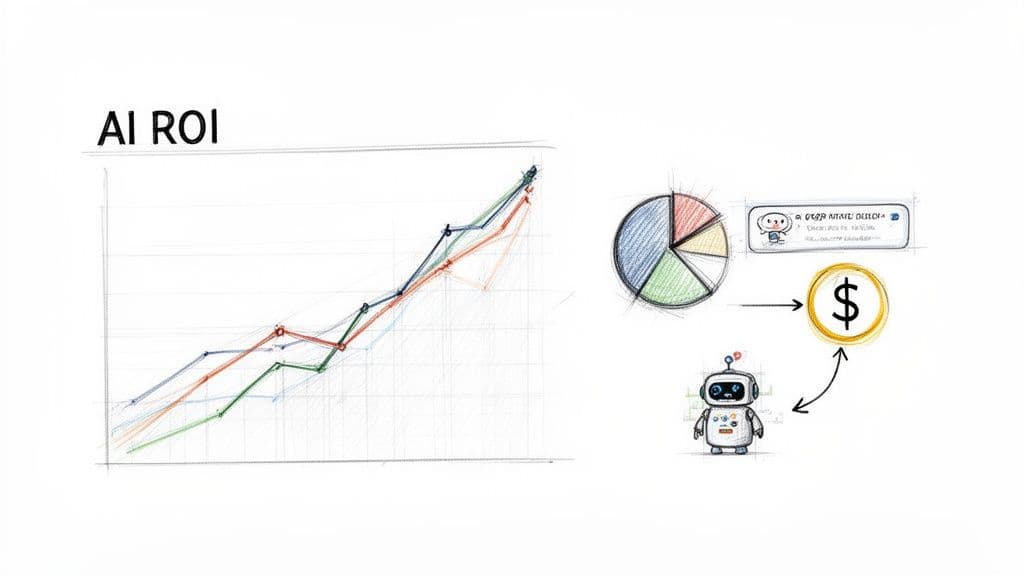
Let's get straight to the point: proving the value of your AI search optimization agency means looking past old-school SEO metrics. Keyword rankings and organic traffic numbers are just part of the story now. The real goal is to measure your brand's influence within AI-generated answers, which calls for a completely new measurement framework.
Your agency partner needs to deliver a dashboard that tracks the metrics that actually move the needle today. This isn't about fuzzy promises of "future visibility." It's about seeing the direct business impact as AI fundamentally changes how your buyers find information.
The New KPIs for AI Search Success
The central question is no longer "Where do we rank?" It's "Are we the source?" To answer that, you need to track a new breed of performance indicators. Any agency worth its salt should be reporting on these from day one.
These metrics paint a vivid picture of your authority and visibility inside the AI ecosystem.
- Share of AI Voice: This is your new North Star metric. It calculates the percentage of AI answers for your target topics where your brand is mentioned, cited, or recommended over your competitors.
- Brand Accuracy in AI Responses: How are AI models describing your business? Tracking this helps you catch and correct misinformation that could poison your reputation or send potential customers down the wrong path.
- Quality of AI-Referred Traffic: Clicks are one thing, but quality is everything. This metric digs into the behavior of users who land on your site from a link in an AI answer. High engagement and solid conversion rates are the clearest signals that you're being cited for the right queries.
You simply can't track these new KPIs without the right technology. Your agency must have a platform built to monitor brand mentions and sentiment across multiple AI models, not just Google. This is a deal-breaker.
Putting a Monitoring Platform to Work
The most practical way to measure ROI is to plug a dedicated AI visibility platform, like Attensira, into your reporting workflow. A good agency will handle this for you, translating raw data into clear, actionable insights your team can use.
The process is straightforward. You connect your domain, define your core topics and competitors, and the platform starts tracking. This creates a feedback loop where your agency can spot content gaps the AI has surfaced, pivot strategy on a dime, and clearly demonstrate the financial impact of their work.
If you want to dive deeper into the financial side, our guide on how to measure marketing ROI breaks down the calculations. Ultimately, this level of transparent, data-backed reporting is what separates a genuine AI search partner from a traditional agency playing catch-up.
Common Questions About Hiring an AI SEO Agency
When you start thinking about bringing on an AI search optimization agency in Chicago, a lot of questions pop up. This is a new frontier, and it’s moving incredibly fast. As a business leader, you need clear, no-nonsense answers to make the right call. Let's tackle some of the most frequent questions we hear.
How Long Until We See Results from AI Search Optimization?
With traditional SEO, you're often told to wait 6-12 months for meaningful traction. While that's still true for deep, foundational work, AI search optimization can deliver initial results much faster—often within 3-6 months.
Why the difference? Because you're targeting specific, dynamic elements like AI Overviews and featured snippets, which can be influenced more quickly than broad organic rankings. A good agency will be upfront about this. They’ll focus on scoring early wins—like correcting your brand’s information in an AI-generated answer or getting you cited as a source for a niche query—while simultaneously building out the long-term strategy. Some technical fixes, like deploying advanced schema markup, can even start showing results just a few weeks after Google indexes them.
Can Our In-House Team Handle AI Search Optimization?
Your in-house team is an invaluable asset, no doubt. But AI search optimization requires a very specific—and still rare—skill set. It’s not just traditional SEO with a new name. It demands a sophisticated understanding of how Large Language Models (LLMs) behave, expertise in complex schema, and a knack for creating conversational content.
A specialized agency brings dedicated tools, cross-industry experience from solving similar problems for other clients, and a focused expertise that's hard to replicate internally.
Often, the most effective path forward is a hybrid model. Let the agency spearhead the advanced AI strategy and handle the heavy technical lifting. At the same time, they can work on training and upskilling your internal team, building that capability in-house for the long haul without losing momentum right now.
What's the Biggest Mistake to Avoid When Hiring an Agency?
The single biggest pitfall is hiring a firm that simply slaps an "AI" label on their standard SEO package. They'll use the buzzword in their sales pitch, but when you look under the hood, there’s no distinct methodology or specialized tools for influencing generative AI responses.
To avoid this, you have to dig deeper. Ask for specific proof. Don't just settle for case studies showing a bump in Google rankings. You need to see evidence of increased visibility inside AI platforms like ChatGPT or Perplexity. If an agency can't show you that, you're essentially paying for an outdated strategy that will fall flat in the new search landscape.
How Does Local Chicago SEO Work with AI Search?
For local businesses, AI search is a game-changer. When someone asks an AI for "the best B2B software consultants in Chicago," the model scours local data sources—Google Business Profiles, city-specific directories, and geo-tagged content—to construct its answer. A Chicago-based agency lives and breathes this local digital ecosystem.
Any worthwhile AI search optimization agency in Chicago will obsess over your local entity information. This goes way beyond basic listings. They will ensure your NAP (Name, Address, Phone) data is perfectly consistent everywhere, actively manage your online reviews, and precisely define your service areas. Getting this right is what ensures your business shows up as an authoritative, accurate answer for high-intent local queries. It's absolutely critical for driving qualified leads right to your door.
Ready to see how your brand truly appears in AI search? Attensira provides the tools to track your visibility across ChatGPT, Google AI Overviews, and more. Stop guessing and start measuring. Connect your domain and get actionable insights today.