Master Perplexity SEO optimization with actionable strategies for B2B brands. Learn to secure citations, build trust, and win visibility in AI-driven search.
To get your content noticed by Perplexity, the game has changed. You need to create factual, data-rich content that's easy to verify. The goal is to position your brand as a primary source, one that an AI engine would be confident citing. This isn't just a tweak to your old strategy; it's a fundamental shift away from chasing keyword rankings and toward earning direct mentions in AI-generated answers.
The End of Search As We Know It
The old, predictable user journey—a straight line from a question to a Google search—is a thing of the past. That line is now fracturing, with significant traffic branching off to AI answer engines like Perplexity and ChatGPT. This isn't some far-off trend; it’s happening right now, and it’s making the classic B2B SEO playbook obsolete.
These platforms aren't just another search engine. They're conversational "answer engines." Their entire purpose is to synthesize information from multiple sources and deliver a direct, sourced answer, completely bypassing the traditional list of blue links. This is the next evolution of a trend we've seen growing for years with zero-click searches, where users get what they need without ever leaving the results page.
The core objective of perplexity seo optimization isn't about ranking #1 anymore. It's about becoming a cited source within the AI's answer, making your brand part of the solution itself, not just another option on a long list.
A New Competitive Arena
This new reality forces us to redefine what "visibility" even means. If your brand isn't being cited by these AI models, you're essentially invisible to a huge and growing part of your audience—people who now start their research with a direct question instead of a string of keywords.
AI search has completely redrawn the competitive map. For the first time in over a decade, Google’s search market share has reportedly dipped below 90%, with that traffic splintering off to other platforms. You can explore the full findings on AI search statistics to see just how quickly this shift is happening. If you fail to build a presence in these AI summaries, you risk being left behind.
The path forward is no longer about reacting to the latest algorithm update. It's about building genuine, verifiable authority. The old SEO tactics that got us here simply aren't enough for this new challenge.
Contrasting the Old and New Playbooks
To really understand the pivot we need to make, it helps to put the old and new models side-by-side. While some core principles carry over, the primary goals and the tactics we use to achieve them are worlds apart. Optimizing for Perplexity is all about source credibility and data integrity, not just keyword volume and backlink counts.
Here’s a look at how the focus shifts.
Traditional SEO vs. Perplexity SEO Optimization
What this table really shows is that success is no longer just about being found by a web crawler; it’s about being trusted by a synthesis engine. Your content has to be structured for AI models to parse, verify, and cite with confidence. This guide will walk you through exactly how to build a content strategy that does just that, ensuring your brand is seen and cited where it matters most.
How Perplexity Discovers and Trusts Content
To get your content featured by Perplexity, you have to completely rethink how you approach SEO. Forget the old model of just crawling and indexing. Perplexity operates more like a real-time research assistant, and this shift in function is everything.
Instead of simply retrieving a list of links, Perplexity actively consumes, synthesizes, and evaluates information from the live web to build a direct answer. It's not just looking for keywords; it's hunting for explicit facts, hard data, and clear answers to a user’s question. If your content doesn't offer concrete, verifiable information, it simply won't make the cut.
This flowchart illustrates the evolution perfectly—from a classic search journey to an answer-focused one, with the final, crucial step being the citation.
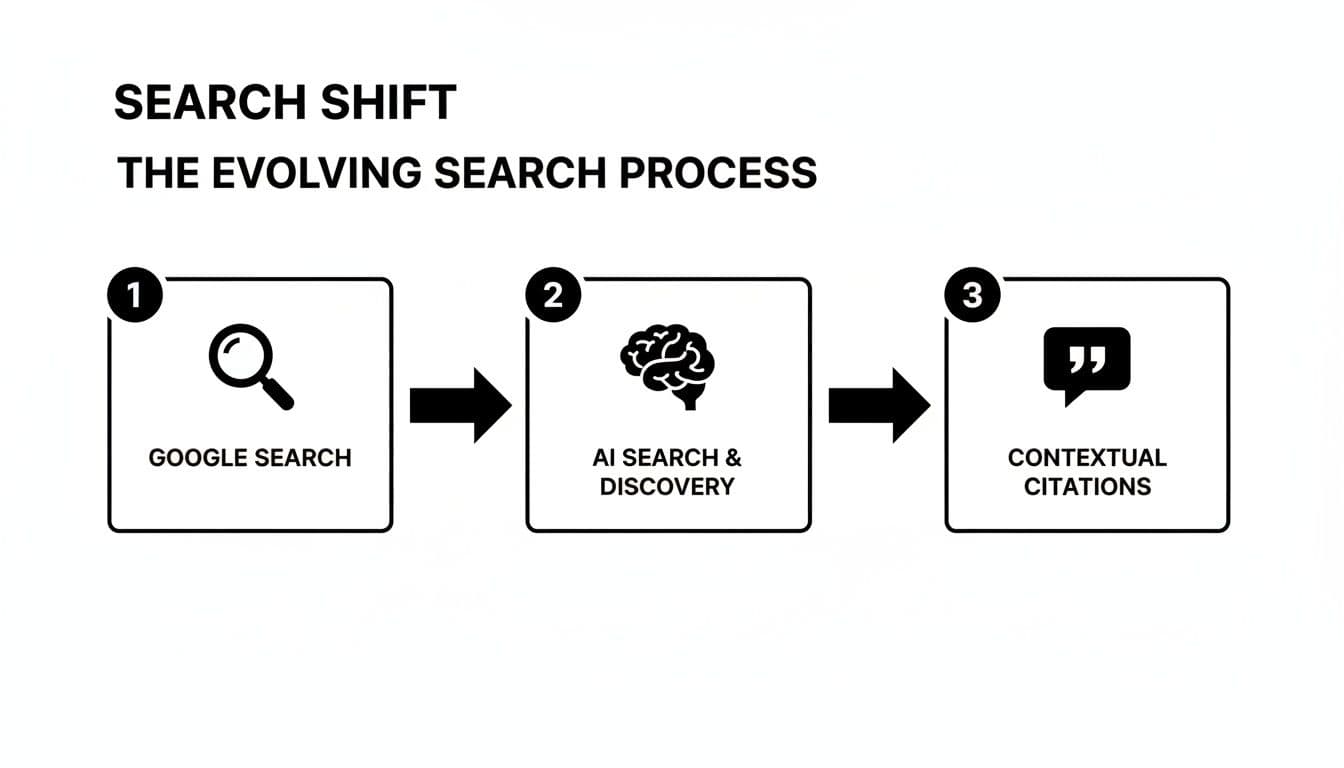
The goal is no longer just to rank. The goal is to become an integral part of the AI's answer, cited as a trusted source.
The Anatomy of a Trusted Source
So, what does an AI consider "trustworthy"? From my experience analyzing thousands of AI-generated answers, it all comes down to signals of credibility and factual accuracy. Perplexity has a strong bias toward content that is transparent, well-structured, and meticulously sourced.
Think of it like an academic review. A professor trusts a research paper that includes clear citations, data from reputable studies, and a logical argument. Perplexity runs on a similar principle, just at an incredible scale and speed.
It's constantly looking for:
- Verifiable Claims: Any statement backed by data, statistics, or—ideally—a link to a primary source.
- Clear Attribution: Explicitly showing where information originates, including author bios and details about your organization.
- Structured Information: Using elements like lists, tables, and distinct headings that make facts easy for the machine to pull out.
- Topical Authority: A consistent track record of publishing deep, expert content on one particular subject.
Perplexity isn’t just indexing your page for someone else to find later. It's evaluating whether your page is the answer. If your content is vague, filled with opinions, or lacks clear evidence, Perplexity will ignore it for a source that provides more certainty.
This live-web analysis is a major departure from how many other large language models work, which often rely on static training data. For Perplexity, freshness and real-time accuracy are everything. You can read more about these different approaches in our guide on how ChatGPT indexes and uses content.
Signals That Build Confidence
Getting cited by Perplexity means earning its confidence. You do this through a specific combination of on-page content structure and technical signals that, together, broadcast credibility. I've found through my own testing that a few key practices consistently lead to more citations.
For instance, a simple page with a data table comparing two products is far more likely to be used for a "product A vs. product B" query than a dense paragraph trying to describe the same information. The AI can parse that structured data with much higher confidence.
Here are the signals I’ve seen make the biggest difference:
- Write with Conviction: Be direct. Instead of hedging with "it might be that X causes Y," state the fact clearly: "Studies show that X causes Y." If you have the data, be definitive.
- Embed Data and Statistics: Weave in specific numbers like "73% of CMOs" or "a 45% increase." These data points are gold for an AI synthesizing an answer. Just as importantly, always link out to your original source.
- Use Authoritative Outbound Links: Linking to respected academic studies, government reports, or top-tier industry publications shows you're part of a trustworthy ecosystem of knowledge.
- Implement Key Schema Markup: Using
Organization,Author, and especiallyFactCheckschema gives the AI explicit, machine-readable context about who you are and why your information is credible.
When you focus on these elements, you're doing more than just traditional SEO. You’re structuring your expertise in a format built for verification and citation, which is the core of winning in the new era of AI search.
Creating Content That Earns AI Citations
The move toward AI answer engines demands a serious rethink of how we approach content. It's no longer about just writing a big, comprehensive article and hoping it ranks. Now, you have to build your content specifically for AI to consume and, most importantly, cite. This means we're shifting away from old-school SEO tactics like chasing keyword density and moving toward creating a library of verifiable, data-rich assets.
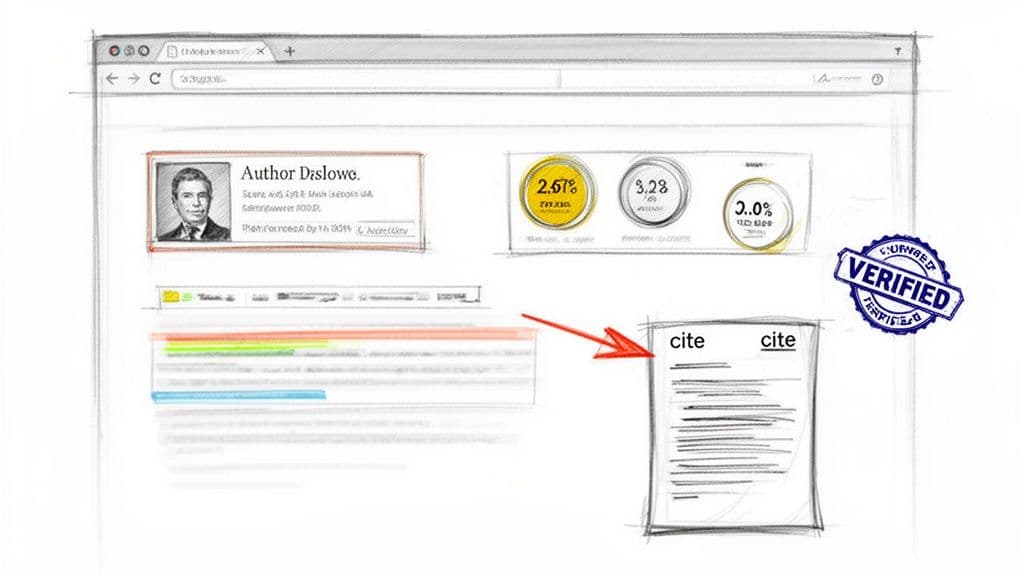
The goal here is simple: make your content the most trustworthy and easily understood source on any given topic. When you do that, Perplexity doesn't just reference you—it features you.
Build on a Foundation of Facts
In the world of AI search, verifiable information is king. Vague claims and unsupported opinions get you nowhere because the AI simply ignores them. Every piece of content you produce needs to be built on a solid foundation of hard data, explicit statistics, and factual statements that an AI can easily cross-reference.
I tell my team to think of every article as a collection of citable facts. Instead of weaving long, narrative paragraphs, we focus on breaking down ideas into distinct, fact-based units. This approach to perplexity seo optimization is less about storytelling and more about smart information design.
For instance, a statement like "Many businesses struggle with AI" is far too generic. It's weak. A much stronger, AI-friendly version sounds more like this: "A recent study found that 78% of B2B marketers lack a clear strategy for AI integration." The second version is specific, measurable, and verifiable—exactly what an AI needs.
Structure for Extraction
Perplexity is built to parse information and find answers fast. It’s not "reading" your article for pleasure; it’s scanning for data points. Walls of text are a dead end for this process.
To make your content easy for an AI to pull from, you have to get strategic with your formatting.
- Bulleted and Numbered Lists: These are ideal for breaking down processes, product features, or key takeaways into scannable, citable points.
- Data Tables: When you’re comparing anything—features, pricing, or statistics—tables are the absolute gold standard. They present information in a structured way that AI models can read with almost perfect accuracy.
- Clear Headings (H2, H3): Use descriptive headings and subheadings to break your content into logical chunks. This helps the AI understand the hierarchy and context of your information.
An AI model is always looking for the path of least resistance to a confident answer. By structuring your content with lists, tables, and clear headings, you're essentially pre-packaging facts for easy consumption. This makes your page a much more attractive source for a citation.
This structured approach is non-negotiable. The landscape for AI search is incredibly competitive. Recent data shows a staggering 62% of brands are practically invisible to AI models, even with strong traditional SEO. What’s more, pages cited in AI summaries are, on average, 26% fresher than typical search results. Implementing structured data has also been shown to triple visibility in AI answers. For more on this, check out the data on AI visibility from Fuel Online.
Cite Your Sources Meticulously
Just as crucial as presenting facts is showing your work. Citing your sources, both internal and external, is a massive trust signal for AI. It proves your information is well-researched and part of a broader ecosystem of credible knowledge.
When you drop a statistic, link directly to the primary source—a research paper, a market study, a government report, whatever it may be. This practice, known as source attribution, is a cornerstone of building trust with answer engines.
And whenever you can, use your own data. Publishing original research, surveys, or industry analysis positions your brand as a primary source, not just someone who repeats what others have found. This is the ultimate goal in perplexity seo optimization: becoming the starting point for information in your field. We cover more strategies for this in our complete guide to Answer Engine Optimization.
A Practical Example of Citation-Worthy Content
Let's say you're writing a blog post about project management software. The old, poorly-optimized way would be to write a long, flowing article discussing the general benefits in dense paragraphs.
A highly-optimized, citation-ready piece would look completely different.
- Start with a Data-Backed Claim: "Gartner's latest report shows teams using integrated PM software complete projects 38% faster." (And you'd link directly to that Gartner report).
- Use a Comparison Table: You’d create a clean table comparing the top 3 software solutions across key features like "Integration Capabilities," "Pricing," and "Team Size Limit."
- Break Down Benefits into a List: Instead of a paragraph, you’d use a bulleted list to outline the top 5 benefits, with each point starting with an action-oriented phrase (e.g., "Reduces meeting time by an average of 5 hours per week").
- Include an Expert Quote: You could add a blockquote with a snappy insight from a well-known project management expert about a specific feature's importance.
This version isn't just an article; it's a structured collection of verifiable facts. That makes it the perfect candidate for an AI-generated answer.
Technical SEO for Answer Engine Visibility
While high-quality content is your ticket to the game, your technical foundation is what actually wins it. The backend of your site sends incredibly strong signals to AI models like Perplexity, and fine-tuning these is a non-negotiable part of any modern perplexity seo optimization strategy. We're not just talking about basic SEO hygiene; we're focusing on the specific technical signals that prove your credibility to these new engines.
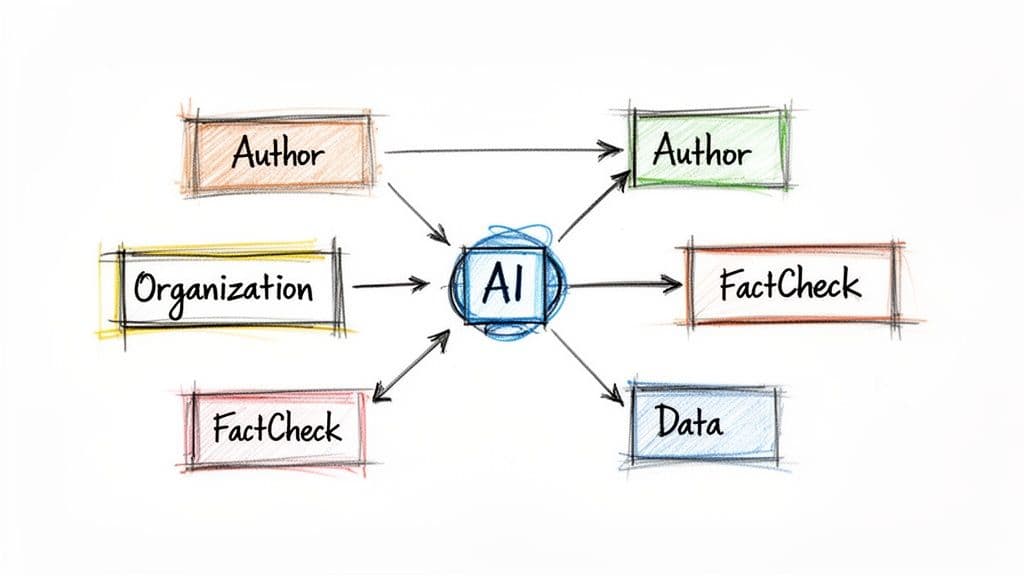
Think of it like this: your content makes a promise, but your technical SEO provides the notarized proof. It’s the difference between merely claiming you're an expert and showing the AI your verified credentials. For CMOs and Brand Managers, this is the checklist to give your technical teams to ensure your website speaks the language of AI.
Signal Credibility with Advanced Schema
Schema markup is, without a doubt, the most direct way to communicate context to an AI. Basic Article or Product schema is a good start, but answer engines are hungry for much deeper signals of trust. Getting these specific types of structured data in place is no longer a "nice-to-have"—it's an absolute must.
- Organization Schema: This is fundamental. It clearly identifies your brand as a distinct entity, telling Perplexity exactly who is behind the content. It’s the first step in establishing a trusted source.
- Author Schema: This connects a piece of content to a real person. When you link this to a detailed author bio page showcasing their credentials and experience, it sends a powerful E-A-T (Expertise, Authoritativeness, Trustworthiness) signal.
- FactCheck Schema: This is pure gold if you publish data, research, or content that debunks common myths. It explicitly tells AI models that your claims are verified, making your content a prime candidate for citation in an answer.
By implementing these schema types, you are no longer leaving interpretation up to the AI. You are explicitly telling it: "This content was created by a real organization, written by a qualified expert, and contains verified facts." This machine-readable proof is invaluable.
Build Context with Strategic Internal Linking
We’ve always known internal linking is important for SEO, but its role is amplified for answer engines. A thoughtful internal linking strategy does more than just pass PageRank; it constructs a contextual map of your expertise for the AI to follow. It demonstrates how your various pieces of content interconnect, proving you have a deep well of knowledge on a topic.
So, when you publish a new article, don't just hit "publish" and move on. Think about how it fits into your existing content ecosystem. If you just released a case study on a new social media tactic, make sure you link it back to your cornerstone guide on social media marketing. This creates a topical cluster that screams authority.
If you're curious about the technical side of this, analyzing log files to understand crawler behavior can give you incredible insight into how bots navigate your site's architecture. You'll often spot missed opportunities for building stronger contextual links.
Prioritize a Clean Site Architecture
Finally, your site's overall structure plays a massive role. A messy, confusing architecture makes it tough for any crawler—AI or otherwise—to figure out what you're an expert in. On the other hand, a clean, logical structure broadcasts your authority with absolute clarity.
Think of your website as a meticulously organized library.
These technical elements work in concert to build a powerful case for your brand’s credibility. Getting this right can be complex, especially when balancing the needs of traditional search and new answer engines. For many, bringing in professional SEO services to manage the technical details is a smart move. A solid technical foundation ensures that all the brilliant content you create is actually seen, understood, and trusted by the AI models you want to influence.
Measuring Your Brand's Presence in AI Search
That old business saying, "If you can't measure it, you can't improve it," has never been more true than in the new era of AI search. The problem is, the metrics we’ve relied on for years in traditional SEO—keyword rankings, organic traffic, domain authority—are fast becoming vanity metrics. They just don't tell the whole story for a perplexity seo optimization strategy.
The game has fundamentally changed. So must our scorecards.
We need to stop asking "Where do we rank?" and start asking the only question that matters: "Are we part of the answer?" Answering this requires a complete pivot in how we track performance, built around a new set of key performance indicators (KPIs) that measure our actual presence and authority inside AI-generated responses.
Moving Beyond Rank Tracking
Here's the hard truth: traditional rank trackers are flying blind. They're great at telling you if your site is on page one of Google, but they have zero visibility into whether Perplexity just cited your latest research to answer a user's complex question.
This is a massive blind spot. Your brand could be getting lapped by competitors who are consistently showing up as trusted sources, and you wouldn't even know it.
The new currency is the citation. A single citation in a well-formed AI answer is often more valuable than a dozen top keyword rankings because it puts your brand right at the user's point of decision, positioned as a definitive source of truth.
Core Metrics for AI Search Visibility
To really see what's going on, you have to adopt KPIs that reflect this new reality. These metrics aren't about simple visibility; they're about measuring your influence and authority within the AI's synthesized answers. For a deeper dive, take a look at our guide on how to track your brand's visibility in ChatGPT and other top LLMs.
To get a clear, actionable picture of your brand's performance in the AI ecosystem, you need to track a new set of KPIs. The table below outlines the most important ones.
Key Metrics for AI Search Optimization Success
By focusing on these metrics, you can move from guessing to knowing exactly how you stack up.
Establishing a Monitoring Workflow
Tracking these KPIs isn't something you can do by manually checking a few queries now and then. That won't give you meaningful data. You need a systematic workflow.
- Define Your Core Topics: First, identify the key subject areas where your brand absolutely must be seen as an authority. This is the foundation of your query set.
- Build a Query Basket: Next, put together a list of 50-100 high-intent questions and long-tail keywords that matter for those topics. Make sure to include a mix of informational queries, comparison questions ("X vs. Y"), and problem-solving prompts.
- Use a Monitoring Tool: This is where a dedicated platform like Attensira is indispensable. Trying to track hundreds of queries by hand is simply not practical. A proper tool automates the process, running your queries at set intervals and logging every citation.
- Analyze and Iterate: Set a recurring time—weekly or bi-weekly—to review your citation frequency, Share of Answer, and content gap reports. These insights will show you what's working and, more importantly, where you need to create new or better-structured content to win citations from your competition.
By consistently tracking these metrics, you transform your perplexity seo optimization efforts from a guessing game into a data-driven strategy. You'll know exactly where you stand, where your competitors are winning, and what you need to do to build a durable competitive edge in AI search.
As SEOs and marketers start wrapping their heads around AI search, the same questions keep popping up. It's clear the old playbook won't work, and we're all figuring out the new rules of the road together. Let's dig into some of the most common questions I hear about optimizing for Perplexity and other answer engines.
This isn't about chasing rankings anymore. It's about becoming a trusted, citable authority that these models rely on. Here’s how to tackle some of the biggest uncertainties you're likely facing.
What Is the Single Most Important Factor for Perplexity SEO?
If I had to boil it down to one thing, it’s verifiable accuracy. Hands down.
Perplexity's entire reason for being is to give users a correct, confident answer. It will always prioritize content that presents clear, data-backed facts over pieces filled with fuzzy opinions or vague claims. Your main job is to build a library of content that is grounded in solid proof.
Here’s what that looks like in practice:
- Publish Original Research: When you release your own surveys and data, you instantly become a primary source that AI has to cite.
- Get Specific with Stats: Don't just say "a lot of users." Say "73% of users" and link directly to the study that proves it.
- Lean on Experts: Quoting recognized industry experts adds a layer of human-backed credibility that models are learning to recognize.
Bottom line: if your content can't be easily fact-checked or cross-referenced, Perplexity will almost always pass it over for a source that can be.
How Does Perplexity SEO Differ from Voice Search Optimization?
This is a common point of confusion, but the distinction is critical. While both are about answering questions, they play very different games.
Voice search optimization is usually about winning the "one-shot" answer—a short, concise snippet perfect for being read aloud, often pulled directly from a Featured Snippet.
Perplexity SEO is different. It's about becoming a foundational source within a larger, synthesized answer. Perplexity rarely relies on a single source; instead, it weaves together information from several places to build its response. Your goal is to be one of those essential, citable threads. It rewards depth and evidence, not just brevity.
The way I explain it is this: for voice search, you want to be the answer. For Perplexity, you want to be a key piece of evidence in the answer.
Is It Still Necessary to Focus on Traditional Google SEO?
Yes, absolutely—but you can't approach it in a silo. Think of it as a two-front strategy. Google isn't going anywhere, and the fundamentals of good SEO (clean site architecture, fast page speed, solid UX) create a strong foundation that benefits both traditional crawlers and AI models.
However, where you focus your energy needs to shift. The data on AI's impact is already telling a powerful story. For instance, when Google’s AI Overviews show up, some studies have shown that organic click-through rates can drop by as much as 61%.
But that's not the whole picture. The same data shows that brands cited within those AI answers see a 35% higher CTR, and the traffic that comes from AI-driven search converts at a rate 4.4 times higher than typical organic visitors. You can dive deeper into these AI SEO statistics to see just how much is changing.
This proves that while traditional SEO keeps you visible, perplexity seo optimization is what captures the high-intent traffic that actually converts.
What Tools Can I Use to Track My Performance?
Your traditional rank tracker is flying blind here. It can't tell you if you're being cited inside an AI-generated answer. To get a true picture of your performance, you need a new class of tools built specifically for answer engine optimization.
These platforms give you a real "Share of Answer" metric by constantly monitoring AI responses. They work by:
- Asking questions at scale, firing thousands of relevant queries at models like Perplexity.
- Logging your citations every single time your domain is used as a source.
- Analyzing your competitors, showing you exactly who is getting cited when you aren't.
This is the only way to get a real, data-backed view of your visibility where it increasingly matters most.
Ready to stop guessing and start measuring your brand's true visibility in AI search? Attensira is the platform built for modern SEO, helping you track citations, analyze competitors, and optimize your content to win in the new era of answer engines. Discover how Attensira can give you a competitive edge.