
Learn how to rank in AI Overviews with our guide to AI search optimization. Discover actionable strategies for content, technical SEO, and measurement.
If you’re still chasing the top ten blue links, you’re playing yesterday’s game. The old rules of search are quickly becoming obsolete. To get noticed now, you need to create authoritative, clearly structured content that AI models can easily parse and, more importantly, trust. It’s less about just ranking and more about becoming the definitive source the AI cites.
The New Rules of Search in an AI-First World
The entire search landscape has changed, and it’s not going back. Traditional SEO playbooks that centered on cracking the top ten results simply don't have the same impact anymore. We've entered a new phase where visibility is earned through genuine credibility and crystal-clear communication, not just clever keyword placement.
This isn't just a minor update; it's a completely different way of thinking about how users find information. Large Language Models (LLMs) now sit between the user and the search results, synthesizing information from dozens of sources to craft a single, cohesive answer. To adapt, you have to understand the technology itself, including the fundamentals of LLM information, which is now essential knowledge for any serious strategist.
The Dominance of AI-Driven Answers
This isn't a future prediction—it's the reality on the ground today. As of February 2026, AI Overviews were already showing up on 18% of all Google searches globally.
Drill down into the US, and that number jumps to about 30% of keywords. But here’s the stat that should really get your attention: Overviews appear on a staggering 57% of long-tail, high-intent searches. These are the very queries that signal a user is ready to make a decision or a purchase. With 2 billion monthly users seeing these AI summaries, you can't afford to be invisible.
This trend is fueling the rise of what we call zero-click searches. The user gets their answer and never leaves the results page. Your new goal isn't just to get a click; it's to be the source cited within the AI's answer.
Being that trusted source means building your content on a foundation that both humans and algorithms can rely on. Before we get into the nitty-gritty tactics, let's establish the core principles that should guide every piece of content you create.
Core Principles for AI Overview Visibility
To be the source that AI models trust and feature, your content must adhere to a few fundamental pillars. It's about signaling deep expertise and structuring your information for easy algorithmic consumption.
Think of your content as a reference document you're submitting to the AI.
Mastering this new reality requires rethinking your content strategy from the ground up. The rest of this guide will walk you through the specific actions you need to take to put these principles into practice and secure your brand’s place in this new search ecosystem.
Auditing Your Brand's Current AI Footprint
Before you can build a winning strategy for AI Overviews, you need a reality check. Where does your brand actually stand today? Without an honest look at your current visibility, any optimization work is just a shot in the dark.
The goal here is to figure out how AI models—from Google's AI Overviews to ChatGPT and Microsoft Copilot—see and cite your content. Or, just as importantly, if they see you at all.
Conducting Manual Spot-Checks
The most straightforward way to start is with a manual audit. Think of yourself as a detective, piecing together clues about your brand's presence in this new AI-driven search world. You’re looking for which of your pages, if any, are being surfaced as sources and in what context.
To kick things off, you can use advanced search operators in Google to mimic the kinds of questions that trigger AI Overviews.
- Brand-focused questions: Start with queries your customers are likely asking about you. Think, "is [Your Brand] a good choice for B2B marketing?" or "how does [Your Product] stack up against [Competitor]?"
- Topical deep dives: Look at your most valuable informational keywords and turn them into questions. If you have a killer guide on project management, you might search for "what are the best project management techniques for remote teams?" and see who the AI cites.
- Competitor reconnaissance: Run those same queries, but swap in your competitors' names. This is a quick way to see who's currently owning the conversation for your target topics and what their successful content looks like.
Don't stop at Google. It's crucial to run these same kinds of searches in ChatGPT and Copilot. More and more users are going directly to these tools for answers, and your visibility there is just as critical for brand perception.
Now, this manual approach is great for getting a feel for the landscape. But it's time-consuming, tough to scale for a large site, and the answers can shift from one search to the next. It gives you a snapshot, not the whole film.
This process really boils down to the core principles AI models use to evaluate sources, as shown below.
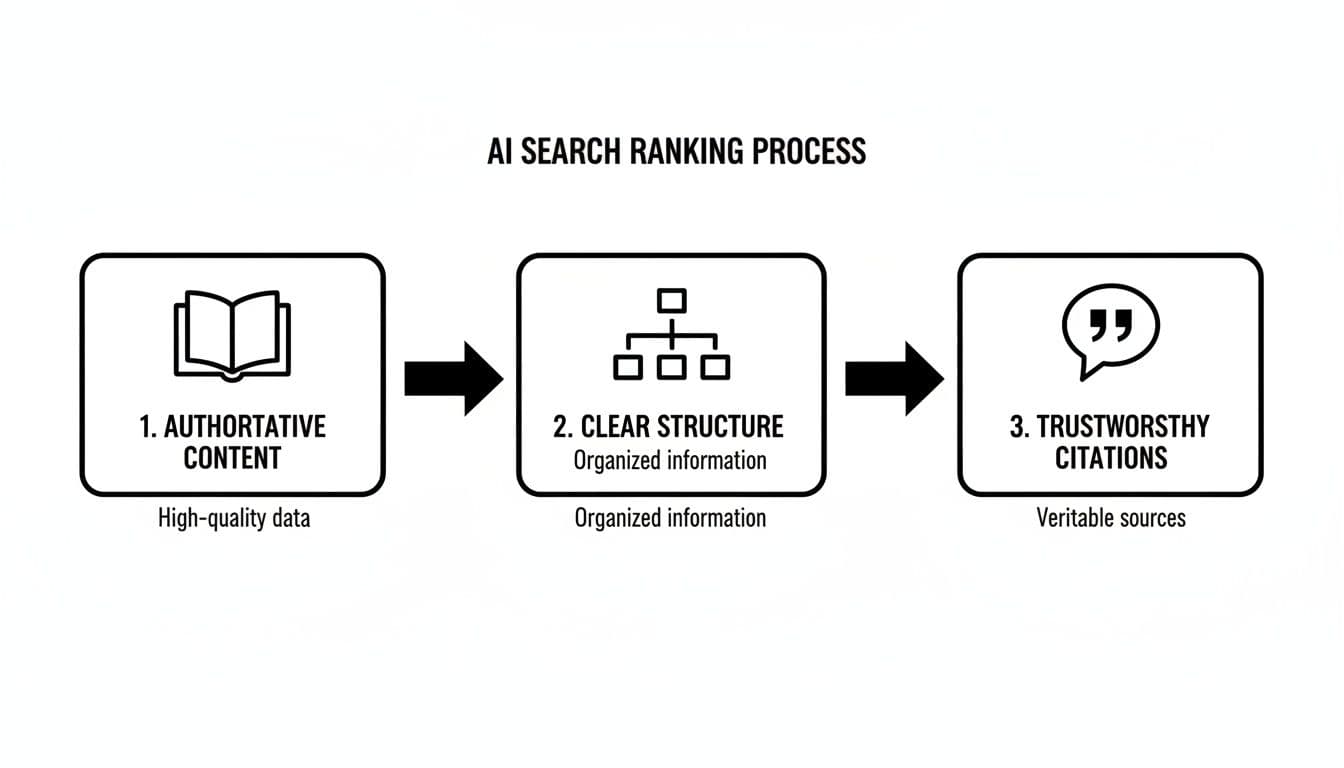
As you can see, getting cited in AI search isn't magic. It's a combination of creating genuinely authoritative content, structuring it clearly for machines, and backing it up with trustworthy signals.
Automating Your AI Visibility Audit
For a truly systematic and data-backed view, you have to move beyond manual checks. Honestly, tracking every possible mention across a dozen different AI platforms just isn't realistic. This is where specialized monitoring tools become indispensable.
Platforms like Attensira, for example, can automate this entire audit. Instead of spending hours running individual searches, you get a comprehensive dashboard that tracks your entire AI footprint.
An automated system gives you a few major advantages:
- Complete Mention Tracking: You can see every single time your brand is cited, what snippet was used, and the exact prompt that surfaced it. No more guesswork.
- Clear Content Gap Analysis: It quickly highlights high-value topics where your competitors are getting featured, but you’re invisible. This gives you a data-driven roadmap for your next content pieces.
- Competitive Performance Benchmarking: You can finally measure your "share of answer" in AI overviews against your rivals and see, in real time, who's gaining or losing ground.
Automating the audit turns anecdotal evidence into actionable data. A great first move is to see how prepared your brand really is by getting your AI Readiness Score. It provides a concrete benchmark to kick off your optimization efforts. A solid audit is the first real step toward mastering how to rank in AI overviews.
Crafting Content for AI Comprehension and Citation
Getting your content featured in AI Overviews isn't about tweaking a few keywords anymore. It requires a whole new way of thinking about content creation—moving from simply writing for human readers to engineering information that’s easily understood and cited by AI models. Your new goal is to become the go-to, citable source an AI relies on to build its answers. Every heading, sentence, and data point has to pull double duty.
If you're wondering if it's worth the effort, the numbers speak for themselves. Nearly 35% of Gen Z already prefer AI chatbots for their searches, and almost 70% of businesses see a better ROI when they integrate AI into their SEO. The budget is following the trend, with 38% of business decision-makers allocating funds for AI Search Optimization. We’re also seeing over 25% of marketers actively creating content designed for AI citation. These efforts are paying off, with platforms like Claude driving a 16.8% conversion rate and ChatGPT a 14.2% conversion rate from their traffic.
Adopt the Inverted Pyramid Model
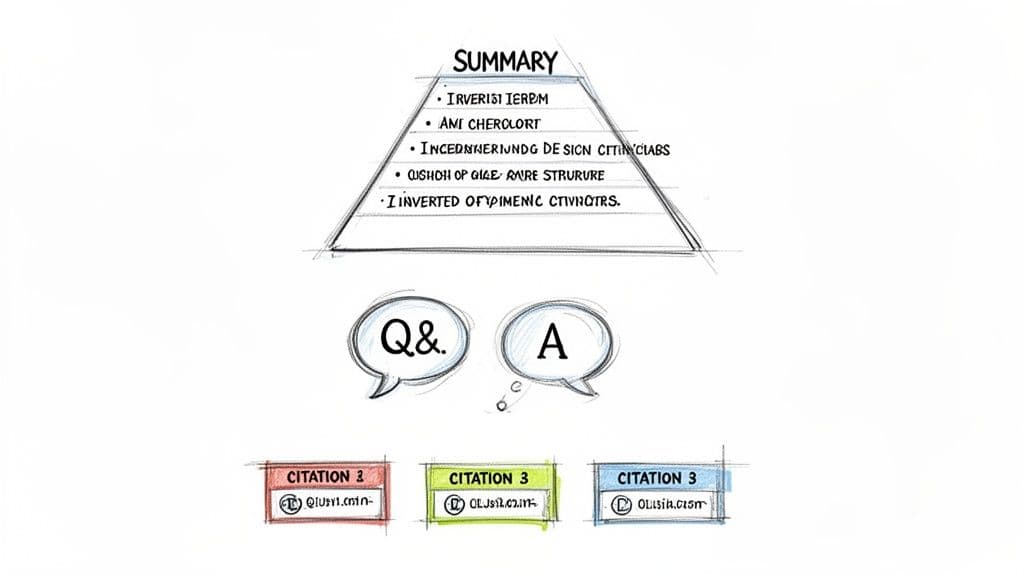
Journalists have sworn by the inverted pyramid for a century for one simple reason: it gets straight to the point. This model is now mission-critical for AI. You have to deliver the most important information immediately, then follow up with supporting details and broader context.
An AI model doesn't have time to sift through a long, winding introduction. It needs the core answer right away. So, start your articles—and even major sections within them—with a direct, punchy summary that answers the most probable user question.
For an article on "project management techniques for remote teams," for example, your opening paragraph should immediately summarize or list the top 3-5 techniques. This front-loads the value, making your content incredibly efficient for an AI to parse, validate, and cite.
Write in Definitive, Citable Statements
AI models thrive on facts, not nuance. They are scanning for definitive, self-contained statements they can confidently extract. Ambiguous or weak language is a fast track to being ignored.
- Weak: "It seems that some teams might find communication to be a bit of a challenge when working remotely."
- Strong: "Poor communication is a primary challenge for remote teams, often leading to project delays and decreased morale."
The second version is a clear, factual statement that an AI can easily lift and present to a user. Treat every sentence as a potential snippet. If it can't stand on its own and offer clear value, it needs a rewrite.
The core of this strategy is to make your content so clear and factual that the AI model sees it as a low-risk, high-value source. Your goal is to become the encyclopedia entry, not the opinion column.
This entire discipline is what's becoming known as AI Response Optimization, which is all about structuring information for machine readability.
Embrace a Conversational Q&A Format
At their heart, AI Overviews are just answers to questions. The most direct way to get featured is to structure your content to explicitly mirror this dynamic. I've seen this work wonders. Turn your subheadings (H2s and H3s) into the exact questions your audience is asking.
For instance, use headings like:
- What Are the Best Tools for Asynchronous Collaboration?
- How Do You Measure Productivity on a Remote Team?
- What Security Risks Are Associated with Remote Work?
Beneath each question-based heading, deliver a direct and thorough answer. This format creates a perfect map between a user's prompt and your content, making it almost effortless for an AI to connect the dots and pull from your page.
Define Entities and Establish Context
AI models don't just see words; they see entities. These are the specific people, concepts, products, and organizations that make up a topic. To prove your authority to an AI, you need to explicitly define these entities and show how they relate to one another.
Don't just mention a term; explain what it is.
For example, instead of just dropping the word "Scrum," you should write: "Scrum, an agile project management framework, helps teams structure and manage their work through a set of values, principles, and practices." That small act of defining the entity gives the AI crucial context. It confirms you know what you're talking about and helps the model build a richer understanding of the subject, with your content as a foundational source.
Getting Your Technical House in Order for AI
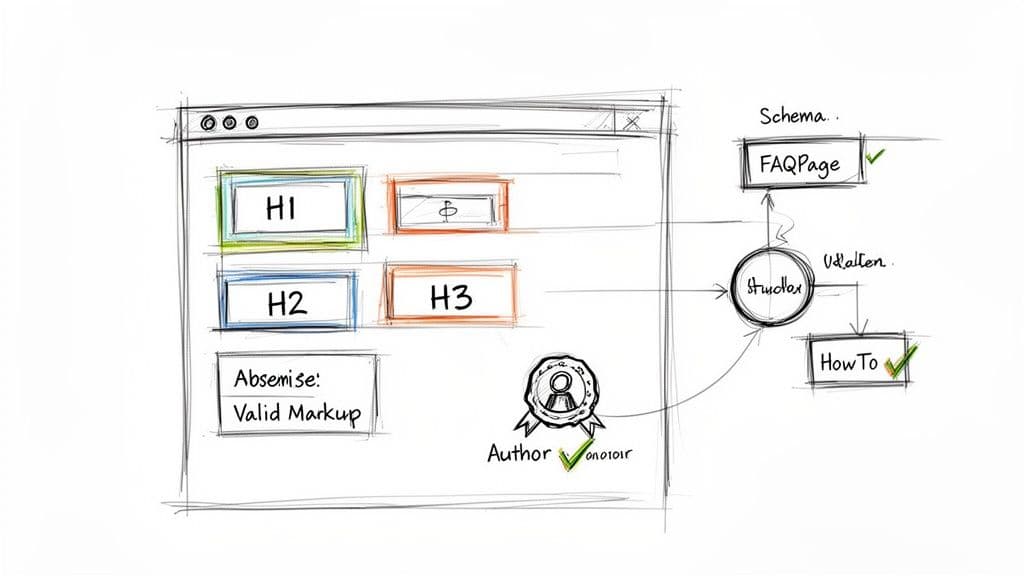
While amazing content is your ticket to the game, your site's technical health is what gets you on the field. It’s the behind-the-scenes work that allows AI crawlers to find, parse, and ultimately trust what you’ve published. Think of it like organizing a massive library—without a clear system, even the most brilliant books will gather dust on the shelves. For AI, this isn't just a best practice; it's a prerequisite.
A technically sound website removes any friction for an AI trying to understand your pages. It sends strong signals of authority and makes it dead simple for the model to confirm what your content is about, who stands behind it, and why it deserves to be cited in an overview.
Give AI a Roadmap with Structured Data
If there's one technical element that moves the needle for AI visibility, it's structured data, also known as schema markup. This is simply a standardized vocabulary you add to your site’s HTML that explicitly describes your content to search engines. It's the difference between showing a crawler a picture and handing it a blueprint.
Structured data essentially translates your human-readable content into a language machines can process instantly. It helps AI models categorize your information with near-perfect accuracy and extract specific facts, figures, and steps with high confidence. When you're figuring out how to show up in AI Overviews, this is not optional.
Don’t think of structured data as just a tweak for search engines. It's your most direct way of communicating with an AI. You're explicitly telling it, in its native language, what your page contains and why that information is valuable and trustworthy.
By implementing schema, you remove the guesswork. This automatically makes your page a more reliable source compared to a competitor’s page that forces an AI to infer meaning from raw text alone.
High-Impact Schema Types for AI Overviews
Hundreds of schema types exist, but for AI Overviews, you can get a lot of mileage by focusing on a select few. These are the markups that directly align with the informational and instructional queries that most often trigger AI-generated answers.
Here’s a breakdown of the schema I’ve seen make the biggest difference.
This is what it looks like in practice: adding HowTo schema to your "how to change a tire" guide turns a wall of text into a structured, machine-readable recipe that an AI can pull from without hesitation.
Reinforce Trust with On-Page Fundamentals
Beyond schema, your foundational on-page SEO habits are more critical than ever. AI models lean heavily on these signals to evaluate the structure, quality, and authority of a page.
- Clean Heading Structures: A logical hierarchy of H1, H2, and H3 tags gives the AI a clear outline of your content. It’s like a table of contents that helps the model grasp the main topic and how all the subtopics connect. Make sure your headings are nested correctly; you can check your work with a free header validator tool.
- Smart Internal Linking: When you link to other relevant, in-depth articles on your own site, you're building a web of context. This shows the AI the breadth of your expertise and helps it discover more of your authoritative content, strengthening your site's overall topical authority.
- Core Web Vitals: Speed and stability matter. A fast, responsive website is a fundamental sign of quality. Google uses these user experience metrics to identify well-maintained sites, which indirectly boosts their credibility as a source worth citing.
All these technical pieces work together. They form the structural support that holds up your great content, making it an undeniable choice when an AI needs a reliable source.
Measuring and Refining Your AI Overview Strategy
Getting your content to appear in AI Overviews isn't a "set it and forget it" task. It’s a constant loop of measuring, refining, and adapting your approach. You have to think beyond traditional SEO metrics. In this new game, it's not just about ranking—it’s about being cited. This means you need a completely different way to measure what's working.
The entire search landscape is fracturing. Traditional Google search volume has seen a 25% year-over-year drop as users flock to new tools. ChatGPT now dominates 81% of the AI search market, handling over 3 billion queries every single month.
And it’s not just one platform you need to worry about. The traffic is splintered: ChatGPT gets 60.7%, Microsoft Copilot takes 13.2%, Google Gemini is at 15%, and tools like Perplexity grab another 5.8%. The numbers paint a clear picture: winning on Google alone is no longer enough. You have to compete for visibility across all of these AI engines at once. If you want to dig into the numbers, this complete guide to the state of AI search breaks it down further.
Redefining Success with AIO-Specific KPIs
To see if your efforts are paying off, you need to track what actually matters for AI Overviews. Clicks and impressions don't tell the full story when a user gets their answer without ever visiting your website.
Your focus should be on these new, essential performance indicators:
- Citation Frequency: Think of this as your new north star. It's the raw count of how many times your domain is sourced in AI answers for your target queries. If this number is going up, you're on the right track.
- Share of Voice (SoV) in AI: It's one thing to get cited, but it's another to own the conversation. SoV tells you what percentage of citations you're capturing compared to your competitors for a given topic. It shows if you're becoming the go-to source.
- Citation Quality: Not all citations have the same impact. Are you being cited for a simple definition, or for a high-intent question that’s close to a purchase? Understanding the context of your citations helps you gauge their actual business value.
Trying to track these metrics by hand is a losing battle. The sheer number of queries and the ever-changing nature of AI responses make manual monitoring practically impossible.
Using Analytics to Drive Your Refinement Loop
This is where a dedicated platform for AIO analytics, like Attensira, becomes invaluable. It gives you the specific data needed to see what's really happening, turning abstract goals into concrete numbers. You can finally pinpoint which content changes are driving more citations and which ones are falling flat.
By tracking your citation frequency and Share of Voice, you move from guessing to knowing. You can directly attribute an increase in citations to a recent content update or the implementation of new schema markup.
This data creates a powerful feedback loop for continuous improvement. Let's say you notice a competitor is constantly cited for a topic where you have a detailed guide. You can dig into their page and see what they're doing differently. Maybe they're using a Q&A format or have HowTo schema you missed. That insight is gold. You can update your own page, deploy the changes, and watch to see if your citation frequency improves.
Even the small amount of referral traffic from AI platforms can offer clues. A sudden, small spike from an AI source might mean your content was used to answer a trending question. That's a signal to double down, perhaps by expanding that piece into a more comprehensive pillar page to solidify your authority. When you can clearly demonstrate the value of your AI-driven traffic, it’s much easier to make the case for continued investment in your AIO strategy and secure your brand's visibility for the long haul.
Answering Your Top Questions About AI Overview Optimization
Whenever a new frontier like AI search opens up, a lot of questions follow. It's natural to feel like you're navigating uncharted territory. Based on the conversations I have with marketers every day, I've found that getting a handle on a few core concepts can make all the difference.
Let's clear up some of the most common points of confusion so you can build a strategy that actually works.
Can I Really Compete with Big Brands for a Spot?
Absolutely. In fact, this is one of the most exciting aspects of AI Overviews. While having a big brand name certainly doesn't hurt, AI models are trained to prioritize the quality, clarity, and expertise of the content itself—not just the size of the logo behind it.
Think about it: a deeply knowledgeable article from a niche expert can easily be cited over a generic, surface-level post from a massive corporation. This is your chance to shine. The key is giving the AI the best, most direct answer and making it incredibly easy for the model to understand and trust your information.
Here’s how you can cut through the noise:
- Lean into E-E-A-T: Don't just say you're an expert; prove it. Use original data, share real-world case studies, and feature author bios that showcase genuine Experience, Expertise, Authoritativeness, and Trustworthiness.
- Answer the Question Head-On: Structure your content so the answer to a user's likely question is immediate and unambiguous.
- Use Clean Structured Data: Implementing schema markup, like
FAQPageorArticleschema, is like giving the AI a clean, organized blueprint of your content.
The AI isn't looking for the loudest voice in the room; it's looking for the most credible expert. Your content is your proof.
Isn't This Just a New Version of a Featured Snippet?
It's a fair question, as they look similar at first glance. But a featured snippet and an AI Overview are fundamentally different beasts.
A classic featured snippet is a direct pull. It grabs a single, concise block of text from one source and places it at the top of the results. It's a simple, one-to-one relationship.
AI Overviews are synthesizers. They pull information from multiple sources and weave them together to create an entirely new, composite answer. This completely changes the game. Your goal is no longer to be the only answer but to become one of the most citable and authoritative sources the AI relies on.
This requires a strategic pivot:
- Go for Depth: Your content needs to be more comprehensive. Don't just answer the question; cover the topic from several angles with plenty of supporting facts.
- Section Your Content Logically: Use clear H2 and H3 headings to break down complex topics. This allows the AI to pull specific details about different sub-topics from a single, well-organized page.
- Build a Web of Trust: Back up your claims with links to other credible sources (both on your site and externally). This corroboration signals to the AI that your information is reliable.
You're no longer writing a quick blurb; you're building a reference document for an AI.
How Long Until I See Any Results from This Work?
The timeline here is often faster than what you'd expect from traditional SEO. While climbing the classic "blue link" rankings can take months, you might see your content appear in AI Overviews much sooner—sometimes within a few days or weeks after an update. This can happen if your page gets recrawled quickly and the AI immediately flags it as a great source for a given query.
That said, building the foundational authority for consistent citations takes time. Your content needs to be indexed, evaluated by Google's systems, and then repeatedly selected for inclusion.
A realistic timeframe to see initial traction is around 4-8 weeks, especially if you're optimizing existing content that already has some authority. For brand-new content, or in a competitive niche where you're just starting, you'll need a bit more patience as you build that trust.
What's the Single Biggest Mistake People Are Making?
Without a doubt, the most common mistake is trying to apply old-school SEO tactics like keyword stuffing. I've seen marketers cram a phrase like "how to rank in ai overviews" into their content over and over, thinking repetition is the key.
Modern AI is far too sophisticated for that trick. These models are designed to understand natural language and semantic context. They value clarity and factual accuracy far more than keyword density. In fact, stuffing keywords makes your content sound robotic and unnatural, which can actively harm your chances of being cited.
So, what should you do instead? Forget about repeating the query. Focus on comprehensively answering the user's intent. Cover the topic inside and out, provide genuine value, and write for a human. The AI is smart enough to recognize your expertise and reward you for it.
Stop guessing and start measuring your AI visibility. Attensira provides the data-driven insights you need to track your citation frequency, analyze competitors, and build a winning AIO strategy. See where you stand today.