A definitive guide to enterprise rank tracker software. Learn to evaluate features, integrate data, and prove ROI for large-scale SEO operations.
If you’ve ever tried to shoehorn a massive keyword portfolio into a standard-issue SEO tool, you know the pain. It’s like trying to fit a square peg in a round hole. These tools are fantastic for smaller projects, but they simply weren't built for the sheer scale and complexity of an enterprise, often creating more headaches than they solve.
This is exactly where dedicated enterprise rank tracker software steps in. It's purpose-built to handle the volume, granularity, and security that large organizations demand.
Why Standard Rank Trackers Fall Short For Enterprises
Let's be clear: standard SEO tools aren't bad. They’re just designed for a different job. They serve small businesses and solo SEOs well by providing a broad overview. But when you subject them to enterprise-level data loads, their architecture starts to creak and groan. The issue isn't a design flaw; it's a fundamental mismatch of scale.
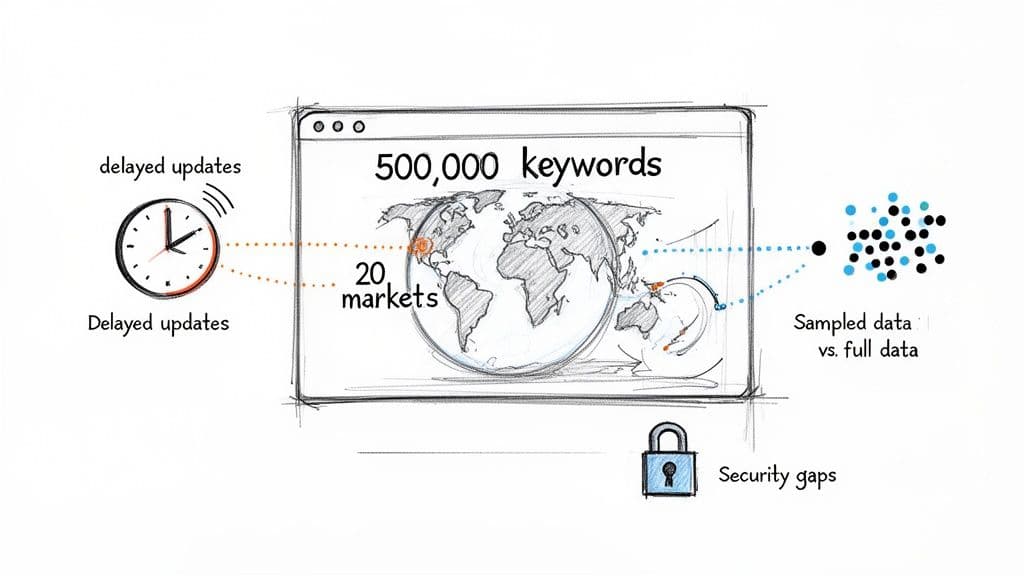
Think about a global e-commerce brand trying to track 500,000 keywords across 20 different countries. With a standard tool, the SEO team will hit a brick wall almost immediately.
The Inevitable Data Bottlenecks
The first problem you'll face is data integrity. To manage costs and server load, many standard platforms resort to data sampling for large keyword sets. This means you're making critical business decisions based on an incomplete picture. Updates are another huge issue—getting fresh data only once a week is a non-starter when SERPs can shift dramatically overnight.
You also lose crucial granularity. These tools often can't handle hyper-local rank tracking at scale. Good luck trying to accurately monitor a keyword's performance in Chicago versus London, on both desktop and mobile. This limitation makes it nearly impossible to roll out precise, region-specific SEO campaigns.
Security and Governance Gaps
Enterprises don't just have more data; they have more complex teams and stricter security rules. This is where standard trackers really show their weaknesses. They rarely offer the sophisticated user management features necessary to operate securely.
What's typically missing?
- Granular user permissions: The ability to give read-only access to a marketing VP while granting full editing rights to an in-house SEO specialist is often absent.
- Role-based access control (RBAC): This is non-negotiable for large teams. You need to ensure data is protected and prevent accidental changes to mission-critical projects.
- Audit logs: For compliance and accountability, you absolutely need a clear record of who changed what and when.
The real difference comes down to this: standard tools treat SEO data as a simple report to be viewed. Enterprises need that data to be a live, secure, and fully integrable asset. This shift in perspective makes a specialized enterprise rank tracker a competitive necessity, not just a nice-to-have.
This demand for better data infrastructure is fueling massive market growth. The enterprise search software market, which hit 5.79 billion**, is projected to reach an incredible **12.86 billion by 2035. This explosion is a direct reflection of businesses demanding more precise, scalable, and intelligent tracking solutions.
In the end, trying to manage enterprise SEO with a standard tool leads to inefficiencies, exposes you to security risks, and leaves you with dangerous strategic blind spots. For a deeper dive into how these platforms differ, check out our comparison of Attensira vs. Semrush. It’s the classic story of bringing the wrong tool for the job—a problem that a dedicated enterprise solution is designed to solve from the ground up.
Defining Your Enterprise Rank Tracking Requirements
Before you ever sit through a software demo or scan a feature list, the most important work happens internally. Jumping into the selection process for an enterprise rank tracker without a clear blueprint of your actual needs is the fastest way to end up with expensive, unused software. This isn't just about making a checklist; it's about making sure this powerful data engine plugs directly into your business goals and existing tech infrastructure.
A classic misstep is letting the SEO team's wish list drive the entire process. You need a much broader perspective. Think about who else will consume this data—brand managers tracking sentiment, product teams gauging interest, even the C-suite looking at market share. Getting this internal audit right from the start ensures you pick a platform that fuels company-wide strategy, not just one that spits out keyword reports.
Auditing Your Data Scale and Scope
First things first, you have to get a handle on the sheer volume of data you're dealing with. "We track a lot of keywords" is meaningless. You need to put hard numbers on your current and future scale, otherwise, you risk choosing a system that will crack under the pressure a year down the road.
Start by getting concrete answers to these questions:
- Keyword Volume: How many keywords are you tracking right now? What’s a realistic projection for the next 12-24 months? Don't forget to factor in new product launches or international expansion.
- Domain & Competitor Count: How many of your own domains, subdomains, and TLDs need to be monitored? Just as important, how many competitors do you realistically need to watch in each market?
- Search Engine Mix: Is this all about Google, or do you have a significant presence on Bing, Baidu, or even vertical engines like YouTube and Amazon? Every additional engine adds a new layer of complexity and cost.
Putting numbers to these questions gives you a solid baseline. For example, a global retailer might need to track 200,000 keywords across 15 country-specific domains while monitoring 5 key competitors in each region. That's a completely different universe from a B2B service tracking 20,000 keywords in a single country.
Determining Data Accuracy and Freshness Needs
Let's be clear: not all rank data is created equal. The two biggest differentiators at the enterprise level are accuracy and frequency. The real question you need to ask is: "How fast do we need to react when the SERPs shift?"
For some businesses, weekly data snapshots are perfectly fine. But if you’re in a volatile space like finance, e-commerce, or travel, daily—or even on-demand—data is essential. A major algorithm update or a competitor's surprise marketing blitz can change everything overnight. If you have to wait a week for your data to catch up, you've already lost.
Enterprise rank tracking is the strategic backbone for major brands, where precision influences revenue in the billions. This importance is reflected in the broader business software market, which surged from USD 660 billion to USD 737.3 billion in a single year, with projections hitting USD 1.28 trillion by 2031. Learn more about the growth drivers of the business software market.
Aligning With SERP Intelligence and Integration Goals
Finally, your requirements need to reflect today's search landscape and your company's existing technology. Simply tracking the position of a blue link is an outdated strategy. The real battle for visibility is won or lost in the rich SERP features that now dominate the results page.
Your platform evaluation must account for these modern realities:
- SERP Feature Tracking: Does the tool give you a clear picture of your visibility in AI Overviews, Featured Snippets, People Also Ask boxes, and Local Packs? If not, you're missing half the story.
- Integration Capabilities: How easily can you get the data out of the platform? Look for a robust API that lets you pipe ranking data directly into your business intelligence tools like Tableau or Google's BigQuery. Data trapped in a silo is nearly worthless.
- Workflow Alignment: Think about how this tool will actually fit into your team's day-to-day work. Does it support the kind of collaboration, reporting, and dashboarding your stakeholders are going to demand? You might want to explore the key features of an enterprise platform to get a sense of what's possible.
By defining these requirements upfront, you shift the procurement process from a simple feature bake-off to a true strategic evaluation. This is how you ensure the tool you choose becomes a long-term asset, not a short-term headache.
Evaluating Key Features For Scalability And Intelligence
Once you’ve laid out your business requirements, it’s time to get into the nitty-gritty of what separates a true enterprise platform from a standard tool with a higher price tag. The real difference isn't just about tracking more keywords; it's about investing in the infrastructure for scale, security, and genuine strategic insight. At this level, you’re buying a data engine, not just another reporting tool.
Features that are mere conveniences in smaller tools become absolute non-negotiables for an enterprise. Without them, your teams will inevitably get bogged down by manual data pulls, create security risks, and operate with an incomplete picture of the competitive landscape.
Robust API and Data Access
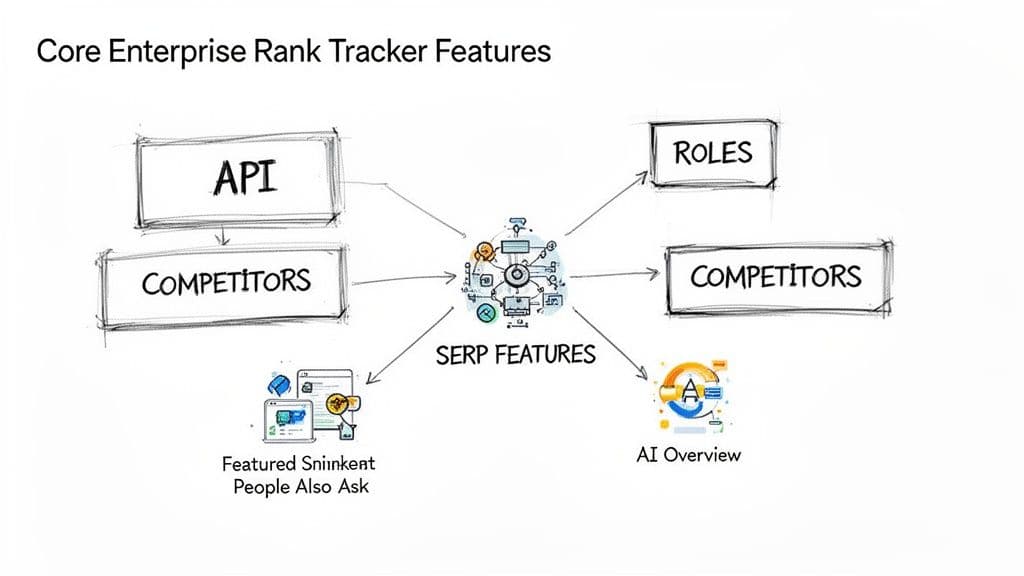
For any large-scale operation, the single most critical feature is a robust, well-documented API. An enterprise rank tracker that locks your data inside its own interface is a strategic dead end. The entire point is to weave SERP data into your wider business intelligence ecosystem, and that journey starts with programmatic access.
A powerful API unlocks so much potential. You can:
- Build custom dashboards: Pipe ranking data directly into tools like Tableau or Power BI. This lets you create executive-level reports that fuse SEO performance with actual business outcomes.
- Automate workflows: Imagine triggering a Slack alert for your content team when a high-value keyword group drops, or automatically creating a task in Jira.
- Enrich other data sets: Combine keyword visibility with data from your CRM or data warehouse to finally model the true ROI of your organic search efforts.
When vetting a vendor's API, don't stop at "Do you have one?" Dig deeper. Ask about rate limits, data schemas, and the specific endpoints they offer. The ability to pull granular data on demand is what elevates raw ranking information into a true business asset. For example, by combining API rank data with insights from your server, you can pinpoint technical SEO issues affecting visibility. You can get a better feel for this by learning how to use crawler log data effectively in our guide.
Granular User Roles and Permissions
In an enterprise environment, security and governance are non-negotiable. You simply can't have hundreds of users operating with the same level of access. This is where granular user roles become essential for protecting data integrity and preventing costly, embarrassing mistakes.
A proper enterprise platform must let you configure precise permissions. For instance, your marketing manager in Germany should only see data for the German market, while a global brand manager needs a consolidated view across all regions. It's a fundamental requirement.
Expert Tip: Look for a system that supports role-based access control (RBAC). This framework allows you to create custom roles—like "Content Analyst" or "Executive Viewer"—with specific, tailored permissions. This ensures people only see the data and features relevant to their job.
This isn't just about locking things down; it's about creating a more focused and efficient user experience. By tailoring the interface to each person's role, you cut through the clutter and help your teams get to the insights they need, faster.
Next-Generation SERP Intelligence
Let's be honest: tracking traditional blue-link rankings isn't enough anymore. Today’s search results are a complex, dynamic mix of SERP features, and your rank tracker has to be able to deconstruct it all. The move toward AI-enhanced enterprise rank tracker software is a huge leap forward, giving teams the tools to navigate modern SERPs with new accuracy.
The numbers don't lie. Generative AI in enterprise software exploded by 320.4% in just one year, with 72% of organizations now using tools that track beyond Google to AI answer engines.
Your evaluation must prioritize platforms that can monitor visibility within these critical areas:
- AI Overviews: Is your brand being mentioned, cited, or even featured in AI-generated answers? This is the new frontier of brand visibility.
- Featured Snippets: Who actually owns "position zero" for your most important queries?
- People Also Ask (PAA) Boxes: Are you answering the questions your audience is really asking? Tracking PAA is a goldmine for your content strategy.
Platforms like Attensira are built from the ground up for this modern search environment, giving you a far more accurate benchmark of your true visibility than any old-school ranking report. Beyond just tracking, large organizations need to integrate with advanced AI SEO tools and services that offer predictive analytics. This is the level of SERP intelligence that allows you to shift from just tracking positions to strategically managing your brand’s entire presence in search.
Essential Feature Evaluation Checklist For Procurement
To help streamline your procurement process, use this checklist to score potential vendors against the features that truly matter for an enterprise-level deployment. It provides a structured way to ensure marketing and procurement are aligned on what "good" looks like.
By systematically working through these questions, you can move beyond slick sales pitches and make a data-driven decision based on the capabilities that will deliver long-term value.
Integrating Rank Data Into Your Business Intelligence Ecosystem
Ranking data is far too valuable to be locked away in a siloed SEO platform. Its true power is only unleashed when you start treating it as a core business intelligence asset—one that adds critical context to every other dataset your company collects. The objective here is to finally bridge the gap between marketing performance and actual business outcomes, shifting the conversation from keyword positions to revenue impact.
This requires a clear plan to connect your enterprise rank tracker software to your company’s wider data stack. When SERP data flows freely into BI platforms, data warehouses, and even your CRM, you can build a truly holistic, data-driven view of performance. This isn't just about fancier reports; it's about making smarter, faster business decisions.
Connecting to Your BI and Analytics Platforms
The first and most critical move is to pipe your ranking data directly into the tools your leadership team already uses every day. If your stakeholders live and breathe in Tableau, Power BI, or Looker Studio, that's exactly where your SEO performance data needs to be. Forcing them to log into yet another platform just creates friction and ultimately dilutes the data's impact.
A robust API from your rank tracker is what makes this possible. With a solid API, you can:
- Visualize Performance: Build dynamic, executive-ready dashboards showing how SERP visibility in key markets directly correlates with website traffic and engagement metrics from Google Analytics.
- Layer SEO on Business Data: Overlay Share of Voice metrics on top of regional sales figures. Now you can finally see if there’s a real connection between your market visibility and revenue.
- Automate Reporting: Put an end to the soul-crushing task of manually exporting CSVs and pasting them into spreadsheets. Automated data flows mean everyone is always working with the most current information.
From Data Warehouse to Holistic Insights
For companies with a more mature data strategy, the next logical step is feeding SERP data into a central data warehouse like Google BigQuery, Snowflake, or Amazon Redshift. This is where you can start doing some truly advanced analysis by joining your SEO data with information from completely different parts of the business.
Think about the possibilities. You could combine hyper-specific, daily ranking data for a product category with sales conversion data straight from your CRM. This lets you move beyond estimated click-through rates and calculate the actual ROI of your content for specific keyword clusters.
A day-by-day record of rankings lets you align analytics data with SERP performance with incredible precision. When you can correlate a specific rank change with a subsequent shift in traffic or leads, you elevate SEO from a marketing expense to a predictable driver of business growth.
This level of integration proves, with hard numbers, how a 3% increase in SERP visibility for "industrial automation solutions" directly contributed to a 5% lift in qualified leads the following quarter. That’s the kind of analysis that gets you a seat at the table during budget meetings.
A Practical Integration Playbook
Turning ranking data into a business asset requires a methodical approach. It’s not about flipping a switch; it's about building a sustainable data pipeline that serves stakeholders across the entire company.
Here’s a structured way to approach it:
- Identify Stakeholders and Their Questions: Start by talking to leaders in sales, product, and finance. What business questions could SEO data help them answer? The sales team, for instance, might want to know if poor organic visibility is hurting lead flow in a new territory.
- Map Your Data Ecosystem: Get a clear picture of your primary sources of truth. Where does sales data live? Web analytics? Customer data? Understanding this map is essential before you can plan any integrations.
- Prioritize Your Integration Points: Don't try to connect everything at once. Start with the highest-impact integration, which is often linking your rank tracker to your main BI tool (like Tableau). This delivers immediate value and builds momentum for the project.
- Develop Core Dashboards: Work with your BI team to build a set of foundational dashboards. Think about an "Executive Summary" view for the C-suite and more granular "Performance Deep Dive" dashboards for the marketing and content teams.
- Enrich and Expand: Once that initial pipeline is stable, start enriching it. Pull in competitor spending data, paid ad performance metrics, and even product inventory levels to create a truly comprehensive view of market dynamics.
Following this process elevates your enterprise rank tracker software from a simple monitoring tool to the central nervous system of your digital marketing intelligence. It’s how you prove that every shift in the SERPs has a direct and measurable impact on the company’s bottom line.
Navigating The Procurement And Rollout Process
Choosing the right enterprise rank tracker is a huge step, but honestly, it’s just the starting line. The real challenge is getting from that vendor handshake to full, enthusiastic adoption across your teams. This isn’t just about installing software; it’s a full-blown change management project that demands a solid strategy for procurement, a smart pilot test, and a carefully planned rollout.
Get this part wrong, and even the most powerful platform will end up as expensive shelfware. The goal is to weave the new technology into your team’s daily workflow from the very beginning.
Crafting An Effective RFP And Business Case
Your Request for Proposal (RFP) is the first real filter. Forget generic feature checklists—they’re useless. You need to ask sharp, specific questions that force vendors to prove they can solve your actual problems.
Get them to respond to real-world scenarios in the RFP. Try something like this:
- Data Validation: "Describe your process for verifying SERP data accuracy for zip code-level tracking in Chicago. Provide a sample data set we can validate."
- API Scalability: "What are the rate limits and typical latency for pulling 100,000 keyword positions daily via your API? Show us the documentation."
- Security Compliance: "Detail how your platform complies with GDPR and CCPA, specifically regarding data residency and user data deletion protocols."
While the RFP is out, you need to be building a rock-solid business case for your execs. Don't talk about rankings; talk about ROI. Connect the software's features to business outcomes, like capturing market share, getting better competitive intel, or finally proving marketing's impact on revenue. If you're wondering what to expect, it helps to see how enterprise software pricing is structured.
The Critical Role Of Pilot Testing
Never, ever commit to a full deployment without a rigorous pilot test. This is your chance to see if the vendor's sales pitch holds up in your environment. A pilot isn't just about a quick demo; it’s about putting the software under serious pressure with your most challenging use cases.
Pick a specific, high-stakes part of your business for the test—maybe one product line in a key international market. Then, assemble a small team of power users from different departments who will give you brutally honest feedback.
A successful pilot should answer one simple question: Does this tool give us more accurate, actionable data than our current solution, and can it do so reliably at scale? If the answer is anything less than a resounding 'yes,' it's a major red flag.
Zero in on data accuracy and workflow integration during the pilot. Do the SERP results match what you see when you check manually? How painful is it to pipe the data into your existing BI dashboards? This hands-on validation is the only way to avoid a very expensive mistake.
The best-case scenario is a seamless data flow, where the tracker becomes a core part of your intelligence stack.
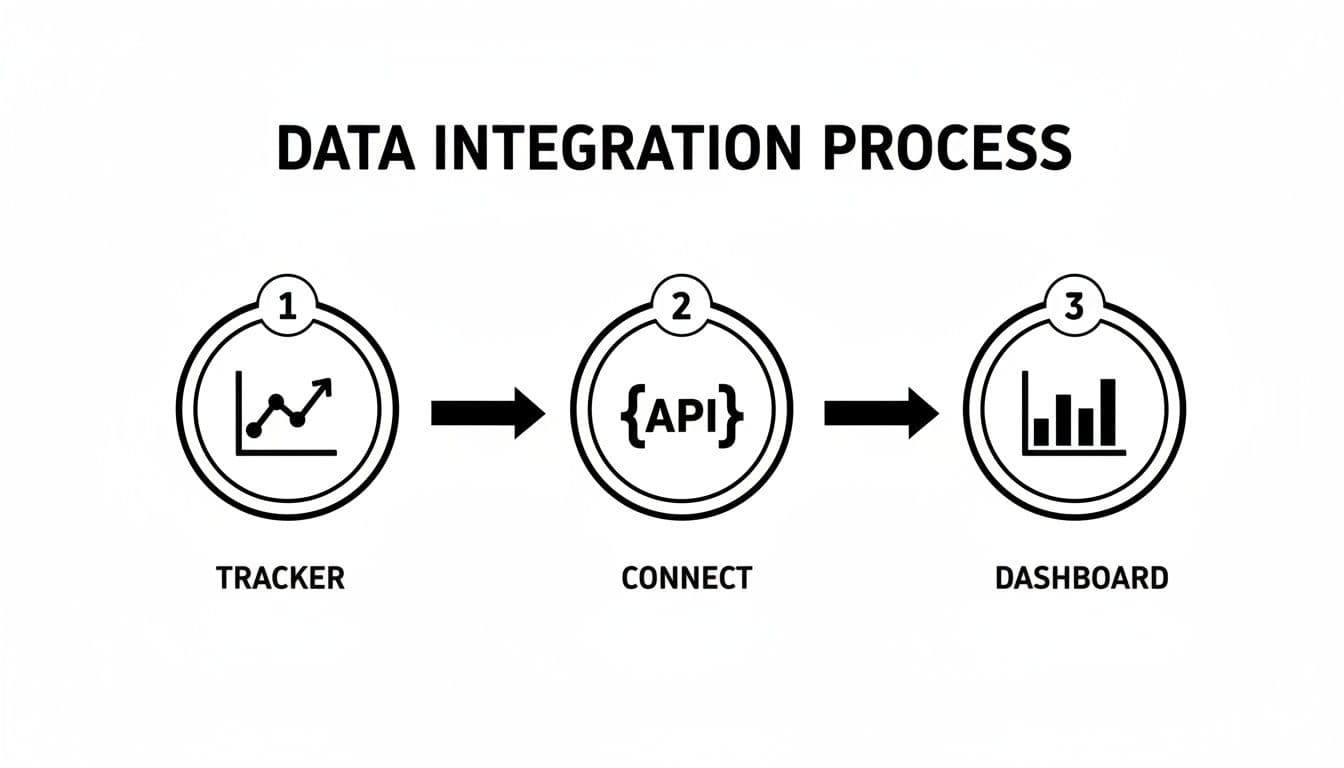
This is what you're aiming for—a process that turns raw SERP data into a strategic asset through a clean API connection.
Designing A Phased Rollout Plan
Once you've picked your platform and the pilot was a success, fight the urge to flip the switch for everyone at once. A phased rollout is much smarter. It minimizes chaos, lets you gather feedback, and creates internal champions who can help you drive adoption.
Structure your rollout in logical stages:
- Core Team First: Start with your central SEO and marketing analytics teams. These are the people who will become the in-house experts and the go-to support for everyone else.
- Expand to a Business Unit: Next, roll it out to a single business unit or a specific regional marketing team. Use what you learned from the first group to make the training and documentation even better.
- Wider Access for Stakeholders: Finally, open up read-only access for executives, brand managers, and product teams. Give them custom dashboards that show only the high-level KPIs they actually care about.
Following this path de-risks the entire implementation. Your new enterprise rank tracker software will become a critical piece of your organization’s data infrastructure, not just another tool that nobody uses.
Measuring ROI and Proving Value to Stakeholders
You’ve done the hard work and secured the budget for a top-tier rank tracker. That's a huge win, but now the real test begins: proving its worth. Let’s be honest, leadership isn’t impressed by "average rank." They want to see gains in market share, more qualified leads in the pipeline, and ultimately, a healthier bottom line.
Your mission is to translate all that rich SERP data into a compelling story of financial return. This is about shifting the entire conversation from technical SEO metrics to the kind of business outcomes that get discussed in the boardroom. We need to connect the dots between visibility and real-world value.
Beyond Rankings to Market Share
The single most effective way I've found to demonstrate impact is by focusing on Share of Voice (SOV). This metric is a game-changer because it reframes the discussion from our performance to our dominance in the market. Instead of just tracking individual keywords, SOV calculates your brand's total visibility across a crucial set of terms compared to all your competitors.
Think about the impact of this. You walk into a meeting and show the CMO a chart revealing your SOV for "cloud security solutions" jumped 15% last quarter, directly at the expense of your biggest rival, whose share fell by 10%. That’s not an SEO report; that's a story of competitive conquest. It immediately elevates SEO from a marketing tactic to a strategic intelligence function.
Connecting SERP Data to the Sales Pipeline
Ultimately, the rubber meets the road when you can tie SEO performance directly to leads and revenue. This is where the integration between your rank tracker, analytics platform, and CRM becomes mission-critical. By modeling click-through rates (CTR) based on SERP position—and now, factoring in appearances in AI Overviews—you can put a real dollar figure on your organic presence.
When you can show that a 5-point increase in visibility for a bottom-funnel keyword cluster correlated with a $150,000 increase in sales-qualified leads, you've successfully proven ROI. This is the data that justifies budget increases and solidifies SEO's role as a primary revenue driver.
Imagine your CMO presenting a dashboard that clearly shows the organic channel—powered by precise tracking data—was responsible for 25% of the entire net-new sales pipeline last quarter. That kind of hard data silences any skepticism and turns SEO into a celebrated business driver.
Here are a few ways to make this connection undeniable:
- Track AI Answer Visibility: Start monitoring how often your brand appears in AI Overviews for your most valuable keywords. This is a critical new touchpoint in the buyer's journey.
- Segment by Funnel Stage: Don't lump all your keywords together. Report on the ROI of top-of-funnel content (which builds awareness) separately from your bottom-of-funnel terms that are driving immediate conversions.
- Create Executive Dashboards: Build simple, visual reports. Focus on SOV trends over time, the estimated traffic value of your rankings, and organic's direct contribution to lead generation.
To truly nail this, you need a solid framework to measure marketing ROI. To get a quick estimate, you can use our simple tool to calculate your potential payback period. Taking this approach transforms your enterprise rank tracker from a line item on the budget into an indispensable engine for business growth.
Frequently Asked Questions
How Much Does Enterprise Rank Tracker Software Typically Cost?
This is a classic "it depends" scenario, but I can give you some real-world figures. Pricing really hinges on a few key factors: how many keywords you need to track, how many user seats you need, and whether you require API access.
For a smaller enterprise dipping its toes in, plans might begin in the 700-1,000 per month range. However, for a large corporation with a massive keyword footprint—we're talking hundreds of thousands of terms—the investment can easily climb from 2,000 to well over 10,000 a month. My best advice? Never go by the sticker price on a website; always get a custom quote that's built around your specific data and scale requirements.
What Is The Difference Between Share Of Voice And Average Ranking?
This is a crucial distinction that separates amateur SEO from professional strategy. Average ranking is, frankly, a vanity metric. It's just a simple mathematical average of where you rank for a list of keywords, and it can be incredibly misleading.
Share of Voice (SOV), on the other hand, is where the real insight lies. It’s a much smarter metric that calculates your brand's total visibility across a keyword set compared to everyone else you're competing against. Most sophisticated SOV models will weigh your rankings by search volume and even estimated click-through rates, giving you a far more accurate picture of your actual market share on the SERP.
Can These Tools Track Rankings In AI Overviews?
Yes, and if a tool can't do this in today's environment, you should walk away. This is no longer a "nice-to-have" feature; it's absolutely critical.
The leading enterprise rank trackers have already built-in capabilities to monitor your visibility within Google's AI Overviews and other generative AI search results. This isn't just about seeing if your link shows up; it's about understanding how your brand is mentioned and positioned in these new answer formats. This is precisely where specialized, forward-thinking platforms show their true value.
Ready to master your visibility in an AI-first world? See how Attensira provides the SERP intelligence enterprises need to dominate search. Discover our platform at https://attensira.com.