Master competitor keyword tracking to monitor SERPs, uncover content gaps, and drive B2B growth with AI-powered insights.
Not long ago, competitor keyword tracking was a straightforward affair focused entirely on Google rankings. Today, it’s a whole different game. We’re now fighting a two-front war: one to defend our turf on traditional search engine results pages (SERPs) and another to win visibility inside AI-generated answers from tools like ChatGPT and Perplexity.
The New Battlefield for Brand Visibility
Think of your digital strategy as operating in two completely different markets. The first is the familiar, high-volume world of Google Search—a mature ecosystem with well-established rules of engagement. The second is the new and rapidly growing market of AI answers, a frontier where the playbook is still being written.
If you’re only paying attention to the first, you're building a strategy on borrowed time. While traditional search is still the undisputed king of traffic, the rise of AI as a primary information source is a trend no one can afford to ignore. For B2B companies, this means tracking how your brand and content appear in AI responses needs to be just as rigorous as monitoring your SERP rankings. It's the new baseline for staying competitive.
The Duality of Modern Tracking
The entire landscape has shifted. Keeping tabs on brand mentions within large language models is now just as critical as watching your keyword positions on Google. It’s easy to look at the numbers and get a false sense of security. Industry data shows Google still drives 345 times more referral traffic than the three biggest AI platforms combined.
But don't let that massive lead fool you. While AI referral traffic is small today, its growth is accelerating. It's a leading indicator of where your audience is headed.
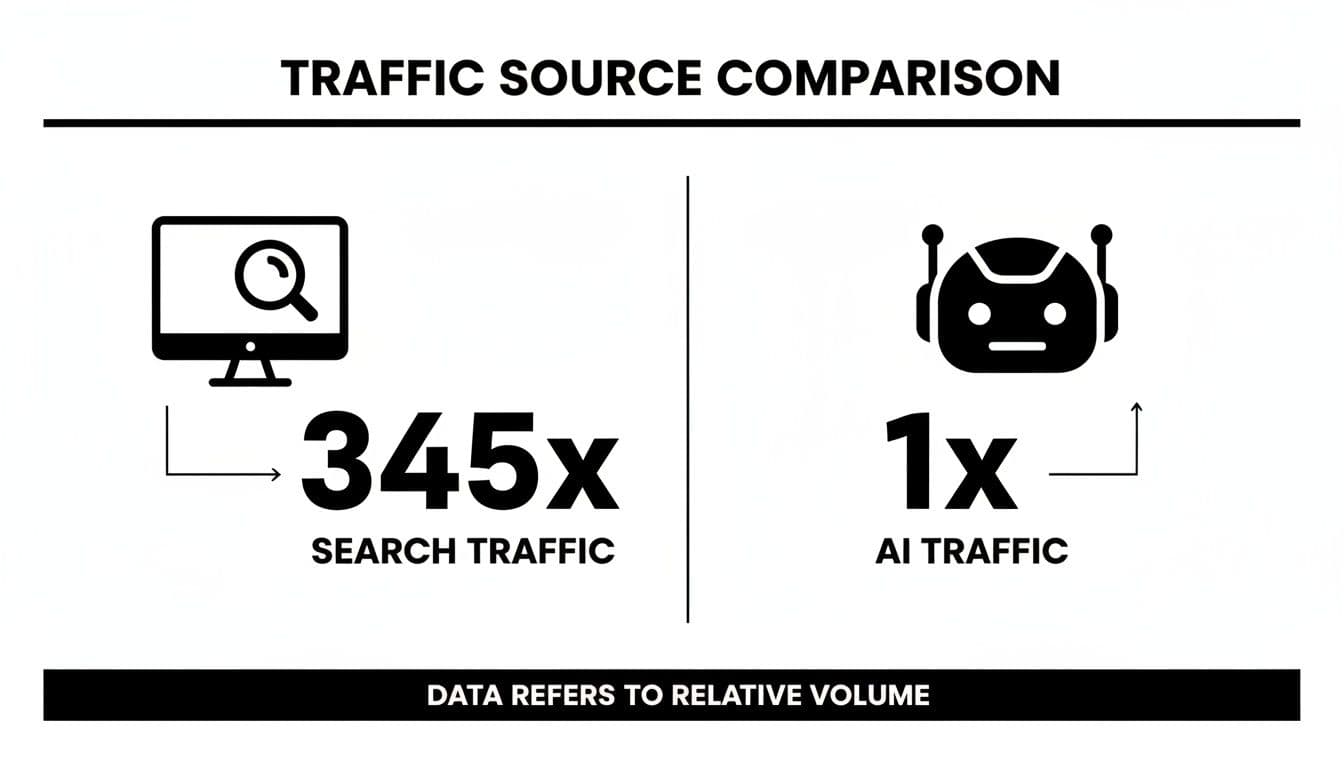
This gap doesn't just show Google's current strength; it highlights the ground-floor opportunity that AI-driven discovery represents.
To navigate this dual environment, you need a tracking strategy that accounts for both SERPs and AI responses. The table below breaks down the distinct objectives and metrics for each.
SERP vs AI Response Tracking at a Glance
This split approach is essential because it reflects how your customers are now looking for information. One person might want a list of links to compare options, while another just wants a direct, synthesized answer from an AI.
Why Both Fronts Matter
A modern competitor keyword tracking strategy must address this fragmented behavior. Your visibility goals are now twofold:
- SERP Visibility: This is still your bread and butter for driving high-intent traffic directly to your site. Ranking on page one remains a core objective for capturing users ready to act.
- AI Visibility: This is about shaping the narrative and building your brand's authority. Being cited in an AI answer positions you as an expert and captures audiences early in their journey, often in a https://attensira.com/glossary/zero-click-search environment where the AI provides the answer directly.
In this new landscape, visibility isn't just about ranking—it's about influence. Being the source that powers an AI's answer can be more valuable than just being the top blue link.
This thinking extends beyond just organic search. A comprehensive Google Ads competitor analysis provides a crucial parallel, showing how paid strategies must also adapt. The ultimate goal is to ensure your brand is the definitive answer, no matter where your customers are asking the question.
Setting Objectives That Drive Business Growth
Truly effective competitor keyword tracking isn’t about the aimless pursuit of a number one ranking. It’s about connecting your efforts to clear business objectives. The goal is to build a strategic framework where every keyword you track and every move a competitor makes gives you intel to drive tangible outcomes.
Think of it as a business intelligence operation. You aren't just collecting data; you're gathering insights to make smarter decisions. Are you trying to steal market share from a key rival? Pinpoint weaknesses in their content? Or maybe uncover new avenues for product-led growth? These are the real questions that should guide your work.
Without that strategic direction, you're just drowning in data. A long list of competitor rankings is pure noise until you tie it to a specific purpose. Your objectives are the filter that separates meaningless fluctuations from genuinely actionable insights.
Defining Your Core Strategic Goals
Your goals for competitor keyword tracking need to be specific, measurable, and tied directly to what moves the needle for the business. Instead of a vague goal like "beat Competitor X," you should be aiming for precise outcomes that build a real competitive advantage. This clarity is what ensures your tracking efforts deliver a clear return on investment.
Try framing your goals around these strategic pillars:
- Market Share Expansion: This is a direct play to capture traffic for high-intent keywords currently owned by your competitors. It means identifying their top-performing commercial terms and then creating superior content or offers to win over that exact audience.
- Content Weakness Exploitation: Here, you're actively hunting for gaps, outdated information, or poor user experiences in your competitors' content. The objective is to exploit those weaknesses by building more comprehensive, valuable, and authoritative resources that both Google and your audience will naturally prefer.
- Product-Led Growth Discovery: This involves tracking keywords related to problems your product solves—especially queries like "alternative to" or "how to." The goal is to uncover new use cases and customer pain points that can inform not just your content, but your entire product strategy.
This dashboard from Attensira shows how you can quantify visibility and market share across different AI topics, giving you a clear picture of where you stand. The real power here is moving beyond a single keyword to measure your "Share of Voice" across a whole strategic topic. That's how you turn a vague goal into a measurable KPI.
Translating Goals into Measurable KPIs
Once you've set your strategic objectives, you need the right Key Performance Indicators (KPIs) to actually measure progress. These are the metrics that make your goals tangible and give you the hard data to prove the value of your work. Good KPIs transform abstract goals into concrete performance benchmarks.
Your KPIs are the bridge between your tracking activities and your business impact. They prove that your SEO efforts are not just an expense but a direct contributor to revenue and market position.
Here are a few powerful KPIs to get you started:
- Share of Voice (SoV) Growth: Instead of just obsessing over individual ranks, track your brand's total visibility across a basket of strategic keywords against your competitors. For instance, a solid objective could be to increase your SoV from 15% to 25% for a specific product category over the next six months.
- Competitor Movement on "Alternative to" Keywords: Keep a close watch on your rank—and your competitors'—for terms like "[Competitor Name] alternative." When their rank drops and yours climbs, it's a direct signal that you're capturing high-intent, bottom-of-funnel traffic.
- CTR from Tracked Commercial Terms: Measure the click-through rate from SERPs for the high-value commercial keywords you're actively targeting. An increasing CTR shows that your titles and descriptions are resonating better than the competition's. You can dig deeper into the connection between search visibility and the potential AI traffic value you might be missing.
How to Find High-Value Competitor Keywords
The most powerful strategic insights often come from the keywords you aren’t even tracking. Finding these hidden gems takes a methodical approach, a bit like a prospector panning for gold. Your competitors' domains are the riverbeds, and they’re full of nuggets—the very keywords driving their most valuable traffic.
This isn't about chasing obvious, high-volume terms. It's about finding the keywords that signal serious commercial intent. These are the searches people make right before they open their wallets, and winning them can have a massive impact on your bottom line.
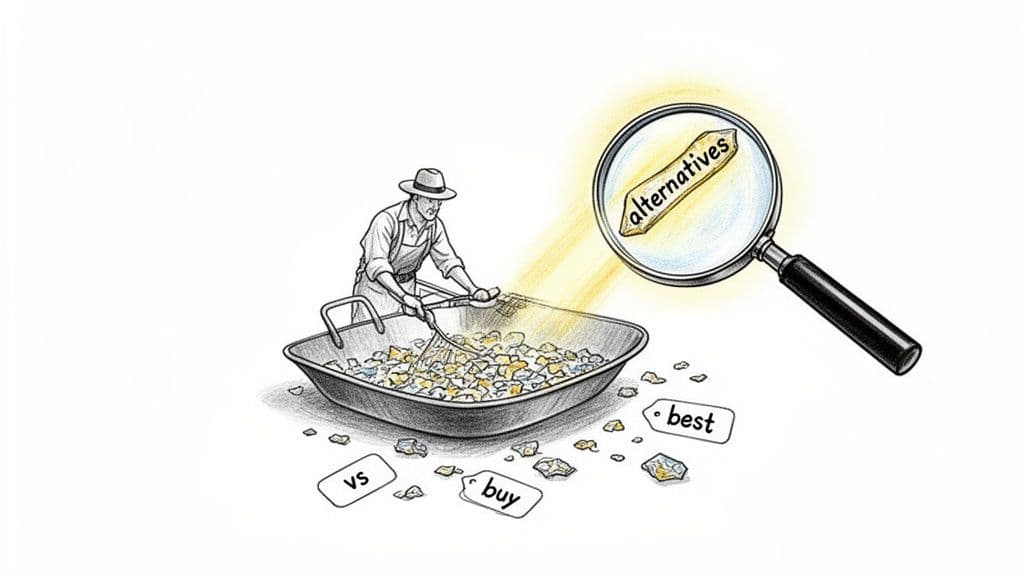
The trick is to focus your competitor keyword tracking on specific categories that show you exactly where your rivals are winning. By looking closely at their digital footprint, you can essentially reverse-engineer their content strategy and spot the opportunities you've been missing.
Start with a Broad Domain Analysis
First things first: you need a high-level view of your competitor's entire keyword profile. Grab your favorite SEO tool, plug in a competitor's domain, and pull a full list of every keyword they rank for. This initial export will likely be huge and messy, filled with thousands of terms.
Don't panic. Your job isn't to target everything. You're simply gathering the raw material, looking for broad patterns and interesting query types that fit your own business goals.
Think of it as creating a topographic map of their territory. You aren't exploring every inch on foot just yet—you’re identifying the major landmarks and promising areas to investigate further.
Filter for High-Intent Keyword Categories
Now it's time to sift through that mountain of raw data. The objective here is to isolate keywords that scream "I'm ready to buy." These terms are often the most valuable pieces of traffic you can capture because the user is deep into their decision-making process.
Zero in on these three crucial categories:
- "Alternatives" Keywords: These are direct shots, like "[Competitor Name] alternative" or "cheaper alternative to [Competitor Product]." A user searching this is actively looking to switch. Ranking here allows you to intercept a customer at the very last second.
- Comparison Keywords: When someone searches for "[Your Product] vs [Competitor Product]" or "compare [Product A] and [Product B]," they're weighing their options. Owning these terms gives you the power to control the conversation and frame your product as the superior choice.
- Problem-Based Queries: These are searches focused on a pain point your product solves, such as "how to fix [common problem]" or "software for [specific task]." These users might not even know a solution like yours exists, making it the perfect moment to introduce your brand.
By prioritizing these keyword types, you shift from a defensive strategy to an offensive one. You’re no longer just protecting your own brand terms; you're actively poaching customers from your competition.
Find the Low-Volume, High-Value Opportunities
Too many marketers get fixated on keywords with massive search volume, completely overlooking the goldmine of less popular terms. This is a huge strategic mistake. The reality is that the search landscape is dominated by low-volume queries, which almost always convert at a higher rate.
The real opportunity in competitor keyword tracking isn't just finding what your competitors rank for, but discovering the profitable, low-competition keywords they might be neglecting.
Search behavior data shows that nearly 74% of all keywords get 10 or fewer searches per month. In a 2026 study analyzing 1,000 "alternatives" keywords—a critical SaaS category—the average search volume was just 128.8 per month with a keyword difficulty of only 17.1. This points to a massive, under-the-radar opportunity to target these specific, high-intent phrases.
These terms are typically long-tail keywords. They're more specific, and the person searching is usually much closer to making a purchase.
Build Your Master Keyword List
The final step is to pull all your findings together into a master keyword list. This document becomes the blueprint for your content strategy and ongoing tracking. I recommend organizing it by competitor and then by keyword category (alternatives, comparison, problem-based).
For each keyword, make sure you track these key metrics:
- Competitor's current rank
- Your current rank (if any)
- Monthly search volume
- Keyword difficulty
This structured list is far more than just data; it's your strategic roadmap. It shows you exactly where the competitive gaps are, what content you need to create or update, and how to prioritize your work for the biggest impact. This is how you turn simple analysis into a concrete plan for stealing market share.
Implementing a Continuous Monitoring System
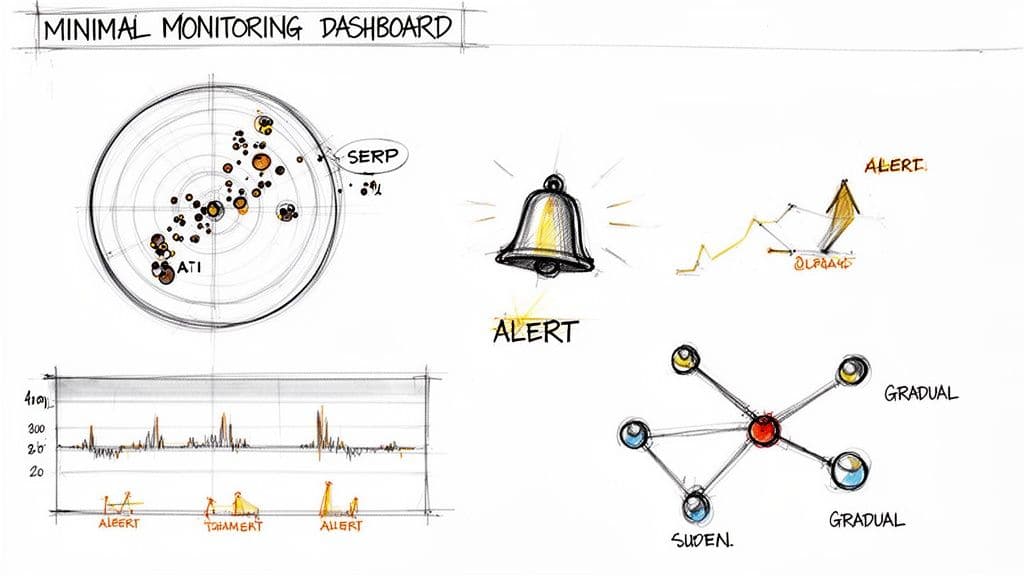
Tracking your competitors' keywords isn't a one-and-done project. It’s an ongoing intelligence operation. To do it right, you need to build a system that actively monitors the landscape, transforming a reactive reporting chore into a proactive, strategic advantage.
Think of it as the difference between a simple security camera and a full-blown security system for your digital turf. One just records what happened yesterday; the other alerts you to threats the moment they appear, catching both gradual shifts and sudden attacks so you can respond immediately.
This system needs to watch two battlegrounds at once: the traditional search engine results pages (SERPs) and the new frontier of AI-generated answers. Without this constant vigilance, you're flying blind. You’ll only discover a rival's winning strategy months after they've already run away with the market share you should have been defending.
Configuring Your SERP Monitoring Alerts
The first layer of your defense system is watching keyword rankings on search engines like Google. Daily fluctuations are mostly noise, but some changes are true signals that demand your attention. A solid monitoring setup automates this process, so you can stop wasting time on manual spot-checks.
Your main goal here is to set up alerts for significant rank changes—both for you and your competitors. These are the triggers that warrant a closer look and a potential response.
Consider setting up these kinds of automated notifications:
- Major Rank Drops: Get an alert when you fall out of the top three or off the first page for a crucial commercial keyword. This could point to a competitor's new content push or a shift in Google's algorithm.
- Competitor Surges: Be notified when a competitor makes a big jump in the rankings for one of your core terms, especially if they crack the top five. This is a direct threat that needs to be investigated right away.
- New SERP Entrants: Alerts for when a new website shows up on page one for your target keywords. This helps you spot emerging rivals before they become a serious problem.
By automating these alerts, you free up your team from the grind of manually checking ranks. Your time is far better spent figuring out why the rankings shifted and what you're going to do about it.
Expanding Monitoring to AI Mentions
While SERP tracking is familiar territory, keeping an eye on your brand's presence in AI-generated answers is a new—and equally critical—discipline. AI models are constantly being updated, and the sources they pull from can change overnight. If you aren't watching, you won't even know you've been dropped from a key answer.
This is where a specialized system for competitor keyword tracking in AI becomes non-negotiable. The objective is to spot "mention gaps"—times when a user's query gets an answer that cites your competitors but leaves you out. These gaps are your next big opportunities.
Set up your monitoring to flag these specific scenarios:
- Direct Competitor Mentions: Get an alert anytime a competitor is name-dropped as a solution to a problem you also solve. For example, if a user asks for the "best CRM for small businesses" and the AI mentions two of your rivals, you need to know.
- Loss of a Citation: If your brand was previously cited for a topic but has disappeared from recent AI responses, that's a red flag. It signals a potential loss of authority that you need to fix.
- New Source Citations: Track when AI models begin citing new sources or competitors for topics relevant to your business. This is often the earliest sign of a new content strategy that you'll have to counter.
You can get a deeper look at how to build this kind of advanced monitoring with our guide to AI prompt tracking. This proactive approach ensures you're never caught off guard, allowing you to react swiftly and turn market shifts into a source of competitive strength.
Turning Tracking Data into Tactical Plays
Gathering data on your competitors' keyword rankings and AI mentions is a great start, but it's just that—a start. Without a clear plan, that data is just a collection of interesting facts. The real value comes when you have a playbook of 'if-then' scenarios ready to go, turning every insight into a decisive action.
Think of it this way: the data tells you what is happening on the search battlefield. Your tactical plays decide what you’re going to do about it.
For example, you might notice a competitor is dominating a high-value keyword because they offer a free template or a handy calculator. Your move isn't just to make your own version. It's to build something far better—more comprehensive, easier to use, and more aligned with what the user truly wants to accomplish. This is how you shift from passively monitoring your rivals to actively outmaneuvering them.
The Keyword Gap Analysis Playbook
One of the most powerful plays in your arsenal is the keyword gap analysis. This isn't about creating another long, intimidating spreadsheet of keywords. It's about turning that raw data into a prioritized content calendar designed to systematically steal traffic from your competition.
Imagine finding valuable, unclaimed territories on a map that your rivals already control. A keyword gap analysis is your guide to conquering them.
Here’s a simple, four-step process to put this into action:
- Identify the Gaps: Start by exporting the keywords your top three competitors rank for in the top 10 positions, but where your own site is nowhere to be found. This list is pure opportunity.
- Qualify the Keywords: Not every gap is worth your time. Filter this list to find terms with real commercial intent—look for modifiers like "pricing," "software," "service," "alternative," or "vs." You should also focus on keywords with a manageable difficulty score where you have a fighting chance.
- Group by Intent: Instead of looking at a huge list of individual keywords, start clustering them into topic groups. For instance, "project management software for remote teams" and "best remote work PM tool" both point to the same user need and can be targeted with a single, authoritative piece of content.
- Prioritize and Execute: Now, rank these topic clusters by their potential business value. The cluster at the top of your list becomes your next big content project—whether that's a new landing page, a deep-dive guide, or a head-to-head comparison article. This simple process turns a chaotic list into a clear roadmap. To learn more about building pages that win, it's worth exploring the core principles of content optimization.
The AI Mention Gap Playbook
While a keyword gap is about traditional SERP rankings, the mention gap is about your visibility inside AI-generated answers. This is a newer, but just as critical, competitive front. A mention gap is what happens when a generative AI model cites your competitors for a relevant topic but completely ignores your brand.
Closing this gap means positioning your brand as an indispensable source of truth that AI models can't help but reference.
In the world of AI search, being the brand that powers the answer is the new number one ranking. A mention gap analysis is your blueprint for achieving that status.
Your playbook here is all about creating and structuring content that fills specific informational voids. The goal is to make your content so clear, authoritative, and well-organized that AI models see it as the most reliable source available.
To help tie all this together, here is a simple playbook showing how to translate specific competitive insights into concrete marketing actions.
Competitor Insight to Action Playbook
As you can see, every piece of data from your tracking efforts can trigger a specific, high-impact response. This strategic approach ensures you’re always playing offense, not defense.
Using Specialized Tools for AI-Centric Tracking
Traditional SEO platforms are still workhorses for SERP analysis, but they weren't built for the nuances of AI search. This new world of competitor keyword tracking demands a more specialized toolkit. We're seeing the rise of platforms designed from the ground up for AI-driven search, and they offer a serious edge. Their entire purpose is to pull actionable intelligence from AI-generated answers, not just bolt on AI tracking as an afterthought.
A platform like Attensira, for instance, is built specifically to monitor brand visibility within this new ecosystem. It’s designed to catch the subtle but critical ways your brand—and your competitors—are framed in the AI responses that are quickly becoming the first point of contact for many users.
From SERP Data to AI Intelligence
This isn't just a new feature; it's a completely different way of measuring what matters. A classic SEO tool might flag a drop from position three to four—important, but not catastrophic. An AI-centric tool, on the other hand, can alert you that your brand was just dropped entirely as a source from a crucial AI-generated answer. That’s a far more significant strategic threat.
To get a full picture, using the best tools for SEO analysis is still essential for broad competitive insights. But a specialized platform is what connects the dots in the AI space. A B2B SaaS company, for example, can plug in its domain and immediately start tracking its AI presence, pinpointing exactly where competitors get mentioned and they don't. These are glaring content and authority gaps that need to be filled.
In an AI-first world, being the source of truth is the new #1 ranking. Specialized tools are no longer a luxury—they are the only way to measure and improve your position as that source.
Bridging the Gap from Problem to Solution
This focused approach does more than just highlight problems; it shows you how to fix them. Once a "mention gap" is found, the platform doesn't just leave you with the bad news. It digs into the context of the AI response and provides concrete recommendations for creating content that fills that specific informational need.
The process is all about creating a clear path forward, as this diagram shows. It visualizes how you can turn a gap in AI mentions into a pipeline for actionable content recommendations.
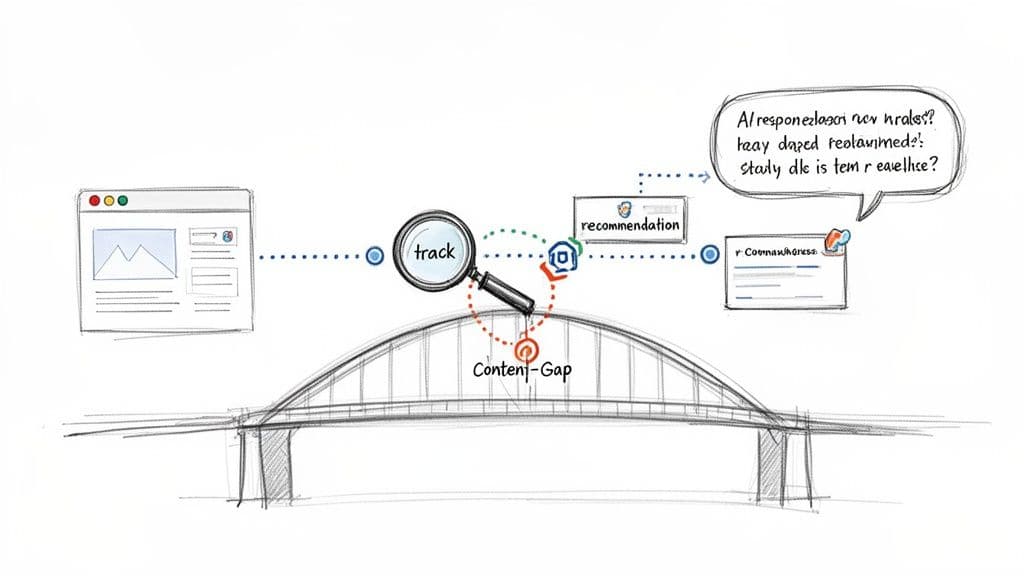
Herein lies the real value: you move from simply identifying an issue—like a competitor owning a key AI answer—to deploying a precise solution. It bridges the chasm between spotting a problem and actually creating the content needed to solve it. This ensures your competitor keyword tracking efforts translate directly into winning back visibility and market influence.
Frequently Asked Questions
As you start tracking competitors across both traditional search and new AI engines, a few practical questions always come up. Here are some of the most common ones we hear, along with straightforward answers to help you get started.
How Often Should I Update My Competitor Keyword List?
For your core keywords—the ones directly tied to your products and most important marketing campaigns—a quarterly review is a great rhythm. It’s frequent enough to keep pace with market shifts or new product launches without becoming a constant fire drill.
But when it comes to finding new opportunities, discovery never stops.
Think of your keyword list as having two parts: a stable core of high-value terms you defend, and a dynamic outer ring where you're constantly exploring new opportunities.
This is where automated monitoring becomes so valuable. It can flag emerging trends and competitor wins in real-time, giving you the agility to react quickly while your core strategy remains stable.
What Is The Difference Between Keyword Gap And Mention Gap Analysis?
This is a fantastic question. While they sound similar, they're focused on two completely different battlegrounds for visibility.
- Keyword Gap Analysis is the classic SEO exercise. It looks at traditional search results on engines like Google and finds keywords where your competitors rank well (usually in the top 10) but you don't. The goal here is simple: find proven opportunities to build content and capture existing search traffic.
- Mention Gap Analysis, on the other hand, is all about AI-generated answers. It pinpoints topics and questions where AI models like ChatGPT or Perplexity cite your competitors as a source but leave your brand out entirely. The objective is to build enough authority to become a go-to source for AI.
Ultimately, a keyword gap helps you win traffic, while a mention gap helps you win influence in the new age of AI.
Can I Do Competitor Keyword Tracking Without Expensive Tools?
You absolutely can, especially when you're just starting out. It's a great way to get a feel for the landscape. For SERP analysis, you can fire up an incognito browser, search for your key terms, and manually log who shows up on the first page. For AI analysis, you can ask different models questions and see which brands they recommend.
But that manual approach hits a wall very, very quickly. It’s incredibly time-consuming, you're likely to make mistakes, and worst of all, you're only seeing a single snapshot in time. You have no idea what changed from yesterday or last week.
For any serious business, automated tools are the only way to do competitor keyword tracking at scale. They're the only practical method for monitoring hundreds of keywords, spotting trends over time, and catching the subtle shifts that a manual check will always miss.
Ready to see where your brand stands in the new world of AI search? Attensira provides the specialized tools you need to track your visibility in AI responses, identify mention gaps, and get actionable recommendations. Start tracking your AI presence today.