Boost your client reach with ai visibility for personal trainers. Discover practical, AI-powered strategies to grow your online presence and attract clients.
Being found by potential clients isn't what it used to be. For years, the goal was simple: get to the top of Google's search results. But that game has changed, and what it takes to win has changed with it. AI visibility for personal trainers is the new frontier. It’s no longer about just being on the list; it’s about being the single, direct answer an AI assistant gives someone when they ask for help.
The New Reality of Client Discovery
Think about how people search now. Instead of typing keywords, they're asking their phones, "Find me a personal trainer who specializes in post-pregnancy workouts." The goal isn't just to rank for that query. It’s to have Google's AI, or another assistant, serve up your name, your contact info, and a summary of why you're the perfect fit.
This is a fundamental shift in client acquisition. You’re moving from being one of many options on a page to becoming the definitive, AI-endorsed solution. This isn't some future prediction; it's happening right now. For a personal trainer, learning how to show up in these new AI-driven results is a critical part of modern fitness trainer marketing.
What AI Assistants Are Looking For
AI models are built to deliver one single, confident answer, not a long list of possibilities. To do this, they rapidly scan the web, piecing together information to validate their recommendation. They are essentially looking for proof that you are the real deal.
They build this confidence by confirming your:
- Expertise: Your digital presence needs to scream specialization. Are you the go-to expert for senior mobility, marathon training, or body recomposition? The AI needs to see this clearly and consistently.
- Authority: Are other credible sources talking about you? Mentions in local blogs, news articles, or even on the websites of other local wellness businesses act as strong votes of confidence.
- Trust: A steady stream of recent, detailed client reviews on platforms like Google Business Profile is non-negotiable. Vague, old reviews won't cut it.
If these signals are weak or missing from your online footprint, the AI will simply skip over you and feature a competitor who has done the work. We dive much deeper into this evolution in our complete guide to the new age of AI search engine optimization.
The mindset for trainers has to evolve. Stop asking, "How do I rank number one?" and start asking, "How do I become the most credible, helpful, and obvious answer to my ideal client's problem?"
Getting this foundation right is the first and most important step. When an AI can confidently conclude that you are the best trainer for a specific person in a specific location, you've already won. The rest of this playbook will show you exactly how to make that happen.
Crafting Your Digital Footprint for AI Discovery
Think of your entire online presence as a detailed resume you’re constantly submitting to an AI. To really stand out, you need to fine-tune every digital asset so that when an AI processes a local fitness query, you’re the most logical and trustworthy answer. This is a whole different ballgame from old-school SEO.
Your Google Business Profile (GBP) is the absolute cornerstone of this strategy. It's no longer a 'set it and forget it' tool. Your profile needs to be a rich, detailed hub of information that leaves no room for ambiguity. Get specific. List out every single service, from "one-on-one kettlebell training" to "group HIIT classes for beginners," and be sure to include pricing and duration for each. High-quality, tagged photos of your facility, you training clients (with their permission, of course), and even before-and-after shots add a layer of authenticity that AI algorithms recognize as proof of your expertise.
Master Your Local Authority Signals
This is where many trainers drop the ball: consistency. Your Name, Address, and Phone number (NAP) have to be perfectly identical everywhere online. That means your website, Facebook page, Yelp profile, and every local business directory must match exactly. A tiny discrepancy like "St." versus "Street" can create confusion for an AI, eroding the trust it needs to recommend you with confidence. We've seen this trip up countless businesses, which is why we break down the solution in our guide on effective business listing management.
The way potential clients find you is fundamentally changing. It's shifting away from a list of blue links to a single, AI-generated answer.
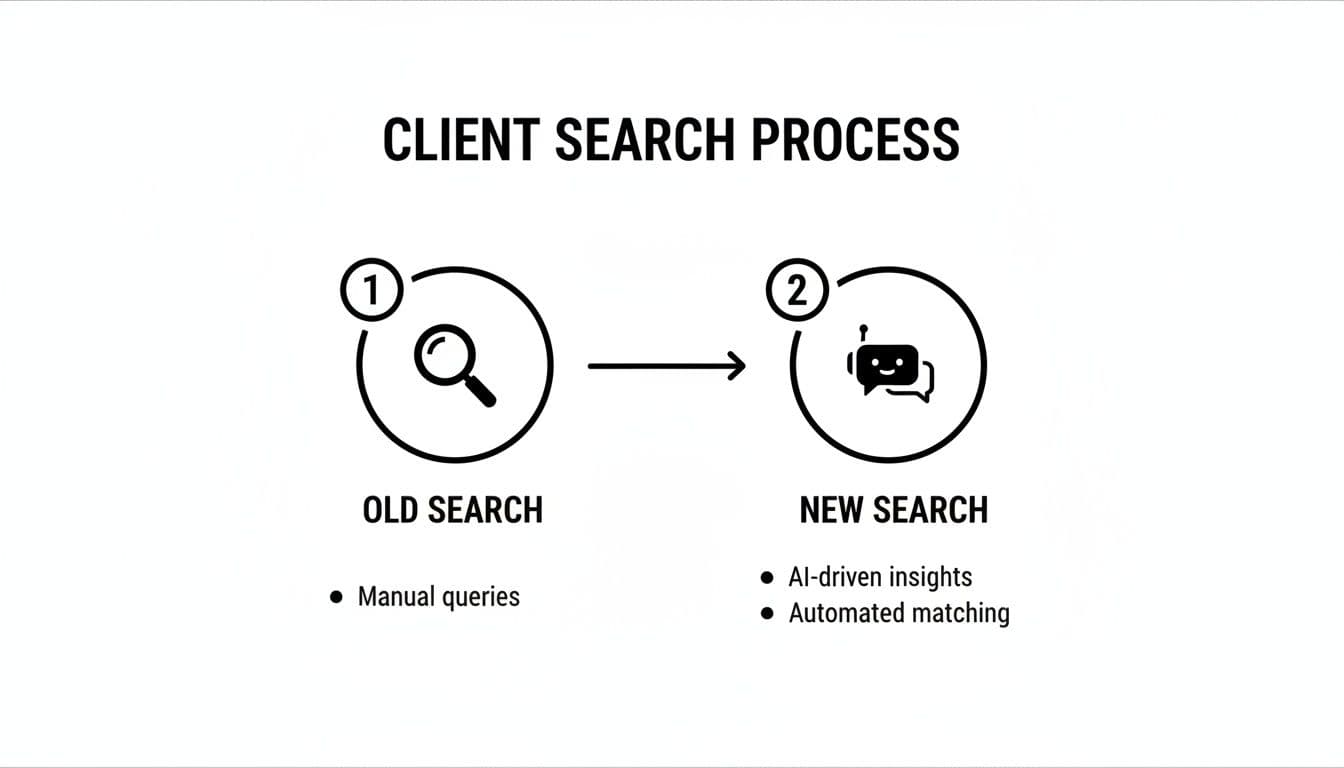
As you can see, the game is no longer about just being on the list; it’s about becoming the answer itself.
Beyond your own profiles, hyper-local signals carry enormous weight. These are the digital breadcrumbs that prove you’re a real, active part of your local community.
- Community Mentions: Getting featured in a neighborhood blog or even just mentioned in a community center’s online newsletter is a powerful validator.
- Business Partnerships: Team up with a nearby supplement shop, a physical therapy clinic, or a healthy café. A feature on their "Local Partners" page creates a strong signal of authority and drives relevant referral traffic.
- Event Participation: If you sponsor or participate in a local 5K run or a community health fair, make sure you're listed on the event's website. This solidifies your local connection in a way algorithms understand.
Ultimately, this is about building a web of digital trust. When an AI sees your consistent NAP, detailed services, and endorsements from other local entities, it has everything it needs to conclude you're a legitimate, active professional worthy of a top recommendation.
To stay ahead, it's worth getting familiar with more advanced concepts like Generative Engine Optimisation (GEO), which is the next frontier in this space. Each of these elements works in concert, building a rich, authoritative digital identity that makes you the undeniable choice.
Your AI Visibility Audit Checklist
Use this checklist to audit your core digital assets and optimize them for AI-driven search algorithms.
Completing this audit gives you a clear, actionable roadmap. By ensuring these core assets are perfectly aligned and rich with detail, you’re not just optimizing for search engines—you’re preparing your business to be the top choice for the AI assistants of tomorrow.
Crafting Content That Answers Conversational Questions
AI-driven search isn't just about matching keywords anymore. It’s about providing direct, confident answers to the kinds of questions people ask out loud or type into their phones. To get noticed, you need to stop thinking about broad topics and start zeroing in on the specific, conversational problems your ideal clients are trying to solve.
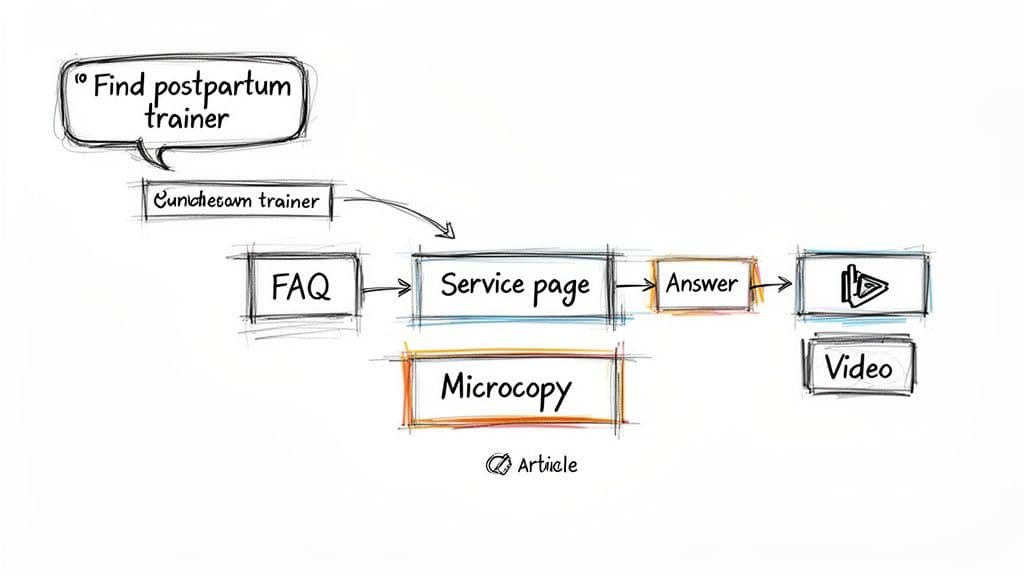
Your goal is to become the definitive source that AI can pull from. Forget generic posts about "postpartum fitness." Instead, build a piece of content that directly answers, "What's the best training for diastasis recti recovery in Brooklyn?" That's the level of specificity that gets you found.
Organize Your Content for Easy AI Digestion
Think of an AI model as a very literal, very busy assistant. It won't spend time trying to decipher a dense wall of text. It needs to find a specific answer, fast. This means you have to structure everything—from your service pages to your blog posts—with clean formatting that an algorithm can instantly interpret.
This starts with your headings. Use clear, descriptive H2s and H3s that act as signposts for your information. A vague heading like "Our Services" tells the AI nothing. But a heading like "One-on-One Strength Training for Senior Mobility" immediately signals exactly what that section is about, allowing the AI to categorize your expertise with pinpoint accuracy.
I once worked with a trainer in Chicago who was struggling to stand out. We helped him target the query, "find a personal trainer who specializes in senior mobility near me." He built out a dedicated service page with a detailed FAQ section addressing common concerns like joint safety, balance improvement exercises, and in-home training options. The result? He became the undeniable local authority, and AI models started recommending his profile as the top result for those searches.
This hyper-focused approach is what makes the difference.
Become the Go-To Source with a Smart FAQ Strategy
One of the most powerful moves you can make is to build out robust Frequently Asked Questions (FAQ) sections across your entire website. You need to get inside the head of a potential client and answer every single question they might have, before they even think to ask it.
- Service-Specific FAQs: Attach a dedicated FAQ block to each service page. For your kettlebell training page, answer questions like, "Is kettlebell training good for weight loss?" and "How many sessions until I start seeing results?"
- Location-Based FAQs: If you cover different neighborhoods or offer in-home training, create content that answers location-based questions directly. "Do you offer in-home personal training in the Upper West Side?" is a perfect example of a query that signals high intent.
- A Central FAQ Hub: You should also have a main FAQ page that covers the bigger picture—your training philosophy, pricing structure, what a first session looks like, and what new clients can expect.
This strategy does more than just help potential clients; it hands AI a perfectly organized set of questions and answers that it can pull directly into search results. We cover this technique in much more detail in our guide to Answer Engine Optimization.
Polish Your Website’s Microcopy
Finally, every little piece of text on your website matters. This "microcopy"—the text on your buttons, your photo captions, and the short blurbs under images—is another chance to feed valuable context to AI.
Don't just upload a photo of you with a client. Add a caption that says, "Helping Sarah hit a new personal record on her deadlift after our 12-week strength program." This tiny bit of text adds incredible context, reinforcing the specific results you deliver and giving AI more proof of your expertise.
Making Your Website AI-Friendly: The Technical Foundation
Think of your website's content as what you say, and its technical setup as how you say it. For an AI to trust and recommend you, that delivery has to be flawless. This isn't about becoming a master coder overnight. It's about sending clear, structured signals that make it incredibly easy for an AI to understand who you are, what you do, and why you're the right choice for a potential client.
Speak the Language of AI with Schema Markup
The single most direct way to improve your AI visibility for personal trainers is through structured data, often called Schema markup. It’s essentially a layer of code you add to your site that acts as a translator, removing any ambiguity for search engines and AI assistants. You’re not just hoping they figure it out; you’re telling them point-blank.
For your personal training business, you'll want to focus on a few key schema types:
- Person: This is your digital business card. It identifies you by name and lets you highlight your credentials, specializations, and years of experience.
- LocalBusiness: This tells an AI you’re a real-world business with a physical presence or service area. You can specify your gym address, phone number, hours, and even the radius you serve.
- Service: Here’s where you get specific about your offerings. Define each service, like "60-minute strength training session" or "postpartum fitness program," and include details like duration and ideal client.
Using these turns your website from a collection of text and images into a highly organized file that an AI can instantly parse. When someone asks an AI for a "female personal trainer near me who specializes in senior fitness," this structured data is what helps it confidently match your profile to that query.
This kind of code makes critical business information instantly recognizable, so AI systems don't have to guess what your services or location are by reading paragraphs of text.
Nail the Foundational Trust Signals
Beyond schema, there are a few core technical benchmarks that are non-negotiable. AI systems are programmed to prioritize user experience, so they weigh these factors heavily when deciding which businesses to feature.
A fast, secure, and mobile-friendly website isn't just a "nice-to-have" for your clients anymore. It's a direct signal to AI that you run a professional, credible, and modern business.
Make sure your site is hitting these three marks:
- Site Speed: AI won't recommend a slow-loading site. It’s seen as a sign of a poor experience. You should be aiming for your pages to load in under 2.5 seconds.
- Mobile-First Design: The overwhelming majority of voice searches and quick queries happen on a phone. If your website is a pain to navigate on a small screen, you're essentially invisible for those searches.
- HTTPS Security: Having a secure site (indicated by an SSL certificate and "https://" in your URL) is a fundamental trust signal. Unsecured websites are a red flag, and AI simply won't recommend them. It's that simple.
Getting these technical elements right is the bedrock of your entire digital strategy. If you're looking to understand how all these pieces connect, our guide on building a strong site architecture for SEO provides a great overview. By mastering these basics, you create a seamless experience for both human visitors and the AI systems trying to send them your way.
Using Social Proof and Reviews for AI Validation
Here’s a hard truth about AI search engines: they trust what other people say about you far more than what you say about yourself. Your claims are just marketing. Client reviews and testimonials, on the other hand, are seen as objective validation. Improving your ai visibility for personal trainers means building a compelling story of client success, one authentic review at a time.
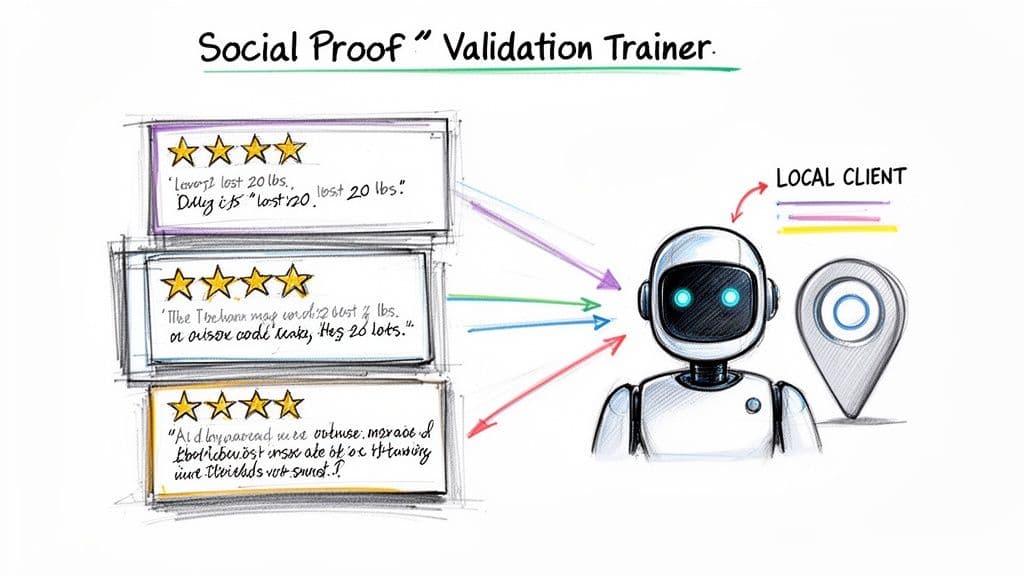
Your most powerful tool here is your Google Business Profile. A steady flow of positive reviews is non-negotiable. But the AI is digging deeper than just the star rating; it’s reading the actual text to understand why people think you're great. A review that just says "great trainer" is nice, but one that gets specific is marketing gold.
How to Get Reviews That Actually Work for You
You have to guide your clients toward leaving the kind of detailed feedback that AI models love. The perfect time to ask is right after they've hit a major goal and are feeling fantastic about their progress.
Don't just send a generic link asking for a review. Instead, frame the request around their specific win. You could say something like, "I'm so thrilled we hit your goal in time for your wedding! If you get a chance to leave a review, it would be a huge help if you mentioned the specific goal we crushed together."
This small nudge is all it takes to get powerful, descriptive reviews that do the selling for you:
- "Sarah helped me lose 20 pounds for my wedding and I felt amazing."
- "My mobility has improved so much after just 8 weeks of training."
- "I finally hit my 300-pound deadlift goal thanks to his programming."
These outcome-driven reviews give AI search engines concrete proof of your skills. It connects you directly to tangible results, making you a much more credible answer for people asking similar questions.
AI models thrive on patterns. When several reviews highlight your skill with "postpartum recovery" or "training for marathons," the AI gains confidence. It learns to categorize you as a specialist and will recommend you more often for those specific needs.
Weave Testimonials into Your Website's DNA
Your website is another critical place to showcase this proof. The biggest mistake I see is trainers hiding all their testimonials on a single page nobody ever clicks on. Don't do that. Instead, sprinkle them strategically throughout your site where they'll have the most impact.
Match the testimonial to the service. On your "Strength Training for Beginners" page, feature a quote from a client who started from scratch and now feels confident in the weight room. This creates an immediate, powerful connection between the service you’re describing and the real-world success your clients achieve. Understanding how AI interprets brand sentiment across different platforms is a deeper topic, and you can explore the fundamentals of AI brand monitoring to learn more.
When you make client success a visible, integral part of your online presence, you're building a case for your expertise that's impossible to ignore. This doesn't just convince potential clients—it gives AI the third-party verification it needs to confidently rank you as the right trainer for the job.
Your Questions About AI Visibility, Answered
Stepping into the world of AI optimization can feel a bit overwhelming, especially when your focus is on your clients, not algorithms. As a personal trainer, you probably have a few questions about what this all really means for your business. Let’s clear up some of the most common ones so you can move forward with confidence.
The best part? You don't need to be a tech genius. The biggest wins in AI visibility for personal trainers come from things you already have a handle on: filling out your Google Business Profile completely, encouraging client reviews, and creating great content. While some technical stuff like Schema markup helps, our focus here is on practical steps you can take yourself, no code required.
How Is This Different From Regular SEO?
So, what's the actual difference between optimizing for AI and the traditional SEO you've been hearing about for years? It's really a shift in the end goal.
Traditional SEO is all about fighting to rank high on a list of blue links, hoping someone clicks yours. AI optimization, on the other hand, is about becoming the definitive answer an AI assistant gives directly to a user. It’s a completely different ballgame.
This means you need to get laser-focused on a few key areas:
- Conversational Content: Writing in a way that directly answers the exact questions your ideal clients are asking. Think "What are the best leg exercises for bad knees?" instead of just "Leg Day Workouts."
- Structured Data: Using behind-the-scenes tools like Schema to spoon-feed AI models the specifics about your business—your location, services, hours, and pricing.
- Real-World Authority: Proving your expertise with a steady stream of glowing client reviews and strong signals that you're a trusted part of your local community.
Think of it this way: SEO helps you get listed in the phone book. AI optimization makes you the one person the operator recommends by name.
A question I hear a lot is, "Does this mean I should stop my other marketing?" Absolutely not. In fact, these AI-focused strategies should be woven into what you’re already doing. They actually make each other more powerful.
For example, when you actively gather more detailed client reviews, you're not just signaling authority to AI. You're also boosting your traditional local search rankings and giving potential clients the social proof they need to book a session. Every effort works together.
What’s a Realistic Timeline for Seeing Results?
Building the kind of authority that AI respects is a marathon, not a sprint. These systems are designed to reward consistency and genuine expertise over the long haul, so don't expect overnight success. That said, you can definitely see real progress on a clear timeline.
Within the first 2-3 months of completely optimizing your Google Business Profile and starting a consistent push for new reviews, you should see a noticeable lift. This is the low-hanging fruit—better visibility in local map packs and more direct inquiries.
Getting to that next level, where an AI assistant like Google Assistant or Siri actually name-drops your business as the go-to recommendation, is the long-term prize. This usually takes 6-12 months of consistent effort. You’re building a deep foundation of digital trust that will pay off for years to come.
Ready to stop guessing and start measuring how you show up in AI search? Attensira gives you the tools to track your brand’s visibility across the major AI platforms. You can spot content gaps and get clear, actionable insights to improve your online presence. Take control of your AI visibility by visiting https://attensira.com.