Unlock patient growth with our guide on AI visibility for clinics. Learn actionable SEO, content, and reputation tactics for generative AI search.
The way patients find a new doctor has been completely turned on its head. It used to be about sifting through a list of websites. Now, they’re asking AI assistants direct questions like, "Find the best clinic near me that treats adult asthma."
The AI's answer is the new 'page one.' For a clinic to be visible today, it needs to be that direct answer, not just another blue link on a long list.
The New Patient Journey and Why AI Visibility Matters
Think about the old patient journey. A person would type a query into Google, click through several clinic websites, compare services, and maybe read a few reviews before even thinking about making a call. That entire process is now being condensed into a single, conversational step.
Patients want immediate, synthesized answers from their AI tools. If your clinic isn't the one mentioned in that answer, you've lost that person before they even had a chance to discover you.
This isn't some far-off prediction; it's happening right now. The numbers are hard to ignore. Google’s AI Overviews, for instance, already have a massive reach of over 2 billion monthly users. These AI-generated summaries show up in about 18% of all Google searches globally. For a medical practice, that means nearly one out of every five potential patients might get their answer from an AI before they ever scroll down to the traditional search results.
You can dig deeper into AI's impact on search over on Semrush.com.
Why Traditional SEO Just Isn't Cutting It Anymore
The core principles of good SEO—like having a fast website and relevant keywords—are still important. But if that's all you're doing, you're going to become invisible. AI models don't just crawl your website for keywords anymore; they're trying to understand it. They’re looking for clear, unambiguous signals of expertise, authority, and trust to build their answers.
To get ahead in this new environment, clinics need to shift their strategy. I've found it comes down to excelling in three key areas:
- A Flawless Technical Foundation: This is all about using structured data (like schema markup) to spoon-feed information to machines in a language they can process instantly.
- Authoritative Content AI Models Trust: Your content needs to be so helpful, clear, and well-supported that AI models confidently choose to cite it in their answers.
- Powerful Reputation Signals: Strong local SEO signals and a steady stream of positive patient reviews act as proof to AI that your clinic is a credible, real-world expert.
For practices just starting to grapple with this, looking into specialized healthcare services can help build out that essential digital foundation.
The game has changed. You're no longer just trying to rank on a results page. The new goal is to become the trusted source that an AI model quotes when a patient asks an important health question. That's the core of modern AI visibility for clinics.
This guide is designed to be an actionable roadmap, not just theory. We’ll break down precisely how to build the kind of digital presence that AI not only recognizes but actively recommends. For clinics that are ready to adapt, this is a huge opportunity to connect with patients more directly than ever before.
To see how we tackle this, you can learn more about Attensira’s approach to https://attensira.com/industries/healthcare and the tools we've built to navigate this shift.
How to See What AI Thinks of Your Clinic
Before you can start climbing the AI search ladder, you have to know where you're starting from. The first step is a baseline audit. This isn’t just a technical exercise; it's about putting yourself in a potential patient's shoes and asking the same questions they are. This process will show you exactly where you stand in the new world of generative AI and, more importantly, where the visibility gaps are that could be costing you new patients.
The heart of this audit is simple: you're going to ask the big AI platforms questions just like a patient would. Forget simple keywords. We're talking about real, intent-driven questions that mirror how people actually search for healthcare.
This modern patient journey is a new funnel. It often starts with a broad search, moves to a specific AI query, and ends with your clinic either being visible or not. That last step is everything.
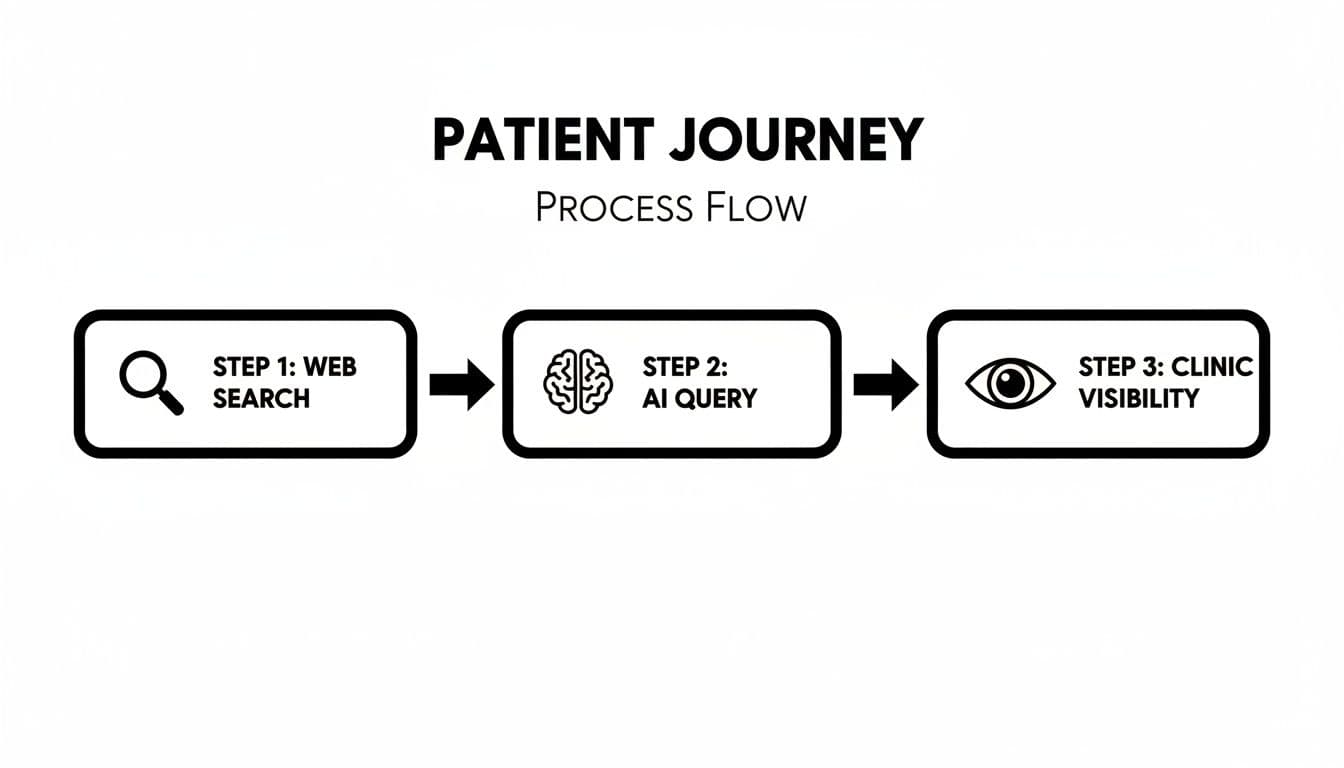
As the diagram shows, if your clinic doesn't show up in that AI response, the journey to your front door stops dead in its tracks.
Running Your Own AI Visibility Audit
To get started, pull up a few of the major AI models—think Google Gemini, ChatGPT, and Perplexity. It’s crucial to run the same queries on each platform because they all pull from different knowledge bases and use different methods to generate answers. Your goal is to test a healthy mix of queries that cover your services, location, and specialists.
Here’s a practical framework to get you started:
- Broad Service Queries:
- "Best dermatologists in San Diego"
- "Top-rated orthopedic clinics near me"
- Condition-Specific Queries:
- "Find a clinic in Texas that treats adult scoliosis"
- "Who specializes in acne scar treatment in the West Village?"
- Procedure-Focused Queries:
- "Where can I get a deep plane facelift in Miami?"
- "Cost of All-on-4 dental implants in the Chicago metro area"
- Physician-Specific Queries:
- "Who is Dr. Jane Smith?"
- "Reviews for Dr. John Doe at The Wellness Clinic"
As you go, track everything in a simple spreadsheet. Document the exact prompt and the response from each AI. This methodical approach will quickly reveal patterns, highlighting which models understand your practice and which ones are completely in the dark.
Think of an AI visibility audit as a diagnostic tool. If your clinic doesn't show up, it's not a failure—it's a bright, flashing arrow pointing to exactly where you need to focus your efforts. This gives you a clear roadmap for your data and content strategy.
What to Look for in the AI's Answers
Once you've collected the responses, it's time for analysis. You're not just scanning for your clinic's name. You need to dig deeper and categorize the type of visibility you have (or don't have). This is where the real insights for improving your AI visibility for clinics come from.
Pay close attention to these four potential outcomes:
- Direct Recommendation: This is the gold standard. The AI explicitly names your clinic or one of your doctors as a top choice, showing it has strong trust signals about your practice.
- Content Citation: Almost as good. The AI answers a user's question and then cites a blog post or page from your website as its source. This is a massive signal of your content's authority.
- Inclusion in a List: You're mentioned, but just as one of several options. This is a good start, but it signals an opportunity to stand out and become the recommended choice, not just an option.
- Complete Invisibility: Your clinic is a ghost. It doesn't appear for even the most relevant local or service-specific questions. This is a red flag and should be your top priority.
By seeing which category you fall into for various queries, you can build a targeted optimization plan. To get a head start, you can use a tool that calculates an AI Readiness Score for your website. It provides a quick, quantifiable benchmark before you begin the deeper audit we've just walked through.
Building a Technical Foundation for AI Recognition
AI models don't see your website the way people do. They can't appreciate your elegant design or persuasive writing. Instead, they need raw, organized information—a clear, machine-readable blueprint of who you are, what you do, and why you’re an authority. This is where your technical SEO foundation, specifically structured data, becomes non-negotiable.
Without it, you're essentially asking an AI to guess about your clinic's services. And in the world of AI, guessing leads to invisibility.
Think of your website like a detailed medical chart. The prose is the patient history, but for an AI to quickly diagnose and understand the key facts, it needs the structured data—the vitals, the lab results, the ICD-10 codes. Schema markup is that code. It’s a specific vocabulary you add to your site that explicitly defines your clinic, your physicians, the conditions you treat, and the procedures you offer. This small step removes all ambiguity for machines.
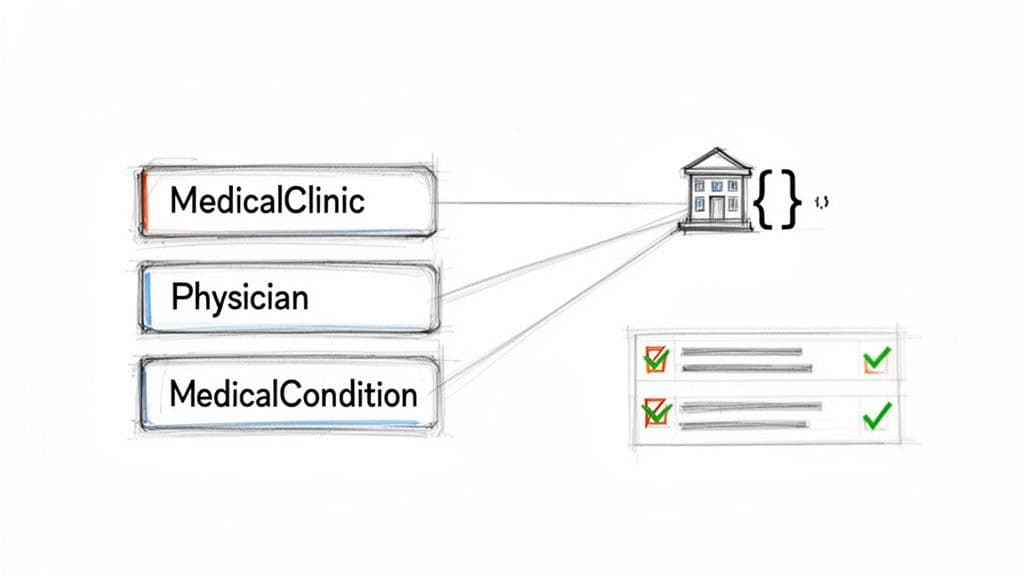
This shift in focus is crucial. While old-school SEO was all about getting keywords on a page to rank, modern AI visibility for clinics is about structuring your data for retrieval. The goal isn't just to be crawlable; it's to be completely and accurately understood by a machine.
The Core Schema Your Clinic Must Implement
Getting started doesn't mean you have to boil the ocean and implement every schema type under the sun. The key is to focus on a core set that paints a clear, interconnected picture of your practice. We're creating a web of defined entities that an AI can follow to grasp your entire operation.
Start with these absolute must-haves:
MedicalClinic: This is your home base. It defines your practice as a medical entity, locking in your official name, address, phone number, and even accepted insurance. It acts as the anchor for everything else.Physician: Every single doctor needs their ownPhysicianschema. This should detail their name, specialty (e.g., Dermatology), and, critically, connect them back to theMedicalClinicwhere they practice.MedicalCondition: On every page where you discuss a condition you treat—from something common like acne to a complex issue like scoliosis—aMedicalConditionschema explicitly defines it. This creates a direct line from a patient's query to your clinic as a viable solution.MedicalProcedure: Likewise, any procedure you offer, whether it’s a "deep plane facelift" or a "total knee replacement," needs its own markup. This clarifies the exact services you provide.FAQPage: This one is a secret weapon. When you mark up your Q&As, you're basically spoon-feeding content to AI assistants in the exact conversational format they prefer.
Nailing these basics builds a simple but powerful knowledge graph for your clinic. It tells AI, "This MedicalClinic, located here, has this Physician who specializes in treating this MedicalCondition by performing this MedicalProcedure." That level of clarity is exactly what an AI needs to recommend you with confidence.
Your website is no longer just a digital brochure; it's a structured database for AI. Every entity you define—from a doctor's specialty to a specific treatment—becomes a node in a knowledge graph that AI uses to build trust and formulate its answers.
Translating Schema Theory into Practice
So, how does this actually look? Let's say you're a dermatology clinic with a page dedicated to acne treatments. Your web developer would embed a JSON-LD script (the most common and preferred format) into that page's code.
Here's a simplified snippet for the clinic itself:
{ "@context": "https://schema.org", "@type": "MedicalClinic", "name": "Downtown Dermatology Associates", "address": { "@type": "PostalAddress", "streetAddress": "123 Health St", "addressLocality": "Metropolis", "addressRegion": "CA", "postalCode": "90210" }, "telephone": "+15551234567" }
This code is invisible to a human visitor, but to an AI, it’s a perfectly clear fact sheet. It removes any doubt. From there, you'd add more schema for the specific conditions and physicians mentioned on the page, building out that interconnected data network. If you want a deeper dive into how models like Google's use this, check out our guide on preparing for Google's AI mode.
Fine-Tuning Your Schema for a Competitive Edge
Once you have the foundation in place, you can add more layers of detail to really stand out. This is where you separate your clinic from competitors who are just checking the boxes.
To help you get more specific, here are some of the most critical schema types and what they tell AI.
Essential Medical Schema For AI Visibility
By meticulously marking up your website's information, you transform it from a simple collection of pages into a powerful, machine-readable asset. This technical foundation isn't just a "nice-to-have"; it's the most critical first step to ensuring your clinic is recognized, trusted, and recommended in the new age of AI-driven search.
Developing Content That AI Models Trust And Cite
With your technical SEO in order, it's time to shift focus to the actual information on your site. Generative AI doesn't just scan your content for keywords; it reads it, digests it, and repackages it to answer user questions directly. This means our content strategy has to evolve. We're no longer just trying to rank—we're trying to become an authoritative source.
The goal now is to make your clinic's content so clear, trustworthy, and well-supported that AI models choose you as a primary source. When a potential patient asks a question about a condition or treatment you offer, you want the AI's answer to be built on the expertise published right on your website. That's how you win at AI visibility for clinics.
This all comes down to demonstrating Expertise, Authoritativeness, and Trustworthiness (E-E-A-T). This concept is even more vital for AI than it was for traditional search, as these models are specifically trained to find and prioritize information that is medically sound, factually accurate, and transparent.
Crafting Authoritative Service and Condition Pages
Your service and condition pages are the real workhorses of your content strategy. They can't just be digital brochures anymore; think of them as potential entries in an AI's knowledge base. To be seen as trustworthy, they need to go deep.
Every page you have on a specific condition or treatment should be a comprehensive resource. Put yourself in a patient's shoes and answer every question they could possibly have, from the first symptoms and diagnosis to detailed treatment options and what recovery really looks like.
Here's how to elevate these pages:
- Cite Reputable Sources: Don't be afraid to link out to peer-reviewed studies, well-known medical journals, and respected organizations like the Mayo Clinic or NIH. This is how you show you've done your homework.
- Present Unique Data: If your clinic has internal data on treatment success rates or patient outcomes (anonymized, of course), share it. This adds a layer of unique authority that AI models are designed to value.
- Ensure Medical Accuracy: Every piece of medical content should be written or, at the very least, reviewed and signed off on by a qualified physician at your practice. Make sure you clearly attribute who reviewed it.
By building out these deep information hubs, you’re creating assets that not only help patients but also serve as rock-solid data points for AI systems trying to construct a reliable answer.
AI models are essentially building a bibliography for every answer they generate. Your goal is to make your clinic's content an indispensable reference in that bibliography, cited for its depth, accuracy, and clarity.
The Power of Citable Snippets
AI models love to pull short, clear definitions and stats directly into their answers. A smart tactic is to deliberately create these "citable snippets" throughout your content. These are small, self-contained, and easily digestible pieces of information that can stand on their own.
A citable snippet could be:
- A clear, one-sentence definition of a medical term.
- A specific statistic, like the prevalence of a condition.
- A bulleted list breaking down the stages of a procedure.
For instance, instead of a long paragraph describing recovery, a citable snippet might say: "Recovery from a total knee replacement typically involves 2-3 days in the hospital, followed by several months of physical therapy to regain full strength and mobility." That clarity makes it incredibly easy for an AI to lift and attribute. You can find opportunities like this by analyzing the information density of your pages; a good starting point is to assess your https://attensira.com/tools/content-depth-score.
Optimizing For A Multi-Platform AI World
It's also important to remember that the AI search world isn't a monolith. While one player has a big lead, the market is very much in flux. For instance, ChatGPT currently holds a dominant market share of around 60.7% to 64.5%.
But the landscape is changing fast. Google Gemini has seen explosive growth, nearly quadrupling its market share in just a year to capture 15.0% to 21.5% of the AI market. This reality means your strategy can't be tied to just one platform.
The good news is that the core principles—creating high-E-E-A-T, well-structured, and citable content—are universal. By focusing on quality and authority, you position your clinic to be a trusted source across all major AI platforms, both now and in the future. The fundamental goal never changes: become the definitive, trusted answer, no matter which AI the patient is asking.
Fortify Your Local and Reputational Signals
If you run a local clinic, you already know that reputation is everything. What's new is how AI models are now your toughest critics, scrutinizing that reputation with incredible detail. To really show up in AI-driven search, you have to move beyond just on-page SEO and content. It's time to focus on the powerful signals that prove your clinic’s real-world authority and patient trust.
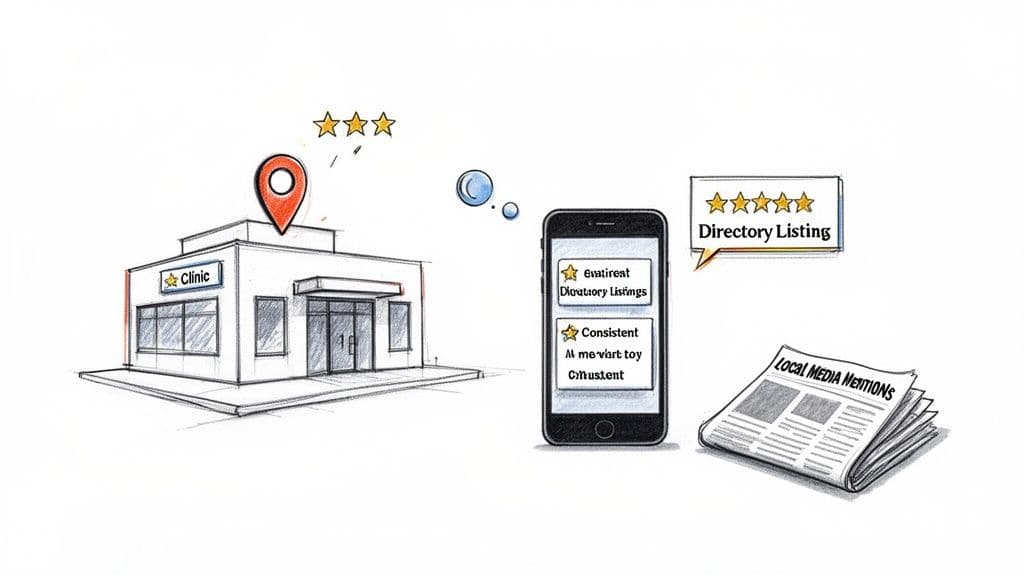
AI models are looking for two things: consistency and social proof. They pull data from countless sources to figure out which clinic is the most credible answer for a local health question. A single, tiny discrepancy in your clinic's name, address, or phone number (NAP) across different directories can create doubt. On the other hand, a steady stream of recent, positive patient feedback is a massive vote of confidence.
Go Beyond a Basic Business Profile
Think of your Google Business Profile (GBP) as more than a digital business card—it’s a primary data source for AI. A bare-bones profile just won’t cut it anymore. You need to dial in every single detail to send clear, authoritative signals about your practice. This is where a serious commitment to Google My Business optimization becomes non-negotiable for appearing in local searches.
This means getting incredibly specific with the services you offer. Instead of a generic entry like "Orthopedics," you need to list out procedures like "Knee Arthroscopy," "ACL Reconstruction," and "Hip Replacement Surgery." This kind of detail directly matches the specific questions real patients are asking.
You also need to actively use the Questions & Answers feature. Don't wait for patients to ask; proactively load this section with common questions and provide clear, physician-approved answers. You’re essentially creating a pre-made, conversational knowledge base that AI can pull from directly.
AI is trying to build a high-confidence profile of your clinic. When you feed it granular details in your GBP—from specific procedures to pre-answered patient questions—you're giving it the structured, reliable data it needs to recommend you over a competitor.
Harness the Power of Patient Reviews
Patient reviews are arguably one of the most powerful reputational signals you have. AI models read feedback on platforms like Healthgrades, Vitals, and Yelp as direct proof of patient satisfaction and your quality of care. A high volume of recent, positive reviews tells a clear story: this clinic is trusted right now.
But just hoping for reviews isn't a strategy. You need a system.
- Automate the ask. A simple post-appointment email or SMS that links directly to your key review profiles can work wonders.
- Train your team. Empower your front-desk staff to mention how much feedback means as patients are checking out. A personal request is often the most effective.
- Respond to all reviews. Engaging with both positive and negative comments shows you're an active, attentive practice. That engagement is, in itself, a positive signal.
This consistent flow of feedback keeps your online profiles fresh and proves ongoing patient trust—a huge factor for AI recommendations. To get a handle on this, check out tools and strategies for improving your local listings management and keeping everything consistent.
Build Authority with Local Citations and Media
Finally, AI looks for outside validation. When your clinic gets mentioned by local news outlets, community blogs, or other respected local websites, it cements your status as a pillar in the local healthcare community.
A feature in a local magazine about a new treatment you offer, or a quote from one of your doctors in a local news story on public health, creates an incredibly valuable, authoritative backlink. AI interprets these mentions as third-party endorsements—strong proof of your clinic’s relevance and expertise, especially for those all-important "near me" searches.
Answering Your Questions About AI Visibility
When I talk with clinic managers and marketers about this shift to AI-driven search, a few key questions always come up. It's a new frontier, and it's natural to wonder how this changes the game and where to even begin. Let's tackle some of the most common ones I hear.
How Is AI Visibility Really Different From Traditional SEO?
This is the big one. For years, we've all been conditioned to think about SEO as a race to the top of a list of blue links. Your goal was simple: get the click.
AI visibility is a completely different mindset. It's no longer about just getting on the list; it's about becoming the answer itself.
Think about it this way: An AI model might pull from a dozen sources to construct a single, comprehensive response. The new goal is to ensure your clinic's expertise, data, and doctors are the authoritative sources the AI chooses to cite. It's a shift from ranking to being referenced. This means we have to go much deeper with structured data and content that screams expertise and trust. We're not just optimizing for keywords anymore; we're structuring our entire digital footprint to be an indispensable part of the AI's knowledge base.
What's the Single Most Important First Step We Should Take?
If you do only one thing right now, make it a comprehensive schema markup audit and implementation. This is the absolute bedrock for getting noticed by AI.
By using specific schema like MedicalClinic, Physician, MedicalCondition, and FAQPage, you're essentially handing the AI a cheat sheet about your practice. You're explicitly telling it who you are, what you do, which doctors work there, and what conditions you treat. It takes all the guesswork out of the equation for the machine. This simple act of translating your website's information into a language AI understands gives you a massive head start.
I always tell my clients to think of schema as a verified fact sheet for their clinic. It’s the fastest way to signal to an AI, "We are a trusted medical authority on this topic," putting you leagues ahead of competitors who haven't bothered to structure their data.
How Long Until We Actually See Results From This?
The timeline here usually plays out in two phases.
First, the technical fixes. Things like implementing detailed schema markup can get picked up by search engine crawlers and AI models surprisingly quickly. I've seen the impact of these structural changes show up in a matter of weeks as a site gets re-indexed.
But the second phase—building the deep, undeniable authority needed to be consistently cited in complex health answers—is more of a long game. That kind of trust is earned over time through top-tier, expert-vetted content, a steady stream of positive patient reviews, and strong local signals. For that, you should be thinking in terms of several months of consistent, focused effort before you see major, sustained results.
Can't We Just Use AI to Write Our Content?
This is a tempting shortcut, but it's a dangerous one. Using AI writing tools to brainstorm topics, create outlines, or even hammer out a first draft can absolutely make your content team more efficient. I'm all for that.
However, letting AI generate medical content from start to finish is a huge mistake. It directly contradicts the very foundation of E-E-A-T (Expertise, Authoritativeness, and Trustworthiness), which is what AI models are trained to look for in health information. AI-generated text often lacks the critical nuance, real-world insight, and verifiable accuracy that both patients and other AIs demand.
The best strategy is a partnership. Use AI tools as an assistant to speed up the process, but every single piece of medical content must be rigorously reviewed, edited, and signed off on by a qualified medical professional from your clinic. For high-stakes health topics, that human verification is simply non-negotiable.
Ready to move from invisible to authoritative in AI search? Attensira provides the tools and insights to track your AI presence, identify critical content gaps, and build a strategy that makes your clinic the answer patients are looking for. See how you stack up by visiting https://attensira.com.