Explore ai search tracking tactics to protect your brand and boost revenue. Learn how B2B leaders monitor AI responses and optimize content in 2026.
AI search tracking isn't just a new buzzword; it's the practice of systematically monitoring how your brand, products, and services show up in the answers generated by AI engines like ChatGPT, Gemini, and Perplexity. This goes far beyond traditional rank tracking. We're now measuring visibility, sentiment, and accuracy inside a conversational response, not just a spot on a list of links.
This is absolutely essential for managing your brand in a world where users get direct answers, not a menu of options.
The New Search Reality and Why Tracking Is Non-Negotiable
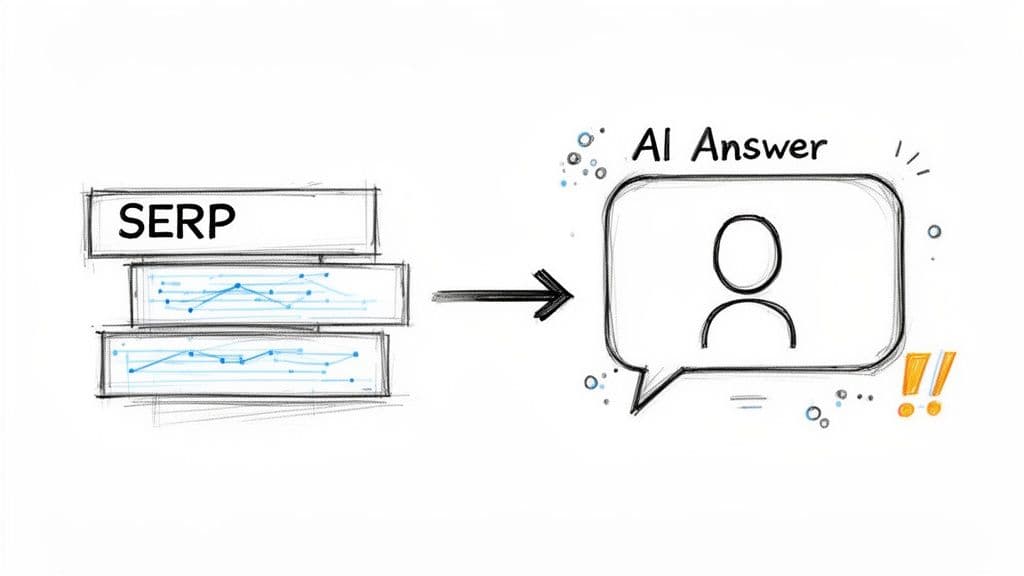
Let's be honest, the predictable world of ten blue links is over. For years, we measured B2B marketing success by our position on a search results page. That game has completely changed. We’ve gone from competing for a rank on a page to fighting to become the answer in an AI-driven conversation.
This shift isn't a slow burn; it's a fundamental disruption. For high-intent B2B buyers, the main discovery channel is no longer a list they scroll through. It's a direct, synthesized response from an AI. The question for CMOs and marketing leaders has shifted from "Where do we rank?" to a much more urgent "Are we even part of the conversation?"
From Clicks to Conversations
The idea of a "zero-click search" isn't new, but AI has put it on steroids. Instead of just seeing a featured snippet, a user can now have a detailed back-and-forth, asking follow-up questions without ever needing to visit your website. For B2B companies with long, complex sales cycles, this is a massive change.
Think about it. When a potential customer asks an AI for the "best cybersecurity platforms for mid-sized banks," that AI-generated text is the new SERP. If your brand isn't mentioned, you're invisible at the most critical moment of buyer intent. If your competitor gets a glowing mention, they've just bypassed your entire marketing funnel.
The real challenge here is that AI models have become the new gatekeepers of information. Your brand narrative is no longer solely in your control; it’s being interpreted and repackaged by an algorithm. AI search tracking is the only way to get a look inside that black box.
A Fragmented and Urgent Market
The search landscape itself is splitting apart. It's no longer just about Google. To build a proper tracking program, you have to know which platforms actually matter for your audience.
Here's a snapshot of the key AI search platforms that B2B enterprises need to have on their radar. This data highlights where users are flocking and where market dominance is forming.
AI Search Platform Market Share 2026
This table clearly shows that while Google remains a giant, the AI-specific arena is led by ChatGPT. For B2B marketers, this fragmentation means a one-dimensional strategy focused on Google is a recipe for being left behind. Recent forecasts show AI-driven search is on track to handle 30% of all global search interactions by 2026.
This new reality creates a few immediate imperatives for B2B leaders:
- Brand Survival: Omission or, even worse, misinformation in AI answers can directly harm your reputation and kill your sales pipeline before it even starts.
- Competitive Intelligence: Seeing how AI frames your competitors is one of the most powerful strategic insights you can get right now.
- Strategic Growth: You can identify the content gaps AI models are surfacing and move quickly to fill them, capturing high-intent audiences.
Ignoring this is no longer an option. With only 22% of marketers currently tracking their AI mentions, there's a huge opening for proactive brands to gain a serious early advantage. Part of this involves understanding the AI Search Gap and why you can't just depend on the LLMs themselves for accurate marketing intel.
Building a formal https://attensira.com/glossary/ai-search tracking program isn't just another task for your team; it's a core business intelligence function that's now essential for growth.
Setting Your AI Search Tracking Goals and KPIs
Let's be blunt: tracking AI search visibility without a clear purpose is just collecting noise. You’ll end up with a mountain of data that tells you nothing about what’s actually working. Before you even think about monitoring AI responses, you have to connect your efforts to real business outcomes.
The whole point is to answer critical business questions. Are we trying to drive more qualified leads? Protect our brand from negative narratives? Or are we simply trying to see where a new competitor is eating our lunch? Your answers to these questions will shape your entire tracking strategy.
From Vanity Metrics to Business Impact
It’s tempting to fixate on simple mention counts, but that number is meaningless without context. An effective tracking program gets past these surface-level metrics and zeroes in on KPIs that actually measure the quality and impact of your visibility.
Here are the metrics that truly matter and should form the foundation of your program:
- Share of Voice (SoV): How often does your brand appear in responses to your target prompts versus your competitors? If you have a low SoV for your core service prompts, that’s a major red flag signaling a content or authority problem.
- Mention Sentiment: Are the mentions of your brand positive, neutral, or negative? This is non-negotiable for brand health. It’s your early warning system for narratives that could hurt your reputation or even your sales pipeline.
- Competitive Presence: When your brand isn't mentioned, who is? Pinpointing these instances gives you a direct roadmap for what content to create and where your rivals are winning the conversation.
- Accuracy Rate: Is the information about your products, pricing, or company correct? Wrong information in an AI-generated answer can actively mislead potential customers and demands immediate remediation on your own website.
These KPIs shift the entire conversation from "Are we showing up?" to "How are we being perceived, and what impact is it having on the business?"
Defining Your Core Objectives
Your business goals will determine which of these KPIs you prioritize. A B2B company chasing enterprise leads will have a very different focus than a D2C brand trying to build a community. To get a better sense of how these elements combine, it's worth understanding what goes into a comprehensive AI Visibility Score.
Let’s walk through a real-world scenario. Imagine you're a SaaS company in the "enterprise project management software" space.
Your primary business goal is to increase demo requests from Fortune 500 companies. A smart AI tracking objective would be: "Achieve a 25% Share of Voice for prompts related to enterprise-grade project management solutions within six months."
This goal is specific, measurable, and tied directly to a business outcome. The supporting KPIs would involve tracking your SoV against competitors like Asana and Trello, monitoring the sentiment of any product comparisons, and flagging every time a competitor is recommended for a feature your platform also offers.
This is how you turn AI search tracking from a passive, academic exercise into a powerful engine for strategic intelligence and business growth.
Alright, with your objectives mapped out, it's time to get your hands dirty with the implementation. Setting up AI search tracking isn't a one-and-done task. It's a thoughtful process of pointing the system at your digital properties, telling it what to look for, and setting a rhythm for data collection. A platform like Attensira is built to make this straightforward for marketers, guiding you through what would otherwise be a major technical headache.
The first move is always to connect your domain. This tells the tracking system what piece of the internet is yours—it's how you claim your territory in the vast AI ecosystem. From there, you'll start specifying all the individual assets tied to your brand.
Defining Your Brand and Competitive Landscape
This is where you get specific. You’re not just tracking a homepage; you’re monitoring how a whole constellation of brand properties shows up in AI-generated answers.
- Primary Domain: This is your main website, like
yourcompany.com. It's the central source of truth for your content and what AI models should be referencing. - Product or Service Names: Don't be shy—list them out exactly. If you sell "QuantumLeap CRM" and "Project Phoenix," that's what the system needs to look for. Precision is key.
- Key Executives or Spokespeople: If your CEO or other leaders are public-facing, their reputation is part of your brand's story. You need to track how they are being portrayed.
- Competitor Entities: This is just as important as tracking yourself. List your top 3-5 competitors and their main products. You need to know how their visibility in AI stacks up against yours.
By defining these entities from the start, you ensure you're getting the full picture of your brand's digital identity, not just a narrow slice.
Choosing the Right AI Models and Signals
Different AI models cater to different audiences, so a one-size-fits-all approach to monitoring won't work. A B2B enterprise has very different priorities than a D2C brand. Your next step is to pick the platforms and data points that actually matter to your goals.
For instance, your monitoring list might include:
- ChatGPT: With its enormous user base, it’s a non-negotiable for gauging general public perception and seeing how broad questions about your market are answered.
- Gemini (via Google AI Overviews): Absolutely critical for understanding how your brand is being presented directly within Google's search results.
- Perplexity: This is a favorite among researchers and the tech-savvy crowd, making it a priority if you're in a B2B space where detailed, sourced answers are valued.
After you've picked your models, you need to configure the signals you'll track. This is where a dedicated platform really proves its worth. For example, in Attensira, you can create a "prompt track" to consistently monitor a curated list of high-value questions your customers are asking. You can dive deeper into setting up advanced prompt tracking in our guide.
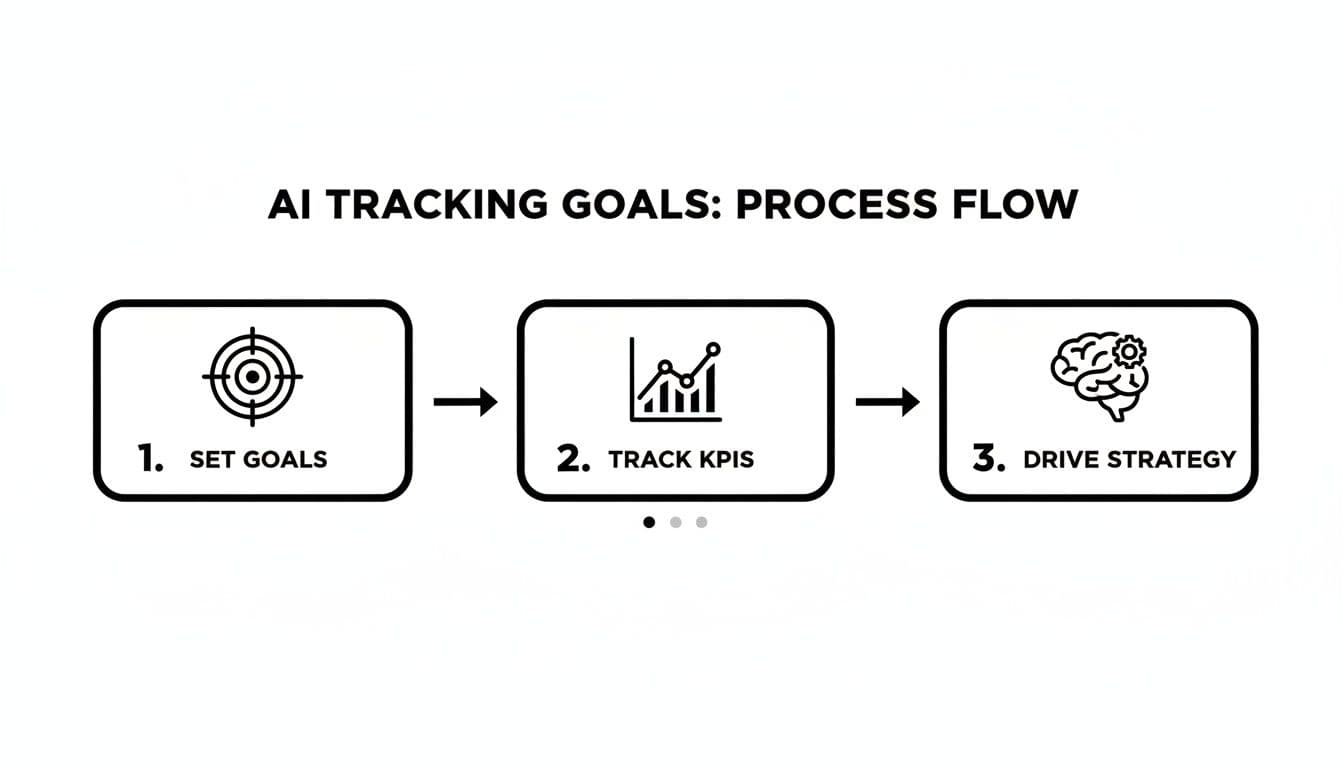
This process shows how your goals should directly inform the KPIs you track, which then shapes your entire strategy. Your implementation choices have to tie back to these objectives.
Setting Your Monitoring Cadence
The final piece of the setup puzzle is deciding how often to query the AI models. This is a balancing act between needing fresh data and managing the cost of frequent sampling. And it's not a trivial detail—we know that AI models can give wildly different answers to the same prompt over time.
Running a prompt just once gives you a single, potentially unreliable data point. To get a statistically sound measure of your visibility, you have to run prompts repeatedly and analyze the aggregated results.
For most B2B companies, I’ve found that a tiered approach to cadence is the most effective and efficient.
- High-Priority Prompts: For your most critical, bottom-of-funnel keywords (think "best enterprise accounting software"), you’ll want to sample daily or every other day. We recommend at least 50-100 runs per prompt to get a stable visibility percentage.
- Secondary Prompts: For more general brand or competitor queries, a weekly sampling cadence is usually enough to spot trends.
- Exploratory Prompts: For new topics or long-tail questions you're curious about, a monthly or even ad-hoc check can provide useful directional insights without burning through your budget.
This layered strategy gives you reliable, fresh data where it counts the most. With your domain connected, signals defined, and cadence established, your AI search tracking program is officially live and ready to start feeding you the insights you need to win.
Analyzing AI Responses to Find Actionable Insights
Once your AI search tracking is up and running, the real work begins. The raw data—mention counts, sentiment scores, and competitor appearances—is just the starting point. The true value emerges when you turn that stream of information into a clear set of strategic actions that protect and grow your brand.
This is where you shift from being a data collector to a strategic analyst. It’s less about staring at a dashboard and more about asking the right questions to spot patterns, diagnose visibility problems, and find opportunities hidden within the AI’s responses.
Conducting a Strategic Gap Analysis
One of the first and most powerful things you can do is a gap analysis. The goal here is to answer one simple, but crucial, question: Where are we missing? You’re hunting for the high-intent prompts where your brand should be mentioned but is nowhere to be found.
A great place to start is by filtering your tracked prompts in a platform like Attensira to show every instance where your brand has a 0% visibility score. This immediately shines a spotlight on your biggest blind spots.
Imagine you're a B2B cybersecurity firm and you discover you’re never mentioned for "best SOAR platforms for financial services." That’s not just a missed mention; it's a direct signal that your content isn't resonating with a critical, high-value buyer persona. This gives your content team a clear mission: build authority around that exact topic.
The point of a gap analysis is to turn invisibility into an action plan. Every prompt where you're absent is a content opportunity waiting to be seized.
Running Competitive Intelligence Workflows
Now that you know where you’re invisible, you need to see who is filling that void. It’s one thing to know you were left out; it’s another to see a competitor receive a glowing, detailed recommendation in your place. This workflow gives you a direct look into your competitors' perceived strengths and your own weaknesses.
In your AI search tracking dashboard, zoom in on prompts where your Share of Voice (SoV) is dramatically lower than your top three competitors.
As you dig in, look for specific patterns in the language the AI uses to describe them:
- Feature Callouts: Is a competitor consistently praised for a specific feature you also have? This suggests their content on that feature is far more convincing to the AI.
- Ideal Customer Profile (ICP): Does the model recommend a rival for a specific industry or company size that you also target? This is a huge red flag that their market positioning is clearer and more effective than yours.
- Negative Comparisons: Are you ever mentioned unfavorably when compared to a competitor? This is a top-priority issue that demands immediate content remediation.
This view from an Attensira dashboard shows exactly what this looks like, highlighting visibility percentages for a brand against its rivals across different high-intent prompts. Here, the data makes it obvious that "Brand A" is falling behind "Competitor 2" on key service-related queries. This provides a clear, data-backed directive for where to focus optimization efforts.
Diagnosing Different Types of Visibility Issues
Not all visibility problems are created equal. A crucial part of your analysis is correctly diagnosing the root cause so you can apply the right fix. The more you understand about how AI completions work, the better you'll get at this.
Here are the common issues I see and what they typically mean:
- Complete Omission: The AI simply doesn't know you're a relevant answer for the prompt. This is an authority and content depth problem, plain and simple.
- Inaccurate Information: The AI mentions you but gets key details wrong. This almost always points to unclear, conflicting, or outdated information on your own website.
- Negative Sentiment: The model frames you in a poor light. This is often driven by negative third-party reviews or a lack of positive, authoritative content from your own domain to counterbalance them. You can learn more about how to fix this through AI response optimization.
Although we've seen zero-click searches climb, with some reports suggesting 58.5% of U.S. Google searches could end without a click by 2026, there's a major silver lining for B2B brands. AI search traffic converts at an impressive 14.2%, blowing Google's 2.8% average out of the water.
This is exactly the kind of high-intent traffic you want to capture, especially since only 22% of marketers are currently even tracking their AI search performance, according to the latest research on the state of the AI search market on airanklab.com.
Optimizing Content to Improve Your AI Visibility
Alright, you've got the data. Your ai search tracking program is humming along, feeding you a constant stream of insights about your visibility. Now what? Insight without action is just an interesting data point. It's time to put those findings to work.
This is where you translate analytics into tangible content changes that directly influence how AI models see and talk about your brand. We're not trying to "game" the algorithm. The goal is to make our content so ridiculously helpful, clear, and well-structured that AI models have no choice but to rely on it. This is how you move from passively watching the narrative to actively shaping it.
Adopting a Conversational Content Strategy
The way people use AI is fundamentally different from a classic Google search. The data couldn't be clearer: while the average search query is around 3.4 words, the typical prompt given to an AI like ChatGPT is closer to 60 words. People aren't just typing keywords; they're asking detailed, conversational questions.
This means your content needs to do the same. Forget just targeting "data analytics platform." You have to create content that directly answers the full question: "What are the best data analytics platforms for a B2B SaaS company with under 500 employees?"
To do this well, you need to:
- Write like a human: Use natural language in your headings and body copy. Mirror the exact phrases your customers use to describe their pain points.
- Make it easy to scan: Structure your articles with clear H2s and H3s that pose questions, with the paragraphs below providing the direct answer.
- Go deep on expertise: Develop comprehensive pillar pages and in-depth guides that explore a topic from every conceivable angle. This signals true authority.
I see a lot of teams make the mistake of treating AI optimization like old-school SEO. It's not about keyword density. AI models reward depth and clarity. Your objective is to become the single most helpful and complete resource on a topic, which naturally makes you the best source material.
Creating and Refining Content Based on Gaps
Your ai search tracking data is your content creation roadmap. That gap analysis you ran earlier? It's a to-do list showing you exactly where you’re invisible. Now you can get to work filling in those holes.
For instance, if your tracking reveals your brand is completely absent from prompts like "alternatives to Competitor X for enterprise teams," your next move is obvious. It’s time to build a detailed, fair, and well-researched comparison page that solidly positions your product as a leading alternative.
This is also the perfect time to audit and improve what you already have. If your data shows negative sentiment or factual errors cropping up in AI answers, you can almost always trace the problem back to a piece of weak or confusing content on your own website.
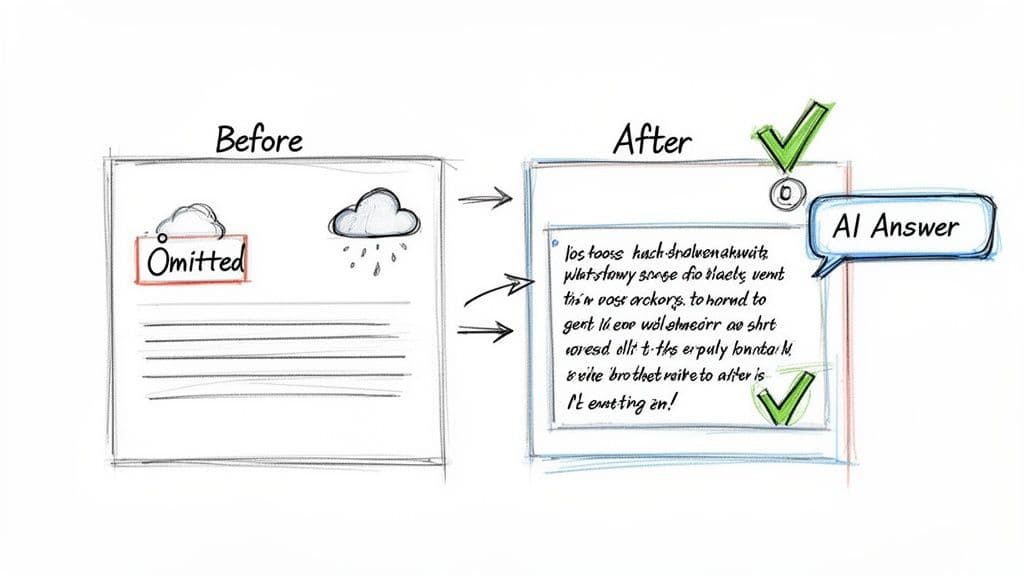
Let's look at a real-world example I see all the time:
- Before: A product page is just a list of features full of technical jargon. As a result, AI models misinterpret what the product actually does.
- After: The page is rewritten to lead with a clear value proposition. It's followed by use-case sections explaining how each feature solves a specific customer problem.
It seems like a small tweak, but this kind of clarification dramatically improves how accurately AI models represent your product. You can get more hands-on guidance for this process using Attensira's dedicated content optimization features.
The Urgency of AI Content Optimization
Ignoring this shift isn't an option. Marketers who fail to adapt their content strategy are already reporting a 39% drop in traffic from AI Overviews. These aren't abstract trends; this is happening right now.
On the flip side, the opportunity is massive. AI-driven traffic shows a staggering 527% year-over-year increase, and referrals from AI are up 357%. This represents a fundamental change in how your most motivated buyers find solutions.
With industry giants like ChatGPT attracting 2.8 billion monthly active users, as highlighted in recent AI search statistics from Exposure Ninja, the competition for AI-driven attention is fierce. Those users are looking for contextual, optimized answers, and being proactive is the only way to win their attention.
Getting Ahead of the AI Search Curve: Your Questions Answered
As more teams start to wrap their heads around AI search, the same set of questions inevitably pops up. It’s a new frontier, and it’s natural to have them. Let's cut through the noise and tackle these common sticking points directly so you can build a strategy that actually works.
Isn't AI Search Tracking Just a New Name for SEO?
I hear this a lot, and it's a critical misunderstanding. Thinking of AI search as just another form of SEO is like comparing a conversation to a phone book listing.
Traditional SEO is all about tracking your rank—your numerical position on a results page. You’re fighting to be #3 instead of #4. It’s a game of ladders.
AI search tracking, on the other hand, is about monitoring your narrative. It's not about a rank; it's about the story the AI tells a potential customer. You’re no longer just a blue link. You're part of a generated answer, and you need to know:
- Are we mentioned at all when someone asks about solutions in our space?
- Is the AI getting the facts about our product right?
- How are we being framed against our main competitors?
- Is the tone positive, or is it highlighting a weakness?
You're not just tracking a position; you're managing your reputation inside the answer itself.
Can We Really Change What an AI Says About Us?
Yes, you can, but not by logging into ChatGPT and hitting an "edit" button. The influence is indirect, but incredibly powerful. These AI models are constantly learning from the public internet, and your own website is their primary textbook for understanding who you are.
If the information on your site is confusing, outdated, or incomplete, the AI will learn and repeat that flawed understanding. It's that simple.
AI search tracking shows you exactly where the AI is getting confused. It pinpoints the content gaps or inaccurate statements on your own digital properties that are poisoning the well. By fixing the source—your website—you are directly teaching the AI the correct narrative over time.
What's the Real ROI Here?
This isn't a vanity metric. Investing in AI search tracking connects directly to your bottom line through revenue generation, brand defense, and competitive intelligence.
The business case is pretty straightforward:
- Massively Higher Lead Quality: We're seeing AI-driven traffic convert at around 14.2%, which completely eclipses the typical 2.8% from Google search. These aren't just any leads; they're high-intent prospects who have already had their initial research questions answered by the AI. They arrive much further down the funnel.
- Crucial Brand Defense: What happens when a prospect asks an AI to compare solutions and your company is left out? Or worse, misrepresented? You lose the deal before your sales team even knows it existed. Tracking is your early-warning system for this silent killer.
- A Goldmine of Strategic Insight: The questions users ask and the way competitors are framed provide an incredible roadmap. This intelligence tells you exactly what content to build and what product features to highlight, giving you a huge advantage in both AI search and traditional SEO.
How Technical Does This Get?
This is the best part: not at all. Modern platforms are built for marketers and business leaders, not engineers.
Getting started with a tool like Attensira is a no-code process. You simply provide your domain, identify your key products or services, and list your competitors. The platform does all the heavy lifting in the background—querying the models, analyzing the answers, and organizing the data. The entire point is to get the technical hurdles out of your way so you can focus on strategy and action.
Ready to stop guessing and start knowing how AI sees your brand? Attensira provides the actionable insights you need to win in the new era of search. Start tracking your AI visibility today.