
Discover the top 12 AI content optimization tools to enhance your strategy. We analyze features, use cases, and pricing for B2B & SEO teams.
The landscape of content discovery is undergoing a seismic shift.The landscape of content discovery is undergoing a seismic shift. Traditional SEO, while still crucial, is no longer the only game in town. Generative AI platforms like ChatGPT, Perplexity, and Gemini are becoming the new search engines, answering user queries directly and citing brands that provide the most value. For B2B and SEO teams, this represents both a threat and a massive opportunity.
Getting your brand mentioned in these AI-driven answers, achieving what we call 'AI visibility', is the next frontier of digital marketing. This requires a new class of AI content optimization tools. While having a solid content marketing strategy remains foundational, the tools you use to execute it must now account for both human and machine audiences. The right platform can mean the difference between being a primary source for AI models and being completely invisible.
This guide moves beyond generic feature lists to provide a rigorous, analytical breakdown of the 12 best AI content optimization tools available today. We will dissect the core functionalities of platforms like Attensira, Clearscope, and Surfer, pinpointing their ideal use cases and weighing their strengths against their weaknesses. Each review includes screenshots and direct links to help your evaluation. Our goal is to provide a clear framework for choosing the right platform not just to rank on Google, but to be cited and recommended by AI.
1. Attensira
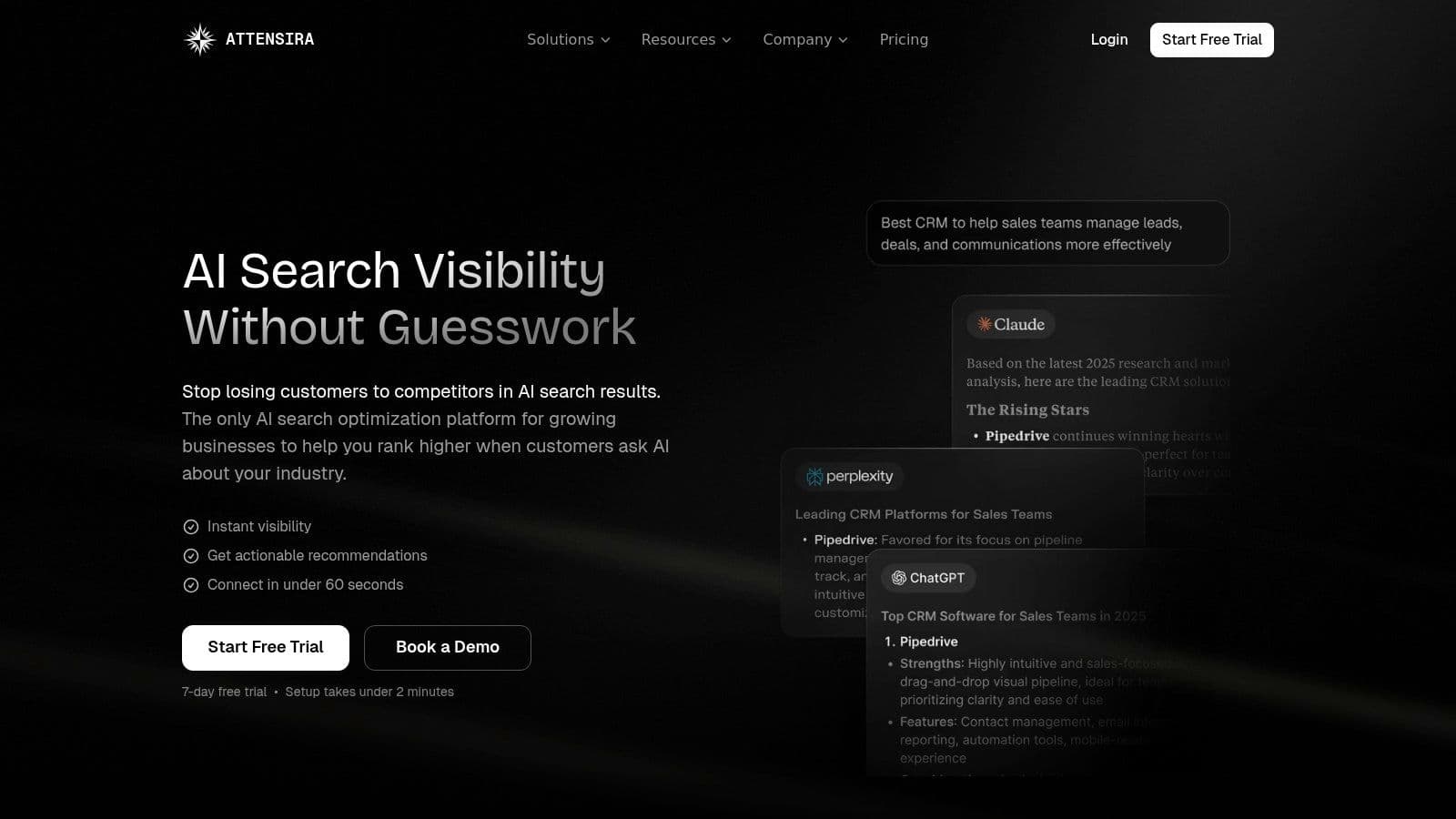
Attensira positions itself as a specialized platform for a new era of search, focusing squarely on getting brands discovered within AI-driven answer engines like ChatGPT, Perplexity, and Gemini. Instead of the traditional SEO approach of chasing thousands of keywords, Attensira sharpens the focus on the 10–20 high-intent prompts your actual prospects are using. This makes it one of the most direct ai content optimization tools for B2B teams aiming to establish authority inside generative AI responses.
The platform's core strength lies in its speed and clarity. Setup is a no-code process that takes minutes: you connect your domain, and the platform scans your content to establish a baseline. From there, it provides a daily visibility score, tracks your share of voice against competitors for key prompts, and identifies precisely where you are already being cited by AI models.
Key Strengths and Use Cases
Attensira excels by delivering a prioritized action plan. It scores existing pages for "AI readability" and generates AI-optimized content drafts that include the specific structure, entities, and schema that language models prefer to reference. This moves teams from analysis to execution quickly.
- Best For: B2B growth teams, SEO specialists, and brand managers who need a measurable strategy for AI engine optimization (AEO).
- Primary Use Case: Identifying and closing content gaps that prevent your brand from appearing in AI-generated answers. A startup can go from being invisible to generating qualified leads directly from platforms like ChatGPT.
- Implementation Tip: Start by inputting the top 5-10 questions your sales team frequently answers. Attensira will track these as prompts and provide a clear roadmap for creating content that directly addresses them, increasing your chances of being cited.
Our Take: Attensira's direct focus on AI answer engine visibility provides a distinct advantage. While other tools adapt traditional SEO for AI, Attensira was built from the ground up for this specific challenge, offering a clear, actionable path to getting your brand recommended.
Pricing and Access
Pricing is not publicly listed, which is a common model for B2B SaaS platforms targeting enterprise clients. Attensira operates on a credit-based system and offers a 7-day free trial to evaluate its capabilities. Interested teams can request a demo for tailored onboarding and pricing details. For more context on where it fits in the market, explore their analysis of the best AI SEO software.
Pros:
- AI-first focus specifically for visibility in AI answers.
- Fast, no-code setup delivers actionable insights in minutes.
- Tracks real customer prompts, not just keywords.
- Daily cross-model visibility and competitive intelligence.
Cons:
- No public pricing; requires a demo for cost details.
- Primarily designed for B2B companies with an existing content foundation.
Website: https://attensira.com
2. Clearscope
Clearscope is a premium content optimization platform known for its high-quality, actionable guidance within a clean, user-friendly editor. It excels at helping content teams achieve deep topical coverage and improve readability, positioning it as a strong choice for organizations focused on creating authoritative, expert-level content that performs well in search. The platform’s real-time grading system provides clear targets for term inclusion, word count, and content structure.
Unlike many AI content optimization tools that focus heavily on automated generation, Clearscope’s strength lies in augmenting human expertise. The interface is exceptionally intuitive, making adoption straightforward for large or distributed teams. Its collaboration features, including unlimited user seats across all plans and easy sharing of reports, support established content workflows without friction. This makes it a go-to tool for agencies and enterprise teams managing multiple writers and editors.
Key Use Cases & Limitations
Clearscope is best suited for creating in-depth articles, pillar pages, and competitive landing pages where topical authority is critical. Its topic discovery and content inventory features also help teams plan and audit their content strategy effectively.
- Pros: The content editor provides excellent, easy-to-follow guidance. It scales well for team collaboration with unlimited users and simple sharing options.
- Cons: The platform comes with a higher starting price than many competitors. Credit limits for content reports and inventory monitoring can become a constraint for high-volume teams, potentially requiring costly add-ons. You can find a detailed analysis in this Attensira vs. Clearscope comparison.
Pricing: Starts at $199/month for the Essentials plan, with Business and Enterprise tiers available.
3. Surfer
Surfer is an end-to-end SEO content optimization platform that balances a broad feature set with strong educational resources, making it a favorite among growing content teams. It guides users from topic ideation to post-publication auditing, all within a unified system. The platform is particularly noted for its Content Editor, which uses NLP-driven guidelines to generate a real-time Content Score, providing clear targets for keyword density, structure, and readability.
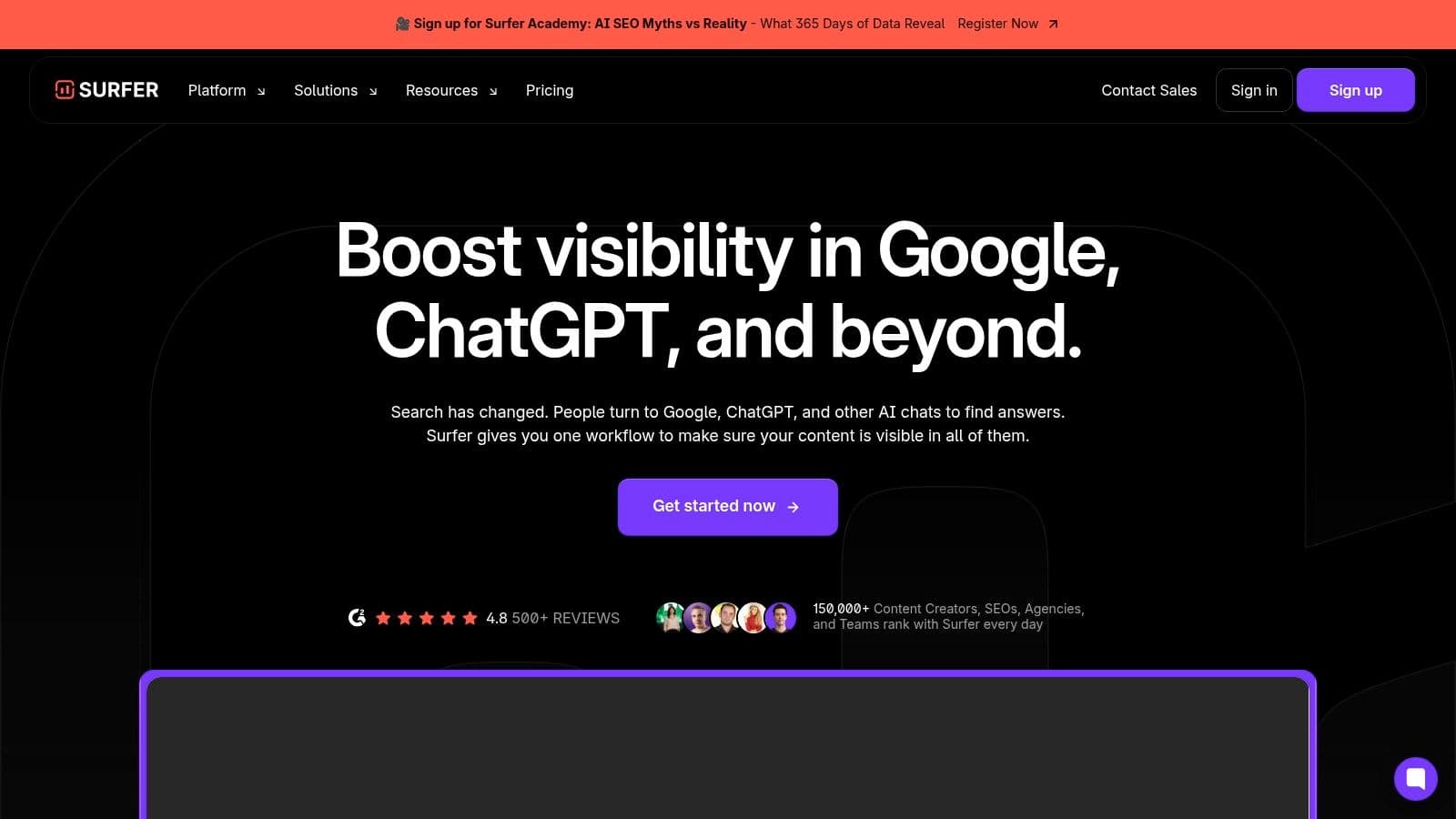
Unlike single-function tools, Surfer aims to cover the entire content lifecycle. Its Topical Map feature helps teams build authority through strategic content clustering, while the Content Audit identifies existing pages with high potential for a refresh. A recent and distinctive addition is its AI Visibility tracking, which monitors a brand's mentions and citations within AI-generated answers from search engines. This forward-looking feature makes it a practical choice for teams preparing for the next wave of search. Its mature integrations with Google Docs, WordPress, and Contentful also ensure it fits smoothly into established workflows.
Key Use Cases & Limitations
Surfer excels in environments that require a comprehensive yet accessible solution for creating and optimizing SEO-focused content. It is ideal for mid-market teams and agencies managing multiple clients who need a single platform for keyword research, content brief creation, on-page optimization, and performance auditing.
- Pros: It provides wide feature coverage at a competitive price point. The platform offers mature integrations that simplify content workflow management.
- Cons: Some advanced features and higher AI credit allowances are locked behind more expensive tiers. The platform's annual billing model and "fair use" policy on certain credits require careful review to avoid unexpected limitations.
Pricing: Starts at $89/month for the Essential plan, with Advanced and Max tiers available. You can learn more at https://surferseo.com.
4. MarketMuse
MarketMuse is an AI-driven content planning and optimization suite built around proprietary topic modeling and a deep analysis of your entire content inventory. It excels at providing strategic direction, helping teams prioritize what to create versus what to refresh, and systematically building topical authority. The platform's strength lies in its personalized difficulty metrics and site-level intelligence, which guide content strategy beyond single-page optimization.
Unlike lighter editor-focused ai content optimization tools, MarketMuse offers a more strategic, top-down approach. It inventories your site, tracks your performance on key topics, and produces heatmaps that visualize content gaps and opportunities. Its multiple brief types (article, FAQ, how-to) and detailed content scoring provide a robust framework for execution. The platform's focus on inventory intelligence makes it a powerful asset for organizations managing large, mature content libraries and aiming for dominance in specific niches.
Key Use Cases & Limitations
MarketMuse is best suited for enterprise-level teams that need to manage hundreds or thousands of pages and make data-driven decisions about their content lifecycle. Its strategy documents and page-level analysis are ideal for scaling a content program with precision.
- Pros: It provides strong intelligence for large content libraries and teams. The platform's differentiated metrics, like Personalized Difficulty and Competitive Advantage, offer unique strategic insights.
- Cons: The platform can be more complex to onboard compared to simpler editor tools. The most valuable features are locked behind paid tiers, and the free plan is quite limited. You can explore more options at MarketMuse's website.
Pricing: Offers a limited free plan. Paid plans start with the Standard tier at 149/month, with a Premium tier at 399/month.
5. Frase
Frase is an all-in-one AI platform that combines SERP research, content creation, optimization, and AI search visibility tracking. Its approach is built around an "agentic" model, using its AI Agent with over 80 skills to handle research, drafting, and optimization tasks. This makes it a compelling choice for teams wanting a single tool that spans both traditional Google ranking and the emerging field of Generative Engine Optimization (GEO).
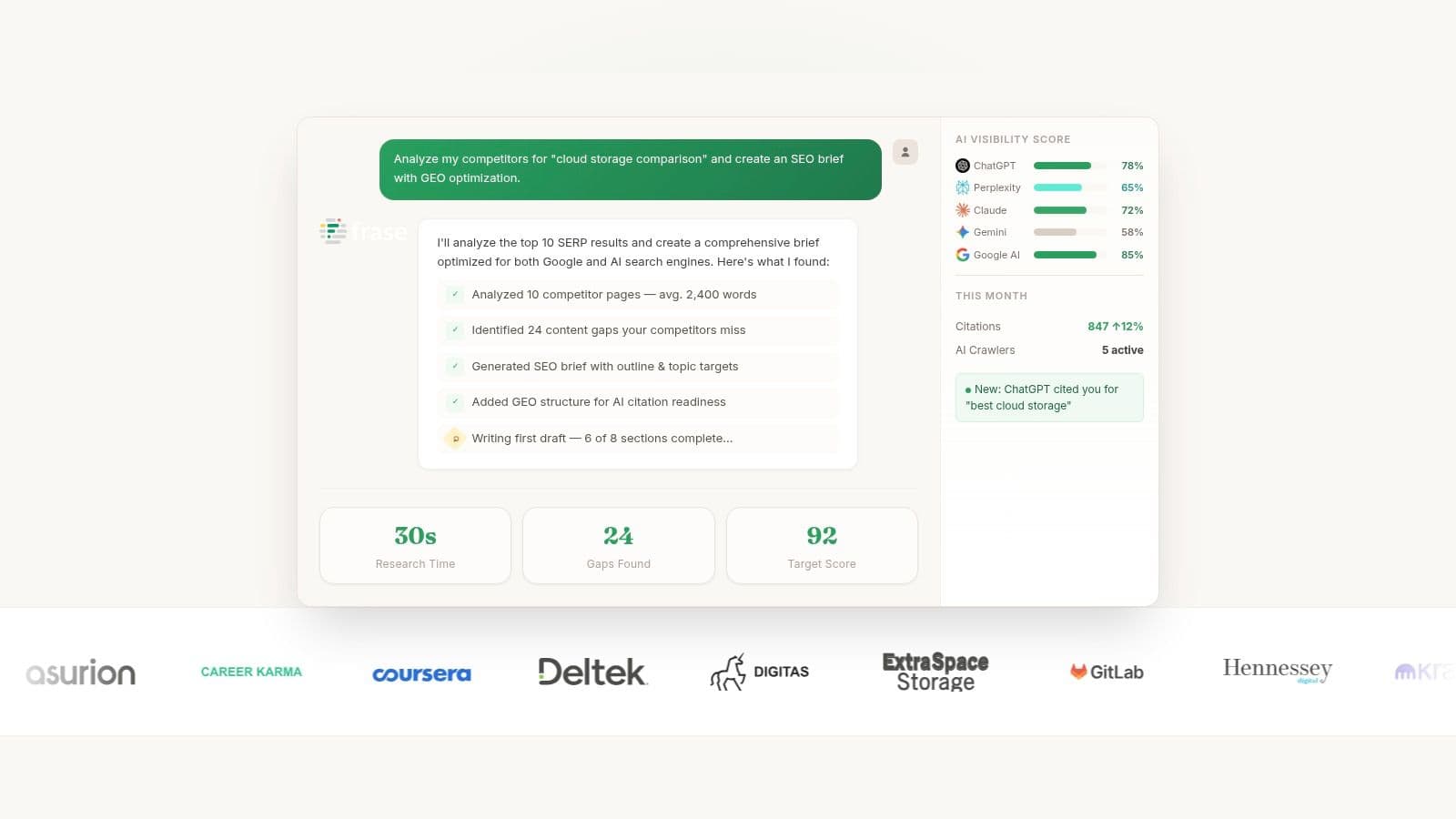
Unlike narrowly focused editors, Frase provides a broad suite of SEO functionalities, including site audits, internal linking suggestions, and direct publishing integrations. A unique feature is its combined SEO and GEO scoring, which guides users to create content optimized for both search engines and AI answer engines. The platform's AI Visibility tracking monitors content presence across up to eight AI platforms, offering a forward-looking metric for content performance. This broad feature set makes it one of the more versatile ai content optimization tools available.
Key Use Cases & Limitations
Frase is best for content teams and SEOs who need a unified workflow from keyword research to final optimization and visibility tracking. It’s particularly useful for those actively preparing their content strategy for visibility in AI-powered search results like Google SGE and Perplexity.
- Pros: Competitive entry pricing and full feature access across all plans, with costs scaling based on usage volume. It includes a 7-day free trial for evaluation.
- Cons: The all-in-one nature might feel too broad for teams only needing a content editor. The depth of GEO and AI tracking is also dependent on the selected plan. You can explore other options in this guide to the best Frase alternatives.
Pricing: Starts at $14.99/month for the Solo plan when billed annually, with Basic and Team tiers available for more extensive needs.
6. Semrush SEO Writing Assistant (SWA)
Semrush’s SEO Writing Assistant (SWA) integrates competitive data directly into your writing process, offering real-time feedback within familiar editors like Google Docs and WordPress. As one of the most accessible AI content optimization tools, it analyzes your text against top-ranking competitors for your target keyword, providing a content score based on SEO, readability, originality, and tone of voice. This makes it an efficient solution for content teams already invested in the Semrush ecosystem.
The assistant’s main advantage is its tight integration with Semrush's broader keyword and competitor analysis data. It pulls recommendations directly from SERP analysis, saving teams from manually cross-referencing multiple tools. The interface is clean, providing actionable suggestions without overwhelming the writer. This approach helps maintain focus on content creation while still adhering to SEO best practices, making it ideal for quick adoption and improving content quality at scale.
Key Use Cases & Limitations
SWA is best for optimizing blog posts and articles directly within a team’s existing workflow, particularly for those using Google Docs or WordPress. Its AI-powered features, like rephrasing and composing, are helpful for overcoming writer's block but are metered by "Smart Writer Words" quotas tied to your subscription level.
- Pros: Works inside familiar editors for a frictionless user experience. It's backed by Semrush's robust market data, providing relevant, competitor-based recommendations.
- Cons: The tool's full value is only realized when paired with a broader Semrush subscription, which can become costly. Usage limits for AI features and content templates vary significantly across different pricing tiers, potentially limiting high-volume teams. A detailed breakdown is available in this Attensira vs. Semrush comparison.
Pricing: Available with Semrush plans, which start at $129.95/month. Specific feature access and limits depend on the subscription tier (Pro, Guru, or Business).
7. Scalenut
Scalenut is an integrated content platform that combines AI writing, SEO research, and content optimization into a single workflow. It is designed for teams that want an end-to-end solution, moving from keyword research and clustering to long-form content creation and on-page optimization without switching tools. The platform’s "Cruise Mode" provides a structured, five-step process for generating full articles, which appeals to users seeking speed and efficiency.

Unlike more specialized AI content optimization tools, Scalenut’s value proposition is its breadth of functionality. It includes a keyword planner with topic clustering, a content optimizer with NLP term suggestions, and content audit features. This all-in-one approach supports the entire content lifecycle, from strategic planning to execution and analysis. Features like multi-workspace support and team management make it a practical choice for agencies and growing content departments managing multiple projects or clients.
Key Use Cases & Limitations
Scalenut is best for teams producing a high volume of content and looking for a unified platform to manage research, writing, and optimization. Its keyword clustering and structured AI writer are particularly useful for building out topic authority quickly.
- Pros: The platform offers practical workflows that guide users from research to a published draft. Its pricing is competitive, often featuring promotions that provide good value for the number of features included.
- Cons: Access to advanced audit features and higher usage limits is restricted to upper-tier plans. The AI engine coverage and data refresh frequency can also vary by subscription level. For those evaluating other options, you can find a useful analysis in this article on the best Scalenut alternatives.
Pricing: Starts at $39/month for the Essentials plan, with Growth, Pro, and Enterprise plans available.
8. Outranking
Outranking is a comprehensive suite for AI content research, briefing, writing, and optimization, recognized for its highly structured, modular workflows. It is particularly effective for teams aiming to build fact-based, E-E-A-T-aligned content by giving users precise control over the entire content creation process, from initial concept extraction to final on-page adjustments. The platform excels at generating SERP-aligned outlines and detailed first drafts.
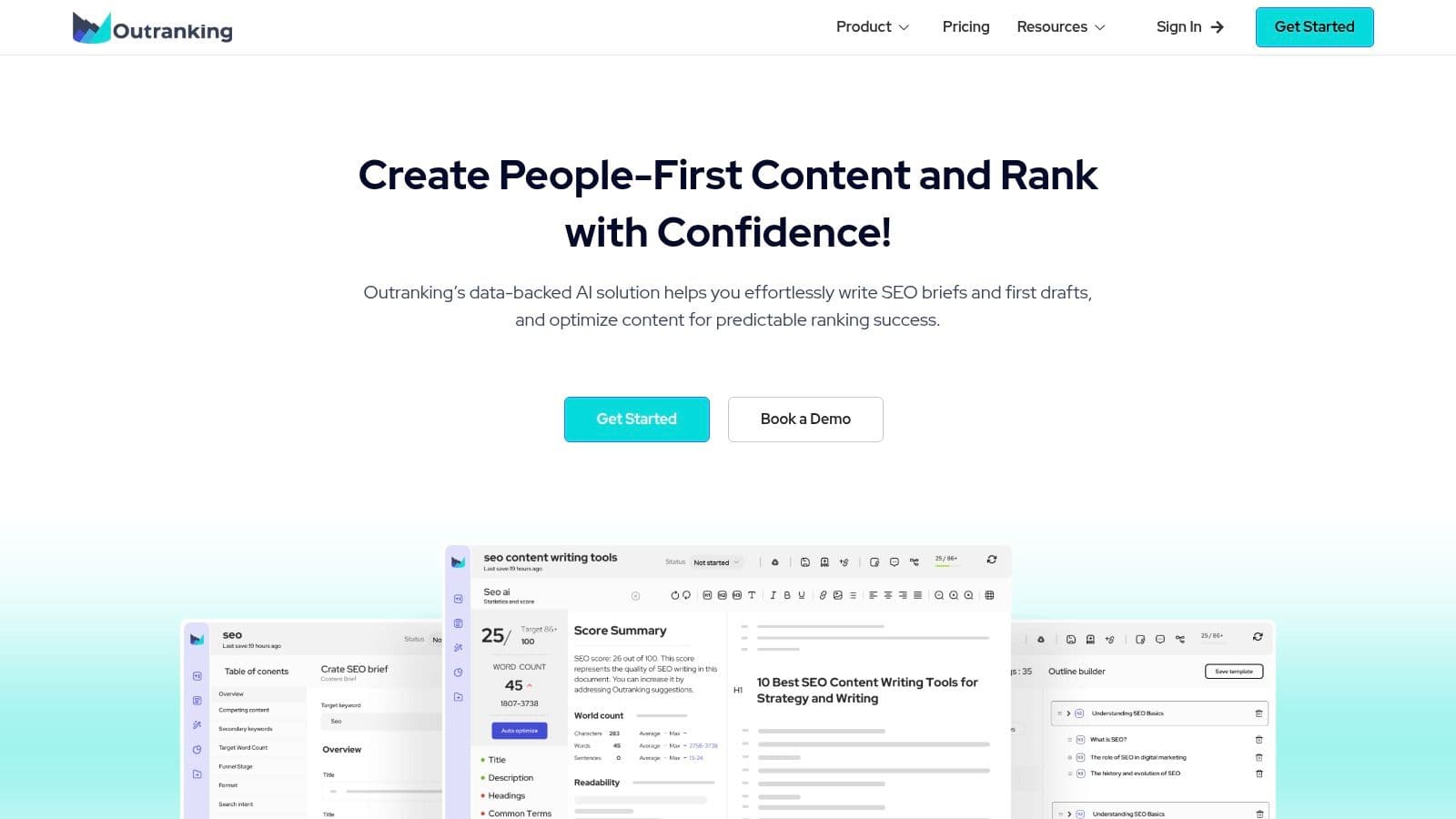
What sets Outranking apart is its methodical approach to content generation and optimization. Rather than offering a single-click writing solution, it guides users through distinct steps, ensuring that each section of the content is supported by research and aligned with search intent. This makes it a strong choice for agencies and B2B marketing teams that need to create repeatable, high-quality content at scale. Its collaboration and project management features, along with smooth import/export functionality with popular CMS platforms, further support established team workflows.
Key Use Cases & Limitations
Outranking is best for teams focused on building well-researched, long-form articles, guides, and pillar pages where factual accuracy and structural integrity are paramount. The tool's ability to extract concepts and factual data directly from top-ranking pages makes it one of the better AI content optimization tools for producing authoritative content.
- Pros: It provides robust controls for defining draft structure and generating fact-led copy. The platform is well-suited for agencies and teams managing repeatable content creation processes.
- Cons: The interface can feel dense and less intuitive compared to more lightweight editors. Its credit-based system for documents and SERP analysis requires careful planning to manage costs, especially for high-volume use.
Pricing: Starts at $79/month for the Solo plan, with higher tiers for teams and agencies. More details are available at outranking.io.
9. NEURONwriter
NEURONwriter is an affordable semantic SEO platform that combines SERP analysis with AI-powered drafting, making it a powerful choice for freelancers, small agencies, and budget-conscious teams. It offers a structured approach to content creation by analyzing top-ranking pages to provide actionable recommendations on terms to use, article structure, and questions to answer. The platform effectively bridges the gap between detailed SEO guidance and practical AI implementation.
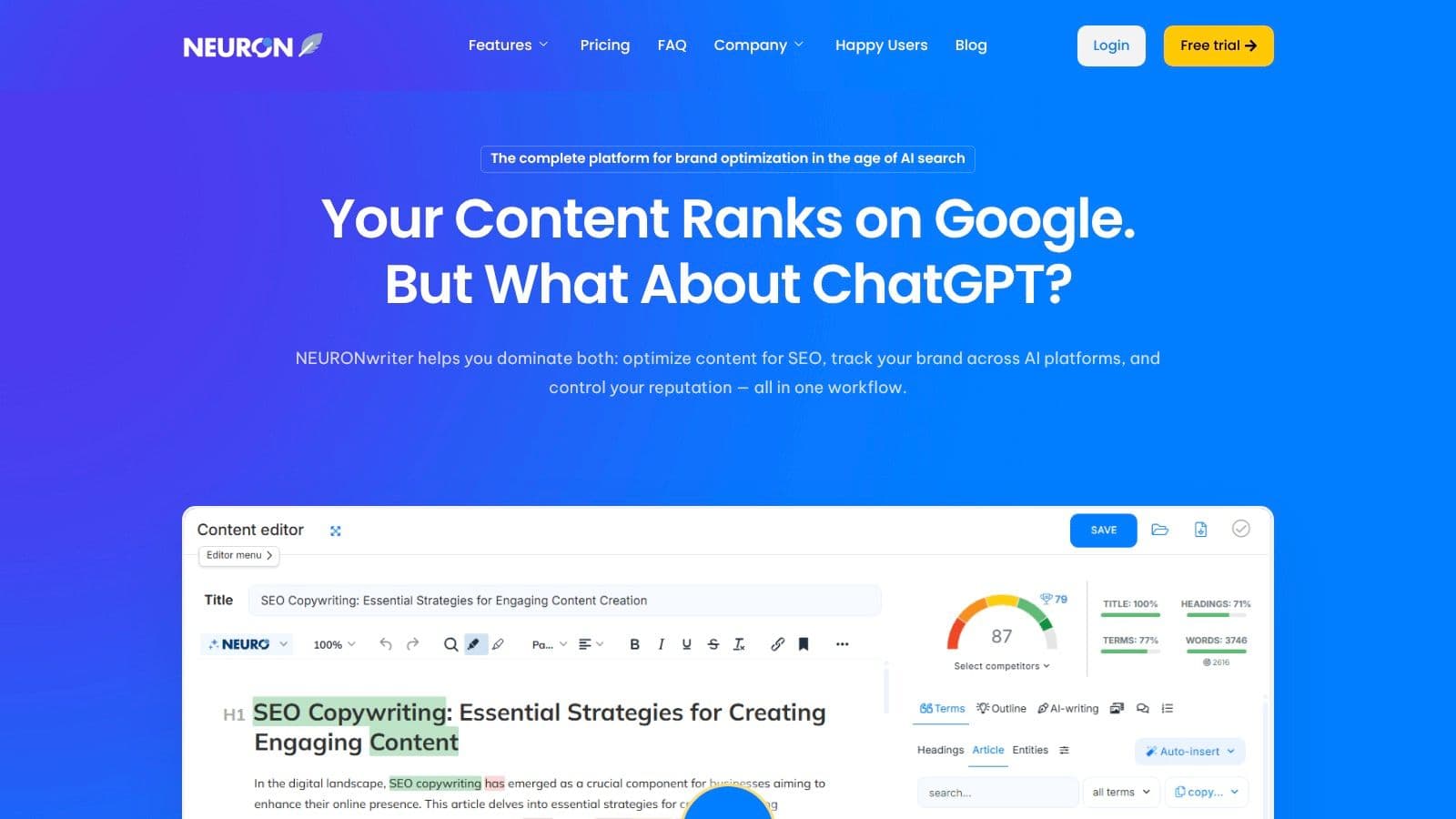
Unlike premium-priced tools, NEURONwriter’s main appeal is its generous feature set at a very competitive price point. It includes one-click article generation, AI writing templates, and built-in plagiarism checks. Integrations with Google Search Console, WordPress, and Shopify add significant workflow value. The ability to connect your own OpenAI API key for AI credits also gives users more control over costs, a distinct advantage for those managing multiple projects or websites under a tight budget.
Key Use Cases & Limitations
NEURONwriter is ideal for producing SEO-optimized blog posts, articles, and product descriptions where aligning with search intent is a primary goal. Its project management system allows users to organize content efforts for different clients or websites efficiently.
- Pros: The pricing is highly competitive, offering generous content analysis credits. It’s a great fit for solopreneurs or small agencies managing multiple projects.
- Cons: The user interface and overall user experience are less polished than those of more expensive competitors. Its collaboration and advanced reporting features are lighter, making it less suitable for large enterprise teams with complex workflows.
Pricing: Starts at $23/month for the Bronze plan, with multiple tiers up to Diamond for agency-level needs. Learn more at neuronwriter.com.
10. Dashword
Dashword offers a practical, low-overhead approach to content optimization, focusing on streamlined briefs and a clean editor. It is a solid choice for teams that need core optimization features without the complexity or cost of larger suites. The platform generates briefs with SERP-driven heading suggestions and common questions, providing a strong foundation for writers to build upon.
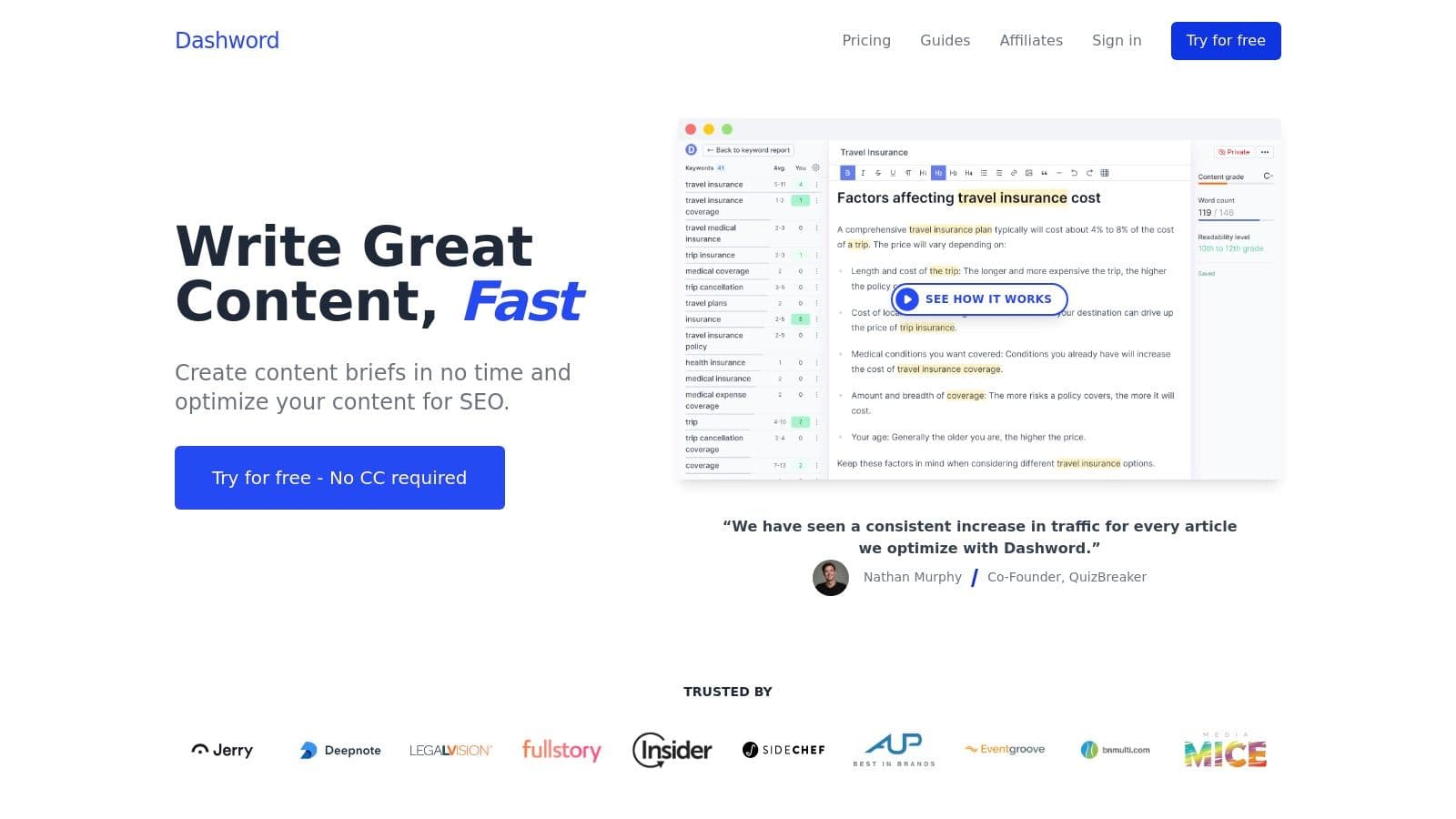
The platform distinguishes itself with predictable, report-based pricing and a very low barrier to entry. This straightforward model makes it easy for smaller teams or agencies to manage costs effectively. Unlike more heavyweight ai content optimization tools, Dashword prioritizes an intuitive user experience, ensuring that writers can adopt the editor with minimal training. The focus is squarely on creating and optimizing content, rather than getting lost in complex research dashboards. This makes it an efficient tool for executing a defined content strategy.
Key Use Cases & Limitations
Dashword is best for teams focused on producing SEO-optimized articles and blog posts who value speed and simplicity. It's particularly effective for generating structured briefs that can be handed off to writers, ensuring baseline quality and topical relevance from the start. Its content monitoring feature also provides a simple way to track the performance of optimized pages over time.
- Pros: The "first report free" trial without a credit card makes it easy to evaluate. Its simple pricing and generous user seat allocation per plan are great for growing teams.
- Cons: It lacks the deep keyword research and broad dataset features found in larger SEO platforms. Bulk processing and automation capabilities are gated behind the more expensive Business tier, limiting its utility for high-volume content operations on the entry plan.
Pricing: Starts at $99/month for the Hobby plan, with Startup and Business tiers available. You can learn more at https://www.dashword.com.
11. PageOptimizer Pro (POP)
PageOptimizer Pro (POP) is a long-standing on-page SEO tool that now integrates its AI writer on top of a powerful, correlation-based optimization engine. It provides granular, tactical guidance for specific on-page signals, making it useful for SEO teams who value data-driven recommendations for each URL and keyword combination. The platform analyzes top-ranking competitors to generate a precise roadmap for improving your content's relevance and structure.
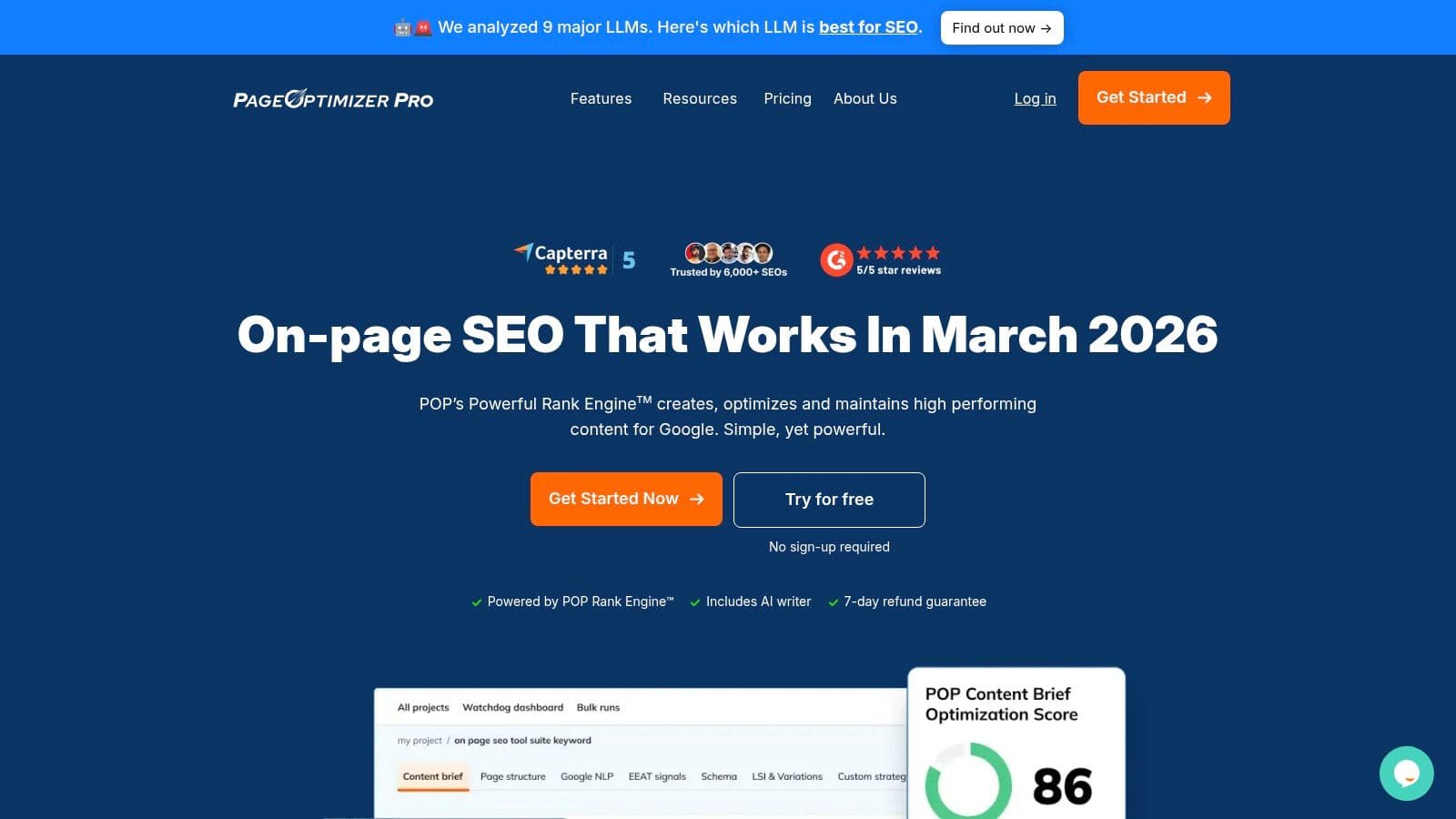
Unlike all-in-one platforms, POP focuses intensely on the technical aspects of on-page SEO, such as term frequency, keyword placement in H-tags, and schema variations. The POP AI Writer is guided by these exact optimization metrics, ensuring the generated text directly addresses the algorithm's recommendations. This approach makes it a strong complement to existing rank trackers and keyword research tools, allowing teams to execute highly specific on-page adjustments with confidence. The interface prioritizes function and data density over a polished aesthetic, appealing to technical SEOs.
Key Use Cases & Limitations
POP is ideal for fine-tuning existing content that is underperforming or for building new pages with a precise, mathematically-driven on-page strategy. Its E-E-A-T and Google NLP analysis reports provide deeper insights for competitive niches.
- Pros: The platform delivers transparent, actionable recommendations for specific on-page elements. It integrates well as a specialized tool within a broader SEO technology stack.
- Cons: The credit-based model for AI generation, NLP analysis, and core POP reports requires careful budgeting and management. The user interface can feel dated and less intuitive compared to newer ai content optimization tools.
Pricing: Starts at $39/month for the Basic plan, with higher tiers for agencies and enterprise users available at pageoptimizer.pro.
12. SE Ranking (Content Marketing + Content Editor)
SE Ranking is an all-in-one SEO platform that provides a broad suite of tools, including a dedicated Content Marketing module with an AI-powered Content Editor. It stands out by offering core content optimization features alongside rank tracking, site audits, and competitor research at a price point significantly lower than many specialized enterprise suites. This makes it an attractive option for businesses and agencies seeking a cost-effective, consolidated solution for their SEO and content workflows.
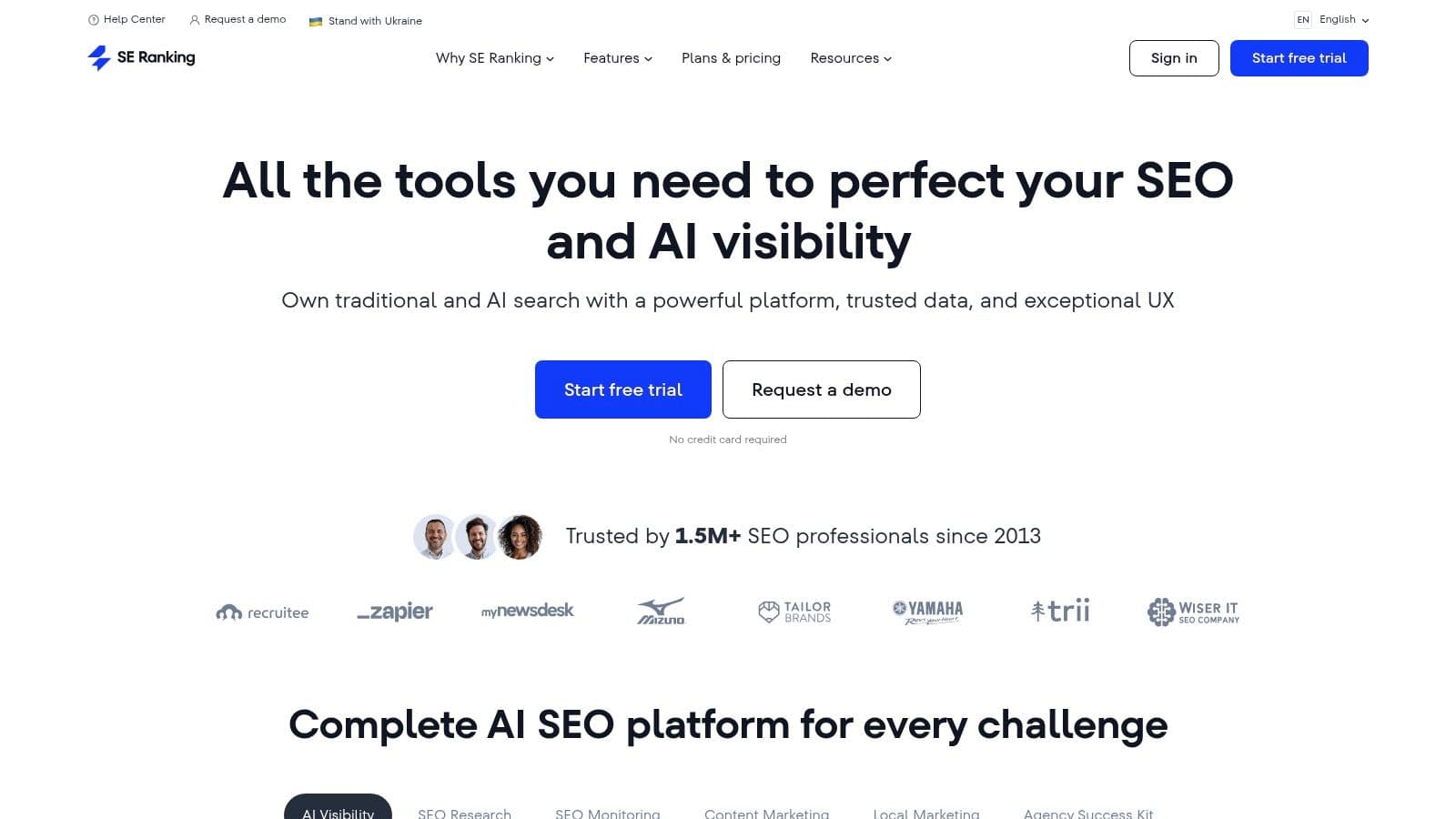
The platform's Content Editor functions similarly to other ai content optimization tools, analyzing top-ranking pages to provide NLP-driven suggestions on keywords, structure, and word count. Its integration with Google Docs and a built-in AI writer streamlines the creation process from brief to final draft. While the platform covers a wide array of functions, the user experience and data depth in certain modules may not match the polish of top-tier, single-purpose tools. However, its value proposition lies in its accessibility and functional breadth for teams that need more than just a content optimizer.
Key Use Cases & Limitations
SE Ranking's Content Marketing module is ideal for SMBs, freelancers, and agencies managing multiple clients on a budget. It allows teams to research, write, and optimize content within the same ecosystem where they track keyword performance and audit site health, creating a cohesive workflow.
- Pros: The platform offers a wide feature set for its price, bundling content optimization with traditional SEO tools. Its flexible plan structure with optional add-ons allows users to scale features as needed.
- Cons: The Content Editor and other advanced modules like AI Search are often add-ons that increase the total cost. The user interface and depth of data can feel less advanced compared to premium competitors.
Pricing: Starts at 55/month for the Essential plan, with the Content Marketing module available as a paid add-on starting from an additional 29/month.
12 AI Content Optimization Tools — Feature Comparison
Choosing Your Tool: From Optimization to Visibility
The journey through the modern ecosystem of ai content optimization tools reveals a clear divergence in strategy. We've moved beyond simply creating content to satisfy search engine crawlers. Today's imperative is a dual focus: mastering traditional on-page SEO while simultaneously securing a foothold in the emerging world of AI-driven answers and conversational search.
The tools detailed in this article, from Clearscope to SE Ranking, each offer a distinct approach to this challenge. Some, like Surfer and Frase, provide exceptional frameworks for building topically relevant articles that perform well in classic SERPs. Others, such as MarketMuse or Scalenut, offer a more expansive suite, combining research, writing, and planning into a single platform. These are powerful assets for any B2B content team looking to improve its operational efficiency and search rankings.
However, a critical distinction has emerged. Most of these tools operate by reverse-engineering Google's algorithm. They analyze top-ranking pages to provide recommendations for your content. While effective for traditional SEO, this method doesn't directly address the new discovery channel: AI chat models and answer engines. This is where a strategic choice becomes paramount for forward-thinking brands.
Making a Strategic Selection
Your decision on which tool to adopt should be guided by your team's specific goals, maturity, and resources. To simplify this process, consider your primary objective:
- For Foundational On-Page SEO: If your main goal is to improve existing content and ensure new articles are well-optimized for Google, a dedicated content editor is a solid starting point. Tools like Clearscope, Surfer, and NEURONwriter excel here, providing direct, actionable feedback to improve your content scores and topical authority. They are the workhorses of modern SEO.
- For All-in-One Content Operations: If you need a more integrated solution that combines keyword research, topic clustering, competitive analysis, and content creation, a comprehensive suite is more appropriate. Semrush, SE Ranking, and MarketMuse fit this profile, offering a central hub for your entire content marketing program. They are best suited for teams seeking to consolidate their tool stack.
- For Gaining an Edge in AI Discovery: If your strategic focus is on future-proofing your brand and ensuring it appears in AI-generated answers, a specialized visibility tool is essential. This is where Attensira offers a unique and critical function. It shifts the focus from ranking on Google to being cited by AI, tracking brand visibility against real customer prompts.
Beyond Optimization: The Imperative of AI Visibility
Implementing any of the discussed ai content optimization tools requires a commitment to process. It's not about just plugging in a keyword and following a checklist. Success demands integrating the tool's insights into your content workflow, from the initial brief to the final review. It means training your writers and editors to think in terms of entities, topical coverage, and user intent.
Ultimately, the most advanced strategy involves recognizing that search is no longer a monolithic entity. The skills and tools that guarantee a top spot on a Google SERP are not the same ones that ensure your brand is the trusted source in an AI-powered response. While traditional SEO tools remain valuable, they only address one part of the equation.
Focusing solely on classic SERP optimization is like preparing for yesterday's battle. The next frontier for B2B brands is discoverability within AI ecosystems. This requires a dedicated approach, measuring what matters: brand citations and visibility in the answers your future customers are seeking. Your choice of tool should reflect this reality, balancing current needs with a clear-eyed view of where your audience is heading.
Ready to move beyond traditional SEO and measure your brand's visibility in the new AI-driven search landscape? Attensira is the only platform built specifically to track and improve your presence in AI answers. See exactly where your brand stands and get the actionable insights needed to become a cited authority with a free analysis from Attensira.